
Would Jesus Need to Die on Another Planet?
Extraterrestrial Life, Cosmic Redemption, and the Reach of the Cross

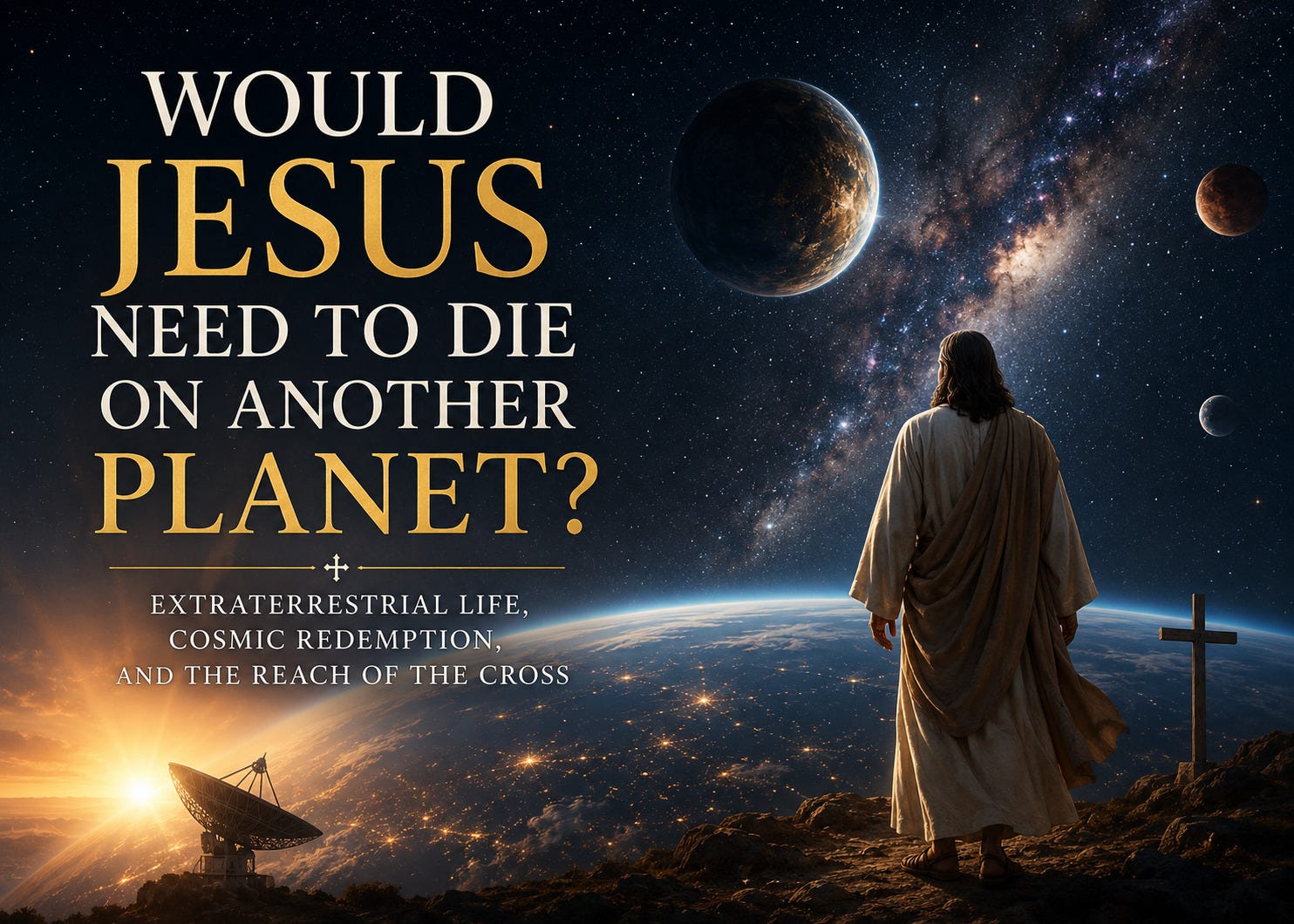
Would Jesus Need to Die on Another Planet?
Extraterrestrial Life, Cosmic Redemption, and the Reach of the Cross
On a clear night, it’s difficult not to wonder.
We look up at billions of stars scattered across the sky, knowing that many of them have planets orbiting them. Modern astronomy has confirmed thousands of exoplanets, and the number continues to grow. Statistically, it seems increasingly possible that somewhere in the vastness of the universe, intelligent life may exist.
If that day comes—if humanity discovers another civilization capable of reason, language, morality, and culture—science will not be the only field forced to respond.
Theology will have questions too.
One of the most profound is this:
Did Jesus Christ’s incarnation, crucifixion, and resurrection on Earth redeem the entire universe, or would intelligent extraterrestrial beings require their own incarnation and saviour?
It may sound like science fiction, but it is a genuine theological question. Scholars at institutions such as the Center of Theological Inquiry have explored the implications of extraterrestrial intelligence for Christian theology. While the subject remains outside mainstream church discussion, it touches some of Christianity’s deepest doctrines: creation, incarnation, redemption, and the identity of Christ.
Christianity Has Always Been Cosmic
Many people unconsciously think of Christianity as a religion concerned only with Earth.
The New Testament paints a much larger picture.
John opens his Gospel by declaring:
“In the beginning was the Word, and the Word was with God, and the Word was God... All things were made through Him, and without Him nothing was made that was made.” (John 1:1–3, NKJV)
Paul writes:
“For by Him all things were created that are in heaven and that are on earth, visible and invisible... All things were created through Him and for Him.” (Colossians 1:16, NKJV)
Notice the language.
Not some things.
Not only Earth.
All things.
Before Jesus became a man in first-century Judea, Christians already believed that the eternal Son was the Creator of the entire universe.
That changes how we approach the question.
The cross happened on one planet.
But the one hanging on that cross was the Creator of every galaxy.
Does Intelligent Life Automatically Need Salvation?
Suppose another civilization exists.
The first mistake would be assuming they must need redemption in exactly the same way humanity does.
Christian theology teaches that salvation answers humanity’s problem of sin.
But intelligence does not automatically imply rebellion against God.
An extraterrestrial civilization could theoretically be:
morally innocent,
fallen like humanity,
redeemed through means known only to God,
or living under circumstances completely different from our own.
Scripture simply does not tell us.
The Bible was written to reveal God’s relationship with humanity, not to catalogue every possible civilization in the cosmos.
Silence should never be confused with denial.
The Greatest Theological Challenge
Here the real difficulty begins.
Christianity teaches that the eternal Son became human.
He did not merely appear human.
He assumed genuine human nature.
This is why early Christians insisted that Christ is fully God and fully man.
The Church Fathers repeatedly argued that what Christ assumed, He healed.
Human nature was redeemed because human nature was united to the eternal Son.
But what if intelligent extraterrestrials possess a completely different biological and rational nature?
Would Christ’s assumption of humanity include them?
Or would God need another incarnation suited to their nature?
This is not an easy question.
It reaches to the heart of Christology.
One Cross for the Entire Universe?
Many theologians believe the answer is yes.
Their reasoning begins not with Earth but with the identity of Jesus.
The one who became incarnate is not merely a Jewish teacher.
He is the eternal Logos.
His person possesses infinite dignity because He is fully divine.
The value of the cross therefore comes not from its geographical location but from who died.
Earth is the place where redemption entered history.
It is not necessarily the limit of redemption’s reach.
Hebrews declares:
“But now, once at the end of the ages, He has appeared to put away sin by the sacrifice of Himself.” (Hebrews 9:26, NKJV)
Later it says:
“Christ was offered once to bear the sins of many.” (Hebrews 9:28, NKJV)
The emphasis is striking.
Once.
Not repeatedly.
Not planet after planet.
Not civilization after civilization.
If Christ’s sacrifice is truly once for all, then its significance may extend far beyond Earth itself.
Or Would God Become Incarnate Again?
Others suggest another possibility.
If intelligent extraterrestrial beings possess a fundamentally different nature, perhaps the eternal Son could become incarnate among them as well.
This would not imply multiple gods.
Nor would it require multiple divine persons.
It would be the same eternal Logos entering another created order.
The idea raises fascinating questions.
Could there be multiple incarnations?
Would there be multiple crucifixions?
Would each incarnation remain united to the same divine person?
Would one incarnation know about another?
Would Hebrews’ declaration that Christ died “once for all” still retain its meaning?
Christian theology has never answered these questions definitively because Scripture never addresses them directly.
The discussion therefore remains speculative.
The Cross Is Larger Than Earth
My own view is that the identity of Christ provides the strongest answer.
The cross occurred on Earth.
But the one crucified is the eternal Creator through whom every star, every galaxy, and every possible civilization came into existence.
The power of redemption does not depend upon the size of our planet.
It depends upon the identity of the Redeemer.
If extraterrestrial civilizations exist and if they require redemption, it seems more consistent with the New Testament to believe that the saving work of Christ possesses cosmic significance rather than merely local importance.
The cross is geographically located.
Its meaning is not.
Humanity Was Never the Centre of the Universe
The discovery of extraterrestrial intelligence would certainly humble us.
For centuries, humanity believed Earth stood at the centre of the cosmos.
Astronomy corrected that assumption.
Perhaps theology also needs to remember something important.
Christianity has never claimed that Earth is the largest or most important place in creation.
Instead, it claims that God chose this small planet as the place where the eternal Son entered history.
That is an astonishing act of grace, not evidence of human superiority.
God’s purposes have always extended beyond our limited perspective.
What Would Change?
If intelligent extraterrestrial life were discovered tomorrow, Christian theology would face new questions.
Churches would debate.
Seminaries would write books.
Scholars would revisit ancient doctrines.
Yet one truth would remain unchanged.
The New Testament never presents Jesus merely as humanity’s teacher.
It presents Him as the Creator through whom all things exist.
That means Christianity already possesses a cosmic vision.
Perhaps our understanding of it has simply been too small.
Final Reflection
Somewhere beyond our telescopes there may be worlds we will never visit, civilizations we will never meet, and creatures whose history remains hidden from us.
Or perhaps humanity is alone among intelligent beings.
Today, we simply do not know.
But this much Christians confess with confidence.
The universe did not begin with humanity.
It began with the eternal Word.
And if the universe contains other intelligent creatures, they too exist because of Him.
Whether they need redemption, how God relates to them, and whether Christ’s one incarnation embraces them are questions that remain open.
Yet one thing seems certain.
The discovery of intelligent extraterrestrial life would not make Christ smaller.
It would invite us to think more deeply about just how vast His lordship, His creation, and perhaps even His redemption truly are.
What do you think? If intelligent extraterrestrial life were discovered tomorrow, would Christ’s one incarnation on Earth be sufficient for the whole universe, or do you think God would reveal Himself differently to other civilizations? I’d love to hear your thoughts in the comments.
© 2026 Daniel J. Grace. All rights reserved.
This article was originally published on Daniel J. Grace’s Substack.
For more articles on Christian faith, biblical theology, church history, science, philosophy, and discipleship, visit:
Faith • Civilization • Theology
About the Author
Daniel J. Grace is an Australian author, journalist, and independent researcher. His work explores Christian theology, biblical interpretation, church history, religious freedom, science, philosophy, and the relationship between faith and contemporary culture.
ORCID: https://orcid.org/0000-0002-9259-8032
Website:
https://danieljamesgrace.com
Journal:
https://faithcivilizationtheology.com
YouTube: https://www.youtube.com/@danielgrace01
Instagram: @danieljamesgrace04
Facebook: https://www.facebook.com/FaithPrayInGod