

WORSHIP IN THE AGE OF REVELATION Part Two
Prayer, Praise, and Christian Gatherings in the First Century

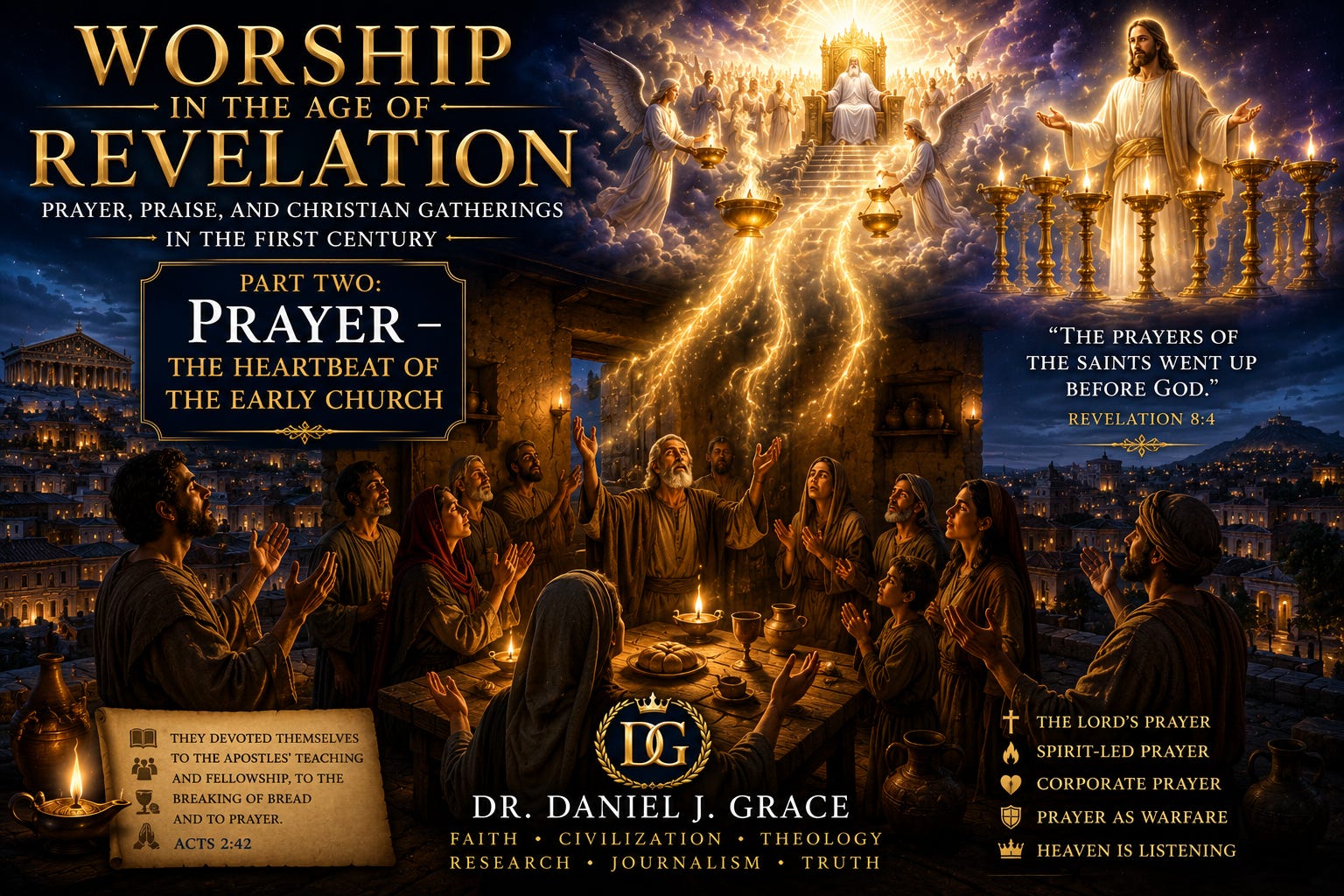
Part Two: Prayer – The Heartbeat of the Early Church
Imagine the room once again.
Oil lamps flicker against the walls.
The aroma of freshly baked bread fills the air.
A small gathering of believers sits quietly in anticipation.
Perhaps the host rises first. Perhaps it is one of the elders.
Slowly, he lifts his hands toward heaven.
One by one, the others stand and do the same.
For the Christians of the first century, prayer was not an optional addition to worship. It was its very foundation.
Prayer was the heartbeat of the early Church.
Throughout the New Testament, we repeatedly encounter believers praying together. Paul instructs Timothy:
“I want men everywhere to pray, lifting up holy hands without anger or disputing.” (1 Timothy 2:8)
This was not unusual behaviour. It was the normal posture of Christian worship.
The Didache, one of the earliest Christian teaching documents outside the New Testament, instructed believers to pray the Lord’s Prayer three times each day—morning, noon, and evening. While early Christians inherited the Jewish tradition of regular prayer, they now centred their devotion upon Jesus Christ, the risen Lord.
Prayer shaped every aspect of their lives.
When Christians gathered on the Lord’s Day, prayer was not simply something they did.
It was who they were.
Devoted to Prayer
The Book of Acts provides one of the clearest descriptions of the first Christian communities:
“They devoted themselves to the apostles’ teaching and fellowship, to the breaking of bread and to prayer.” (Acts 2:42)
Notice the language.
They did not merely participate in prayer occasionally.
They devoted themselves to it.
Prayer was a daily discipline and a shared responsibility.
The Greek text uses the phrase “the prayers,” suggesting recognised patterns of communal prayer already existed within the Church.
There were structured prayers.
There were spontaneous prayers.
There were personal prayers.
And there were corporate prayers offered together as one body.
Prayer united believers with one another and with God.
The Lord’s Prayer
At the centre of early Christian prayer stood the prayer Jesus Himself had taught His disciples.
The Didache specifically instructed Christians:
“Pray in this way three times a day.”
The familiar words became the common language of Christian worship:
“Our Father in heaven, hallowed be Your name.”
For modern readers, these words may seem familiar and routine.
For first-century Christians, they were revolutionary.
To address God as Father was a privilege made possible through Christ.
The Lord’s Prayer reminded believers that they belonged to a new family and a new kingdom.
Every petition carried profound meaning.
When they prayed:
“Your kingdom come, Your will be done.”
They were declaring allegiance to God’s kingdom rather than the kingdom of Caesar.
When they prayed:
“Give us this day our daily bread.”
They acknowledged their dependence upon God rather than earthly wealth.
When they prayed:
“Deliver us from evil.”
They recognised the reality of spiritual conflict in a hostile world.
The Lord’s Prayer was not empty repetition.
It was a declaration of faith.
Spirit-Led Prayer
Alongside structured prayers, early Christian worship also included spontaneous prayer inspired by the Holy Spirit.
Paul’s description of worship in Corinth offers a glimpse into this dynamic atmosphere:
“When you come together, each of you has a hymn, or a word of instruction, a revelation, a tongue or an interpretation.” (1 Corinthians 14:26)
In a house church gathering of twenty or thirty believers, multiple people could contribute.
One person might pray for the sick.
Another might pray for missionaries travelling throughout Asia Minor.
A widow might intercede for persecuted believers.
A merchant might pray for wisdom and integrity in business.
A young believer might offer thanksgiving for God’s provision.
Prayer was participatory.
The congregation listened, responded, and joined together in agreement.
The Holy Spirit was understood to be actively guiding the gathering.
Prayer was not merely speaking to God.
It was listening for His voice.
Prayer During Persecution
The churches addressed in Revelation faced real challenges.
Some experienced poverty.
Others endured social exclusion.
Still others faced imprisonment and persecution.
Prayer became their refuge.
Consider the church in Smyrna.
Jesus warned them:
“Do not be afraid of what you are about to suffer.” (Revelation 2:10)
Imagine those believers gathering before dawn.
Roman authorities watched them with suspicion.
Some may have already lost employment because of their faith.
Others faced rejection by family members.
Yet they prayed.
Not because circumstances were easy.
But because they believed God was listening.
Prayer gave them courage when courage was needed most.
It reminded them that earthly suffering was temporary and that Christ remained victorious.
Corporate Prayer and Response
Historical evidence suggests that many early Christian prayers were offered responsively.
The Roman governor Pliny the Younger observed Christians gathering before dawn and reciting words together in honour of Christ.
Many scholars believe these prayers involved a form of call-and-response worship.
One leader would speak.
The congregation would answer.
This pattern reflects the worship scenes found throughout Revelation.
John repeatedly describes heavenly beings responding to one another:
“Holy, holy, holy is the Lord God Almighty.”
The elders answer.
The angels join in.
The heavenly host responds together.
Earthly worship mirrored heavenly worship.
The voices of believers joined a chorus that stretched from house churches on earth to God’s throne room in heaven.
Confession and Reconciliation
Prayer in the early Church was not limited to praise and thanksgiving.
It also involved confession.
Before believers participated in the Lord’s Supper, they were encouraged to examine themselves and seek reconciliation with others.
The Didache instructed Christians:
“Confess your sins so that your sacrifice may be pure.”
This reflected Jesus’ own teaching about reconciliation before worship.
The early Church understood that spiritual unity mattered.
Personal grudges could not be carried casually to the Lord’s Table.
Forgiveness was expected.
Relationships mattered.
Prayer prepared hearts for fellowship with both God and one another.
Prayers Like Incense
One of Revelation’s most beautiful images concerns prayer.
John sees the prayers of God’s people rising before the throne like incense.
“The prayers of the saints went up before God.” (Revelation 8:4)
For first-century believers, this imagery carried enormous comfort.
Their prayers were not disappearing into the air.
They were reaching heaven.
The widow’s whispered prayer.
The prisoner’s desperate plea.
The elder’s intercession.
The congregation’s cry for mercy.
All of it rose before God.
Every prayer mattered.
Every voice was heard.
Every tear was seen.
This heavenly perspective transformed earthly worship.
Prayer was not a religious routine.
It was participation in the life of God’s kingdom.
Prayer as Spiritual Warfare
Modern Christians often think of prayer primarily as personal devotion.
The first-century Church viewed it differently.
Prayer was spiritual warfare.
When believers prayed:
“Your kingdom come,”
they were challenging the claims of earthly empires.
When they prayed in the name of Jesus, they proclaimed His authority above every ruler and power.
When they interceded for one another, they strengthened the Church against persecution and compromise.
The Roman Empire possessed armies, governors, and political influence.
The Church possessed prayer.
And history ultimately proved which kingdom would endure.
The empire that once persecuted Christians has long since vanished.
The prayers of the saints continue to echo through history.
Hearing What the Spirit Says
Throughout the letters to the seven churches, Jesus repeatedly declares:
“Whoever has ears, let them hear what the Spirit says to the churches.”
This hearing took place within prayerful communities.
The same Holy Spirit who inspired Scripture was present among believers as they gathered.
Prayer opened their hearts to God’s guidance.
It strengthened their faith.
It corrected their errors.
It reminded them of Christ’s promises.
The Spirit continued speaking through worship, fellowship, Scripture, and prayer.
The Church listened together.
Conclusion
For Christians living in the age of Revelation, prayer was not a secondary element of worship.
It was the foundation upon which everything else rested.
Prayer united believers with God.
Prayer strengthened them during persecution.
Prayer prepared them for the Lord’s Supper.
Prayer connected earth to heaven.
Prayer transformed ordinary gatherings into encounters with the living Christ.
The believers of Ephesus, Smyrna, Pergamum, Thyatira, Sardis, Philadelphia, and Laodicea understood something that modern Christians sometimes forget:
The Church survives not because of its resources, buildings, or influence.
The Church survives because God hears the prayers of His people.
And the God who walked among the lampstands still listens today.
To Be Continued...
In Part Three, we explore the second great pillar of early Christian worship: Praise.
How did the first Christians sing?
What hymns did they know?
And why did their songs sound so much like the thunderous worship John heard around the throne of God in Revelation?

Dr. Daniel J. Grace
Faith • Civilization • Theology
Research • Journalism • Truth
🌐 danieljamesgrace.com
© 2026 Dr. Daniel J. Grace. All Rights Reserved.
No part of this article may be reproduced, distributed, transmitted, or published in any form or by any means without prior written permission from the author, except for brief quotations used in academic citation, review, or research purposes.