
WORSHIP IN THE AGE OF REVELATION. Part Three
Prayer, Praise, and Christian Gatherings in the First Century

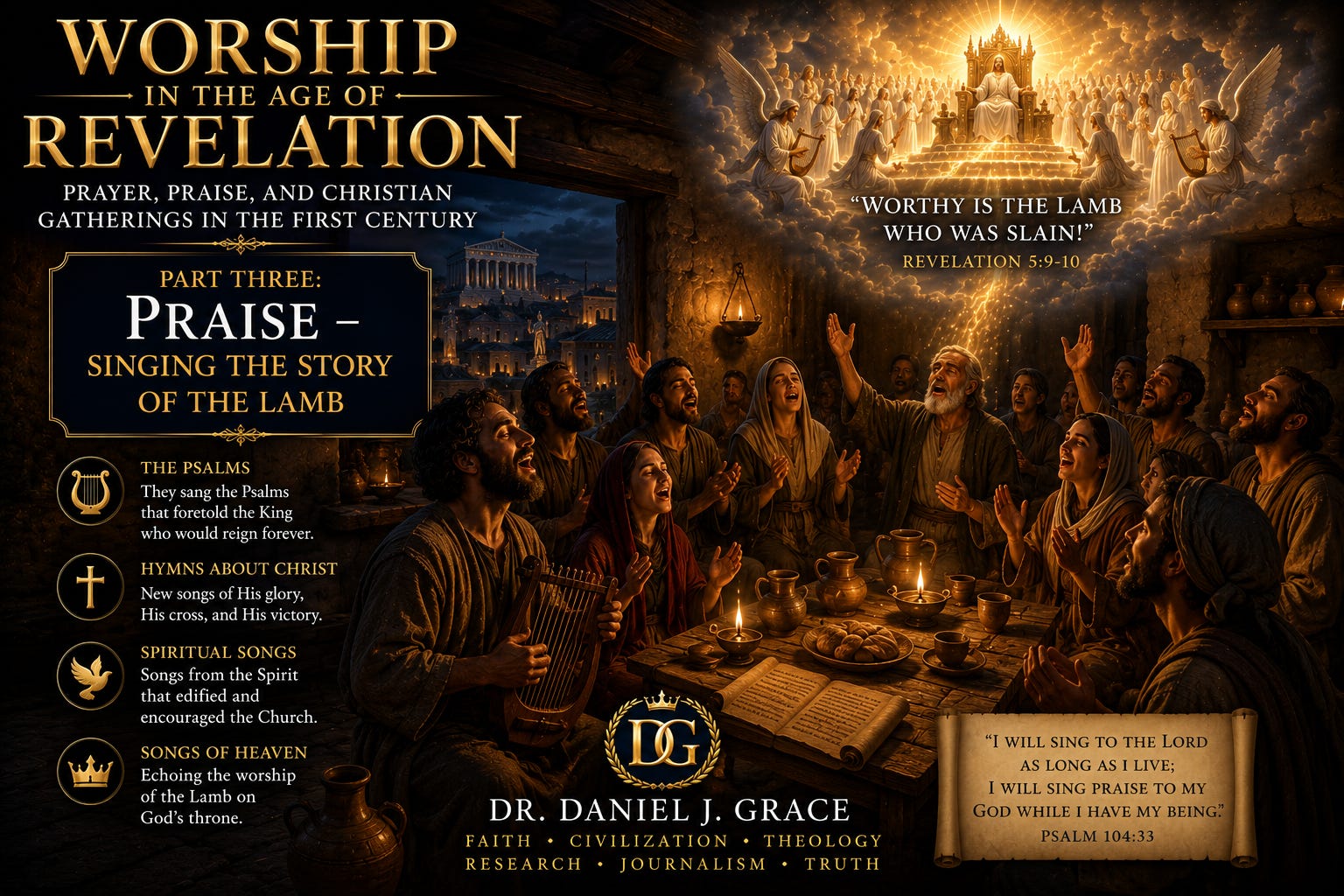
Part Three: Praise – Singing the Story of the Lamb
The prayers have ended.
The room grows quiet for a moment.
Oil lamps continue to flicker against the walls. Families sit together. Bread and wine remain on the table. Outside, the streets of Ephesus, Smyrna, or Philadelphia continue their normal rhythm beneath the authority of Rome.
Then someone begins to sing.
Perhaps it is the elder.
Perhaps it is a widow who knows the Psalms by heart.
Perhaps it is simply a voice rising from the gathering.
Others quickly join.
Soon the entire room is filled with song.
There is no choir loft.
No cathedral organ.
No worship band.
No projected lyrics.
Only the voices of believers united in praise.
This was worship in the age of Revelation.
For the first Christians, singing was not entertainment.
It was theology set to music.
It was Scripture carried in memory.
It was a declaration of loyalty to Christ in a world that demanded loyalty to Caesar.
And it was one of the most powerful expressions of faith within the early Church.
Singing as a Community
Paul’s letters reveal how important singing had become within Christian worship.
Writing to the Colossians, he instructed believers:
“Let the word of Christ dwell in you richly, teaching and admonishing one another with all wisdom through psalms, hymns, and spiritual songs, singing to God with gratitude in your hearts.” (Colossians 3:16)
Similarly, he told the Ephesians:
“Speak to one another with psalms, hymns, and songs from the Spirit. Sing and make music from your heart to the Lord.” (Ephesians 5:19)
Notice the emphasis.
Believers were not merely singing to God.
They were singing to one another.
Christian praise was communal.
Songs taught doctrine.
Songs encouraged perseverance.
Songs reminded believers of God’s promises.
Every voice mattered.
Participation was expected.
The gathered church became both choir and congregation at the same time.
The Psalms: Israel’s Hymnbook
The earliest Christians inherited a rich tradition of worship from Judaism.
At the centre of that tradition stood the Book of Psalms.
Jesus Himself sang the Psalms.
On the night before His crucifixion, He and His disciples sang hymns together after the Passover meal (Matthew 26:30), almost certainly from the Hallel Psalms (Psalms 113–118).
The first Christians continued this practice.
The Psalms became the soundtrack of the early Church.
Certain Psalms were especially significant.
Psalm 2 proclaimed God’s anointed King ruling over the nations.
Psalm 110 declared:
“The LORD says to my Lord: Sit at My right hand.”
Psalm 118 celebrated God’s salvation and victory.
For believers living under Roman rule, these songs carried enormous significance.
Caesar claimed universal authority.
The Psalms declared that Christ alone was King.
Every time Christians sang these words, they proclaimed a kingdom greater than Rome.
Praise became an act of resistance.
New Hymns About Christ
Alongside the Psalms, the early Church developed entirely new songs centred upon Jesus.
Many scholars believe several passages within the New Testament were originally hymns sung during worship gatherings.
One of the most famous appears in Philippians 2:
“Who, being in very nature God,
did not consider equality with God something to be used to His own advantage...”
The poetic structure suggests that believers were already singing these words decades before Revelation was written.
Another example appears in Colossians 1:
“He is the image of the invisible God,
the firstborn over all creation.”
These hymns proclaimed the identity of Christ.
They taught believers who Jesus was.
They celebrated His incarnation, death, resurrection, and exaltation.
Long before formal creeds were written, Christian hymns were already teaching theology.
In a largely illiterate society, songs became a powerful way to preserve and communicate truth.
Spiritual Songs and the Work of the Spirit
Not every song came from a written text.
Paul also refers to “spiritual songs.”
These were likely spontaneous expressions of praise inspired by the Holy Spirit.
In gatherings described in 1 Corinthians, believers contributed hymns, revelations, prayers, and words of encouragement.
The Spirit actively guided worship.
A believer might begin singing a new song of thanksgiving.
Others would join.
The congregation would listen, discern, and respond.
Such moments reflected the living presence of God among His people.
The Book of Revelation itself contains numerous examples of heavenly songs.
John repeatedly hears worship erupting around God’s throne.
The heavenly hosts sing:
“Worthy is the Lamb who was slain.”
And again:
“Great and marvelous are Your deeds, Lord God Almighty.”
These songs celebrate redemption, victory, and the reign of Christ.
The churches on earth echoed the songs already being sung in heaven.
Worship That Reflected Heaven
One of the most remarkable features of Revelation is its emphasis on worship.
Again and again, John is shown scenes of praise before God’s throne.
The four living creatures cry:
“Holy, holy, holy is the Lord God Almighty.”
The twenty-four elders respond.
The angels join the chorus.
Countless voices unite in worship.
This heavenly pattern shaped earthly worship.
When believers gathered in house churches throughout Asia Minor, they understood themselves to be participating in something far greater than a local meeting.
Their songs joined the worship of heaven itself.
The small congregation in Philadelphia.
The persecuted believers in Smyrna.
The struggling church in Sardis.
Each gathering became an earthly reflection of God’s eternal throne room.
This perspective transformed worship.
They were not simply singing in a house.
They were joining heaven’s choir.
Praise Amid Persecution
Praise took on even greater significance during times of suffering.
The churches addressed in Revelation faced intense pressures.
Economic hardship.
Social exclusion.
Political hostility.
Threats of imprisonment.
In such circumstances, singing became an act of courage.
Imagine believers in Thyatira who had resisted false teaching.
Outside their gathering, pagan festivals filled the streets.
Guild feasts honoured idols.
Pressure to compromise existed everywhere.
Yet inside the house church, another song was being sung.
The song of the Lamb.
Or consider Smyrna.
Jesus warned them that suffering lay ahead.
Some would face prison.
Others would face death.
Yet they continued to praise.
Why?
Because worship reminded them that Christ had already won the ultimate victory.
Their hope rested not in earthly circumstances but in the risen Lord.
Praise strengthened faith when fear threatened to overwhelm it.
Songs That Taught Truth
In the first century, many believers could not read.
Books were expensive.
Copies of Scripture were limited.
Songs helped preserve and spread Christian teaching.
Every hymn carried doctrine.
Every chorus reinforced truth.
Believers learned about Christ by singing about Christ.
They remembered Scripture through melody.
They passed theology from one generation to the next through worship.
Praise served as a living classroom.
The Church sang its faith before it wrote systematic theology.
Music became a vessel for memory, discipleship, and spiritual formation.
The Voice as the Instrument
Most first-century Christian worship was probably sung without elaborate musical accompaniment.
While some Jewish Christians may have occasionally used simple instruments, the human voice remained central.
The voice itself became the instrument of worship.
This reflected a profound theological truth.
Christian worship was not dependent upon technology, wealth, or performance.
It depended upon hearts transformed by grace.
Rich and poor.
Slave and free.
Jew and Gentile.
Men and women.
All could join the same song.
The unity of voices reflected the unity of the Church.
A People Who Could Not Be Controlled
Roman authorities could tolerate many religions.
What troubled them about Christianity was its exclusive loyalty to Christ.
Believers refused to worship Caesar.
They refused to acknowledge other gods.
And they gathered regularly to sing to Jesus as Lord.
Pliny the Younger observed Christians singing hymns to Christ “as to a god.”
This simple statement reveals much.
Their worship centred on Jesus.
Their songs proclaimed His divinity.
Their praise declared His authority.
A people who sing confidently about a crucified and risen King become difficult to intimidate.
Such people cannot easily be controlled by fear.
Their songs become testimonies of hope.
Their worship becomes a declaration that another kingdom is coming.
Conclusion
For the Christians of the seven churches, praise was far more than music.
It was theology.
It was discipleship.
It was encouragement.
It was resistance.
It was hope.
Through psalms, hymns, and spiritual songs, believers proclaimed the story of God’s redemption.
They sang of Christ’s victory over sin and death.
They sang of a kingdom greater than Rome.
They sang because they believed heaven itself was listening.
And in their songs, they found strength to overcome.
The churches of Revelation remind us that worship is not merely preparation for Christian life.
It is part of Christian life itself.
The songs of the early Church continue to echo across the centuries, calling every generation to join the chorus:
“Worthy is the Lamb who was slain.”
To Be Continued...
In Part Four, we will explore the climax of first-century Christian worship: the breaking of bread, fellowship, and the Lord’s Supper.
How did these simple house-church gatherings strengthen believers to endure persecution, resist compromise, and remain faithful to Christ?

Dr. Daniel J. Grace
Faith • Civilization • Theology
Research • Journalism • Truth
🌐 danieljamesgrace.com
© 2026 Dr. Daniel J. Grace. All Rights Reserved.
No part of this article may be reproduced, distributed, transmitted, or published in any form or by any means without prior written permission from the author, except for brief quotations used in academic citation, review, or research purposes.