
WORSHIP IN THE AGE OF REVELATION.... Part Four
Prayer, Praise, and Christian Gatherings in the First Century

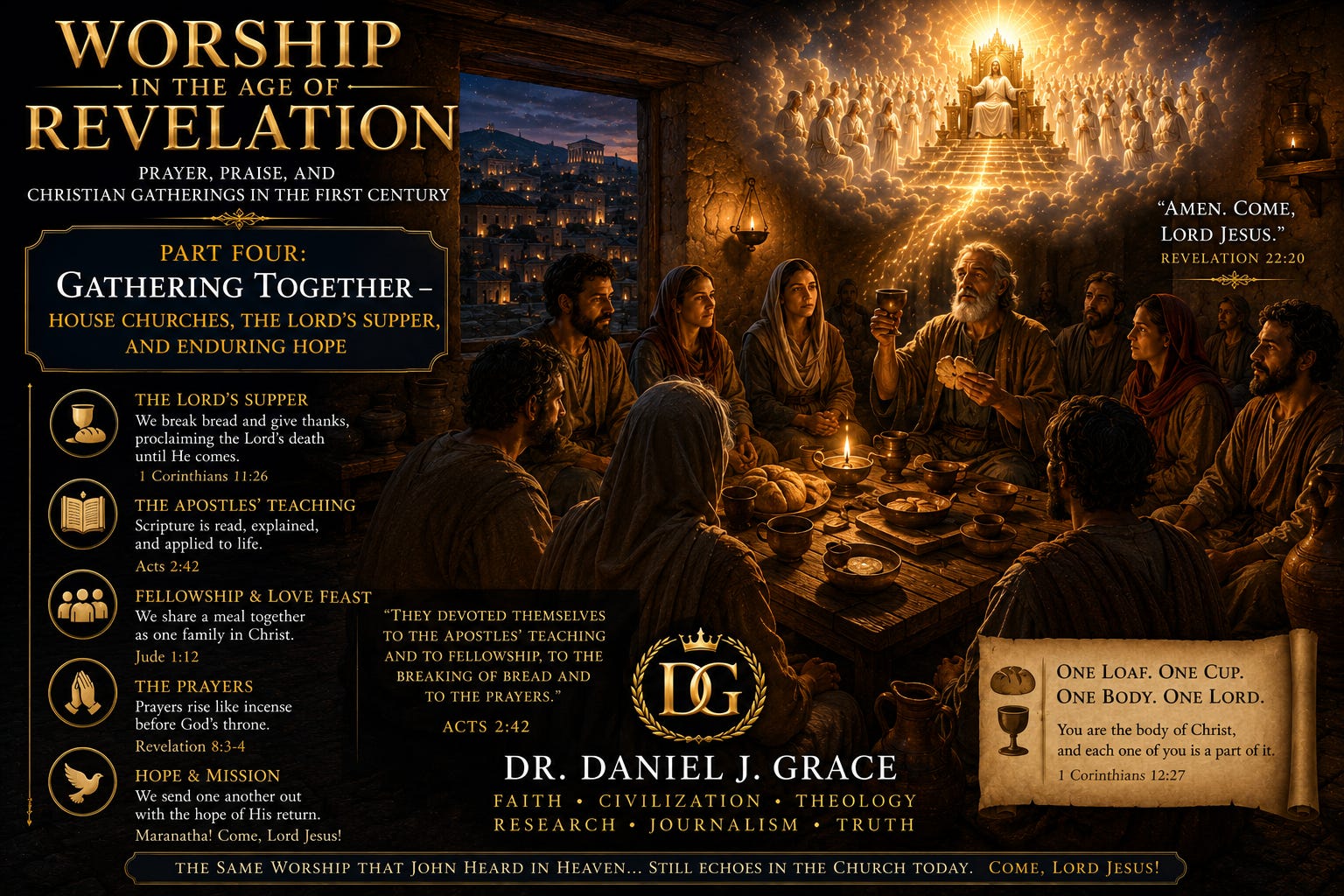
Part Four: Gathering Together – House Churches, the Lord’s Supper, and Enduring Hope
The singing gradually fades.
The room grows quiet.
Oil lamps continue to flicker softly against the walls as believers settle into their places around the table.
A sense of anticipation fills the gathering.
Now comes the climax of worship.
The breaking of bread.
For the first Christians, this was far more than a religious ritual.
It was a sacred encounter with the risen Christ.
Everything in the gathering had been leading to this moment.
The prayers.
The Scripture readings.
The songs of praise.
The fellowship.
All culminated at the Lord’s Table.
The Table at the Centre
One of the earliest Christian documents outside the New Testament, the Didache, provides a remarkable glimpse into how believers celebrated the Lord’s Supper during the late first century.
Before the meal began, believers were encouraged to confess their sins and seek reconciliation with one another.
Purity of heart mattered.
Unity within the body mattered.
The community then offered prayers of thanksgiving over both the cup and the bread.
The Didache records these words:
“We thank You, our Father, for the holy vine of David Your servant, which You made known to us through Jesus Your servant.”
And concerning the bread:
“We thank You, our Father, for the life and knowledge which You made known to us through Jesus Your servant.”
These prayers reflected gratitude rather than mere ritual.
The meal reminded believers that everything they possessed—life, salvation, forgiveness, and hope—came through Christ.
One Bread, One People
The bread itself carried profound symbolism.
The Didache compares scattered grains gathered into one loaf with God’s people gathered from the ends of the earth into His kingdom.
This simple image beautifully captured the nature of the Church.
Jews and Gentiles.
Rich and poor.
Men and women.
Slaves and free citizens.
People from different backgrounds and cultures were united through Christ.
The Roman world was deeply divided by class, wealth, ethnicity, and social status.
The Church was different.
At the Lord’s Table, all believers shared the same bread and drank from the same cup.
The meal proclaimed a new identity.
They belonged not primarily to Rome, Ephesus, Smyrna, or Laodicea.
They belonged to the Kingdom of God.
The Love Feast
In the first century, the Lord’s Supper was usually celebrated within a larger communal meal often called the Agape Feast or Love Feast.
Believers did not simply receive a small piece of bread and a sip of wine.
They shared a full meal together.
This reflected the pattern established by Jesus during the Last Supper.
The meal provided practical support for poorer members of the congregation while strengthening relationships within the community.
Paul’s instructions in 1 Corinthians 11 demonstrate that this practice was already well established by the middle of the first century.
Unfortunately, some churches struggled with divisions and selfish behaviour.
Paul rebuked believers who treated the meal as an ordinary banquet rather than a sacred remembrance of Christ.
The Lord’s Supper was never intended to highlight social differences.
It was intended to reveal Christian unity.
Remembering Christ
At some point during the meal, the host or elder would repeat the words of Jesus:
“This is My body, which is for you.”
“This cup is the new covenant in My blood.”
These words connected every gathering directly to the events of the Last Supper.
The bread reminded believers of Christ’s sacrifice.
The cup reminded them of the covenant established through His blood.
Every celebration proclaimed the same message:
Christ died.
Christ is risen.
Christ will come again.
The Lord’s Supper linked the past, present, and future together.
It remembered the cross.
It celebrated Christ’s presence among His people.
And it anticipated His return.
Scripture and Teaching
After the meal, Scripture was often read aloud.
During the earliest years of Christianity, this primarily included the Old Testament.
As time passed, letters from Paul, Peter, James, John, and other apostolic writings began circulating among the churches.
Eventually, the Gospels were added to these readings.
Since most believers could not read, public reading was essential.
Scripture was heard before it was studied privately.
An elder, teacher, or visiting prophet would explain the text and show how it pointed to Jesus.
Questions could be asked.
Discussion often followed.
Teaching was participatory rather than passive.
The goal was spiritual growth and deeper understanding.
The apostles’ teaching remained one of the foundational pillars of Christian worship.
Spiritual Gifts in the Gathering
The first-century church was not a spectator event.
Everyone was expected to contribute according to the gifts God had given them.
Paul describes gatherings where believers shared hymns, teachings, prophecies, tongues, interpretations, and words of encouragement.
Everything was to be done for the strengthening of the Church.
The Holy Spirit actively worked among God’s people.
While order was important, there was also room for spontaneity.
Worship was both structured and Spirit-led.
Believers expected God to be present.
They expected Him to speak.
And they expected lives to be changed.
Caring for the Poor
Before the gathering ended, many churches collected offerings for those in need.
Paul instructed believers to set aside resources regularly for the support of poorer Christians and struggling congregations.
These collections became tangible expressions of Christian love.
The Church did not simply preach generosity.
It practised it.
Widows were cared for.
Orphans received support.
The hungry were fed.
Travelling missionaries were assisted.
The Lord’s Table naturally led to practical compassion.
The worship of God produced service toward others.
Maranatha – Come, Lord Jesus
As the gathering drew to a close, believers often exchanged a kiss of peace and offered a final declaration of hope.
One of the most beloved expressions was:
Maranatha.
The phrase means:
“Come, Lord Jesus.”
This simple prayer appears in 1 Corinthians 16:22 and echoes the closing words of Revelation:
“Amen. Come, Lord Jesus.” (Revelation 22:20)
For believers facing persecution, poverty, and uncertainty, these words carried enormous power.
They reminded the Church that history was moving toward a glorious conclusion.
Christ would return.
Justice would come.
Suffering would end.
The Kingdom would be fully revealed.
Every gathering ended with hope.
The Message of Revelation
The Book of Revelation ties all of these themes together.
The seven churches were far from perfect.
Ephesus had lost its first love.
Pergamum tolerated compromise.
Thyatira struggled with false teaching.
Sardis appeared alive but was spiritually dead.
Laodicea had become lukewarm.
Yet despite their failures, Christ continued to walk among the lampstands.
He called them to repentance.
He invited them to overcome.
And He promised extraordinary rewards.
The tree of life.
A new name.
White garments.
A place in God’s kingdom.
A throne alongside Christ.
These promises gave meaning to every gathering.
Every prayer.
Every song.
Every shared meal.
The future Kingdom was not merely something distant.
It was already breaking into the present.
Worship and Enduring Hope
By the end of the first century, the pattern of Christian worship had spread throughout the Roman Empire.
From Asia Minor to Rome.
From Syria to North Africa.
Believers gathered around the same essentials:
The apostles’ teaching.
Fellowship.
The breaking of bread.
The prayers.
No central authority imposed this structure.
It emerged naturally as the Holy Spirit guided the Church.
John’s vision in Revelation helped believers understand what was truly happening.
Their small gatherings were participating in heaven’s worship.
Their prayers reached God’s throne.
Their songs joined angelic choirs.
Their meals anticipated the marriage supper of the Lamb.
Their hope rested in Christ’s ultimate victory.
Conclusion
The age of Revelation was not an age of magnificent church buildings, large budgets, or advanced technology.
It was an age of courageous faith.
Believers met in homes.
They worshipped under pressure.
They prayed, sang, shared meals, and encouraged one another.
They gathered around Christ.
And through these simple acts, they changed the world.
The same foundations remain today.
The apostles’ teaching.
Fellowship.
The breaking of bread.
The prayers.
When Christians gather in Christ’s name, they still participate in the worship that never ceases before God’s throne.
The lampstands still shine.
The Spirit still speaks.
And the Church still waits with hope.
Come, Lord Jesus.
Final Reflection
Thank you for joining this four-part journey into worship during the age of Revelation.
If this series has deepened your appreciation for the faith, courage, and devotion of the first Christians, consider sharing it with others who love Christian history, biblical studies, and the enduring message of Revelation.
The story of the seven churches continues to speak.
And its message remains as relevant today as it was nearly two thousand years ago.
Grace and peace to you.
Dr. Daniel J. Grace
Faith • Civilization • Theology
Research • Journalism • Truth
🌐 danieljamesgrace.com
© 2026 Dr. Daniel J. Grace. All Rights Reserved.
No part of this article may be reproduced, distributed, transmitted, or published in any form or by any means without prior written permission from the author, except for brief quotations used in academic citation, review, or research purposes.