

WORSHIP IN THE AGE OF REVELATION Part One
Prayer, Praise, and Christian Gatherings in the First Century

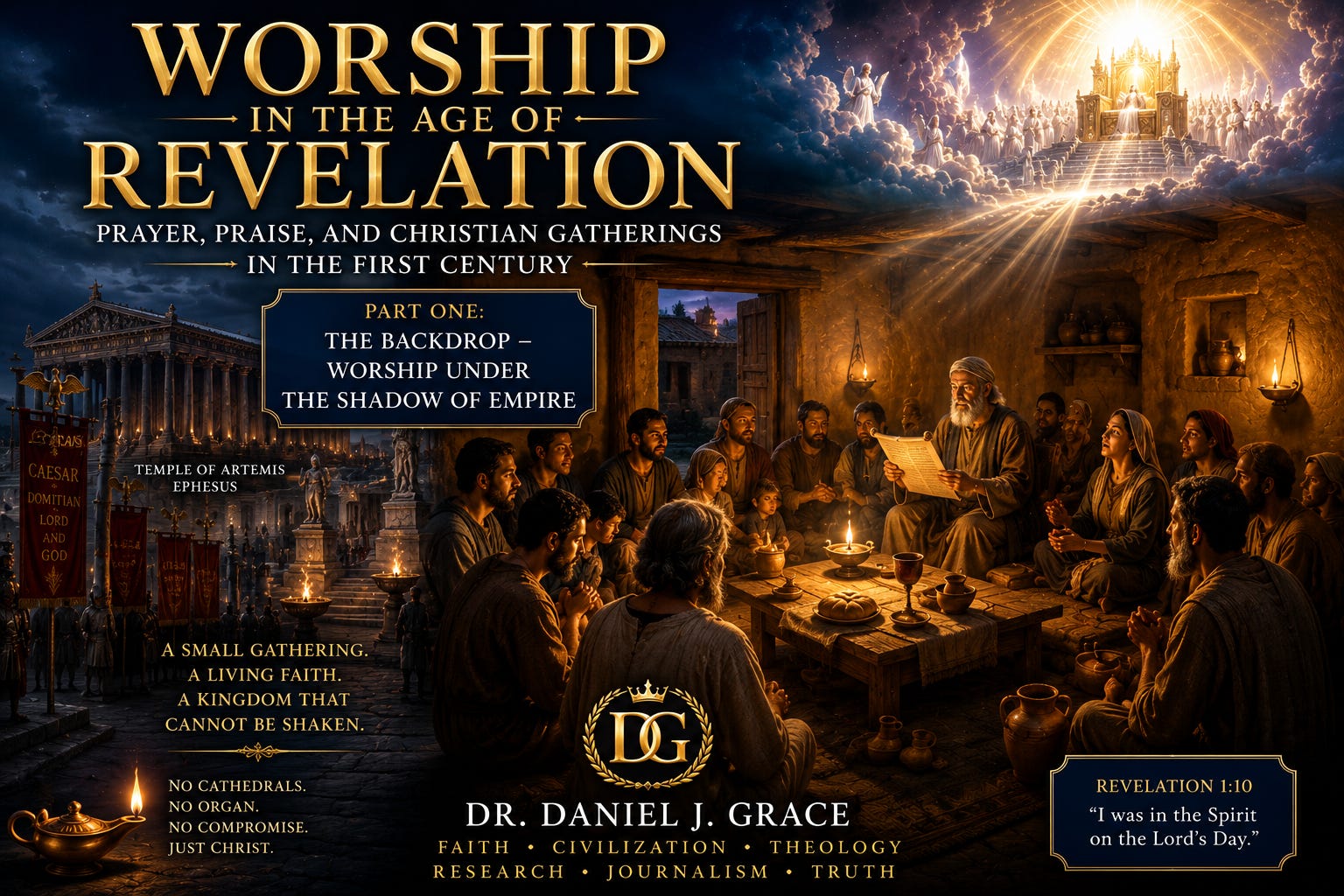
Part One: The Backdrop – Worship Under the Shadow of Empire
Welcome to this four-part series exploring worship in the age of Revelation.
If you have ever wondered what Christian worship looked like in the days of the seven churches—Ephesus, Smyrna, Pergamum, Thyatira, Sardis, Philadelphia, and Laodicea—this series is for you.
Together, we will travel back to the closing years of the first century, around AD 95, when the Apostle John received the Revelation of Jesus Christ while exiled on the island of Patmos.
There were no cathedral buildings. No stained-glass windows. No church steeples. No organs, worship bands, or sophisticated sound systems. Christianity was still a small and often persecuted movement scattered across the Roman Empire.
Yet the worship of these early believers possessed a remarkable spiritual power.
It was sincere.
It was courageous.
It was deeply rooted in prayer.
It was filled with praise.
Above all, it was anchored in the unwavering conviction that Jesus Christ—the Lamb who was slain—was Lord over all creation.
Drawing upon the New Testament, the Book of Revelation, the Didache, and early historical sources, this series seeks to reconstruct what worship looked like in the churches of Asia Minor during the age of Revelation. More than a historical investigation, it is an exploration of a living faith that continues to challenge and inspire believers today.
Gathering Under the Shadow of Rome
Imagine it is early Sunday morning in the city of Ephesus sometime during the reign of Emperor Domitian.
The sun has not yet risen.
The streets are quiet.
Many of your neighbours will soon make their way to pagan temples or local shrines dedicated to the emperor cult. Throughout the Roman Empire, citizens are encouraged to honour Caesar with incense and public acts of devotion. Domitian has even embraced titles such as “Lord and God.”
Yet a small group of Christians is preparing for a very different gathering.
You quietly leave your home before dawn.
Perhaps you carry a loaf of bread beneath your cloak.
Perhaps you are a merchant, a craftsman, a widow, a slave, or a freedman.
Carefully making your way through the streets, you arrive at a modest house where fellow believers are already gathering.
Inside are twenty or thirty people from different backgrounds.
A Jewish family who came to faith in Jesus.
A Greek merchant who once worshipped Artemis.
A Roman citizen risking social disgrace.
A slave woman serving alongside her master as an equal before Christ.
They greet one another warmly.
Some exchange the traditional holy kiss, a symbol of Christian unity and family.
No one arrives as a social superior.
No one is treated as spiritually inferior.
In Christ, they are brothers and sisters.
This is worship in the age of Revelation.
The Lord’s Day
One of the most significant developments in early Christianity was the emergence of Sunday worship.
John writes:
“I was in the Spirit on the Lord’s Day.” (Revelation 1:10)
This simple statement reveals an important reality.
By the end of the first century, Christians had already established Sunday as their primary day of worship.
Unlike Judaism, which centred worship on the Sabbath, Christians gathered on the first day of the week because it was the day Jesus rose from the dead.
The resurrection transformed the calendar of the Church.
Other New Testament passages confirm this pattern.
Acts 20:7 describes believers gathering on the first day of the week to break bread.
Paul instructs the Corinthians to set aside offerings on the first day of the week (1 Corinthians 16:2).
Later Christian writers such as Justin Martyr provide further evidence that Sunday worship had become universal among believers.
This choice was far from convenient.
Sunday was not a Roman holiday.
Most Christians still worked long hours and often met before sunrise or after sunset.
Gathering on the Lord’s Day was therefore a deliberate declaration of loyalty.
It proclaimed that Jesus—not Caesar—was King.
A Different Kind of Worship
The Roman world was saturated with religion.
Temples dominated city skylines.
Public festivals filled the streets.
Sacrifices were offered daily to various gods and goddesses.
Participation in civic religion was often expected.
Trade guilds frequently held banquets that included food sacrificed to idols.
To refuse participation could lead to economic hardship, social exclusion, or even persecution.
This background helps explain several warnings found in Revelation.
The churches at Pergamum and Thyatira, for example, struggled with pressure to compromise and participate in practices associated with idolatry.
Against this backdrop, Christian worship became an act of spiritual resistance.
Believers refused to acknowledge Caesar as Lord.
They refused to worship idols.
Instead, they gathered around a different table and confessed a different King.
Their worship was not merely private devotion.
It was a public declaration of allegiance to Christ.
House Churches: The First Christian Meeting Places
Modern Christians often associate worship with church buildings.
However, the first-century Church had no dedicated places of worship.
Christians met primarily in private homes.
Large houses owned by wealthier believers often served as gathering places for local congregations.
The New Testament mentions several such homes.
Lydia hosted believers in Philippi.
Priscilla and Aquila opened their house for worship.
Gaius welcomed Christians in Corinth.
These house churches became the centre of Christian life.
The Didache, an early Christian teaching document probably circulating near the end of the first century, simply instructs believers:
“On the Lord’s own day gather together, break bread, and give thanks.”
The emphasis was not on buildings.
It was on the gathered community.
The Church was not defined by architecture.
It was defined by people united in Christ.
The Four Pillars of Christian Worship
Although local customs varied, Christian worship throughout the Roman world rested upon four foundational practices.
These are described in Acts 2:42:
“They devoted themselves to the apostles’ teaching and to fellowship, to the breaking of bread and to prayer.”
These four pillars remained central throughout the first century.
1. The Apostles’ Teaching
Scripture was read and explained.
Believers listened to the teachings of Jesus and the writings of the apostles.
Letters from Paul, Peter, James, and John circulated among the churches.
Teaching provided doctrinal stability in a culture filled with competing beliefs.
2. Fellowship
Christian fellowship involved far more than casual friendship.
The Greek word koinonia describes deep participation in a shared spiritual life.
Believers supported one another materially, emotionally, and spiritually.
They regarded one another as family.
3. The Breaking of Bread
The Lord’s Supper stood at the centre of Christian worship.
Bread and wine reminded believers of Christ’s sacrifice and anticipated His return.
The meal proclaimed the death and resurrection of Jesus until He came again.
4. Prayer
Prayer saturated every aspect of Christian life.
Believers prayed together, interceded for one another, and worshipped God through thanksgiving and praise.
Prayer connected the earthly congregation with the heavenly throne room.
Worship on Earth, Worship in Heaven
One of Revelation’s most powerful themes is the connection between earthly worship and heavenly worship.
When believers gathered in small homes throughout Asia Minor, they were participating in something far greater than a local meeting.
John’s vision reveals heaven itself.
In Revelation chapters 4 and 5, he sees God’s throne surrounded by worship.
Twenty-four elders fall before Him.
Four living creatures cry:
“Holy, holy, holy is the Lord God Almighty.”
Countless angels proclaim:
“Worthy is the Lamb who was slain.”
The message is clear.
The worship of the Church on earth reflects the worship already taking place in heaven.
The small gathering in Ephesus was connected to the throne of God.
The prayers of Smyrna joined the praises of angels.
The worship of Philadelphia echoed through eternity.
Christian worship was never merely local.
It was cosmic.
Evidence from a Roman Governor
One of the most valuable historical descriptions of early Christian worship comes from Pliny the Younger, governor of Bithynia-Pontus.
Writing to Emperor Trajan around AD 112, Pliny describes what he learned from interrogating Christians.
He reports that believers gathered before dawn on a fixed day and sang hymns to Christ as God.
They committed themselves to moral living and later shared a common meal.
This testimony confirms what Scripture already suggests.
First-century Christian worship was remarkably simple.
It centred on Christ.
It included singing, prayer, teaching, fellowship, and shared meals.
Yet despite its simplicity, Roman authorities regarded it as a powerful movement.
Worship as Resistance
The churches of Revelation faced enormous pressures.
Some endured persecution.
Others struggled with compromise.
Some became spiritually complacent.
Yet they continued gathering.
Why?
Because worship was not optional.
It was essential.
Every prayer declared that Christ reigns.
Every hymn proclaimed His victory.
Every shared meal anticipated His return.
Every gathering reminded believers that they belonged to a kingdom greater than Rome.
For the Christians of Asia Minor, worship was not an escape from reality.
It was a declaration of ultimate reality.
Jesus Christ is Lord.
And that truth changed everything.
To Be Continued...
In Part Two, we will step inside a first-century Christian gathering and explore what actually happened when believers came together for prayer, Scripture reading, praise, teaching, and the Lord’s Supper.

Dr. Daniel J. Grace
Faith • Civilization • Theology
Research • Journalism • Truth
🌐 danieljamesgrace.com
© 2026 Dr. Daniel J. Grace. All Rights Reserved.
No part of this article may be reproduced, distributed, transmitted, or published in any form or by any means without prior written permission from the author, except for brief quotations used in academic citation, review, or research purposes.