

Women in the Early Churches: Faith, Leadership, Service, and the Hidden Foundations of Christianity
Revisiting the Biblical Role of Women in the Growth and Survival of the Early Christian Movement

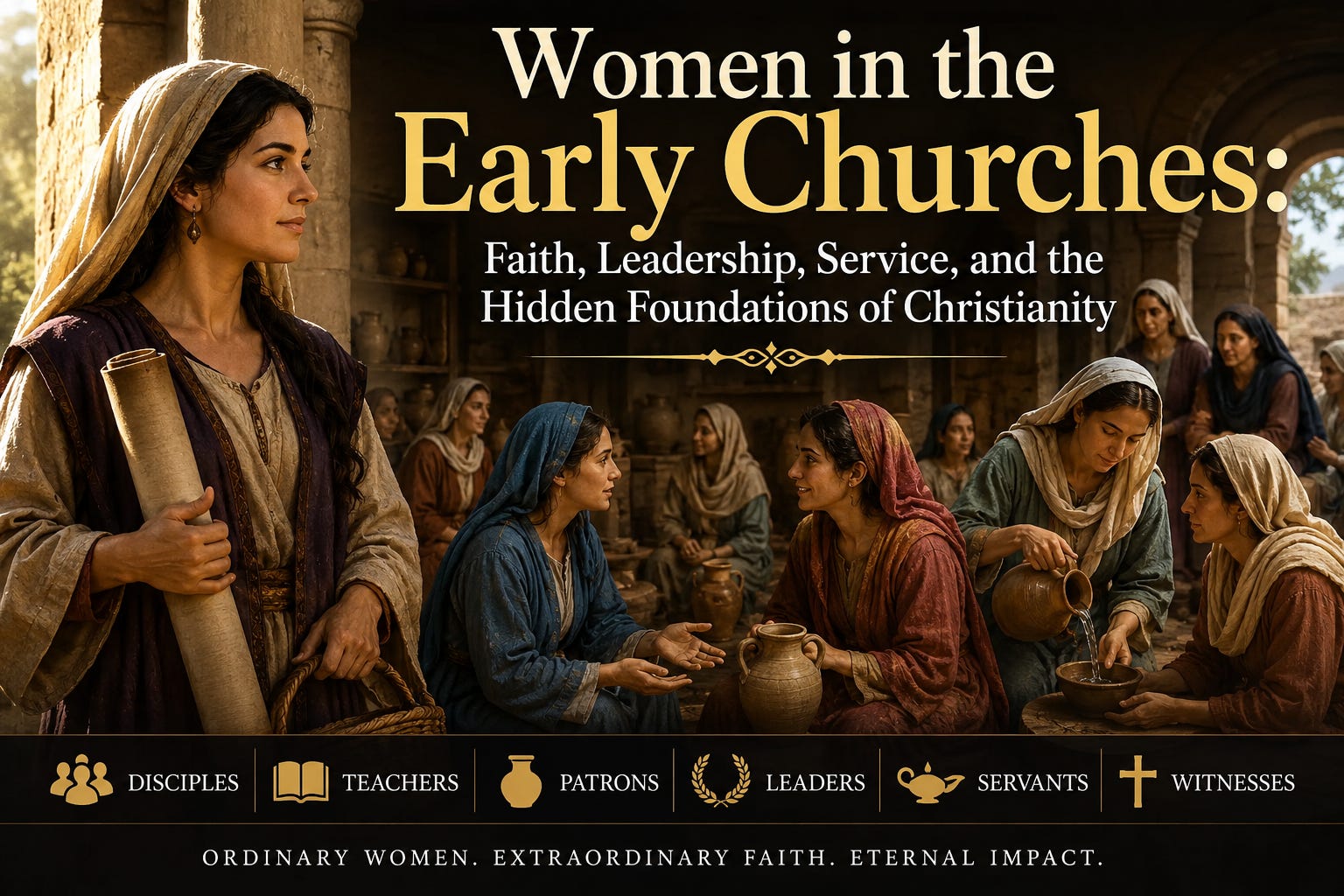
The role of women in early Christianity remains one of the most discussed subjects in contemporary theological and historical scholarship. Modern debates often project contemporary assumptions onto the ancient world, obscuring the remarkable contribution women made to the growth of the early church. While strong patriarchal norms structured first-century society, the New Testament presents a more complex picture than is often assumed. Women appear as disciples, patrons, teachers, evangelists, prophets, benefactors, and leaders within Christian communities. From the women who followed Jesus during His ministry to those who supported the apostles' missionary work, biblical evidence demonstrates that women played a vital role in the expansion of Christianity. This article explores the historical, social, and theological significance of women in the early churches and examines how their contributions helped shape the Christian movement during its formative years.
Introduction
Few topics generate more discussion in modern Christianity than the role of women in the church. Debates concerning leadership, ministry, authority, and service often focus on isolated passages while overlooking the broader narrative of the New Testament.
The earliest Christian communities emerged within a world dominated by Roman, Greek, and Jewish social structures. In many parts of the ancient world, women possessed limited legal rights and restricted opportunities for public influence. Yet Christianity entered this environment with a message that affirmed the spiritual value and dignity of every human being.
The result was not a social revolution in the modern sense but something equally significant: the creation of communities in which women became indispensable participants in worship, ministry, hospitality, charity, evangelism, and discipleship.
To understand the development of early Christianity, one must also understand the women whose faith, courage, and service helped sustain the church during its most vulnerable years.
Women in the Ministry of Jesus
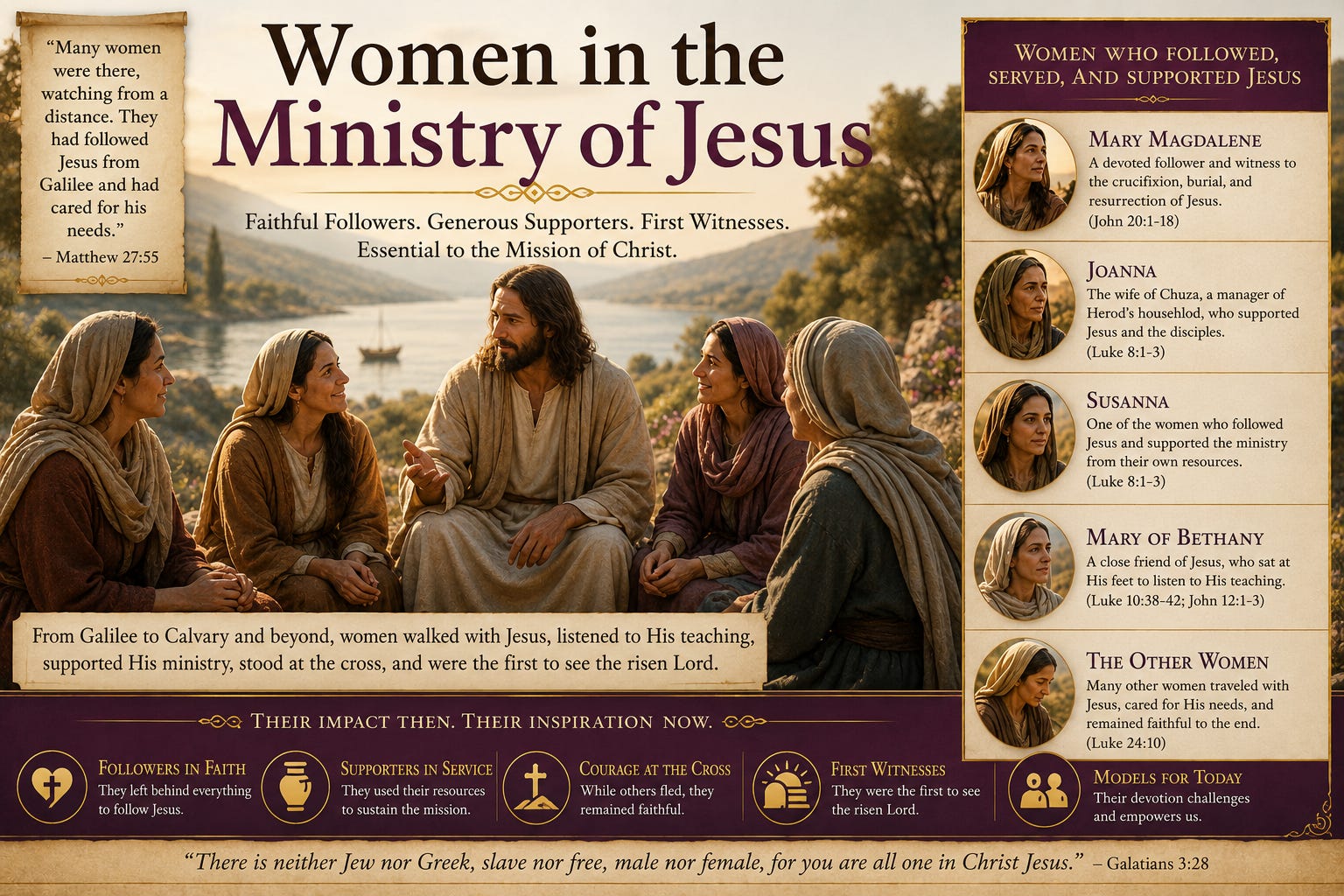
The story begins with Jesus Himself.
The Gospels consistently portray women as active participants in His ministry. Unlike many religious teachers of His time, Jesus regularly interacted with women, taught them publicly, healed them, and welcomed them as disciples.
Women such as Mary Magdalene, Joanna, Susanna, Martha, and Mary of Bethany appear throughout the Gospel narratives. Luke records that several women supported Jesus and the disciples financially from their own resources.
Remarkably, women remained present during the crucifixion when many male disciples fled in fear. They were also the first witnesses of the resurrection.
The fact that the resurrection accounts place women at the center of the discovery is historically significant. In a culture where female testimony often carried less legal weight, the Gospel writers nevertheless preserved this tradition because they believed it to be true.
The House Churches and Female Leadership
Early Christianity spread primarily through house churches rather than dedicated church buildings.
Many of these gatherings met in homes owned by wealthier believers. Several New Testament references suggest that women played important roles in hosting and supporting these communities.
Lydia of Philippi, a successful merchant, opened her home to the emerging Christian congregation after her conversion. Priscilla, together with her husband Aquila, hosted church gatherings and participated in teaching ministry.
The home was not merely a private space in the ancient world. It functioned as a center of business, social interaction, and community life. Those who controlled households often exercised considerable influence within local Christian communities.
Women who opened their homes to the church therefore contributed directly to the expansion of Christianity.
Priscilla and the Ministry of Teaching
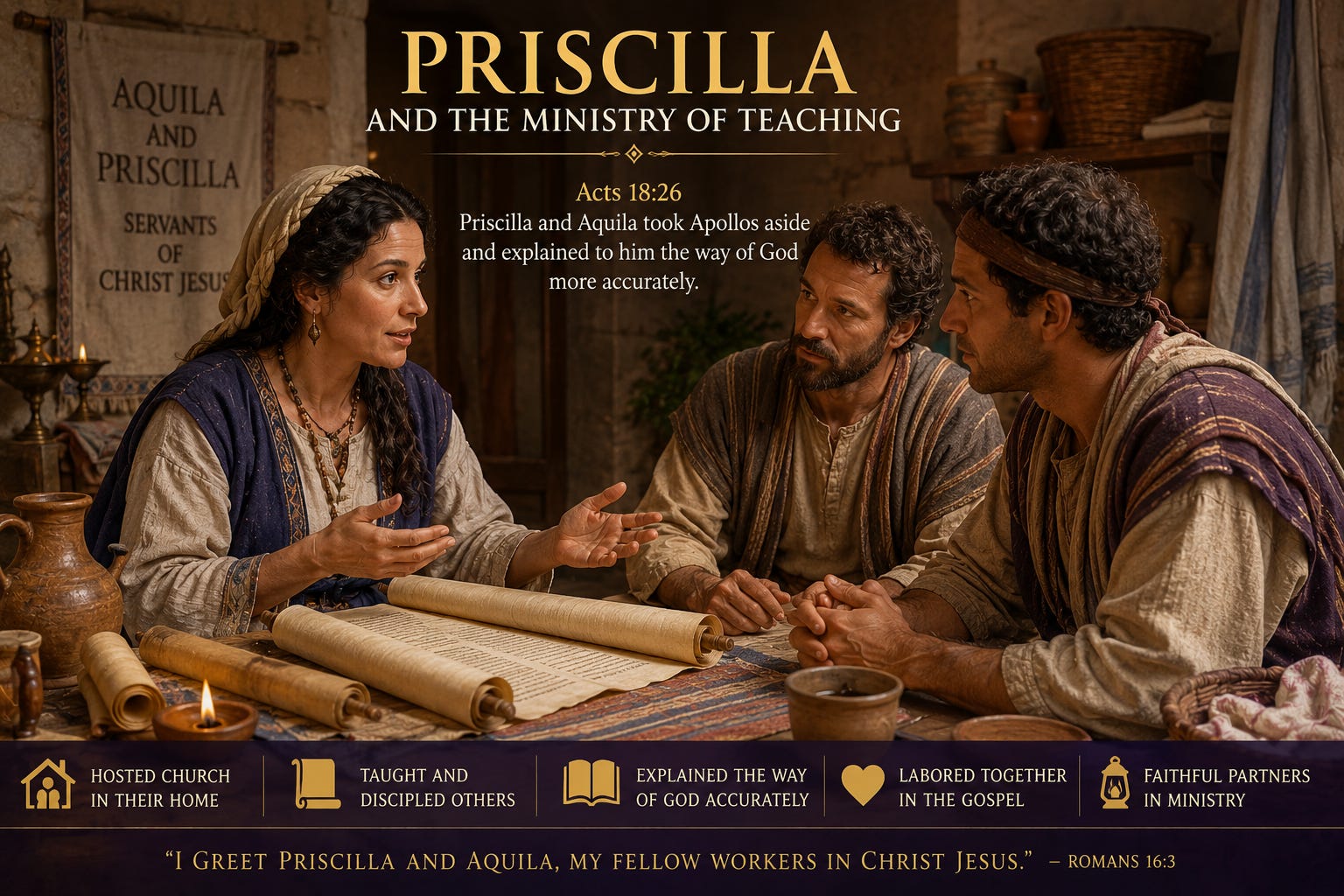
Among the most fascinating figures in the New Testament is Priscilla.
She appears repeatedly alongside her husband Aquila in the Book of Acts and Paul’s letters. Together they encountered Apollos, an eloquent preacher who possessed incomplete knowledge of Christian teaching.
Acts records that Priscilla and Aquila explained the way of God more accurately to him.
This episode demonstrates that women participated in theological instruction within the early church. While scholars continue to debate specific questions regarding church offices, the New Testament clearly presents Priscilla as an active participant in Christian teaching and discipleship.
Phoebe and the Ministry of Service
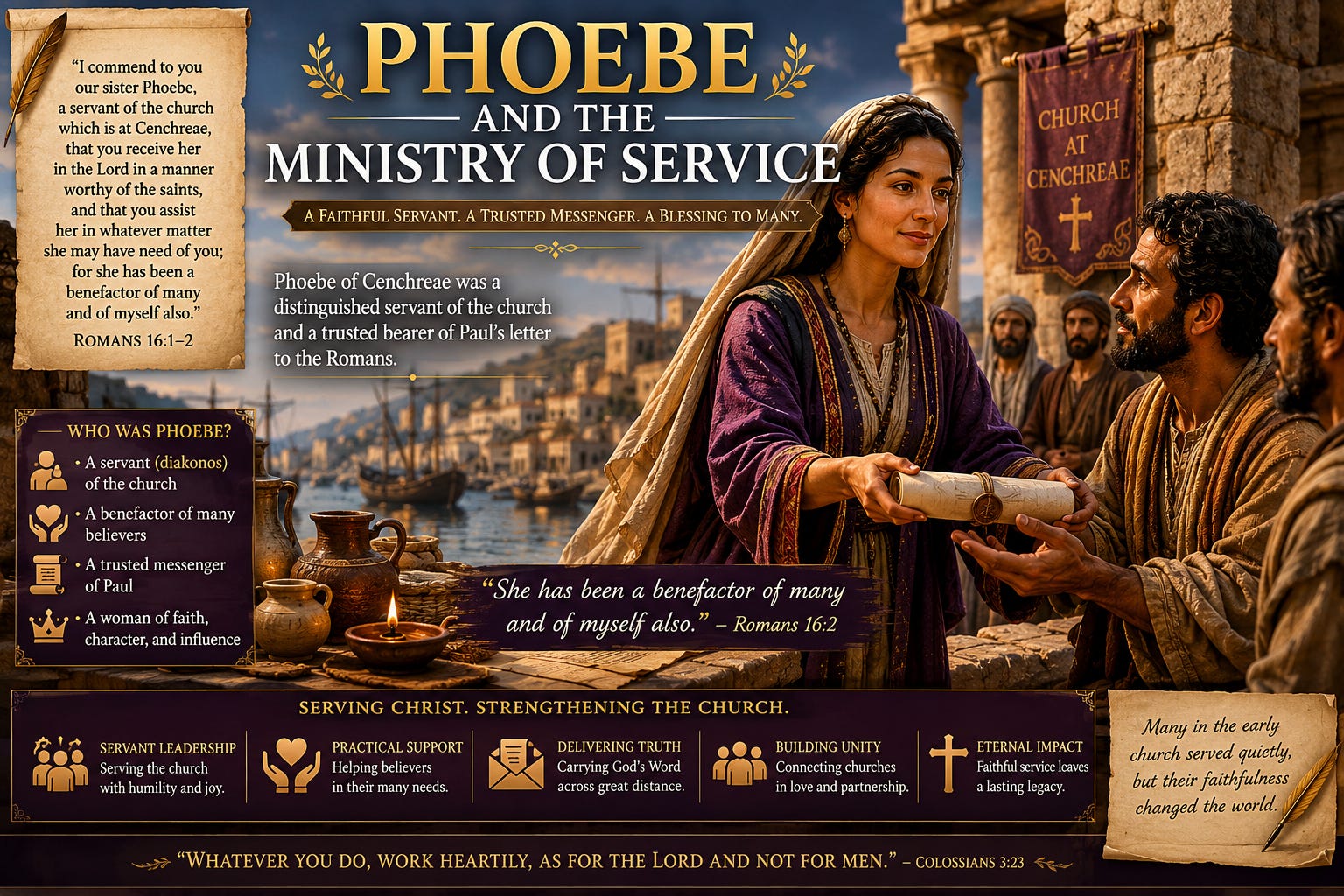
Romans 16 introduces Phoebe, whom Paul describes as a servant of the church at Cenchreae and a benefactor of many believers.
Many scholars believe Phoebe may have been entrusted with delivering Paul’s Letter to the Romans. If so, she carried one of the most important theological documents in Christian history.
Paul’s commendation suggests that she enjoyed considerable respect within the Christian community.
Her example highlights an important reality: much of the church’s growth depended upon individuals whose faithful service often remained outside the spotlight.
Women as Patrons and Benefactors
The spread of Christianity required resources.
Travel, hospitality, care for the poor, support for missionaries, and assistance to persecuted believers all demanded practical support.
Several women appear in the New Testament as benefactors who contributed financially to Christian ministry. Their generosity enabled churches to function and missionaries to continue their work.
In a world without institutional funding, such support was essential.
The history of Christianity cannot be understood solely through apostles, bishops, and theologians. It must also include the countless women whose resources sustained Christian communities.
Courage During Persecution
Women also played important roles during periods of persecution.
Early Christian sources preserve accounts of women who remained faithful despite imprisonment, social exclusion, and even death.
Their stories demonstrate that courage was not limited to church leaders or public preachers. Ordinary believers often displayed extraordinary faithfulness under difficult circumstances.
The willingness of Christian women to endure suffering contributed significantly to the credibility and growth of the Christian movement.
Theological Equality and Spiritual Dignity
One of Christianity’s most transformative teachings appears in Galatians 3:28:
“There is neither Jew nor Greek, slave nor free, male nor female, for you are all one in Christ Jesus.”
This statement did not erase social distinctions overnight. However, it established a profound theological principle: all believers share equal standing before God through Christ.
This spiritual equality became one of Christianity’s defining characteristics and contributed to its appeal across diverse social groups.
The early church remained a product of its historical environment, yet it introduced ideas concerning human dignity that would influence future generations.
Modern Lessons from the Early Church
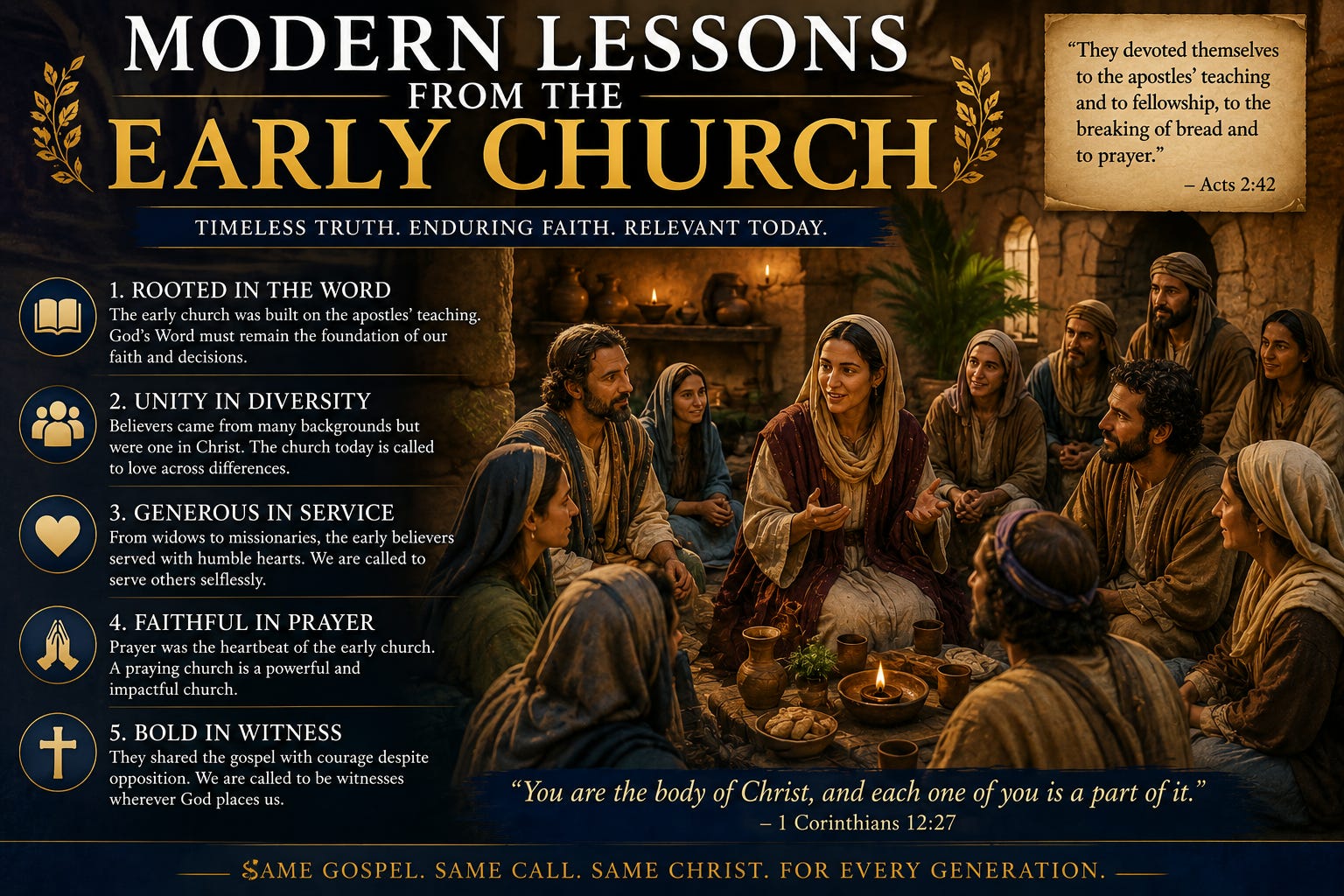
The example of women in the early churches offers important lessons for modern Christians.
First, the growth of Christianity was a collective effort involving both men and women.
Second, faithful service often occurs outside public recognition. Many of the individuals who sustained the early church are known only through brief biblical references.
Third, spiritual influence is not measured solely by formal titles or public visibility. Hospitality, generosity, discipleship, encouragement, and perseverance all contributed to the survival and expansion of Christianity.
Finally, the history of the church reminds believers that God frequently works through individuals whom society overlooks.
The story of women in the early churches is not a peripheral chapter in Christian history. It is part of the foundation upon which the church was built.
From the women who followed Jesus during His earthly ministry to those who hosted house churches, supported missionaries, instructed believers, and endured persecution, their contributions shaped the development of Christianity in profound ways.
The New Testament presents a picture of women actively engaged in the life of the church, serving Christ through faith, generosity, leadership, hospitality, and courage.
Their legacy continues to challenge modern believers to recognize the importance of every member of the Christian community and to remember that the growth of the church has always depended upon the faithful service of many, not merely the visibility of a few.
Dr. Daniel J. Grace
Research • Journalism • Theology
© 2026 Dr. Daniel J. Grace. All Rights Reserved.