
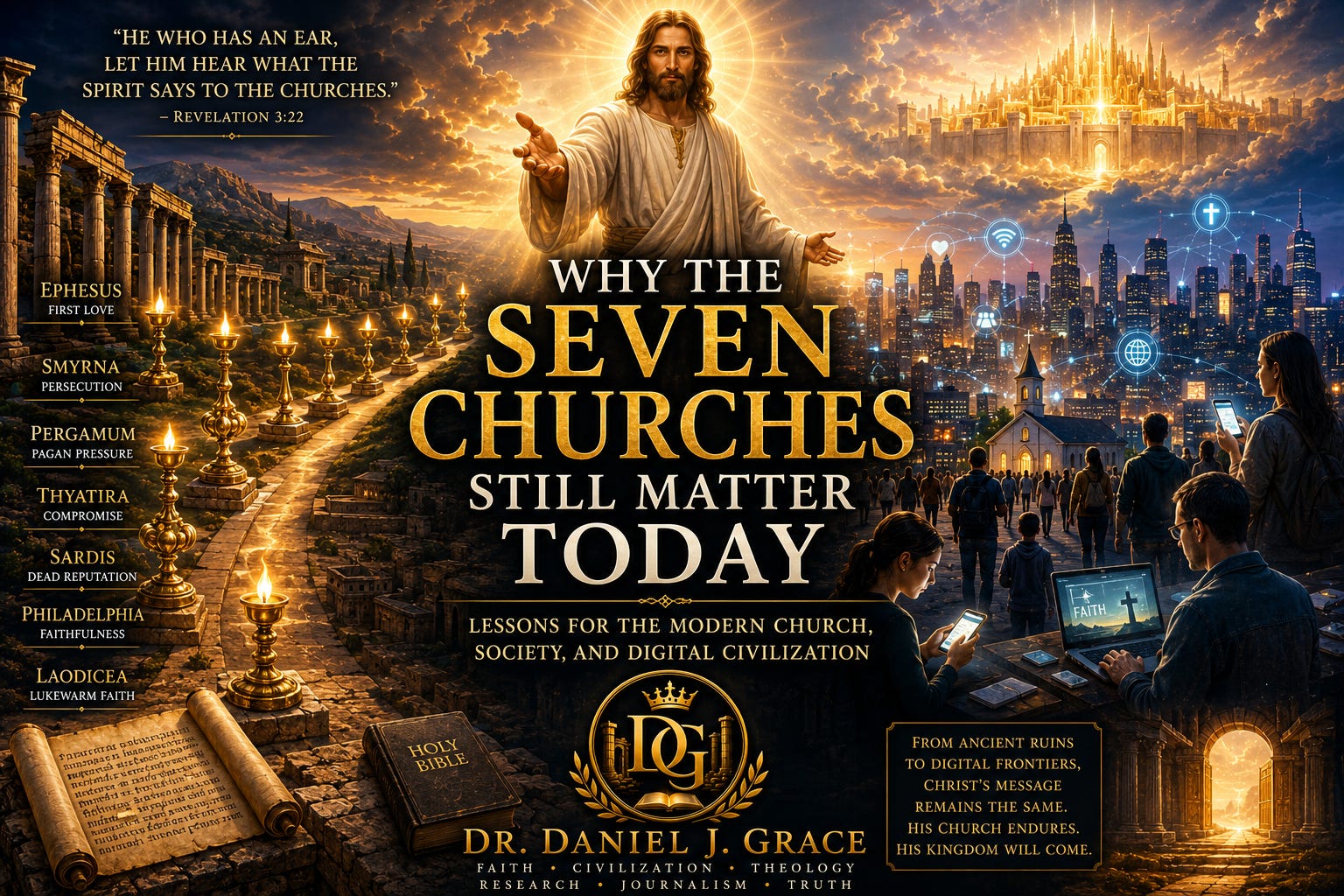
Why the Seven Churches Still Matter Today
Lessons for the Modern Church, Society, and Digital Civilization

Conclusion: The Enduring Voice of Revelation
Nearly two thousand years have passed since the Apostle John received his vision on the rocky island of Patmos.
Empires have risen and fallen.
Rome has disappeared.
The temples of Artemis, Zeus, and the Caesars lie in ruins.
The marketplaces that once bustled with merchants stand silent.
The seven cities of Asia Minor have faded into history.
Yet the voices of the seven churches continue to speak.
That alone should make us pause.
Why do these ancient congregations still matter?
Why does Jesus’ message to a handful of first-century believers continue to challenge churches, nations, and individuals across the world?
The answer is simple.
Human nature has not changed.
Technology changes.
Politics changes.
Economies change.
Civilizations rise and fall.
But the human heart remains remarkably the same.
The churches of Ephesus, Smyrna, Pergamum, Thyatira, Sardis, Philadelphia, and Laodicea faced the very struggles that confront humanity today.
Different tools.
Different cultures.
Different technologies.
The same spiritual battle.
This is why Revelation remains one of the most relevant books ever written.
The seven churches are not merely historical congregations.
They are mirrors.
When we read their stories, we see ourselves.
Ephesus and the Crisis of Losing Our First Love
Modern society possesses more information than any civilization in human history.
We can access libraries, universities, research databases, and theological resources instantly through a smartphone.
Knowledge has multiplied.
Yet love has not always increased alongside it.
The church in Ephesus was doctrinally sound.
It rejected false teachers.
It defended truth.
It worked tirelessly.
Yet Christ confronted them with a devastating diagnosis:
“You have forsaken the love you had at first.”
The modern church faces the same danger.
We can know theology without knowing Christ.
We can defend doctrine while neglecting compassion.
We can win arguments and lose our hearts.
The lesson of Ephesus is timeless:
Truth without love eventually becomes cold religion.
Smyrna and the Reality of Suffering
Many Christians in the Western world have never experienced serious persecution.
Millions of believers elsewhere have.
Across parts of Africa, the Middle East, Asia, and beyond, Christians continue to face imprisonment, discrimination, violence, and death.
The church of Smyrna reminds us that suffering does not mean abandonment.
Jesus never promised comfort.
He promised His presence.
The Christians of Smyrna discovered that faith often grows strongest when everything else is stripped away.
Their message remains essential in an age obsessed with comfort and convenience.
Pergamum and the Pressure to Conform
The Roman Empire demanded conformity.
Modern culture often does the same.
The pressures may be different, but the challenge remains remarkably familiar.
Pergamum stood where “Satan’s throne” was located.
Believers faced enormous pressure to compromise in order to fit into society.
The same temptation exists today.
Every generation must decide whether it will conform to the spirit of the age or remain faithful to eternal truth.
Pergamum teaches that compromise rarely begins with major decisions.
It usually begins with small concessions.
History repeatedly proves that what starts as accommodation often ends in surrender.
Thyatira and the Seduction of Acceptance
The church of Thyatira struggled with the desire to fit in.
Economic opportunity, social acceptance, and cultural participation all encouraged compromise.
Twenty-first century believers face similar pressures.
The temptation is not usually persecution.
The temptation is acceptance.
To be liked.
To be approved.
To avoid criticism.
To reshape faith until it no longer challenges anyone.
Yet Christianity was never designed to reflect culture.
It was designed to transform it.
Thyatira reminds us that faithfulness often requires courage.
Sardis and the Illusion of Success
Never has there been a time when appearances mattered more.
Social media allows individuals, churches, businesses, and governments to project carefully crafted images.
We can appear successful while hiding profound weakness.
We can appear connected while living in isolation.
We can appear alive while being spiritually exhausted.
Sardis had a reputation for being alive.
Christ saw something very different.
The lesson is deeply relevant in the digital age.
Image is not reality.
Reputation is not character.
Visibility is not vitality.
God sees beyond the appearance.
He sees the heart.
Philadelphia and the Power of Faithfulness
Modern culture celebrates influence, popularity, wealth, and size.
Jesus celebrated something different.
Philadelphia had little strength.
No great resources.
No impressive reputation.
No political power.
Yet Christ commended them.
Why?
Because they remained faithful.
The lesson is liberating.
God does not require greatness.
He requires faithfulness.
Throughout history, some of the most significant movements began with small groups of ordinary people who simply refused to quit.
Philadelphia reminds us that faithfulness is often more important than success.
Laodicea and the Age of Digital Comfort
Perhaps no church speaks more directly to modern civilization than Laodicea.
Never before have so many people enjoyed such unprecedented levels of comfort, convenience, entertainment, and material abundance.
We carry powerful computers in our pockets.
We have access to endless information.
Food, entertainment, communication, and distraction are available twenty-four hours a day.
Yet many people remain spiritually empty.
Laodicea possessed wealth but lacked passion.
Comfort but not conviction.
Prosperity but not spiritual vitality.
The danger facing modern civilization is not merely immorality.
It is indifference.
Apathy.
Distraction.
Spiritual numbness.
The church of Laodicea warns that comfort can be just as dangerous as persecution.
The Seven Churches and Digital Civilization
The world John knew was connected by Roman roads.
The world we inhabit is connected by digital networks.
Information now travels globally in seconds.
Artificial intelligence, social media, virtual communities, and emerging technologies are reshaping human experience at an unprecedented pace.
Yet the central questions remain unchanged.
Who will we worship?
What will shape our identity?
Where will we find truth?
What kind of people will we become?
Technology can amplify human potential.
It can also amplify human weakness.
The seven churches remind us that every civilization eventually faces a spiritual test.
The challenge is not merely technological.
It is moral.
It is spiritual.
It is eternal.
The Final Message of the Seven Churches
The greatest lesson of the seven churches is not their failures.
It is Christ Himself.
In every letter, Jesus walks among the lampstands.
He sees.
He knows.
He corrects.
He encourages.
He warns.
He promises.
The churches were imperfect.
Some compromised.
Some suffered.
Some became complacent.
Yet Christ never abandoned them.
The same remains true today.
The Church is still imperfect.
Individuals are still imperfect.
Nations are still imperfect.
Yet the risen Christ continues to call people to repentance, faithfulness, endurance, and hope.
That is why the seven churches still matter.
Their story is our story.
Their struggles are our struggles.
Their warnings are our warnings.
Their promises are our promises.
And their future points toward our future.
The New Jerusalem and the Final Hope
The story of the seven churches does not end in Ephesus, Smyrna, Pergamum, Thyatira, Sardis, Philadelphia, or Laodicea.
It ends in the New Jerusalem.
The final vision of Revelation is not one of destruction but restoration.
Not fear but hope.
Not defeat but victory.
The churches of Revelation remind us that history is moving toward a destination.
The kingdoms of this world are temporary.
The Kingdom of God is eternal.
One day the lampstands will give way to the light of God’s presence.
Faith will become sight.
Hope will become reality.
The Church’s long journey will be complete.
Until then, the words of Christ continue to echo across the centuries:
“He who has an ear, let him hear what the Spirit says to the churches.”
May we hear.
May we overcome.
And may we remain faithful until He comes.
Come, Lord Jesus.
Dr. Daniel J. Grace
Faith • Civilization • Theology
Research • Journalism • Truth
🌐 danieljamesgrace.com
© 2026 Dr. Daniel J. Grace. All Rights Reserved.
No part of this article may be reproduced, distributed, transmitted, or published in any form or by any means without prior written permission from the author, except for brief quotations used in academic citation, review, or research purposes.