
Why the Seven Churches Still Matter in the Digital Age
Technology, Influence, Distraction, and Faith in the Twenty-First Century

Ancient Messages for a Connected World
The world of the Seven Churches seems far removed from modern life.
The believers of Ephesus, Smyrna, Pergamum, Thyatira, Sardis, Philadelphia, and Laodicea lived in an age without electricity, computers, smartphones, social media, or artificial intelligence. Their world moved at the speed of foot travel and handwritten letters.
Our world moves at the speed of light.
Yet despite these enormous technological differences, the messages of Revelation remain surprisingly relevant.
The reason is simple.
Technology changes.
Human nature does not.
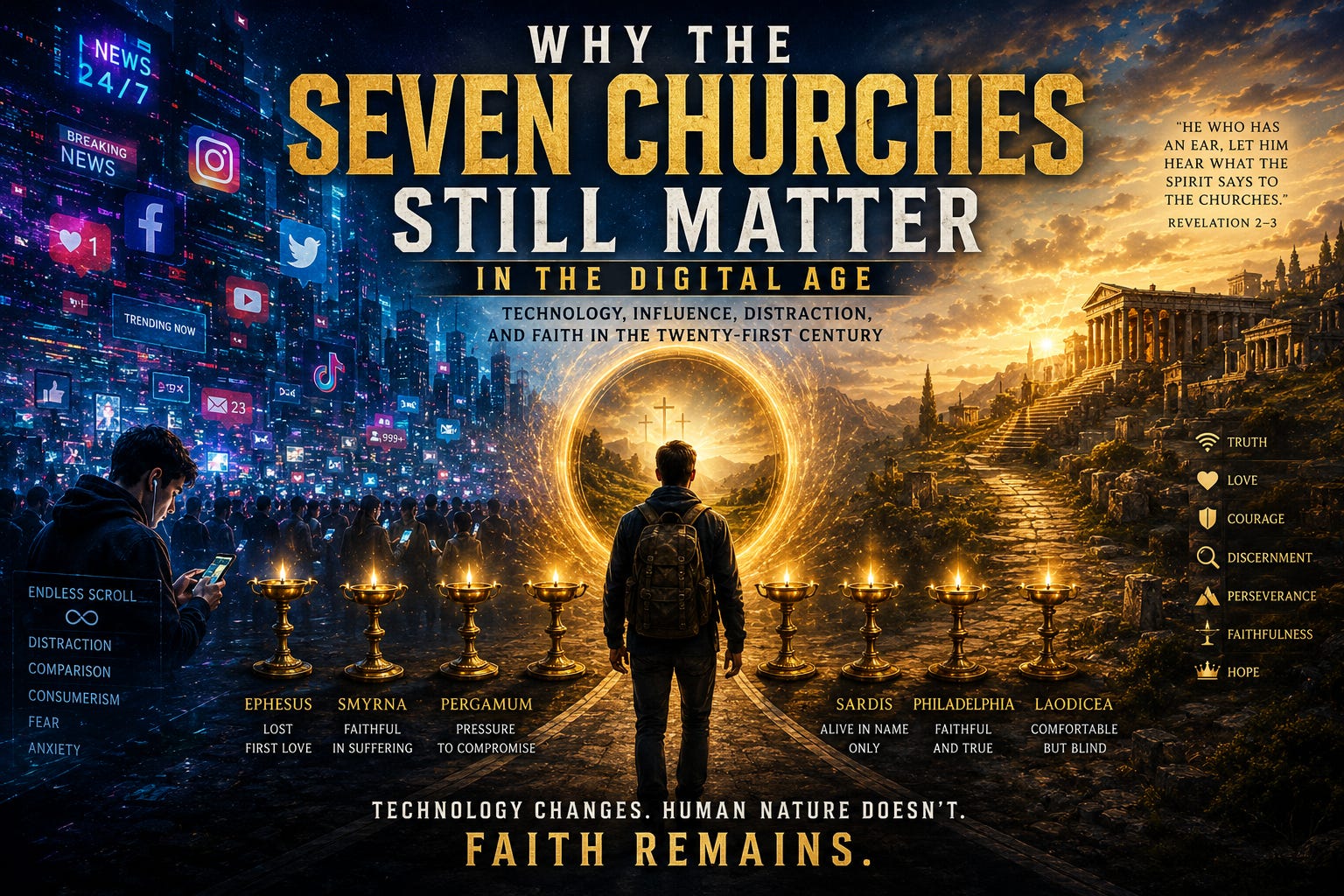
The challenges facing the Seven Churches—distraction, compromise, pride, fear, complacency, faithfulness, and perseverance—continue to shape human behaviour in the digital age.
The forms have changed.
The struggles remain remarkably familiar.
Ephesus and the Danger of Digital Busyness
The church at Ephesus was praised for hard work, perseverance, and doctrinal discernment.
Yet Christ declared:
“You have left your first love.”
This warning may be more relevant today than ever.
Modern technology has made it possible to remain constantly active.
Emails arrive every minute.
Social media never sleeps.
News updates are continuous.
Notifications demand attention.
People are often busy without being focused.
The danger is not merely physical exhaustion.
It is spiritual distraction.
Many believers remain active in ministry, church life, online discussions, and religious content while slowly drifting from the intimacy of their relationship with Christ.
The message to Ephesus reminds us that activity is not the same as devotion.
A person can be connected to everything and disconnected from what matters most.
Smyrna and Fear in the Age of Anxiety
Smyrna faced persecution and uncertainty.
Christ encouraged them:
“Do not fear.”
Fear remains one of humanity’s most powerful emotions.
Technology has not eliminated fear.
In some ways, it has amplified it.
Every day people encounter:
Breaking news
Economic concerns
Global conflicts
Social pressure
Online criticism
Digital outrage
The result is often anxiety and emotional exhaustion.
The believers of Smyrna remind us that courage is not the absence of fear.
It is faithfulness despite fear.
In an age of constant information, Christians must learn once again to place trust above anxiety.
Pergamum and Cultural Pressure Online
Pergamum lived in a culture dominated by emperor worship and political conformity.
Believers faced pressure to compromise.
The digital world creates similar challenges.
Social media platforms often reward conformity.
Public opinion can exert tremendous influence.
Many individuals fear exclusion, criticism, or cancellation.
As a result, there is often pressure to adjust beliefs to align with popular trends.
The church at Pergamum reminds believers that truth cannot be determined by popularity.
Faithfulness sometimes requires standing apart from the crowd.
The challenge facing Pergamum continues in digital form.
The pressure to belong remains powerful.
Thyatira and the Problem of Digital Influence
Thyatira tolerated teachings that led believers away from spiritual faithfulness.
The modern world is saturated with influence.
Every day people consume:
Videos
Podcasts
Articles
Social media posts
Online personalities
Artificial intelligence content
Not all influence is harmful.
Much of it can be beneficial.
Yet the sheer volume of information creates new challenges.
Discernment has become increasingly important.
The question is no longer whether people are being influenced.
The question is who is influencing them.
The warning to Thyatira remains relevant because ideas shape behaviour.
Digital influence can strengthen faith or weaken it.
Wisdom requires learning to distinguish between the two.
Sardis and the Illusion of Appearance
Christ told Sardis:
“You have a reputation of being alive, but you are dead.”
Few messages describe social media culture more accurately.
Digital platforms often encourage image management.
People carefully curate photographs, achievements, opinions, and experiences.
Online identity can become more important than reality.
The result is a dangerous illusion.
A person may appear successful while struggling internally.
A church may appear vibrant while experiencing spiritual decline.
A ministry may appear influential while lacking genuine depth.
The message to Sardis reminds us that appearances can deceive.
Christ sees beyond reputation.
He sees reality.
In the digital age, authenticity has become increasingly valuable.
Philadelphia and Faithfulness in Small Things
Philadelphia possessed limited strength.
Yet Christ praised its faithfulness.
The modern world often celebrates visibility.
Success is measured through:
Followers
Views
Likes
Subscribers
Influence
The church at Philadelphia challenges these assumptions.
God’s evaluation differs from society’s evaluation.
Faithfulness matters more than popularity.
Character matters more than visibility.
Obedience matters more than influence.
The lesson is particularly important in the age of social media.
Many believers may never achieve large audiences.
Yet faithful service remains significant.
Philadelphia reminds us that God values faithfulness even when the world does not notice.
Laodicea and Digital Consumerism
Laodicea was wealthy, comfortable, and self-sufficient.
Its prosperity became a spiritual danger.
The modern world has elevated comfort to an unprecedented level.
Technology offers:
Instant entertainment
Instant shopping
Instant communication
Instant gratification
Convenience has become one of the defining characteristics of modern life.
While convenience itself is not evil, it can create a culture of spiritual passivity.
The church at Laodicea believed it needed nothing.
Many modern societies share a similar confidence.
Material abundance can create the illusion of self-sufficiency.
The warning to Laodicea remains deeply relevant.
Comfort is a poor substitute for spiritual vitality.
Artificial Intelligence and Human Wisdom
Artificial intelligence represents one of the most significant technological developments of the modern era.
AI can generate text, analyse information, create images, and assist with countless tasks.
Yet Revelation reminds us that knowledge alone is insufficient.
Human beings have always possessed the ability to accumulate information.
The challenge has never been information.
The challenge has been wisdom.
The Seven Churches reveal that spiritual maturity depends upon character, discernment, humility, faithfulness, and love.
These qualities cannot be automated.
Technology can assist human beings.
It cannot replace the transformation of the human heart.
The Digital Battle for Attention
Perhaps the greatest challenge of the digital age is attention.
Modern technology competes relentlessly for human focus.
Every platform seeks engagement.
Every application seeks time.
Every notification seeks attention.
The result is fragmentation.
People often struggle to remain present, reflective, and attentive.
Yet throughout Scripture, spiritual growth requires attentiveness.
Prayer requires attention.
Worship requires attention.
Reflection requires attention.
Relationships require attention.
The battle for attention has become one of the defining spiritual struggles of the twenty-first century.
In this sense, the messages of Revelation remain profoundly relevant.
Ancient Wisdom for Modern Challenges
The Seven Churches continue to matter because they address enduring aspects of human nature.
Technology has transformed communication.
It has transformed commerce.
It has transformed culture.
Yet it has not transformed the human heart.
People still wrestle with:
Fear
Pride
Distraction
Compromise
Comfort
Perseverance
Hope
The churches of Revelation speak directly to these realities.
Their lessons transcend historical periods because they address universal human experiences.
Conclusion
The Seven Churches belonged to the first century, but their message belongs to every century.
The digital age presents new technologies, new opportunities, and new challenges.
Yet beneath the surface, many of the same spiritual struggles remain.
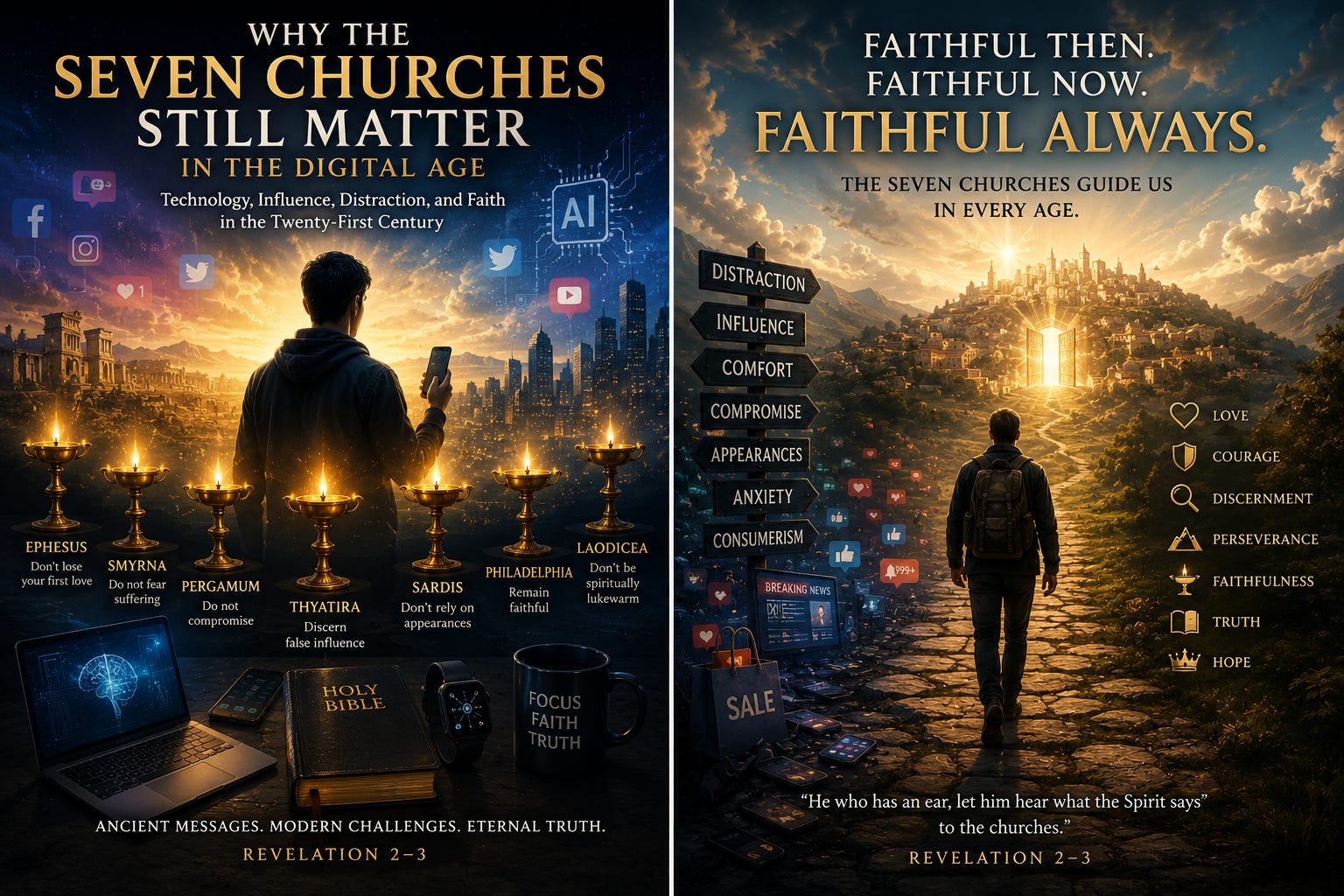
Ephesus warns against losing devotion amid activity.
Smyrna teaches courage in times of fear.
Pergamum confronts cultural compromise.
Thyatira challenges unhealthy influence.
Sardis exposes superficial appearances.
Philadelphia celebrates faithfulness.
Laodicea warns against the dangers of comfort.
These messages remain relevant because they address the realities of the human heart.
The tools may have changed.
The technologies may have evolved.
But the call of Revelation remains the same:
To remain faithful to Christ in every age.
Including our own.
Dr. Daniel J. Grace
Faith • Civilization • Theology
Research • Journalism • Truth
© 2026 Dr. Daniel J. Grace. All Rights Reserved. First published via Zenodo Digital Repository, 2026.