


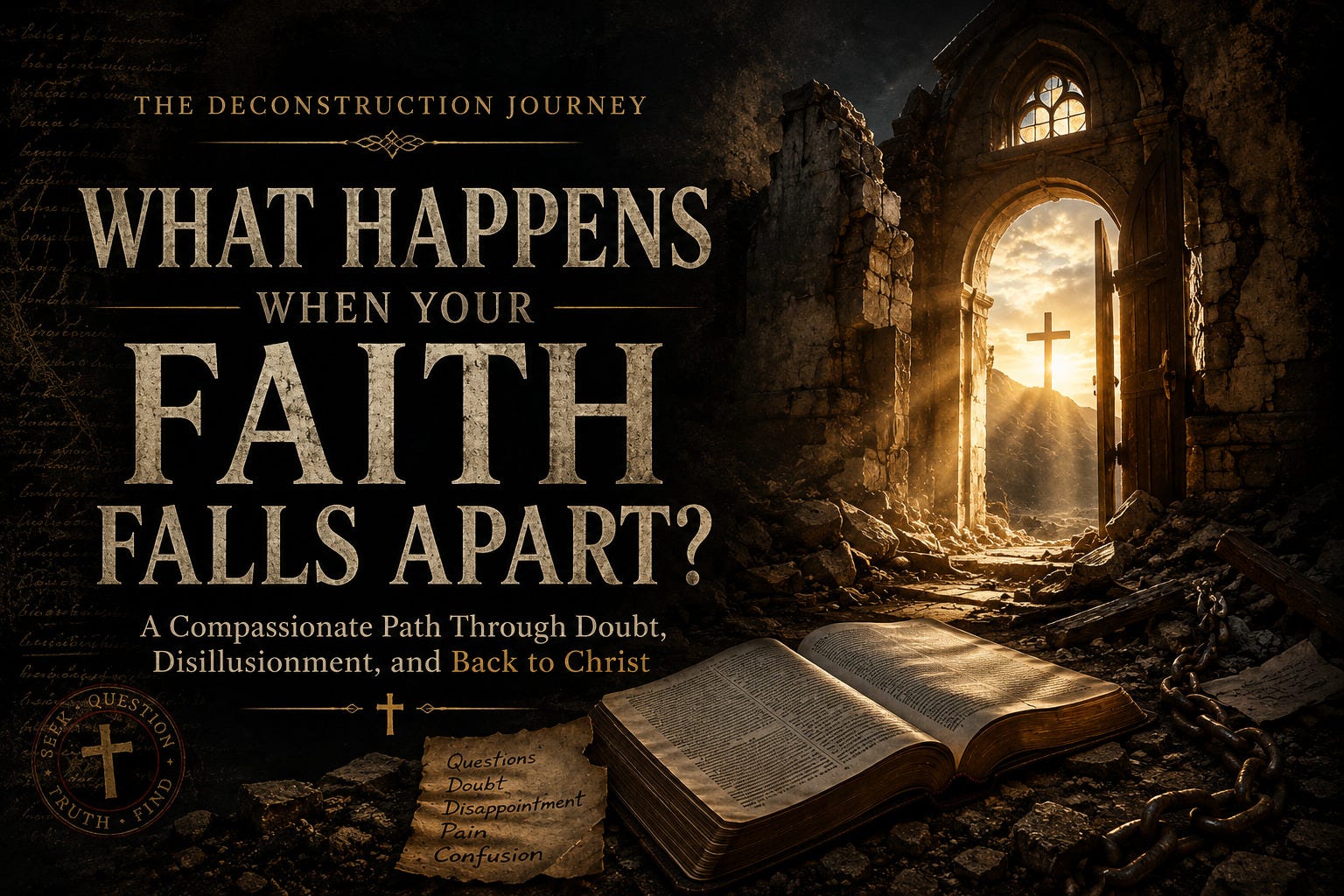
There is a moment in some Christians’ lives when the faith that once felt solid begins to shake.
Sometimes it starts with a question.
Sometimes with disappointment.
Sometimes with a church.
Sometimes with a pastor you trusted.
Sometimes with suffering that refuses to fit inside the answers you were given.
And sometimes you simply wake up one morning and realise that you no longer know whether you believe everything you once said you believed.
We have given this experience a modern name:
Deconstruction.
For some Christians, that word sounds dangerous.
For others, it sounds like freedom.
I think we need to be more careful with both reactions.
Because questioning what you were taught is not necessarily the same thing as rejecting Jesus.
Sometimes the thing falling apart isn’t Christ.
Sometimes it’s everything we built around Him.
When the House Begins to Crack
Imagine discovering cracks in the walls of a house you’ve lived in your entire life.
At first, you ignore them.
Someone tells you not to worry.
Another person tells you that good Christians don’t ask questions about cracks.
So you paint over them.
But they return.
Eventually you begin pulling things apart because you need to know whether the foundation underneath you is actually strong.
That is what deconstruction can feel like.
You begin asking questions you once thought you weren’t allowed to ask.
Why do I believe this?
Is this actually in Scripture?
Did Jesus teach this—or did my denomination teach it?
Is this Christianity, or is it culture wearing Christian clothing?
Why did people who preached grace treat me without grace?
Why did the church tell me to trust leaders who hurt people?
Why didn’t God answer my prayer?
And perhaps the most frightening question:
What if I have been wrong?
Those questions don’t necessarily make you faithless.
They make you human.
The Bible is filled with people who asked difficult questions.
David asked God why He seemed distant.
Job demanded answers in the middle of unbearable suffering.
Jeremiah questioned why the wicked prospered.
Thomas wanted evidence before he could believe that Jesus had risen.
Even from the cross, Jesus cried:
“My God, my God, why hast thou forsaken me?”
— Matthew 27:46, KJV
Christianity has never been a story populated exclusively by people who never doubted.
Sometimes Christians Are Deconstructing the Wrong Jesus
This is where I think churches need humility.
When someone says, “I’m deconstructing my Christianity,” our first reaction shouldn’t always be:
How do we stop them?
Perhaps we should first ask:
What exactly are they deconstructing?
Because someone may not be rejecting Jesus at all.
They may be rejecting manipulation.
They may be rejecting hypocrisy.
They may be rejecting a church culture where questions were treated like rebellion.
They may be rejecting politics that were presented to them as though they were part of the gospel.
They may be rejecting fear.
They may be rejecting teachings about God that never really resembled Jesus.
And if that’s what is happening, Christians shouldn’t immediately panic.
We should listen.
There is a difference between dismantling Christianity and removing things that never belonged to Christ in the first place.
But Deconstruction Cannot Be the Destination
There is another side to this conversation.
Taking something apart is relatively easy.
Living permanently among the pieces is much harder.
Eventually, the question becomes:
What will I build now?
If you discovered that Christians disappointed you, does that mean Christ is false?
If a pastor failed morally, does that mean Jesus failed?
If a denomination became unhealthy, does that invalidate the resurrection?
If someone used Scripture to control you, does that mean Scripture itself was responsible for the abuse?
These are different questions.
And separating them matters.
Human beings can corrupt beautiful things.
Religion can become institutional power.
Leadership can become control.
Tradition can become legalism.
But none of those things automatically answer the central Christian question:
Who is Jesus Christ?
Eventually every Christian going through deconstruction has to come back to Him.
Not your pastor.
Not your denomination.
Not Christian celebrities.
Not social media.
Not me.
Jesus.
Go Back to the Man from Galilee
If your Christianity has fallen apart, perhaps don’t begin by trying to reconstruct the entire theological building.
Start smaller.
Open one of the Gospels.
Read Matthew.
Read Mark.
Read Luke.
Read John.
And meet Jesus again.
Watch Him touch the leper everyone else avoided.
Watch Him sit beside people religious society despised.
Watch Him confront religious hypocrisy.
Watch Him forgive sinners.
Watch Him weep beside a grave.
Watch Him wash His disciples’ feet.
Watch Him welcome Thomas’s questions.
Watch Him carry a cross.
And then ask yourself:
Is this the Jesus I rejected?
Or did I reject something people built around Him?
That distinction can change everything.
Faith After Deconstruction May Look Different
Reconstructed faith doesn’t necessarily look exactly like the faith you had before.
Perhaps it shouldn’t.
A child’s faith and an adult’s faith are not identical.
There are things I believed when I was younger that I understand differently today.
There are questions that no longer frighten me.
There are also mysteries I have become more comfortable admitting I cannot solve.
Mature faith doesn’t require pretending that every difficult question has a simple answer.
Sometimes mature faith says:
I don’t know.
And then adds:
But I still trust Christ.
There is strength in that.
Faith doesn’t have to be certainty about everything.
Christian faith ultimately rests in Someone.
Jesus Is Not Afraid of Your Questions
This is what I wish more struggling Christians heard from churches:
You can ask.
You can wrestle.
You can investigate.
You can admit that something doesn’t make sense.
You can say that something a Christian leader did wounded you.
You can reconsider traditions.
You can study Scripture again.
You can sit silently before God when you don’t know what to pray.
Jesus doesn’t become smaller because you asked a difficult question.
Truth doesn’t need to be protected from honest investigation.
And Christians should never be frightened of someone’s sincere search for truth.
We should be frightened when people feel they must lie about their questions in order to remain welcome among us.
Don’t Confuse Jesus with the People Who Hurt You
Perhaps this is the hardest part.
Someone reading this may have been deeply wounded by Christians.
I’m not going to tell you that the wound wasn’t serious.
I’m not going to tell you simply to “get over it.”
And I’m certainly not going to pretend Christians cannot behave terribly.
They can.
But I would ask you for one thing:
Don’t make Jesus answer for every Christian who failed to resemble Him.
Judge Jesus by Jesus.
Read His words.
Look at His life.
Look at His cross.
Look at His resurrection.
Then decide what you believe about Him.
Because Christianity ultimately stands or falls there.
Maybe the Ruins Aren’t the End
If your old faith is lying around you in pieces, perhaps you don’t need to be frightened.
Maybe some things needed to fall.
Maybe some assumptions needed questioning.
Maybe some traditions needed examining.
Maybe some wounds needed to be acknowledged instead of buried beneath religious language.
But don’t stop among the ruins.
Keep walking.
Keep asking.
Keep reading.
Keep searching.
And above all, keep looking toward Christ.
Because deconstruction doesn’t have to end with walking away from Jesus.
Sometimes it can become the painful journey through which you finally discover the difference between the Jesus you inherited and the Jesus you actually know.
And perhaps what rises afterward will not be the fragile faith you once had.
Perhaps it will be quieter.
Humbler.
Less interested in pretending.
More comfortable with mystery.
More compassionate toward doubters.
More resistant to manipulation.
And more deeply rooted in Christ.
Sometimes faith has to survive the questions before it truly becomes our own.
And sometimes, after everything else has fallen away, we discover that Jesus is still standing.
© 2026 Daniel J. Grace. All rights reserved.
Daniel J. Grace is an Australian Christian writer, journalist, and independent researcher whose work explores biblical theology, church history, global Christianity, religious freedom, and the contemporary life of the Church.