
Why Christianity Is Not a Western Religion
Recovering the Eastern, Jewish, African, and Global Roots of the Christian Faith

One of the most common misunderstandings in the modern world is the idea that Christianity is mainly a Western religion. Many people speak as if Christianity belongs naturally to Europe, America, or Western civilisation, while other cultures received it only through colonialism, empire, or foreign missions. This idea has become so common that many people repeat it without examining history carefully.
Yet the truth is deeper, older, and far more beautiful.
Christianity was not born in London, Rome, Paris, Berlin, Geneva, or New York. Christianity was born in the ancient Near East, in the land of Israel, among the Jewish people, under Roman rule, in a world shaped by Hebrew Scripture, Second Temple Judaism, Greek language, Roman power, Eastern trade routes, and the spiritual hopes of a people waiting for redemption.
Jesus Christ was not a Western philosopher. He was a Jewish Messiah. He lived in Galilee and Judea. He walked the roads of Nazareth, Capernaum, Samaria, Jericho, Bethany, and Jerusalem. He prayed in synagogues, taught from the Scriptures of Israel, celebrated Jewish festivals, and proclaimed the kingdom of God in a world very different from modern Western imagination.
The first Christians were not Europeans in the modern sense. They were Jewish men and women who believed that Jesus of Nazareth was the crucified and risen Lord. The first church was not established in a European capital. It was born in Jerusalem. The first Christian sermon after Pentecost was preached in the Jewish world. The first Christian debates concerned the Law, the Temple, circumcision, Gentile inclusion, and the fulfilment of Israel’s promises.
This means that Christianity is not a Western invention. It is a faith rooted in the story of Israel and opened by Christ to all nations.
“Go therefore and make disciples of all the nations.”
— Matthew 28:19
From the beginning, the Christian faith was both particular and universal. It began in a real place, among a real people, in real history. But it was never meant to remain trapped within one ethnicity, one language, one empire, or one civilisation. The gospel moved outward because Jesus Christ is Lord not only of one nation, but of all creation.
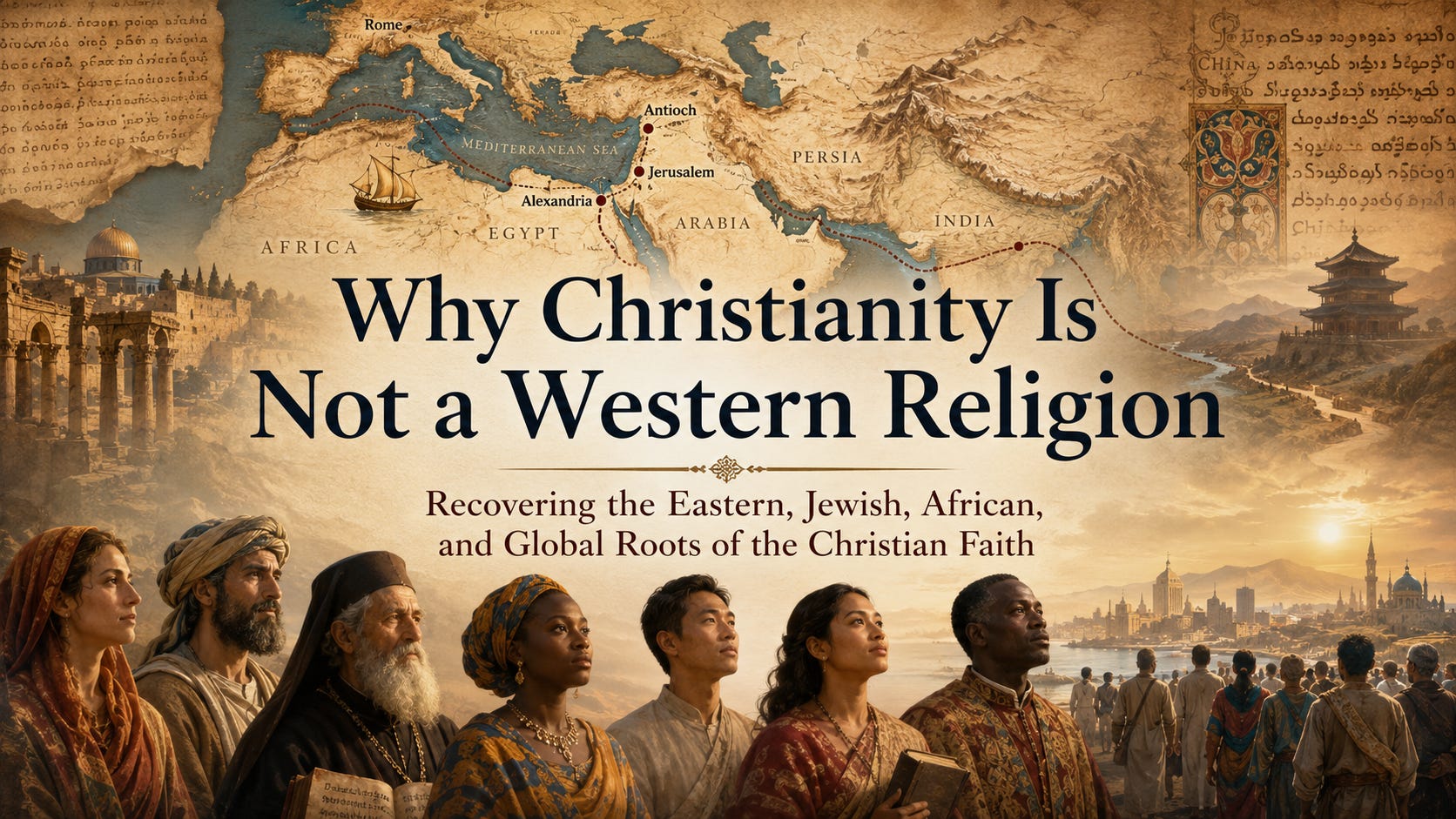
This is why the story of Christianity cannot be told honestly if we begin only with medieval Europe, the Reformation, modern America, or Western missions. Those chapters matter, but they are not the whole story. Before Christianity became powerful in Europe, it had already spread across the eastern Mediterranean, North Africa, Syria, Mesopotamia, Persia, Armenia, Georgia, India, and beyond.
The early Christian world was far more eastern, African, and multicultural than many people realise.
Antioch, one of the earliest great centres of Christianity, was located in Syria. Alexandria, one of the most important cities for early Christian theology, was in Egypt. Edessa became a major centre of Syriac Christianity. Armenia became the first kingdom to adopt Christianity as a state religion. Ethiopia developed one of the most ancient Christian traditions in the world. The Church of the East carried the gospel across Persia and Central Asia, reaching even China. The St Thomas Christian traditions of India bear witness to the deep antiquity of Christianity in South Asia.
Long before modern Western missionary movements, Christians were praying, worshipping, translating Scripture, building monasteries, writing theology, suffering persecution, and preaching Christ across lands that many modern people do not associate with Christianity at all.
This matters because the phrase “Western religion” does not simply describe Christianity incorrectly. It also hides the suffering, beauty, and witness of millions of non-Western Christians.
It hides the ancient Coptic Christians of Egypt.
It hides the Syriac-speaking Christians whose hymns, prayers, and theology shaped generations of believers.
It hides the Armenian Christians who endured war, displacement, and genocide while holding to Christ.
It hides Ethiopian Christianity, with its deep biblical imagination, liturgical beauty, and ancient monastic life.
It hides Indian Christians whose communities trace their identity to very early Christian witness.
It hides the persecuted churches of the Middle East, who have kept the name of Jesus alive in lands where the apostles once walked.
It hides African Christians, Asian Christians, Pacific Christians, Indigenous Christians, and migrant churches whose faith is not an imitation of Europe but a living confession of Christ.
To say that Christianity is not Western is not to deny the importance of Western Christianity. Europe contributed enormously to Christian history. The Latin fathers, medieval theology, monastic learning, cathedrals, universities, the Reformation, evangelical revivals, missionary societies, Bible translations, Christian social reform, and modern theological scholarship all shaped the global church in profound ways.
But Western Christianity is one major chapter, not the whole library.
The danger comes when one chapter is mistaken for the entire book.
Christianity belongs to Christ before it belongs to any civilisation. It is not owned by East or West, Africa or Europe, America or Asia. The church is one body made from many peoples, languages, cultures, histories, wounds, and gifts. Wherever Christ is confessed as Lord, wherever Scripture is received, wherever baptism and worship mark a community of faith, wherever the poor are loved and the gospel is proclaimed, there the church bears witness to the kingdom of God.
“There is neither Jew nor Greek, there is neither slave nor free, there is neither male nor female; for you are all one in Christ Jesus.”
— Galatians 3:28
This does not erase cultural difference. It redeems it. Christianity does not ask every people to become the same culture. It calls every people to worship the same Lord. The gospel can be spoken in Greek, Latin, Syriac, Coptic, Armenian, Ge’ez, Arabic, English, Chinese, Korean, Japanese, Turkish, Hindi, Swahili, Tongan, Samoan, and thousands of other languages. Christ does not belong to one language. He is the Word through whom all things were made.
The early church understood this concept more deeply than many modern Christians. At Pentecost, the Holy Spirit did not make everyone speak only one sacred human language. Instead, people from many nations heard the mighty works of God in their languages. Pentecost was not the destruction of culture. It was the sanctification of human speech for the glory of God.
That is why global Christianity is not a modern accident. It is part of the original movement of the gospel.
The Christian faith moved from Jerusalem to Judea, Samaria, Antioch, Asia Minor, Greece, Rome, Egypt, Syria, Persia, India, Armenia, Ethiopia, Europe, Africa, the Americas, Oceania, and beyond. It crossed deserts, seas, mountains, empires, languages, and political systems. It survived persecution, heresy, division, corruption, renewal, reform, martyrdom, and revival. Occasionally it travelled with missionaries. Occasionally it moved through merchants, migrants, prisoners, refugees, monks, translators, mothers, teachers, and ordinary believers whose names history has forgotten but heaven has not.
This is why Christians today need a larger memory.
A church without memory becomes shallow. A church that remembers only its own nation becomes narrow. A church that forgets the suffering of other Christians becomes spiritually poor. But when we recover the global story of Christianity, we begin to see the greatness of Christ more clearly.
The same Jesus worshipped in a small village church in Africa is worshipped in an Orthodox liturgy in Eastern Europe, a house church in Asia, a cathedral in Europe, a Pentecostal gathering in Latin America, a migrant church in Australia, and a quiet prayer meeting in the Pacific Islands. The forms may take different shapes. The languages may differ. The music may differ. The architecture may differ. But the confession remains:
Jesus Christ is Lord.
This truth also challenges both Western arrogance and anti-Christian prejudice.
To the Western Church, it says: Christianity is bigger than you. Learn from the ancient East. Learn from Africa. Learn from persecuted Christians. Learn from the poor. Learn from believers who have suffered more and possessed less, yet loved Christ deeply.
To critics of Christianity, it says, ‘Do not reduce the Christian faith to colonial history. Colonialism must be examined honestly, and Christians must never hide the sins committed by empires, institutions, or people who used Christian language for power. But the gospel itself is older than colonialism, deeper than empire, and wider than the West.
The gospel did not begin with European ships. It began with an empty tomb.
It began with Mary Magdalene hearing her name spoken by the risen Christ. It began with frightened disciples becoming witnesses. It began with apostles proclaiming that God had raised Jesus from the dead. It began with a crucified Jewish Messiah worshipped as Lord by Jews and Gentiles together.
That is the heart of Christianity.
Not empire.
Not race.
Not political power.
Not Western culture.
Christ.
“And He is before all things, and in Him all things consist.”
— Colossians 1:17
The future of Christianity will also not be simply Western. In many parts of Europe and North America, churches struggle with secularisation, decline, confusion, and cultural exhaustion. Yet across Africa, Asia, Latin America, and Oceania, Christian communities continue to grow, suffer, pray, evangelise, and renew the global church. The centre of Christian vitality has shifted dramatically toward the Global South and the non-Western world.
This does not mean the West is finished. God is able to renew any people. But it does mean Christians must learn to see the church as truly global.
The Christian world is no longer best understood through one continent. It is a communion of many histories. The African church, Asian church, Middle Eastern church, Eastern Orthodox church, Oriental Orthodox church, Catholic church, Protestant churches, Pentecostal movements, Indigenous churches, migrant churches, and persecuted churches all form part of the wider story of Christian witness.
When we see this, our faith becomes humbler and stronger.
We stop asking, “Which civilisation owns Christianity?”
We begin asking, “How has Christ been glorified among the nations?”
That question leads us back to the Bible.
From Genesis onward, God’s purpose was never limited to one tribe for the sake of one tribe only. Abraham was blessed so that all families of the earth would be blessed. Israel was chosen to bear witness to the one true God. The prophets saw nations streaming to the light of God. The Psalms called all peoples to praise the Lord. Jesus sent His disciples to all nations. Revelation ends not with one ethnic group alone, but with a multitude from every tribe, tongue, people, and nation worshipping before the throne.
That is the final vision of Christianity.
Not Western domination.
Not cultural erasure.
Not religious nationalism.
But redeemed humanity worshipping God through Jesus Christ.
“After these things I looked, and behold, a great multitude which no one could number, of all nations, tribes, peoples, and tongues, standing before the throne and before the Lamb.”
— Revelation 7:9
This is why Christianity is not a Western religion.
It is the faith of the apostles.
It is the fulfilment of Israel’s hope.
It is the confession of the martyrs.
It is the song of the ancient churches.
It is the prayer of the persecuted.
It is the hope of the poor.
It is the life of the global church.
It is the good news of Jesus Christ for all nations.
The West has shaped Christianity, but it does not own Christianity.
The East preserved Christianity, but it does not own Christianity.
Africa has suffered and renewed Christianity, but it does not own Christianity.
No nation owns Christ.
Christ owns the church.
And because Christ is Lord of all, the gospel belongs to all peoples.
That is the beauty of the Christian faith. It began in a small land, under Roman occupation, with a crucified Messiah — and from that place, the good news moved to the ends of the earth.
The world still needs to hear that message.
Not as a Western ideology.
Not as a cultural weapon.
Not as a memory of empire.
But as the living gospel of the crucified and risen Jesus Christ, who calls every nation, every culture, every language, and every human heart to Himself.
Dr Daniel J. Grace
Faith • Civilization • Theology
Research • Journalism • Truth
🌐 Official Web Page
🌐 Amazon Books Page
© 2026 Dr Daniel J. Grace. All Rights Reserved.
No part of this article may be reproduced, distributed, transmitted, republished, or adapted in any form or by any means without prior written permission from the author, except for brief quotations used in academic citation, review, or research purposes.