
When the Soul Gets Tired: Why Modern People Are Exhausted Even When Life Looks Comfortable
A Christian reflection on burnout, loneliness, digital noise, and the quiet invitation of Christ

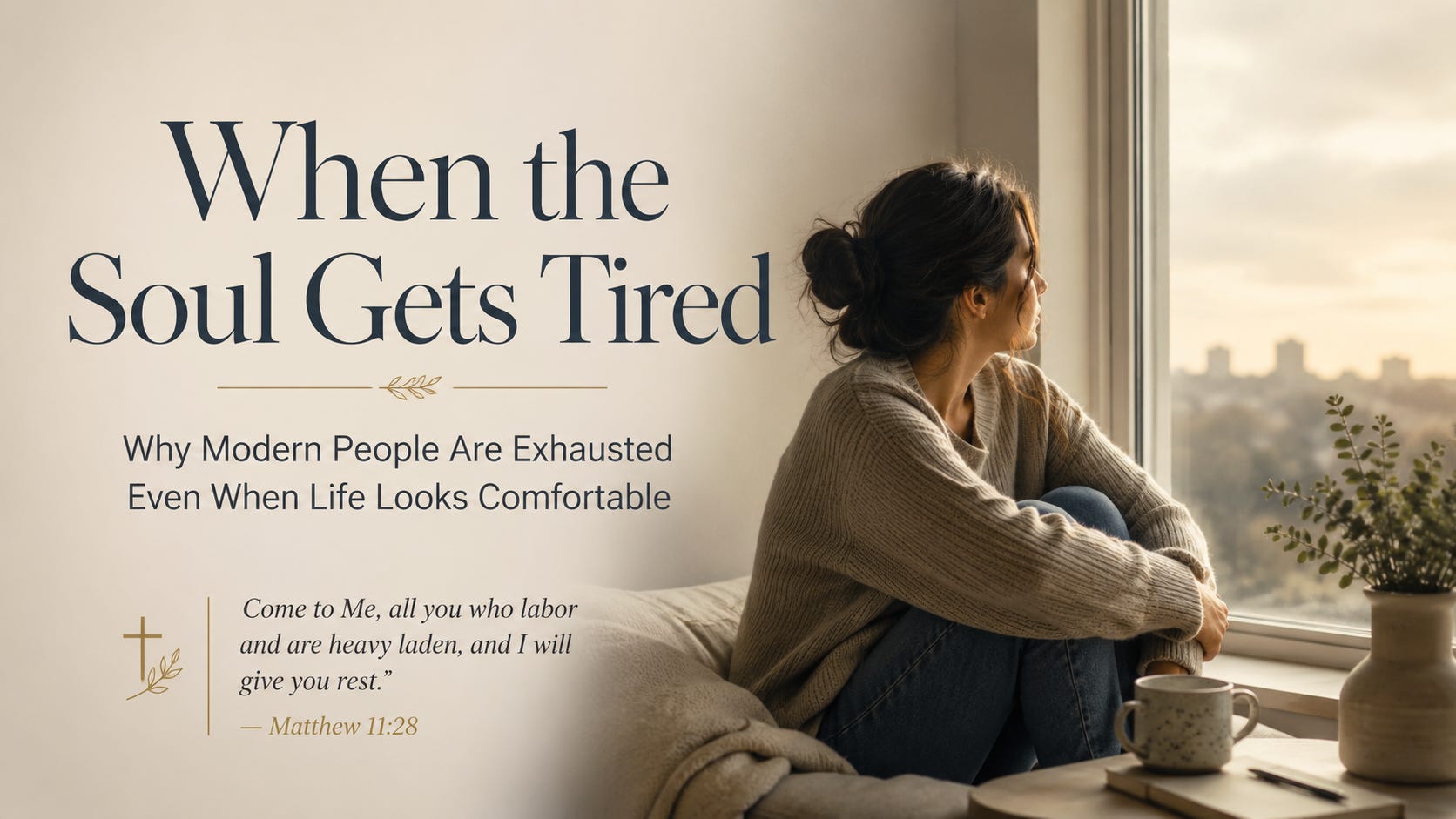
There is a kind of tiredness that sleep cannot heal.
It is not only the tiredness of the body. It is not simply the result of a long day, a difficult week, or too many responsibilities. It is deeper than physical exhaustion. It is the weariness of the soul.
Many people today live with this hidden tiredness. They wake up, work, answer messages, pay bills, scroll through their phones, try to look strong, and keep going. From the outside, life may look normal. Some even look successful. They may have a home, a job, a phone, a social media profile, entertainment, food, and access to more information than any generation before them. Yet inside, many feel empty, anxious, lonely, or spiritually dry.
Modern life gives us many comforts, but not always peace. It gives us speed, but not always direction. It gives us connection, but not always love. It gives us noise, but not always meaning.
This is one of the great spiritual struggles of our age.
We are surrounded by things that promise rest, but many of them only distract us for a moment. We watch another video, open another app, buy another item, read another headline, or search for another answer. Yet when the screen goes dark, the same emptiness often remains.
The human soul was not made to live only on distraction.
The soul needs truth. The soul needs love. The soul needs silence. The soul needs forgiveness. The soul needs God.
In the Gospel of Matthew, Jesus gives one of the most beautiful invitations in Scripture:
“Come to Me, all you who labor and are heavy laden, and I will give you rest.” — Matthew 11:28, NKJV
This verse is not only for people who are physically tired. It is for the burdened, the anxious, the ashamed, the lonely, the disappointed, and the spiritually exhausted. Jesus speaks to people who have carried too much for too long. He does not begin by demanding that they become stronger. He does not shame them for being weary. He says, “Come to Me.”
That is the heart of Christian rest.
Christian rest is not escape from reality. It is not laziness. It is not pretending that pain does not exist. It is the deep rest that comes from bringing our whole life before Christ — our weakness, fear, failure, grief, and longing — and discovering that we are still loved.
Many people today are tired because they are trying to carry burdens that were never meant to be carried alone. They carry the burden of proving themselves. They carry the burden of being constantly available. They carry the burden of comparison. They carry the burden of old wounds. They carry the burden of looking fine when they are not fine.
Social media has made this even heavier. We compare our private pain with other people’s public images. We see edited lives, smiling photos, success stories, beautiful homes, perfect families, strong bodies, and confident voices. But behind many screens there are also tears, fear, loneliness, debt, sickness, broken relationships, and silent prayers.
The modern world teaches us to perform. Christ invites us to come.
There is a great difference between performance and presence. Performance says, “I must prove that I am worthy.” Presence says, “I can come to God as I am.” Performance hides weakness. Presence brings weakness into the light of grace.
This does not mean that Christian life is free from suffering. The Bible never promises that. Many faithful people suffer deeply. Many believers know anxiety, grief, illness, rejection, and spiritual dryness. But Christianity does offer something the world cannot give: the presence of Christ in the middle of the burden.
Jesus does not merely stand at a distance and give advice. He enters human suffering. He knows rejection. He knows sorrow. He knows pain. He knows what it means to be misunderstood, betrayed, wounded, and alone. At the cross, Christ carried the weight of sin and sorrow. In the resurrection, He opened the door to hope.
That is why Christian hope is not shallow optimism. It is not pretending that everything is easy. It is the confidence that darkness does not have the final word.
When the soul gets tired, it often needs to return to simple things.
A quiet prayer.
A short Scripture.
A moment of honesty before God.
A walk without noise.
A conversation with someone trustworthy.
A confession of weakness.
A decision to stop pretending.
Sometimes the most spiritual sentence we can pray is very simple:
“Lord, I am tired.”
God is not offended by honest prayer. The Psalms are full of cries, questions, tears, and longing. Scripture gives us permission to bring our real selves before God. We do not need to impress Him with religious language. We do not need to hide our exhaustion.
The tired soul does not need more performance. It needs mercy.
The tired soul does not need more noise. It needs peace.
The tired soul does not need more comparison. It needs love.
The tired soul does not need another temporary escape. It needs Christ.
One of the dangers of modern life is that we confuse distraction with rest. We may spend hours being entertained and still feel empty afterward. We may scroll for a long time and feel even more anxious. We may keep ourselves busy because silence feels uncomfortable. But silence often reveals what noise has been hiding.
In silence, we may discover grief we have not processed. We may remember wounds we tried to ignore. We may feel the loneliness we have been avoiding. But silence can also become a holy place, because God often meets us there.
The Christian life invites us not only to believe in God, but to abide in Him. Jesus said:
“Abide in Me, and I in you.” — John 15:4, NKJV
To abide means to remain, to stay, to dwell. It is the opposite of restless spiritual running. It is learning to live with Christ, not merely think about Him occasionally. It is the slow healing of the soul through communion with God.
This kind of healing does not always happen instantly. Sometimes God restores us slowly. Sometimes He gives enough strength for one day, one hour, one step. That is still grace.
We live in a world that loves speed, but the soul often heals slowly.
A wounded soul cannot always be rushed. A grieving person cannot simply be told to move on. A burned-out believer cannot always be fixed by one sermon, one book, or one motivational phrase. Deep restoration often takes time, prayer, community, wisdom, and patience.
But there is hope.
The tired soul can breathe again.
The anxious heart can find peace again.
The lonely person can discover that they are seen by God.
The wounded believer can learn that weakness is not the end of the story.
Christ still says, “Come to Me.”
Not come when you are impressive.
Not come when you have everything fixed.
Not come when your faith feels strong.
Not come when your life looks perfect.
Just come.
Come with your tiredness.
Come with your questions.
Come with your tears.
Come with your silence.
Come with the parts of yourself you do not know how to explain.
This is the tenderness of Jesus. He does not crush the weary. He does not despise the broken. He does not turn away the one who comes honestly.
The world may ask us to keep performing, but Christ calls us to receive.
The world may tell us to build an image, but Christ calls us to truth.
The world may offer temporary distraction, but Christ offers rest for the soul.
And when the soul gets tired, that is the rest we need most.
Final Reflection
Maybe today you are not tired only in your body. Maybe your soul is tired too.
Maybe you have carried too much quietly. Maybe you have smiled while hurting. Maybe you have kept going because you felt there was no other choice.
But the invitation of Christ remains open:
“Come to Me, all you who labor and are heavy laden, and I will give you rest.”
This is not only a verse to read. It is an invitation to receive.
The tired soul is not forgotten.
The wounded heart is not beyond grace.
The weary believer is not abandoned.
There is still rest in Christ.
There is still hope.
There is still a way home.
Substack:
© 2026 Daniel J. Grace. All rights reserved.
Written by Daniel J. Grace
Independent Researcher and Author
MEAA Member
ORCID: https://orcid.org/0000-0002-9259-8032
Official Website: https://danieljamesgrace.com
Amazon Book: https://www.amazon.com/dp/B0H4DG8C98
Faith • Civilization • Theology