

When Technology Helps Creation Heal
Artificial Intelligence, Rewilding, and the Christian Hope for a Renewed Earth

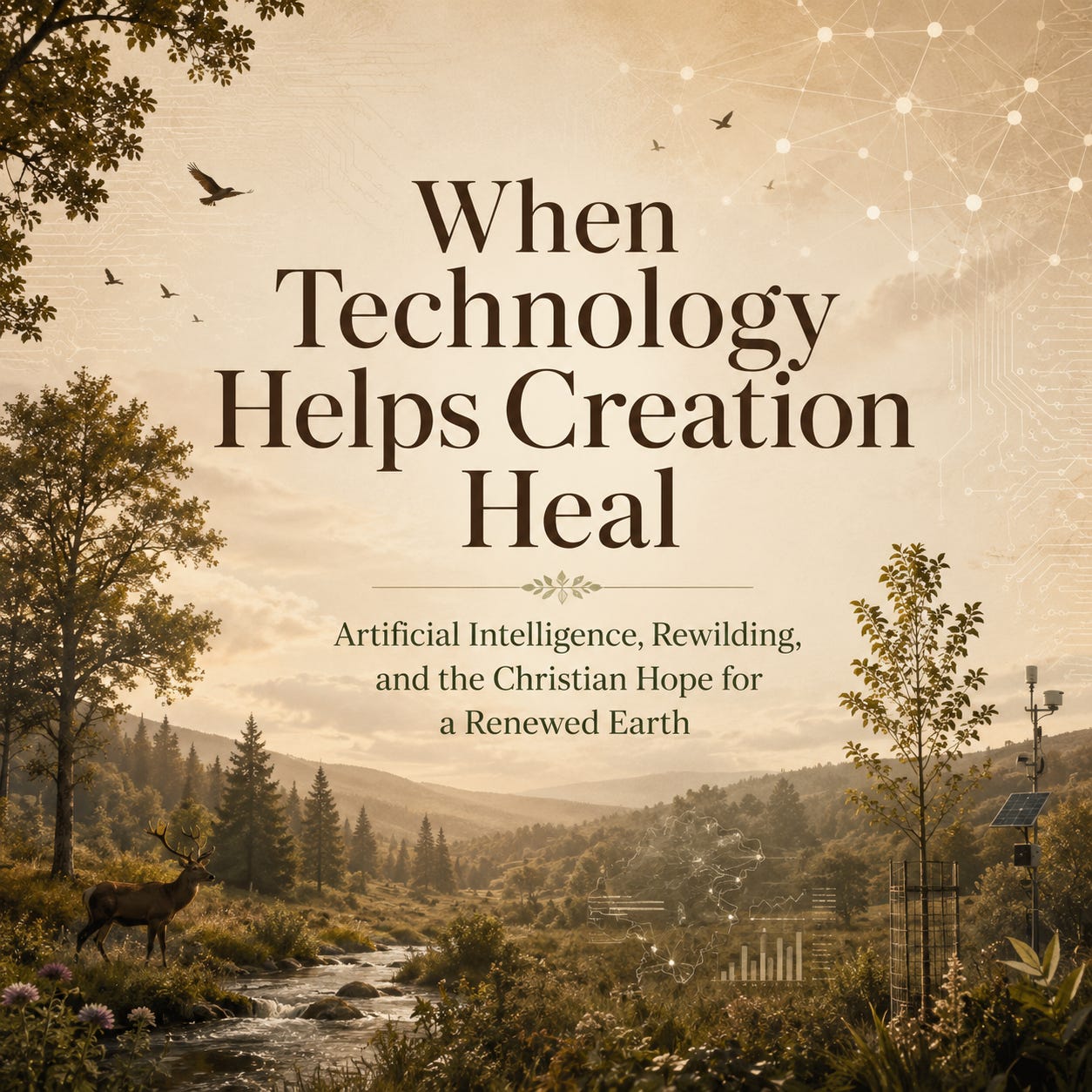
Technology is often blamed for the damage done to the natural world.
That criticism is understandable.
Machines have helped clear forests, deepen extraction, accelerate consumption, pollute rivers, and fragment habitats. Modern industry has given humanity the power to alter the earth at a scale earlier generations could barely imagine.
But technology doesn’t have only one direction.
The same tools that intensify damage may also help repair it.
Artificial intelligence can detect forest loss before it spreads. Sensors can monitor water quality without sending people repeatedly into sensitive habitats. Drones can distribute native seeds across damaged land. Automated systems can identify invasive species, track wildlife movement, and help reconnect broken ecological corridors.
This raises an important theological question.
Can technology become part of creation’s healing?
Not as a saviour. Not as a replacement for repentance. Not as another excuse for human control.
But as a servant of restoration.
That possibility deserves serious attention.
Beyond the Old Conflict Between Machine and Nature
We often speak as though nature and technology belong to opposite worlds.
Nature is pictured as living, pure, and organic. Technology is pictured as artificial, cold, and destructive.
The contrast feels obvious, but it’s too simple.
Human beings have always made tools. We’ve shaped wood, stone, metal, soil, water, and energy. Technology didn’t arrive from outside creation. It emerged from human creativity within creation.
That doesn’t make every tool good.
A machine can destroy a forest. It can also remove toxic waste from a river. A drone can support surveillance or help monitor endangered animals. An algorithm can increase industrial extraction or identify ecological collapse before it becomes irreversible.
The moral question isn’t whether a tool looks natural.
The question is what kind of relationship it creates.
Does it increase control?
Does it deepen dependence?
Does it serve profit while ignoring the life around it?
Or does it reduce harm and help damaged ecosystems recover?
Technology isn’t morally innocent, but neither is it automatically hostile to creation.
Its value depends on its purpose.
Why Stewardship Isn’t Always Enough
Christian environmental teaching often begins with stewardship.
Humanity is told to care for what God has made. This has helped many Christians reject careless interpretations of dominion.
But stewardship can still keep humanity at the centre.
The earth remains something we manage, organise, supervise, and improve. Even gentle stewardship may assume that nature needs permanent human direction.
Rewilding offers a different vision.
Rewilding doesn’t try to control every part of an ecosystem. It seeks to restore the conditions in which natural processes can continue with less interference.
A river is allowed to move again.
A forest is given room to regenerate.
Wildlife corridors are reopened.
Native species return.
Predators, prey, plants, soil, water, and climate begin to reconnect.
This doesn’t mean every damaged landscape should simply be abandoned.
Some places have been changed too severely for immediate recovery. Pollution may need to be removed. Invasive species may need to be controlled. Fragmented habitats may need to be reconnected. Vulnerable populations may need temporary protection.
But the goal isn’t permanent management.
The goal is recovery.
The deeper purpose is to help creation regain its own capacity for life.
What Cyber Ecology Could Mean
Cyber ecology may sound complicated, but the basic idea is simple.
It’s the careful use of digital and automated tools to observe ecological conditions, assist repair, and reduce unnecessary human intrusion.
A sensor placed near a wetland may detect water changes before fish begin dying.
An acoustic monitoring system may recognise the return of frogs, birds, or insects.
Satellite images may reveal illegal clearing.
Artificial intelligence may identify where a wildlife corridor has been broken.
Drones may carry native seeds into steep or fire damaged areas.
Robotic systems may remove pollutants from places where human workers would face danger or cause greater disturbance.
These tools can be helpful.
They can also become another form of control.
A forest can be reduced to data.
Wildlife tracking can become commercial surveillance.
Automated planting can be used to create the appearance of environmental responsibility while ancient forests continue to be destroyed elsewhere.
Technology doesn’t become ethical simply because it’s efficient.
It becomes responsible when it serves life without pretending to own it.
The Best Technology May Know When to Stop
Modern technology often expands after it enters a system.
It requires updates, energy, maintenance, data, replacement parts, and further intervention. What begins as assistance can become permanent dependence.
That’s a serious problem for ecological restoration.
A rewilding project should not replace one form of human control with a more advanced digital version.
The aim should be the opposite.
Technology should help restore the conditions in which ecosystems can function with less assistance.
A sensor network may remain useful for a time.
A robotic system may help remove invasive growth.
An artificial intelligence model may help identify when a species is recovering.
But the system should also be capable of stepping back.
The most successful technology may be the technology that becomes less necessary.
That idea challenges the way we usually define progress.
We often admire machines that do more.
Ecological wisdom may require machines that know when to do less.
Artificial Intelligence and the Return of Ecological Freedom
Artificial intelligence can process forms of ecological information that would be difficult for people to analyse quickly.
It can compare years of satellite images.
It can identify movement patterns across large landscapes.
It can detect changes in vegetation, soil moisture, animal behaviour, or water quality.
This can help restoration become more precise.
A small strip of restored habitat may reconnect two large ecosystems. A wildlife crossing may prevent repeated animal deaths. A change in fencing may reopen a migration route.
Artificial intelligence can help identify those possibilities.
But it shouldn’t be treated as an unquestionable authority.
Data is never the whole reality.
A forest is more than carbon storage.
A river is more than flow volume.
An animal population is more than a number.
Living systems include memory, relationship, adaptation, vulnerability, and forms of value that cannot always be measured.
Artificial intelligence may help us see patterns.
It cannot tell us the full meaning of creation.
Rewilding as an Act of Restraint
Rewilding requires action, but it also requires restraint.
That distinction matters.
Human beings often respond to damage by increasing control. We organise, redesign, monitor, and manage.
Sometimes intervention is necessary.
But intervention should have limits from the beginning.
How much action is truly required?
Who decides when it should stop?
Does the technology increase ecological independence?
Can local communities understand and challenge the system?
Does the project protect nonhuman life even when there’s no immediate economic benefit?
These questions keep restoration from becoming another form of domination.
Rewilding doesn’t mean doing nothing.
It means acting in ways that make constant action less necessary.
The Christian Hope for a Renewed Earth
Christian hope is often described as though it concerns only human souls.
But the biblical vision is wider.
Creation suffers.
Creation waits.
Creation shares in the hope of liberation.
The future promised by God isn’t simply an escape from the material world. It includes the renewal of creation.
That changes how Christians should think about ecological responsibility.
If creation has a future before God, then the earth isn’t disposable.
If the material world belongs within divine renewal, then present care for it carries theological meaning.
Human beings cannot manufacture that final renewal.
No environmental policy can produce the new creation.
No artificial intelligence system can engineer the eschaton.
No machine can redeem the earth.
But that doesn’t make present restoration meaningless.
A recovered wetland is not the final renewal of creation.
A restored forest doesn’t end suffering.
A returning species doesn’t overcome death.
Yet each may become a sign that destruction isn’t accepted as final.
Bringing the Future Into the Present
Theological language sometimes uses the word proleptic to describe something in the present that anticipates a future reality.
Ecological restoration can work in this way.
A healed river can become a small sign of renewal.
A reopened wildlife corridor can become a sign of restored relationship.
A forest allowed to regenerate can become a sign of life released from permanent control.
These acts don’t create the future promised by God.
They allow that future to shape present behaviour.
Christian hope should never become passive.
It shouldn’t wait for divine renewal while continuing to support destruction.
Hope acts.
Hope repairs.
Hope limits.
Hope protects.
Hope also knows that human power remains incomplete.
That’s what makes ecological restoration an act of faithfulness rather than a claim to mastery.
Technology Can’t Replace Repentance
There is a danger in every technological environmental promise.
A company may continue clearing land while funding automated tree planting elsewhere.
A government may permit pollution while investing in new monitoring systems.
An industry may advertise artificial intelligence as evidence of environmental care without changing the practices causing the damage.
That isn’t restoration.
It’s public relations.
Technology must never become an excuse for avoiding repentance.
A machine that plants trees doesn’t justify the destruction of an ancient forest.
A robot that removes pollution doesn’t justify continued pollution.
An algorithm that measures biodiversity loss doesn’t answer the moral failure behind that loss.
Repair matters.
Prevention matters more.
The Christian idea of repentance involves a change of direction.
Ecological repentance means turning away from practices that continue to wound creation.
Without that change, even the most advanced technology will remain part of the problem.
The Human Role Is Not to Disappear
The answer isn’t human absence.
People are part of creation too.
Human communities need food, safety, shelter, energy, and meaningful work. Ecological care shouldn’t ignore human dignity.
But neither should human need be used to justify unlimited control.
The challenge is to find forms of restoration that protect both vulnerable people and vulnerable ecosystems.
Local communities must remain part of environmental decisions.
Indigenous knowledge must not be pushed aside by digital systems.
Data should serve people and places, not remove authority from those who live within them.
Technology should support wisdom, not replace it.
When Technology Becomes a Servant
Technology helps creation heal when it does five things.
It pays attention without claiming total knowledge.
It intervenes only where necessary.
It restores ecological capacity.
It respects the value of nonhuman life.
It knows when to withdraw.
This is a different vision of technological progress.
It doesn’t celebrate the machine for its own sake.
It asks whether the machine serves life.
It doesn’t treat creation as a system waiting to be optimised.
It treats creation as a living order that human beings have often wounded and now have a responsibility to help repair.
The future of ecological theology won’t be shaped by a simple choice between technology and nature.
The real choice is between domination and restraint.
Technology may continue to tighten the human grip on the earth.
Or it may help us loosen that grip.
When artificial intelligence supports rewilding, when restoration makes ecological freedom possible, and when Christian hope leads to practical repair, technology can become more than part of the crisis.
It can become part of the healing.
© 2026 Daniel J. Grace. All rights reserved.
This essay is adapted from Daniel J. Grace’s academic article, “The Technocene Covenant: Cyber Ecology, Rewilding, and Eschatological Participation in the Renewal of Creation,” published in Faith • Civilization • Theology, Volume 1, Issue 2, August 2026.