
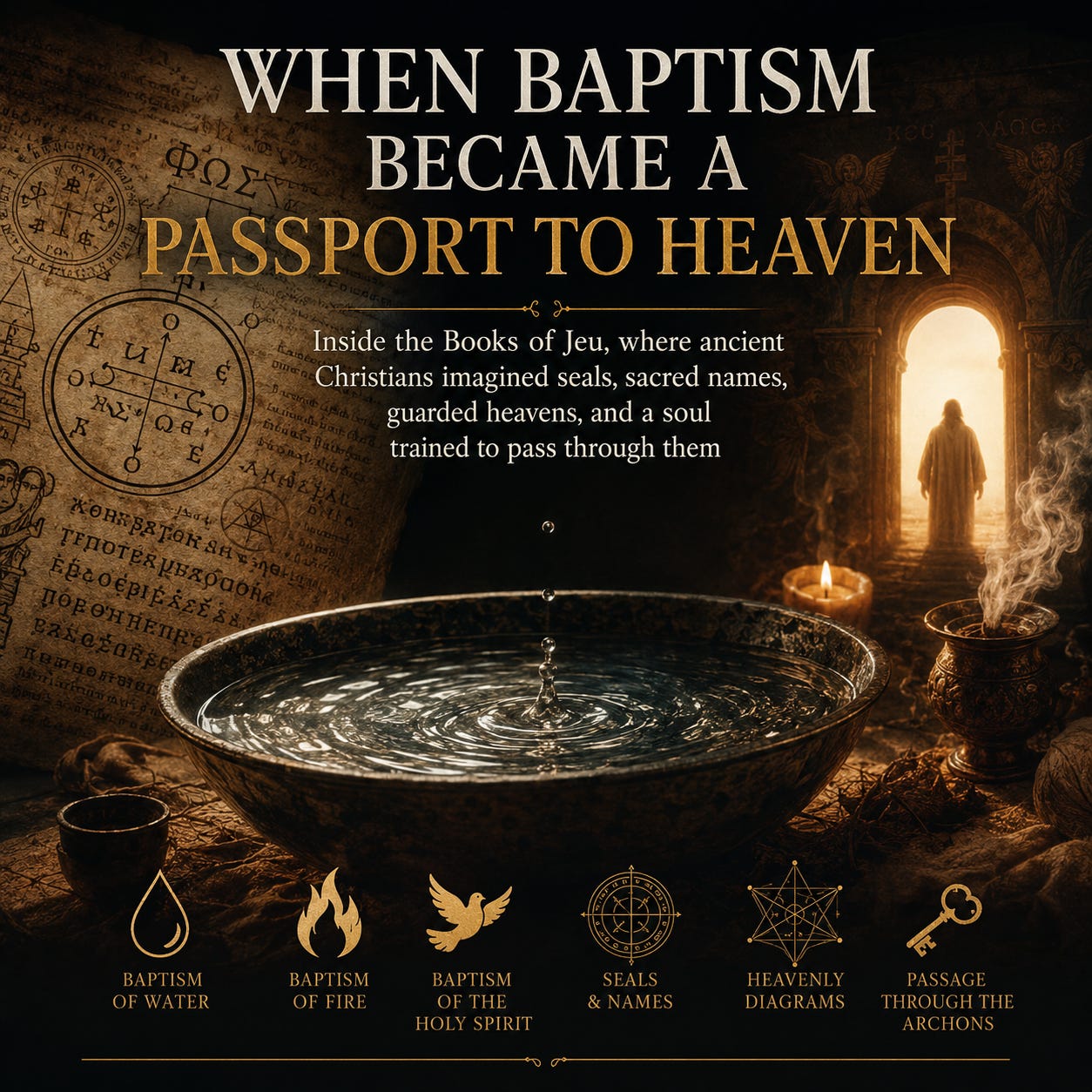
When Baptism Became a Passport to Heaven
Inside the Books of Jeu, where ancient Christians imagined seals, sacred names, guarded heavens, and a soul trained to pass through them

Most Christians think of baptism as water, faith, forgiveness, and entry into the Church.
In the Books of Jeu, baptism becomes something far more elaborate.
It becomes preparation for the afterlife.
The initiate isn’t simply washed. The initiate is sealed, instructed, clothed, marked, and taught how to move through a guarded universe. The soul must know where it’s going. It must recognise the powers standing in its way. It must carry the right signs. It must speak with the right authority.
The body becomes a passport.
The ritual becomes training.
Heaven becomes a place with boundaries.
This is one of the strangest visions of salvation to survive from late ancient Christianity.
A Different Kind of Jesus Tradition
The Books of Jeu are preserved in the Coptic Bruce Codex.
They don’t read like the canonical Gospels. There are no birth stories, village journeys, public crowds, or parables about seeds and vineyards.
The setting is after the resurrection.
Jesus speaks to a selected group of disciples. He reveals heavenly treasuries, guarded regions, watchers, archons, seals, divine names, ciphers, gestures, and baptisms.
He doesn’t merely tell them that heaven exists.
He explains how it’s arranged.
He shows them what the soul may face after death.
He teaches them what must be known, spoken, displayed, and performed in order to pass through the barriers separating the lower world from the Kingdom of Light.
This doesn’t make the text a lost biography of Jesus.
It’s closer to a ritual manual.
The purpose isn’t to tell readers more about Jesus’ earthly life. The purpose is to train the initiate for an invisible journey.
A Guarded Universe
The Books of Jeu imagine the universe as layered.
The space between the human world and the highest divine realm isn’t empty. It contains rulers, watchers, powers, veils, and guarded regions.
Some beings assist the soul.
Others obstruct it.
The soul doesn’t rise automatically after death. It must cross boundaries controlled by powers that can challenge its movement.
That’s why the text contains so many names, seals, diagrams, and formulas.
They aren’t decorative.
They belong to the logic of passage.
A modern comparison with border control helps explain the idea.
A traveller reaches a boundary. A guard asks who the traveller is. Evidence must be presented. Authority must be recognised. Those without the right status may be refused.
The Books of Jeu imagine the afterlife in a similar way.
The soul must be recognised as belonging to a higher realm.
Jesus as Celestial Guide
The Jesus of the Books of Jeu doesn’t only teach doctrine.
He creates ritual competence.
He draws.
He names.
He seals.
He arranges ritual space.
He baptises.
He teaches the disciples what to say before celestial beings and how to recognise the structures of the heavens.
This gives the text a technical atmosphere.
Jesus appears almost like a cosmic cryptographer. The phrase is modern, but it captures something important. He reveals hidden structures. He gives access to knowledge that ordinary perception can’t reach. He explains how guarded systems work.
Still, the soul isn’t hacking its way into heaven.
That would be the wrong image.
The initiate is authorised by a higher power. The signs and names work because they come from Jesus, whose authority stands above the rulers guarding the lower regions.
The soul doesn’t break the rules.
It reveals that it belongs under a greater authority.
The Diagrams Matter
One of the most unusual features of the Books of Jeu is the presence of diagrams.
The manuscript doesn’t only describe heavenly structures. It draws them.
Names, seals, watchers, emanations, and treasuries appear inside organised visual forms. The drawings help the reader understand how the invisible world is arranged.
They can look like maps.
They can look like seals.
They can look like plans for guarded spaces.
To a modern reader, they may even resemble security diagrams or access systems.
That comparison isn’t historically literal. The ancient authors didn’t think in terms of computers, software, or digital encryption.
But they did think in terms of controlled access.
Certain regions were protected.
Certain signs belonged to them.
Certain names carried authority.
Certain seals identified the initiate.
The diagram therefore wasn’t just a picture.
It was part of the ritual knowledge.
The Body as a Living Manuscript
The most powerful feature of the text is the way written signs move from page to body.
A seal appears in the manuscript.
Then it’s received in ritual.
Then it may be reproduced through gesture.
The body learns what the page displays.
The mouth learns the names.
The hands learn the signs.
The initiate turns toward particular directions.
The body becomes part of the map.
This is why the Books of Jeu can’t be reduced to secret ideas.
They’re not simply teaching hidden information.
They’re producing people who carry hidden information in their bodies.
The manuscript contains the pattern.
The initiate becomes its living form.
Three Baptisms
The ritual centre of the text is a sequence of baptisms.
The surviving material describes three principal rites:
the baptism of water,
the baptism of fire,
and the baptism of the Holy Spirit.
These aren’t presented as simple symbolic moments.
They’re layered ceremonies involving prayer, offerings, sacred substances, seals, bread, wine, incense, plants, linen, bodily positions, and invocations.
The initiate moves through stages of preparation.
Water cleanses.
Fire purifies.
The Holy Spirit completes and authorises.
The sequence suggests that salvation isn’t only something the believer understands.
It’s something the believer undergoes.
The Baptism of Water
The baptism of water begins with preparation.
The rite includes wine, bread, incense, prayers, and sealing. Jesus calls upon heavenly helpers to participate in the baptism.
The text then describes a sign in which wine becomes water.
The disciples are baptised with what the text calls the water of life.
This baptism does more than wash.
It forgives.
It seals.
It gives status.
It places the initiate among those who belong to the Kingdom of Light.
The disciple becomes recognisable.
The Baptism of Fire
The baptism of fire is even more elaborate.
The ritual uses vine branches, incense, myrrh, frankincense, juniper, balsam, mastich resin, nard, and other substances.
There is smoke.
There is fragrance.
There is heat.
There is bread and wine.
There is ritual movement.
There are spoken invocations.
This isn’t fire as a metaphor alone.
The rite creates an atmosphere in which purification is experienced through the senses.
The initiate sees, smells, hears, tastes, and feels the ritual.
The body isn’t ignored.
It’s drawn into the process of transformation.
The Baptism of the Holy Spirit
The third baptism continues the same pattern.
More substances are prepared. Wine is placed beside the incense. Bread is arranged. Jesus seals the disciples and invokes names associated with the Treasury of Light.
The Holy Spirit isn’t presented only as an inward feeling.
The Spirit is approached through ritual density.
The invisible is mediated through visible things.
The heavenly is received through earthly matter.
This is important because it challenges a common description of Gnostic Christianity as purely anti-material.
The lower world may be seen as dangerous or defective, but material things can still be used in sacred transformation.
Water purifies.
Fire initiates.
Incense sanctifies.
Plants crown.
Bread and wine bless.
The body receives the seal.
Matter isn’t trusted in its ordinary condition, but it isn’t useless.
It can be transformed.
Baptism as Recognition
The key idea running through the entire system is recognition.
The soul must become legible within the heavenly order.
A modern passport doesn’t create the traveller. It identifies the traveller within a recognised system.
The baptisms of the Books of Jeu work in a similar way.
They prepare the person to be recognised.
The seal shows identity.
The name establishes authority.
The gesture gives visible form to the mystery.
The formula gives it sound.
The baptism attaches the whole system to the initiate.
The soul’s journey begins before death because the body is prepared in advance.
Passwords and Sacred Names
The text contains unfamiliar names and spoken formulas.
To modern ears, they may sound like meaningless strings of syllables. Within the ritual world, they carry authority.
It’s tempting to describe them as passwords.
That word is useful, but only as an analogy.
A password grants access because it corresponds to a protected system. In the Books of Jeu, sacred names and formulas function through a similar logic of recognition.
The soul speaks what the celestial powers must acknowledge.
But the words don’t operate alone.
They belong to a person who has been prepared, instructed, sealed, and baptised.
This isn’t a magical trick anyone can copy from a page.
It’s part of an initiated identity.
The Archons as Border Guards
The hostile rulers of the lower regions are often called archons.
They appear powerful, but their power is limited.
They can challenge the soul.
They can obstruct it.
They can control particular regions.
But they don’t possess the highest authority.
When the initiate presents the correct seal, name, or mystery, the archon must withdraw because the authority behind the initiate is greater.
The comparison with border guards helps again.
The traveller doesn’t overpower the guard.
The traveller presents credentials issued by a higher authority.
The guard recognises them and allows passage.
That is the spiritual drama imagined by the text.
Was This Christianity?
The Books of Jeu may feel far removed from familiar Christianity.
The diagrams look unusual.
The names sound strange.
The rituals are complicated.
The cosmology is difficult.
Yet the text still understands itself as Christian.
Jesus is the supreme revealer.
The disciples receive the teaching.
Baptism remains central.
Forgiveness matters.
The Holy Spirit matters.
Bread, wine, water, prayer, sealing, and communal instruction all remain part of the system.
The authors didn’t abandon Christianity.
They reorganised it.
Jesus doesn’t only forgive sin. He reveals the route through cosmic danger.
He doesn’t only defeat death. He trains the soul for what comes after it.
He doesn’t only form a community. He creates travellers capable of reaching the light.
Why the Text Disappeared
It’s tempting to imagine that church officials found the Books of Jeu, condemned them, and systematically destroyed every copy.
The evidence doesn’t prove that.
Ancient manuscripts disappeared for many reasons.
Communities died out.
Languages changed.
Texts stopped being copied.
Libraries were abandoned.
Parchment and papyrus deteriorated.
War, fire, moisture, insects, neglect, and theological rejection all contributed to the loss of ancient literature.
The survival of the Bruce Codex is remarkable enough without inventing a conspiracy.
What we can say is that the tradition became marginal.
Its understanding of salvation didn’t become part of mainstream Christianity.
Its rites weren’t widely preserved.
Its manuscripts weren’t repeatedly copied.
The system survived only in fragments.
The Real Conflict
The deepest conflict wasn’t simply between freedom and church authority.
The Books of Jeu weren’t anti-authority.
Their rituals required teachers.
Their diagrams required interpretation.
Their formulas had to be transmitted accurately.
Their baptisms required preparation.
This was not a religion without hierarchy.
It was a different hierarchy.
Mainstream Christianity increasingly located authority in public teaching, recognised bishops, shared creeds, Scripture, and sacramental life within the Church.
The Books of Jeu located authority in possession of hidden mysteries and specialised ritual knowledge.
The conflict was between rival answers to the same question:
Who has the authority to define salvation?
What the Books of Jeu Reveal
The Books of Jeu reveal how diverse early Christianity became in late antiquity.
Different communities asked the same basic questions and produced very different answers.
What happens after death?
What is baptism?
Who controls salvation?
What authority does Jesus give?
What does the soul need to reach God?
For the community behind the Books of Jeu, salvation wasn’t only a matter of belief.
It was visual.
It was spoken.
It was embodied.
It was ritual.
It was spatial.
The soul needed a map.
The body needed seals.
The mouth needed names.
The hands needed gestures.
The initiate needed baptism.
Nothing remained ordinary.
Baptism became equipment.
The body became a passport.
The diagram became a key.
The name became authority.
The archon became a border guard.
The soul became a traveller.
And the hidden manual taught that traveller how to pass.
Adapted from Daniel J. Grace, “The Forgotten Gnostic Manual of Jesus: How an Ancient Coptic Text Turned Baptism into a Geometric Map of the Heavens,” published in Faith • Civilization • Theology, Volume 1, Issue 2, August 2026.