

What the Seven Churches Teach About Spiritual Leadership
Successes and Failures of Christian Leaders in Revelation

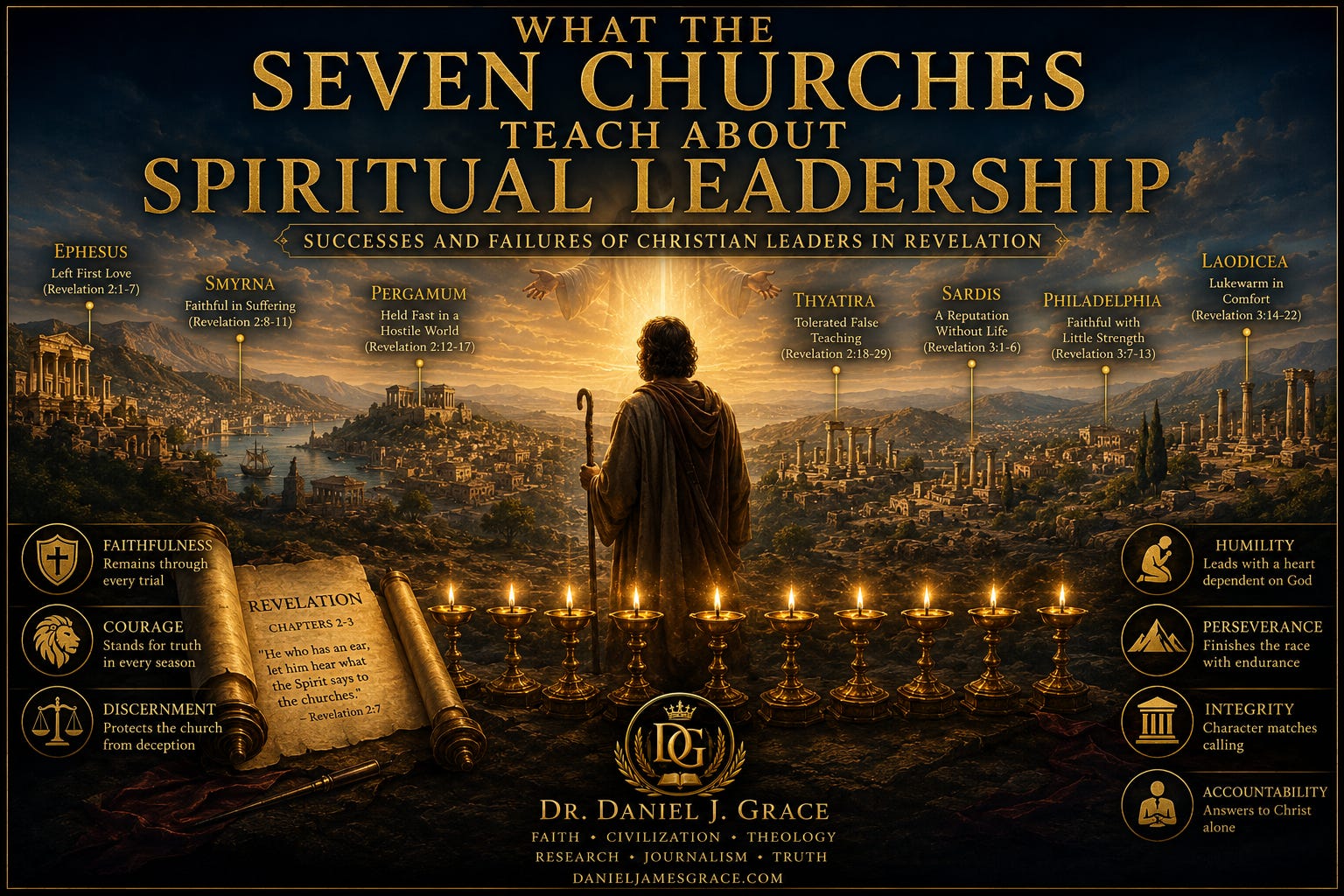
Lessons from Ancient Asia Minor for Modern Pastors, Ministry Leaders, and Christian Influencers
Leadership has always been one of the greatest challenges facing the people of God. Throughout history, nations have risen or fallen, movements have flourished or collapsed, and churches have grown or declined largely because of the quality of their leadership. The Book of Revelation provides one of the most powerful examinations of spiritual leadership in the New Testament through Christ’s messages to the Seven Churches of Asia Minor.
These churches existed in different cities, cultures, and circumstances. Some leaders guided their congregations faithfully through persecution and hardship. Others tolerated compromise, false teaching, and spiritual decline. Together, their stories provide a timeless leadership manual for every pastor, elder, ministry worker, missionary, and Christian leader.
The messages of Revelation were not merely directed to congregations. They were addressed to the “angels” of the churches, a term many scholars understand as referring to the spiritual representatives or leaders of each church. As a result, every message contains lessons about leadership responsibility, accountability, courage, and faithfulness.
More than nineteen centuries later, these lessons remain remarkably relevant.
Leadership Begins with Accountability
One of the most striking features of Revelation chapters 2 and 3 is Christ’s direct involvement with His churches. He walks among the lampstands and knows their condition completely.
Nothing is hidden from Him.
He knows their works.
He knows their struggles.
He knows their strengths.
He knows their failures.
Modern leaders often become preoccupied with public perception, attendance figures, social media influence, budgets, or reputation. Yet Revelation reminds us that leaders ultimately answer not to congregations, denominations, or supporters but to Christ Himself.
The first lesson of spiritual leadership is accountability.
The true measure of leadership is not popularity but faithfulness.
Ephesus: The Danger of Losing First Love
The church in Ephesus demonstrated many admirable qualities. It defended sound doctrine, rejected false teachers, and persevered through difficult circumstances.
By most visible standards, Ephesus appeared successful.
Yet Christ identified a serious problem.
The church had abandoned its first love.
This warning applies especially to leaders.
Ministry can gradually become professionalized. Sermons, meetings, administration, and programs can replace genuine devotion to Christ.
A leader may remain doctrinally correct while becoming spiritually cold.
The lesson from Ephesus is clear:
Effective leadership begins with personal love for Christ.
When leaders lose their passion for God, churches eventually lose theirs as well.
Smyrna: Leadership Through Suffering
Unlike most of the other churches, Smyrna received no rebuke.
Instead, believers were encouraged to remain faithful despite persecution.
Spiritual leadership often involves suffering.
Many modern leadership models focus on influence, success, visibility, and achievement. Revelation presents a different picture.
Faithful leaders sometimes face opposition.
They may experience criticism, rejection, misunderstanding, or hardship.
The leaders of Smyrna teach that courage is often more important than comfort.
Faithfulness matters more than convenience.
The greatest leaders are not always the most celebrated. Often they are the ones who remain faithful when following Christ becomes costly.
Pergamum: Courage in a Hostile Culture
Pergamum existed in a city deeply committed to emperor worship and pagan religion.
The church had remained loyal despite intense cultural pressure.
Yet compromise had begun to enter its ranks.
False teaching was tolerated.
Dangerous influences were allowed to spread.
Leadership requires both courage and discernment.
It is not enough for leaders to withstand external pressure while ignoring internal problems.
Many churches today face similar challenges.
Cultural acceptance often appears attractive.
Compromise seems easier than confrontation.
Yet faithful leaders must protect truth even when doing so is unpopular.
The lesson from Pergamum is that leadership requires both conviction and courage.
Thyatira: The Cost of Tolerating Error
Among the strongest rebukes in Revelation is Christ’s message to Thyatira.
The church displayed love, faith, service, and perseverance.
Yet it tolerated false teaching symbolized by “Jezebel.”
The problem was not merely doctrinal error.
It was leadership failure.
Leaders failed to address destructive influences before they harmed the congregation.
One of the most difficult responsibilities of leadership is correction.
Most leaders prefer encouragement to confrontation.
However, love sometimes requires difficult conversations.
Healthy leadership protects the church from teachings and practices that undermine the Gospel.
Thyatira reminds leaders that tolerance without discernment eventually damages spiritual health.
Sardis: The Danger of Reputation
Sardis possessed an impressive reputation.
People believed the church was alive.
Christ declared otherwise.
It was spiritually dying.
Leadership can easily become focused on appearances.
Churches may appear successful externally while declining internally.
Programs can continue.
Buildings can remain full.
Events can be well attended.
Yet spiritual vitality may be disappearing.
The lesson from Sardis is especially important in the age of social media.
Visibility is not the same as vitality.
Influence is not the same as spiritual health.
Leaders must evaluate reality rather than reputation.
Philadelphia: Faithfulness in Small Things
Philadelphia received no condemnation.
The church possessed limited strength but remained faithful.
This message offers tremendous encouragement to leaders who serve in small congregations, remote locations, or difficult circumstances.
Modern culture often celebrates large platforms and public influence.
Christ praised faithfulness.
Philadelphia teaches that leadership success is not measured by size but by obedience.
Many of God’s most faithful servants lead quietly, without recognition or publicity.
The Lord values faithfulness more than fame.
Small acts of obedience often have eternal significance.
Laodicea: The Leadership Crisis of Comfort
Laodicea presents perhaps the most sobering leadership warning in Revelation.
The church was wealthy, comfortable, and self-sufficient.
Its leaders believed everything was going well.
Christ saw a different reality.
They were spiritually lukewarm.
The greatest danger facing many leaders today may not be persecution or opposition.
It may be comfort.
Prosperity can create complacency.
Success can weaken dependence upon God.
Influence can produce self-confidence rather than humility.
The leaders of Laodicea remind us that spiritual decline often begins when people believe they no longer need God’s help.
Effective leadership requires continual dependence upon Christ.
Characteristics of Faithful Spiritual Leaders
When the messages to the Seven Churches are considered together, several qualities emerge.
Faithfulness
Leaders remain committed regardless of circumstances.
Humility
They recognize their dependence upon God.
Courage
They defend truth even when unpopular.
Discernment
They identify and address dangerous influences.
Love
They maintain genuine devotion to Christ.
Perseverance
They continue serving through hardship and opposition.
Integrity
Their private lives reflect their public teaching.
These qualities mattered in the first century and remain essential today.
Leadership in the Digital Age
The modern church faces challenges unknown to the leaders of Revelation.
Social media, online influence, celebrity culture, and digital communication have transformed ministry.
Yet the core issues remain unchanged.
Leaders still face temptation.
Churches still confront compromise.
Truth still requires protection.
Faithfulness still matters.
The Seven Churches demonstrate that technology may change, but human nature does not.
The same spiritual principles that guided Christian leaders in ancient Asia Minor continue to guide faithful leadership in the twenty-first century.
Conclusion
The Seven Churches of Revelation provide a profound portrait of spiritual leadership.
Some leaders protected truth.
Some endured persecution.
Some tolerated compromise.
Some became complacent.
Some remained faithful despite limited resources.
Together, they reveal that successful spiritual leadership is not defined by popularity, wealth, influence, or numerical growth.
It is defined by faithfulness to Christ.
The ultimate question facing every Christian leader is the same question posed by Revelation:
Will we seek the approval of the world, or will we seek the approval of the One who walks among the lampstands?
The answer determines not only the future of leaders but also the future of the churches they serve.

Dr. Daniel J. Grace
Faith • Civilization • Theology
Research • Journalism • Truth
🌐 danieljamesgrace.com
© 2026 Dr. Daniel J. Grace. All Rights Reserved.
No part of this article may be reproduced, distributed, transmitted, or published in any form or by any means without prior written permission from the author, except for brief quotations used in academic citation, review, or research purposes. This work is protected under international copyright law and intellectual property regulations. Research • Journalism • Theology