

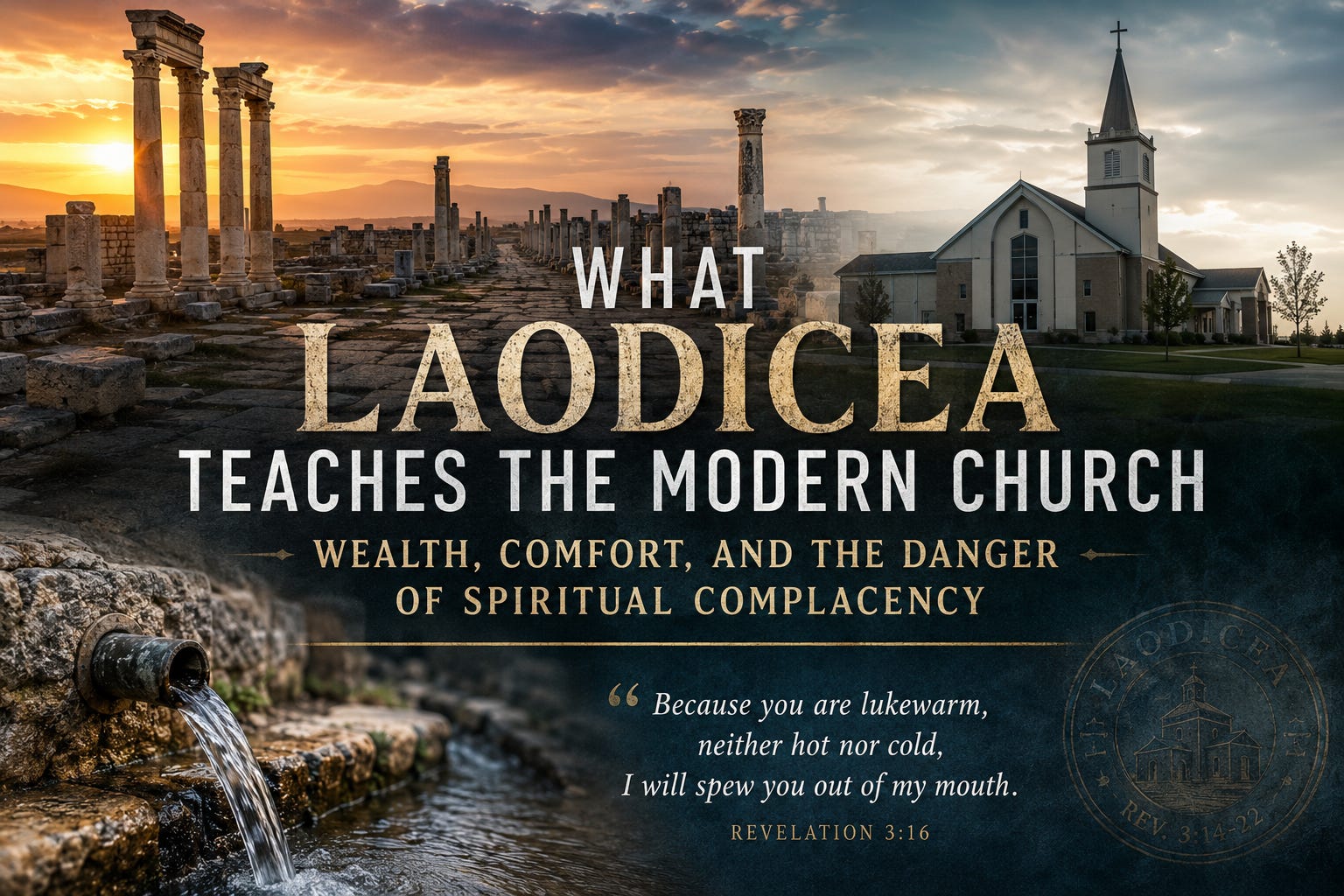
What Laodicea Teaches the Modern Church: Wealth, Comfort, and the Danger of Spiritual Complacency
How Ancient Laodicea Exposes Modern Christian Self-Sufficiency and Spiritual Drift

Abstract
Among the seven churches addressed in the Book of Revelation, none speaks more directly to the modern Western church than Laodicea. The church possessed material wealth, social influence, and apparent stability, yet Christ delivered one of the strongest rebukes found in Scripture. The Laodicean believers considered themselves prosperous and self-sufficient, but in God’s assessment they were spiritually impoverished, blind, and exposed. This article examines the historical background of Laodicea, the meaning of Christ’s warning concerning spiritual lukewarmness, and the relevance of that warning for contemporary Christianity. It argues that many modern churches face temptations strikingly similar to those confronting ancient Laodicea: reliance upon material success, accommodation to cultural values, diminished dependence upon God, and the substitution of institutional strength for genuine spiritual vitality.
Introduction
The modern church operates in an age of unprecedented wealth, technological sophistication, and global connectivity. Christian ministries possess resources that would have been unimaginable to earlier generations. Churches broadcast sermons worldwide, maintain extensive facilities, employ professional staff, and engage audiences through digital platforms. Yet the question posed by Christ to Laodicea remains deeply relevant: does external success necessarily indicate spiritual health?
The message to Laodicea challenges assumptions that numerical growth, financial prosperity, and organizational achievement are reliable indicators of God’s approval. Instead, Christ directs attention toward spiritual realities that often remain hidden beneath outward appearances.
The Historical Context of Laodicea
Laodicea was one of the wealthiest cities in Asia Minor. Situated near important trade routes, it became a major commercial center known for banking, textile production, and medicine. The city produced a distinctive black wool and housed a respected medical school associated with treatments for eye diseases.
Its wealth became famous throughout the Roman world. Following a devastating earthquake in AD 60, Laodicea rebuilt itself without imperial assistance, demonstrating extraordinary economic strength and civic pride.
Yet the city possessed one notable weakness: an inadequate water supply. Unlike nearby Hierapolis, known for its hot mineral springs, and Colossae, known for its cold mountain water, Laodicea relied upon aqueducts that transported water over considerable distances. By the time the water arrived, it was often lukewarm and unpleasant.
This geographical reality provides essential context for Christ’s rebuke in Revelation 3:15–16.
Understanding the Meaning of Lukewarmness
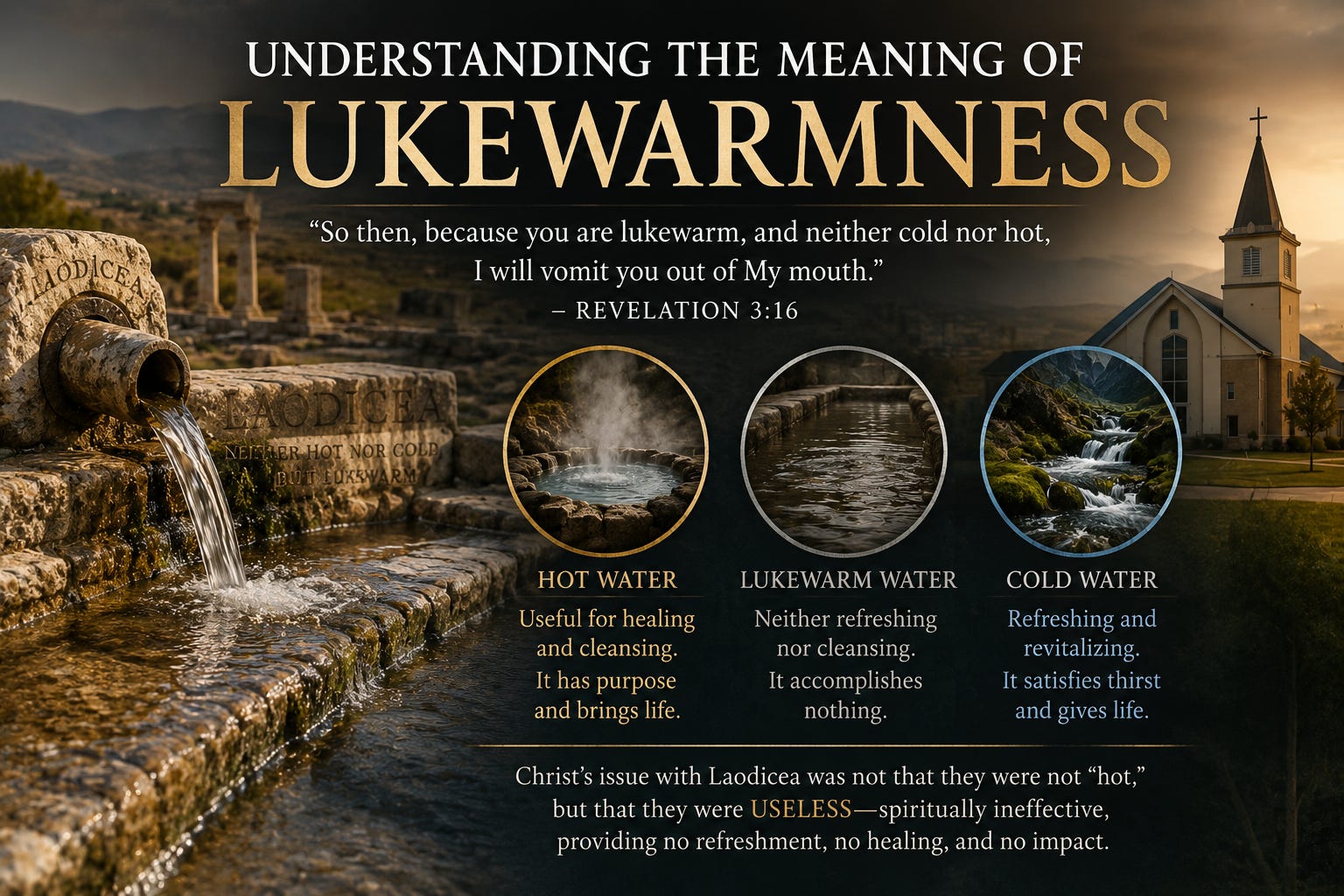
Many readers assume that Christ preferred believers to be spiritually “hot” rather than “cold.” While enthusiasm for God is certainly commendable, the historical context suggests a more nuanced interpretation.
Both hot water and cold water were useful. Hot water provided healing and therapeutic benefits. Cold water offered refreshment. Lukewarm water, however, lacked the desirable qualities of either.
Christ’s criticism therefore concerns uselessness rather than temperature alone. The church had become spiritually ineffective. It neither refreshed the weary nor provided healing to the broken. It existed, but it no longer fulfilled its calling.
The warning is especially relevant to churches that maintain activity without spiritual influence, programs without transformation, and growth without discipleship.
The Modern Church and the Spirit of Laodicea
The similarities between Laodicea and many contemporary churches are striking.
Modern Christianity often measures success through attendance figures, financial resources, building projects, social influence, and online visibility. While none of these are inherently wrong, they can create the illusion of spiritual health.
Like Laodicea, churches may begin to trust their resources rather than God’s provision. Dependence upon prayer can be replaced by dependence upon strategy. Faithfulness may be overshadowed by branding, marketing, and institutional preservation.
Christ’s words expose this danger:
“You say, I am rich; I have acquired wealth and do not need a thing.”
This attitude represents the heart of Laodicean Christianity. It is the temptation to believe that prosperity removes the need for dependence upon God.
Cultural Accommodation and Spiritual Drift
Another lesson from Laodicea concerns cultural accommodation.
Many churches face pressure to conform to prevailing social values. The desire to remain relevant can gradually become a willingness to compromise biblical convictions.
Throughout history, Christian communities have confronted pressures from political power, economic interests, and cultural expectations. The church in Laodicea appears to have adapted comfortably to its prosperous environment.
The modern church faces similar challenges. Materialism, consumerism, individualism, and moral relativism often shape Christian thinking more deeply than Scripture itself.
The danger is not outright rejection of Christianity but gradual assimilation into the surrounding culture.
Christ’s Prescription for Renewal
Despite the severity of His rebuke, Christ’s message remains hopeful.
He counsels the Laodiceans to obtain true riches from Him, white garments to cover their shame, and spiritual sight to replace their blindness.
These images directly confront the city’s sources of pride:
Banking wealth cannot replace spiritual riches.
Black wool cannot provide righteousness.
Medical expertise cannot cure spiritual blindness.
The solution is repentance and renewed dependence upon Christ.
The famous declaration, “Behold, I stand at the door and knock,” is addressed not to unbelievers but to a church. The image is deeply sobering. A congregation may continue functioning while Christ Himself remains outside.
Conclusion
The message to Laodicea stands as one of the most relevant warnings in Scripture for contemporary Christianity. It challenges churches to examine whether external success has concealed internal weakness, whether cultural acceptance has replaced faithfulness, and whether prosperity has diminished dependence upon God.
The central lesson is timeless: genuine spiritual vitality cannot be measured by wealth, influence, popularity, or institutional success. Churches are called not merely to survive but to remain spiritually useful, faithful, and dependent upon Christ.
Ancient Laodicea reminds modern believers that the greatest danger is not persecution or poverty. The greatest danger may be comfort without conviction, prosperity without dependence, and religion without the living presence of Christ.
Dr. Daniel J. Grace
Research • Journalism • Theology