
Wealth, Poverty, and Power
Economic Lessons from Smyrna, Philadelphia, and Laodicea

What the Seven Churches Teach About Money, Success, and Spiritual Health
Money has always shaped human society.
Throughout history, wealth has provided security, influence, opportunity, and power. At the same time, poverty has often brought hardship, uncertainty, and vulnerability.
The modern world continues to wrestle with questions surrounding wealth and inequality. Entire political systems, economic theories, and social movements attempt to address the relationship between prosperity, poverty, and power.
Interestingly, the Seven Churches of Revelation provide remarkable insight into these issues.
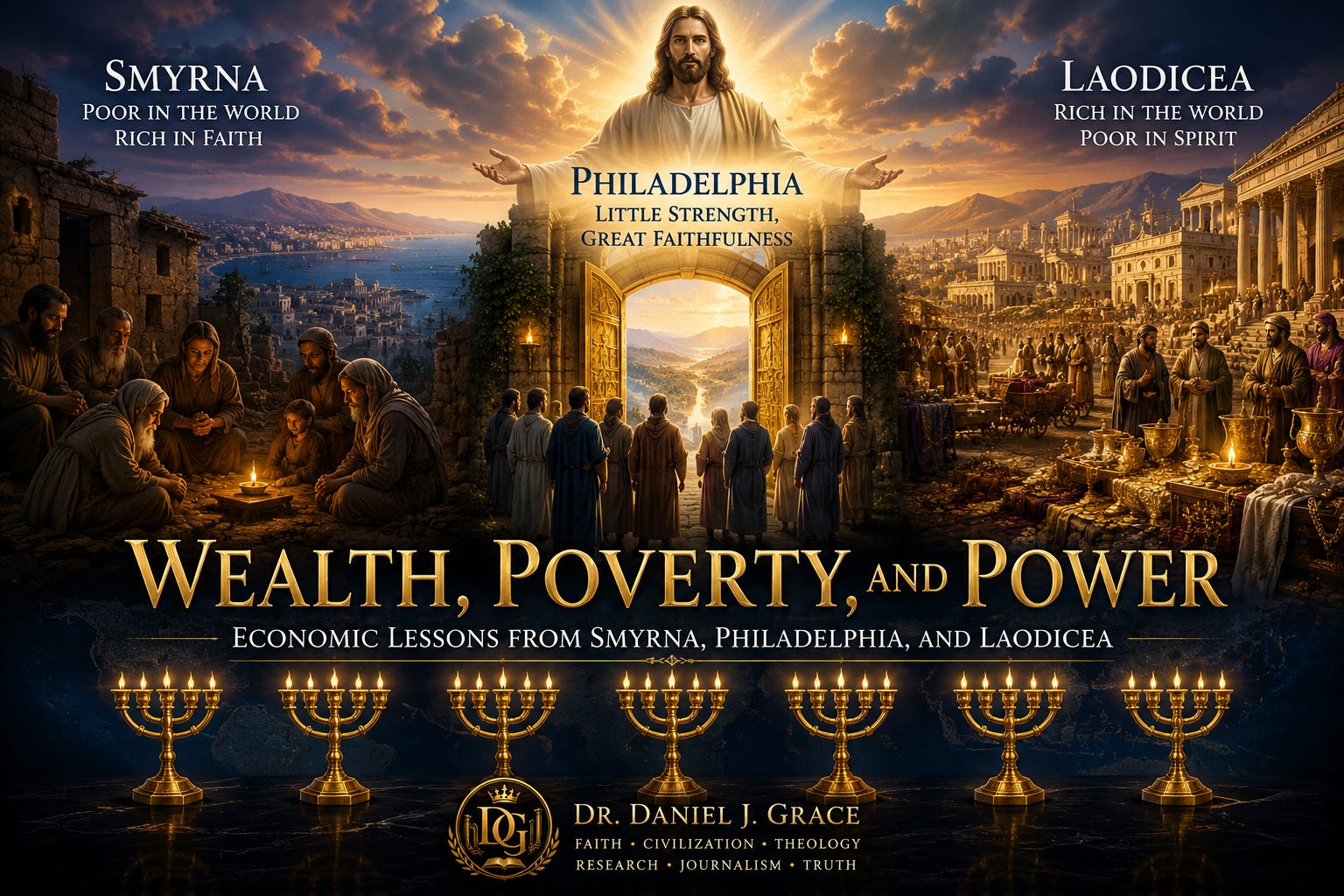
Among the seven churches, three stand out for what they reveal about economics and spiritual life: Smyrna, Philadelphia, and Laodicea.
One church was materially poor but spiritually rich.
One church possessed limited strength but received Christ’s praise.
One church was wealthy yet spiritually bankrupt.
Together, they offer profound lessons for every generation.
Smyrna: Poor Yet Rich
Smyrna was one of the wealthiest cities in Asia Minor.
It possessed an excellent harbour, thriving commerce, and strong connections to Rome.
Yet despite the city’s prosperity, many Christians in Smyrna lived in poverty.
Christ acknowledged their suffering:
“I know your tribulation and your poverty—but you are rich.”
This statement challenges conventional assumptions about success.
In most societies, wealth is often viewed as evidence of achievement, influence, or blessing.
Yet Christ evaluated the believers of Smyrna according to different standards.
Although materially poor, they were spiritually rich.
Their faithfulness, perseverance, and devotion possessed eternal value.
The lesson remains powerful today.
Economic circumstances do not necessarily reflect spiritual condition.
A person may possess limited financial resources while demonstrating extraordinary character, generosity, and faith.
True wealth cannot be measured solely by bank accounts, property, or possessions.
Poverty and Human Dignity
The message to Smyrna also reminds believers that human dignity does not depend upon economic status.
Modern societies often measure success according to income, career achievement, or social position.
Yet Scripture consistently presents a different perspective.
Human worth originates from being created in the image of God.
The poor possess the same dignity as the wealthy.
The vulnerable possess the same value as the powerful.
The church at Smyrna demonstrates that hardship does not diminish spiritual significance.
Indeed, suffering sometimes reveals strengths that comfort can conceal.
Philadelphia: Limited Resources, Great Faithfulness
Philadelphia occupied a different position.
The city lacked the prestige of Ephesus or the wealth of Laodicea.
The church itself possessed what Christ described as “little strength.”
Yet despite limited resources, Philadelphia received only praise.
Christ commended their perseverance and faithfulness.
This lesson remains highly relevant.
Modern culture frequently associates effectiveness with size, wealth, and influence.
Large institutions often receive the greatest attention.
Yet the church at Philadelphia demonstrates that faithfulness matters more than power.
The believers were not famous.
They were not wealthy.
They were not politically influential.
Yet they remained obedient.
Their example reminds us that success cannot always be measured numerically.
Some of the most significant contributions to society are made quietly by individuals whose names never become widely known.
The Myth of Bigger Is Better
One of the most persistent assumptions in modern culture is that bigger automatically means better.
Bigger companies.
Bigger churches.
Bigger platforms.
Bigger audiences.
The message to Philadelphia challenges this way of thinking.
Spiritual health is not determined by scale.
Faithfulness is not measured by popularity.
Many individuals and organisations become so focused on growth that they neglect integrity, service, and purpose.
Philadelphia reminds believers that small acts of faithfulness often possess extraordinary value.
God evaluates differently than markets.
Laodicea: Wealth Without Wisdom
If Smyrna represents poverty and Philadelphia represents limited strength, Laodicea represents prosperity.
Laodicea was one of the richest cities in the Roman world.
It was famous for banking, textiles, and medicine.
The city possessed significant economic power.
The church reflected this prosperity.
Its members believed they lacked nothing.
Christ quoted their attitude:
“I am rich, have become wealthy, and have need of nothing.”
Yet His assessment was dramatically different.
“You are wretched, miserable, poor, blind, and naked.”
This may be the most shocking economic lesson in Revelation.
The wealthiest church received the strongest criticism.
Why?
Because prosperity had produced self-sufficiency.
The believers no longer recognised their dependence upon God.
Their material abundance created spiritual blindness.
The Danger of Comfortable Faith
Laodicea illustrates a challenge that remains highly relevant in modern societies.
Comfort is not inherently wrong.
Neither is wealth.
The problem arises when comfort becomes an idol.
Prosperity can create the illusion that human beings are self-sufficient.
When everything appears secure, dependence upon God often weakens.
History repeatedly demonstrates this pattern.
Nations become prosperous.
Institutions become successful.
Individuals accumulate wealth.
Gradually, gratitude is replaced by entitlement.
Humility is replaced by self-confidence.
Faith is replaced by self-reliance.
The church at Laodicea serves as a warning against this danger.
Wealth Is a Tool, Not a Master
The lessons of Revelation do not condemn wealth itself.
Scripture contains numerous examples of faithful individuals who possessed substantial resources.
The issue is not wealth.
The issue is the human heart.
Money is a tool.
It can be used to help others, support communities, advance worthy causes, and improve lives.
Yet money can also become an object of trust.
The question is not whether people possess wealth.
The question is whether wealth possesses them.
Smyrna, Philadelphia, and Laodicea each reveal different responses to material circumstances.
Economic Lessons for the Digital Age
The modern economy differs greatly from the Roman world.
Yet many of the same temptations remain.
Social media frequently celebrates wealth and luxury.
Consumer culture encourages constant acquisition.
Success is often measured through possessions, influence, and visibility.
The result is a society increasingly focused upon external indicators of achievement.
The churches of Revelation invite a different perspective.
They encourage people to ask deeper questions:
What truly matters?
What creates lasting value?
What does genuine success look like?
What kind of wealth endures?
These questions remain as important today as they were in the first century.
Power and Responsibility
Wealth often produces power.
Power creates influence.
Influence creates responsibility.
The churches remind believers that power must be exercised wisely.
Economic resources should serve people rather than dominate them.
Success should create opportunities for service rather than pride.
Leadership should produce humility rather than arrogance.
The healthiest communities are not necessarily the wealthiest.
They are the communities that use their resources responsibly and ethically.
What the Three Churches Teach Together
Smyrna teaches that poverty does not prevent spiritual richness.
Philadelphia teaches that limited resources do not prevent faithfulness.
Laodicea teaches that prosperity does not guarantee spiritual health.
Together, these churches challenge many assumptions of the modern world.
Material wealth and spiritual vitality are not identical.
Economic success and moral success are not the same thing.
The most important forms of wealth cannot be measured financially.
Character.
Faithfulness.
Integrity.
Wisdom.
Compassion.
Hope.
These qualities remain valuable regardless of economic conditions.
Conclusion
The messages to Smyrna, Philadelphia, and Laodicea reveal a timeless truth:
God evaluates differently than the world.
The poor church was rich.
The small church was strong.
The wealthy church was poor.
Such paradoxes challenge conventional thinking.
They remind believers that money, power, and success are temporary realities, while spiritual character possesses eternal significance.
The modern world continues to pursue wealth, influence, and comfort.
The churches of Revelation invite a deeper question.
Not how much wealth we possess.
But whether our wealth, our poverty, or our power has shaped our relationship with God.
The answer to that question may determine what true riches really are.
Dr. Daniel J. Grace
Faith • Civilization • Theology
Research • Journalism • Truth
🌐 danieljamesgrace.com
© 2026 Dr. Daniel J. Grace. All Rights Reserved.