

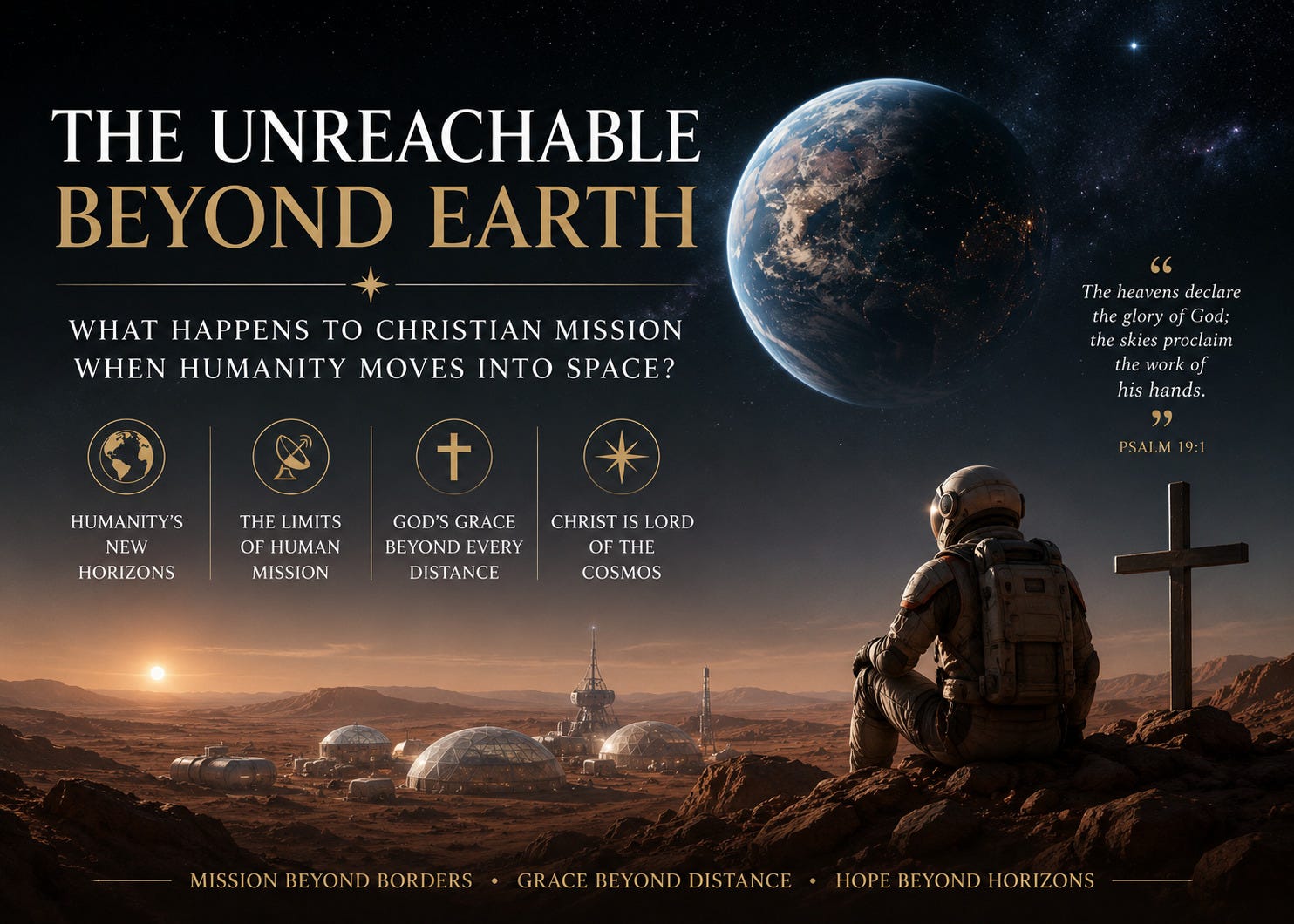
The Unreachable Beyond Earth
What Happens to Christian Mission When Humanity Moves Into Space?

For most of Christian history, the word unreached has referred to people separated from the gospel by geography, language, politics, culture, or history.
A community might live beyond a mountain range.
A people group might have no Bible in its own language.
A government might prevent missionaries from entering.
A generation might live and die before Christian proclamation reaches it.
Christian missiology has spent centuries thinking about these realities. It has asked how the Church should cross borders, learn languages, enter unfamiliar cultures, and proclaim Christ where He is not yet known.
But what happens when human geography no longer ends at Earth?
What happens when people live permanently on the Moon, Mars, deep-space stations, or vessels travelling far beyond immediate contact with Earth?
The question may sound like science fiction.
It isn’t entirely science fiction.
It is a theological question about human limitation.
It asks what Christian mission means when distance becomes so great that ordinary travel, communication, and physical presence are no longer possible.
More importantly, it asks whether the limits of human proclamation can ever become limits upon divine grace.
They cannot.
From Earthly Geography to Cosmic Geography
The Great Commission was given in a world without aircraft, satellites, digital communication, or space travel.
Jesus told His followers:
“Go therefore and make disciples of all the nations.”
—Matthew 28:19, NKJV
The phrase “all the nations” refers to the peoples of the world. The command was not limited to the political borders of the Roman Empire. It expressed the universal direction of Christian mission.
The gospel was not to remain in one city.
It was not to remain among one ethnic group.
It was not to remain inside one language or culture.
It was to move outward.
Jerusalem.
Judea.
Samaria.
The ends of the earth.
For the first disciples, “the ends of the earth” described the farthest imaginable reach of human geography.
Today, the phrase carries a new possibility.
What if human civilisation eventually extends beyond Earth itself?
The theological principles of the Great Commission would not disappear. Human beings would still need truth, grace, community, forgiveness, hope, and reconciliation with God.
The location would change.
Human nature would not.
A person born on Mars would still be human.
A child raised on a lunar settlement would still bear the image of God.
A generation living aboard a deep-space vessel would still ask the oldest human questions.
Who are we?
Why do we exist?
Is there meaning beyond survival?
What is good?
What happens when we die?
Does God know where we are?
The movement of humanity beyond Earth would therefore create more than a technological challenge.
It would create a missiological horizon.
The Problem of Cosmic Isolation
Imagine a permanent human colony far from Earth.
At first, it remains connected.
Messages travel between worlds.
Religious texts are preserved.
Churches gather.
Christian teachers serve the community.
Families pass faith from one generation to another.
Then something happens.
Communication fails.
Transport becomes impossible.
Political conflict causes separation.
A disaster destroys essential records.
A colony survives, but contact with Earth is lost.
Generations pass.
The original settlers die.
The descendants remember fragments of the past, but the institutions that once connected them to Earth disappear.
What would Christian mission mean then?
No missionary could simply board a plane.
No pastor could arrive the following week.
No mission agency could cross the distance through ordinary human effort.
The isolated population would be geographically unreachable in a way no earthly community has ever been.
This is where astro-missiology becomes more than speculation about extraterrestrial life.
It becomes a study of human beings beyond human missionary reach.
The problem is not that God cannot reach them.
The problem is that we may not be able to.
That difference matters.
Human Mission Has Limits
Christian mission requires human action.
People travel.
People preach.
People translate.
People teach.
People baptise.
People form communities.
People preserve Scripture.
People care for the sick, protect the vulnerable, and bear witness to Christ through ordinary life.
This embodied character of mission is important.
Christianity is not merely information transmitted across a network.
The gospel is proclaimed by people who live among people.
The Church gathers.
Bread is broken.
Prayer is shared.
Suffering is carried together.
Faith is taught through words, relationships, habits, memory, and worship.
But every human action has limits.
Missionaries are limited by distance.
Churches are limited by resources.
Languages are difficult to translate.
Borders can close.
Technology can fail.
Lives are short.
Humanity may one day develop extraordinary forms of space travel, but it will not become omnipresent.
There will always be places we cannot reach quickly.
There may eventually be places we cannot reach at all.
Christian theology must therefore distinguish between the mission of the Church and the mission of God.
The Church participates in God’s mission.
The Church does not control it.
We are witnesses.
We are not the source of grace.
We proclaim Christ.
We do not make Christ present.
God is already present.
God Is Not Earth-Bound
The Christian doctrine of God does not describe a deity confined to one planet.
God is not located on Earth in the way creatures are located in physical space.
The heavens declare His glory.
Creation bears witness to His power.
The cosmos exists through His will.
The Psalmist writes:
“The heavens declare the glory of God; and the firmament shows His handiwork.”
—Psalm 19:1, NKJV
This declaration does not stop at the edge of Earth’s atmosphere.
The stars do not become silent when viewed from another planet.
The created order does not lose its theological meaning when humanity leaves its place of birth.
A person looking at the heavens from Mars would see a different sky, but not a different Creator.
A person travelling through deep space would remain within creation.
There is no region of the universe outside God’s knowledge.
There is no distance that weakens His sovereignty.
There is no colony too remote for His presence.
There is no communications failure in heaven.
Human isolation is real.
Divine absence is not.
General Revelation in the Void
Christian theology has long spoken of general revelation.
This is the knowledge of God available through creation, conscience, moral awareness, human reason, and the structure of existence itself.
General revelation is not the same as the full proclamation of the gospel.
The sight of the stars does not automatically explain the incarnation, the cross, or the resurrection.
Creation does not replace Scripture.
Conscience does not replace Christ.
Still, general revelation affirms an important truth.
God does not leave Himself without witness.
Paul writes that God’s invisible attributes are perceived through the things He has made.
That claim is cosmic in scope.
Creation continues to reveal that it is not self-explanatory.
Existence still raises the question of its source.
Order still raises the question of meaning.
Moral awareness still raises the question of accountability.
Death still raises the question of eternity.
These realities would remain present in an isolated human colony.
A distant society might lose contact with Christian institutions, but it would not escape the deeper questions built into human existence.
Its people would still encounter wonder.
Guilt.
Love.
Fear.
Beauty.
Sacrifice.
Mortality.
Hope.
Theology should be cautious here.
We should not invent detailed answers where Scripture remains silent.
We should not claim to know exactly how God would deal with every hypothetical generation cut off from explicit Christian proclamation.
But we can say this with confidence:
God’s justice would not be defeated by distance.
God’s knowledge would not be reduced by isolation.
God’s grace would not become less powerful because human missionaries could not arrive.
Christ Is Lord of the Cosmos
The New Testament does not present Jesus Christ as Lord of one region, civilisation, or planet.
It presents Him as Lord of creation.
Paul writes of Christ:
“For by Him all things were created that are in heaven and that are on earth, visible and invisible.”
—Colossians 1:16, NKJV
This is larger than earthly geography.
Christ’s lordship does not have to be extended into space.
It is already there.
Humanity may one day travel to places it has never seen.
Christ will not be arriving for the first time.
We may discover new worlds.
We will not discover a place beyond His authority.
This changes the way the question should be asked.
The question is not:
Can Christ reach Mars?
The better question is:
Can Christian missiology understand that Christ is already Lord wherever humanity may go?
The gospel is not true because it was first proclaimed on Earth.
It is true because Christ is who He is.
The incarnation occurred within human history.
The crucifixion occurred in a particular place.
The resurrection occurred at a particular moment.
Christian faith is rooted in history.
But the meaning of those events is not geographically trapped.
The cross was planted on Earth.
Its significance reaches creation.
The Great Commission Beyond Earth
Does “make disciples of all nations” include future human societies beyond Earth?
The text does not mention planets.
It did not need to.
The command identifies the scope of Christian witness through humanity itself.
Where human beings form communities, cultures, languages, and societies, the missionary responsibility of the Church remains relevant.
A Martian settlement would not become a new species merely because its address changed.
It would still consist of people.
They would still form families.
They would still create institutions.
They would still develop customs, disagreements, fears, and beliefs.
Missiology would need to learn their culture just as missionaries have always learned cultures.
It would need to think about time delays, restricted travel, local leadership, digital discipleship, sacramental practice, theological education, and the preservation of Christian memory.
Mission beyond Earth would not simply be earthly mission with a rocket attached.
It would require new thinking.
But its centre would remain unchanged.
Christ.
Scripture.
Grace.
Truth.
Community.
Love of God and neighbour.
The Unreachable Are Never Unknown to God
The idea of cosmic isolation exposes a mistake Christians sometimes make.
We can begin to act as though God’s saving concern depends entirely on our success.
Mission matters.
Obedience matters.
Proclamation matters.
The Church must not use divine sovereignty as an excuse for passivity.
But the salvation of the world has never rested upon human competence.
We are called to go.
We are not told that God becomes powerless where we fail to arrive.
This applies to earthly history as much as any future cosmic settlement.
There have always been people beyond the reach of particular missionaries.
There have always been communities separated by geography, war, language, disease, and time.
The expansion of humanity into space would intensify the problem.
It would not create it.
Astro-missiology therefore pushes us back toward an old theological truth.
God is just.
God is sovereign.
God knows every person completely.
God is not confused by circumstances that confuse us.
He does not judge ignorantly.
He does not lose people in the distance.
No human being becomes invisible because Earth is far away.
Beyond Science Fiction
The value of this discussion does not depend on predicting exactly when permanent colonies will exist.
Theology often examines future possibilities because future possibilities reveal present assumptions.
This question reveals how easily we connect God’s activity with our physical reach.
It reminds us that the Church is finite.
It reminds us that technology is fragile.
It reminds us that geography can change while divine sovereignty does not.
Humanity may remain close to Earth for centuries.
It may establish settlements on other worlds.
It may travel much farther than we currently imagine.
Whatever happens, Christian theology should be prepared to say something more meaningful than, “The Bible does not mention Mars.”
The Bible does not provide a technical manual for space colonisation.
It provides a vision of God, humanity, creation, sin, grace, Christ, justice, hope, and the final renewal of all things.
Those doctrines are sufficient to begin serious reflection.
A New Horizon for Missiology
Astro-missiology should not begin with imaginary aliens.
It should begin with humanity.
It should ask what happens when the human family expands beyond the geography in which Christian mission developed.
It should ask how the Church prepares faith communities for extreme isolation.
It should ask how Christian memory can survive across generations.
It should ask how Scripture, worship, leadership, and discipleship might continue when Earth is no longer accessible.
It should also know where to stop.
We must not speak with certainty where revelation has not spoken.
We must not turn theology into fantasy.
But humility does not require silence.
It requires disciplined thought.
The future may force Christian mission to confront distances greater than anything in its history.
Human reach may fail.
Communication may fail.
Institutions may fail.
God will not fail.
The horizons of human geography may expand from nations to planets and perhaps, one day, from planets to stars.
Yet divine grace will not need to expand with them.
It was never geographically confined.
The unreachable may be beyond us.
They are never beyond God.
Publication Note
Originally published by Faith • Civilization • Theology.
For more articles on Christian faith, biblical theology, church history, missiology, and contemporary Christianity, visit:
https://faithcivilizationtheology.com
https://danieljamesgrace.com
ORCID: https://orcid.org/0000-0002-9259-8032
© 2026 Daniel J. Grace. All rights reserved.
No part of this article may be reproduced, distributed, republished, stored, or transmitted in any form or by any means without prior written permission from the author, except for brief quotations used for academic, educational, review, or citation purposes with full attribution.
Suggested citation:
Grace, Daniel J. “The Astro-Missiology of the Unreachable: Christian Proclamation and Divine Grace Beyond Earthly Horizons.” Faith • Civilization • Theology, 2026.