
The Theology of Mundane Matter in Late Antiquity
Church Property, Material Resources, and Everyday Economic Practice in the Early Christian World

Church history usually remembers late antiquity through its largest controversies. We study the councils, the creeds, the disputes over Christ, the Trinity, episcopal authority, and the relationship between church and empire. We remember emperors, bishops, theologians, martyrs, and monastic founders.
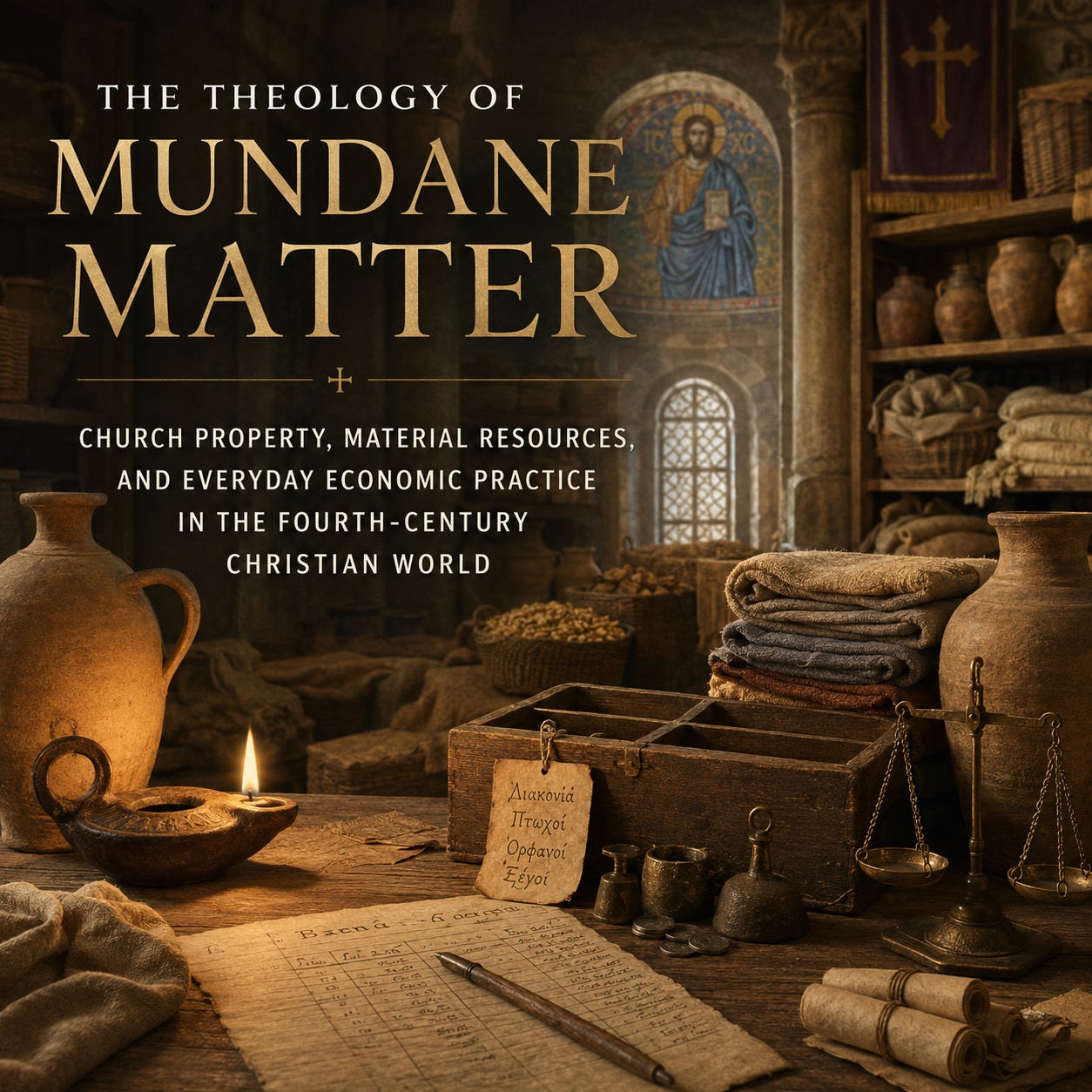
Yet the churches of late antiquity also had to obtain oil, store grain, repair roofs, maintain lamps, purchase cloth, protect land, record donations, support clergy, feed the poor, shelter strangers, and decide what could or couldn’t be sold.
These tasks rarely appear at the centre of theological history. They seem too ordinary. A container of oil doesn’t look as important as a creed. A storeroom doesn’t appear as spiritually significant as an altar. A receipt for wheat seems less revealing than a bishop’s sermon.
But Christianity was lived through material things.
Every church building needed maintenance. Every lamp required fuel. Every charitable distribution depended on something being collected, stored, counted, and delivered. Gifts had to be accepted or refused. Property had to be distinguished from the personal possessions of bishops. Church revenues had to be protected from theft. Someone had to decide who received food, money, clothing, shelter, or medical care.
The theology of the late-antique church therefore appeared not only in councils and sermons, but also in receipts, storerooms, inventories, lamps, estates, workshops, kitchens, and distributions to the poor.
The management of mundane matter was never merely mundane.
A Material Church
Christianity emerged with a powerful language of spiritual transformation. Christians spoke of the kingdom of God, eternal life, resurrection, holiness, and a new creation. Yet Christian communities couldn’t exist without physical resources.
They needed places to gather. They used bread and wine in the Eucharist, water in baptism, oil in anointing and lighting, textiles in worship and charity, and books or scrolls for public reading. They buried the dead, assisted widows, supported orphans, cared for travellers, and provided relief during famine, disease, and displacement.
As Christianity became more publicly established during the fourth century, these responsibilities expanded. Churches received donations, land, buildings, valuable vessels, agricultural produce, and income from estates. Imperial favour increased the legal and economic position of many churches, while Christian giving gradually became an important form of late Roman philanthropy. This didn’t simply replace older civic generosity overnight. Christian charity and traditional civic benefaction continued to interact, overlap, and compete.
This expansion created a difficult question.
How could a community that preached detachment from wealth become a significant owner and administrator of property?
The answer wasn’t to pretend that material resources didn’t matter. The church instead tried to redefine their purpose. Property could be possessed, but it was to be treated as entrusted property. Wealth could be received, but it carried obligations. Goods could support worship, but they also had to serve the poor. Authority over resources was permitted, but it was subject to accountability before God and the community.
Late-antique church economics developed within this tension between possession and stewardship.
When Property Became Sacred
Once an object, building, estate, or donation was given to a church, its status changed. It might still consist of ordinary stone, metal, wood, cloth, grain, or money, but it no longer belonged to a private individual in the same way.
It had entered a communal and sacred economy.
This didn’t necessarily mean that every church object was ritually holy. It meant that church property had been separated for an ecclesial purpose. It could support worship, clergy, buildings, strangers, widows, or the poor. Its use was therefore limited by the intention of the gift and by the responsibilities of the church.
The Canons of Antioch, issued in 341, reveal how seriously these distinctions were taken. Canon 24 required church property to be clearly known to the presbyters and deacons. The bishop retained authority over its administration, but the property couldn’t remain hidden or confused with his personal possessions. The purpose was practical: when a bishop died, church goods shouldn’t disappear, and his family shouldn’t become involved in disputes over which property belonged to whom.
This rule exposes a world in which ecclesiastical property could be lost, concealed, inherited improperly, or privately appropriated. It also shows that the church understood accounting as a moral responsibility.
A bishop’s private property could be left to his family or other beneficiaries. Church property had to remain with the church.
The distinction protected both sides. It prevented the church from taking what belonged to the bishop’s relatives, and it prevented relatives or successors from taking what belonged to the community. Material clarity served justice.
Another canon addressed church property sold by presbyters while no bishop was present. Such sales could be reversed, with the bishop determining how the matter should be resolved. The rule suggests that church assets weren’t treated as ordinary commodities available for any cleric to sell at will. Their disposal required legitimate authority and consideration of the church’s long-term interest.
These regulations weren’t abstract legal exercises. They arose because real communities faced real temptations, disputes, shortages, and administrative failures.
Theology entered the issue through the belief that God remained the ultimate judge of those who handled the community’s resources.
The Bishop as Steward
Late-antique bishops weren’t only preachers and theological teachers. They often carried extensive administrative responsibilities.
A bishop might oversee church income, clergy support, building maintenance, charitable distributions, hospitality, burial assistance, and the management of land or donations. In some cities, episcopal administration became a substantial institution within the urban economy.
The Apostolic Constitutions, compiled in the late fourth century, presents the bishop as a distributor of offerings and a guardian of resources intended for vulnerable people. Offerings were to support orphans, widows, the afflicted, and strangers in distress. The bishop administered them under the conviction that God would examine his accounts.
That language is significant.
The bishop wasn’t simply accountable to donors, clergy, or civic authorities. He was accountable to God. Economic administration became a spiritual duty because the goods under his care had been entrusted for the service of others.
This ideal didn’t guarantee honest administration. Indeed, the repeated warnings against greed, partiality, and misappropriation suggest that abuse was possible. Bishops were warned not to admire the rich, hate the poor, pursue money, or become entangled in financial conflict.
The sources preserve an ideal of episcopal stewardship precisely because the office carried economic power.
A bishop might receive gifts from wealthy donors while deciding how much reached people in need. He could become the point at which sacred authority, social prestige, and material control met. Christian writers therefore tried to surround episcopal administration with moral restrictions.
The bishop wasn’t supposed to be the owner of the church’s wealth. He was its steward.
The Emergence of the Oikonomos
As ecclesiastical property became more complex, bishops needed specialised assistance.
The office of the oikonomos—a steward or administrator of ecclesiastical goods—developed within the Eastern church. The word referred broadly to someone responsible for managing a household. Within ecclesiastical administration, the church itself became the household whose resources required supervision.
By the fifth century, the importance of this office was formally recognised. Canon 26 of the Council of Chalcedon required churches with bishops to appoint an oikonomos from among the clergy to administer ecclesiastical property under episcopal authority. The canon responded directly to accusations that church property was being mishandled.
The development of this office reveals an important transition.
Spiritual authority alone wasn’t considered sufficient for increasingly complex administration. The church needed identifiable officers, delegated duties, records, and systems of accountability.
This wasn’t the abandonment of theology in favour of bureaucracy. It was an attempt to embody theological responsibility through institutional practice.
A belief in stewardship had to become a procedure.
A concern for the poor had to become a distribution system.
A prohibition against theft had to become an inventory.
A commitment to transparency had to become a record of income and expenditure.
The oikonomos stood at the meeting point between theological principle and administrative reality.
Oil, Lamps, and the Material Cost of Worship
Christian worship depended on ordinary consumable goods.
Oil was needed for lamps. Bread and wine were required for the Eucharist. Water had to be accessible for baptism. Textiles clothed ministers, covered sacred spaces, and assisted the poor. Buildings needed timber, stone, metal fittings, doors, roofs, and repairs.
These resources weren’t endlessly available. Their supply depended on agriculture, trade, donors, labour, transport, and local environmental conditions.
Light provides a particularly revealing example.
A burning lamp carried rich Christian symbolism. Christ was proclaimed as the light of the world. Believers were told to shine before others. Lamps appeared in biblical parables, liturgical spaces, vigils, tombs, and commemorations.
But symbolic light required physical fuel.
Someone had to cultivate or purchase oil, transport it, store it, protect it from contamination, fill the lamps, trim the wicks, and replace damaged vessels. A spiritual image depended on an economic chain.
Later evidence shows how important oil and wax became in sustaining Christian lighting practices, especially when suitable fuel was scarce or expensive. Church authorities and patrons could gain prestige by providing lights, while ordinary donors also participated by contributing to their maintenance.
The exact scale and organisation of fourth-century church lighting varied by region, and evidence concerning specific inventories is uneven. We shouldn’t imagine that every congregation possessed elaborate supplies or permanent illumination. Still, the larger point remains: Christian worship transformed material resources into liturgical experience.
Oil could become light.
Grain could become Eucharistic bread or relief for the hungry.
Metal could become a vessel, fitting, tool, or object of exchange.
Cloth could become liturgical furnishing or clothing for someone in need.
Material goods didn’t lose their physical character. Their meaning changed through use.
Gifts That Couldn’t Be Accepted
The church’s material economy wasn’t only concerned with how resources were spent. It also asked where they came from.
The Apostolic Constitutions warns church leaders against accepting offerings from people whose wealth was connected with serious wrongdoing or exploitation. The concern was that resources couldn’t be separated entirely from the moral character of their acquisition.
A gift wasn’t automatically purified by being donated.
This principle created difficult practical tensions. Poor communities needed resources. Bishops required money to support worship and charity. Wealthy donors could provide buildings, land, food, or income. Yet accepting every gift risked allowing powerful people to purchase honour, avoid repentance, or legitimise injustice.
The source even distinguishes between using certain unwanted funds for necessities such as wood and fuel rather than food, reflecting an effort—however unfamiliar its logic may seem today—to prevent morally compromised wealth from directly feeding the ministers of the church.
The deeper issue was theological.
Could unjust wealth become holy simply by entering the church?
Late-antique Christian writers often answered cautiously. Generosity mattered, but repentance mattered too. A donation couldn’t replace justice. Church leaders were expected to examine both the giver and the gift.
This was an early form of ethical resource policy.
It recognised that stewardship begins before money reaches the storeroom.
Storerooms and the Poor
Christian charity is often remembered through sermons about generosity. Yet generosity required organisation.
Food had to be collected before it could be distributed. Clothing had to be stored. Lists or local knowledge were needed to identify widows, orphans, strangers, prisoners, the sick, and those unable to work. Resources had to be rationed when needs exceeded supply.
The church’s charitable identity therefore depended upon material administration.
The Apostolic Constitutions describes offerings being directed toward orphans, widows, afflicted people, and strangers. It also calls upon Christian households to receive and care for orphans rather than leaving all responsibility to ecclesiastical officers.
This indicates that Christian welfare wasn’t confined to one central institution. It involved bishops, deacons, donors, households, widows, and other members of the community.
Nevertheless, as churches accumulated property and regular income, their capacity for organised charity increased. Christian gifts took many forms: alms given directly, offerings entrusted to churches, funds for clergy and the poor, and donations toward buildings and institutions. These exchanges linked spiritual motives to measurable material consequences.
This created another theological tension.
Was church property primarily for worship, institutional continuity, or relief of suffering?
Late-antique sources don’t give one simple answer. Buildings had to be maintained. Clergy needed support. Worship required supplies. Yet the poor remained a central theological claim upon the church’s resources.
The material church existed for more than its own preservation.
Basil of Caesarea and the Morality of Stored Wealth
Basil of Caesarea offers one of the strongest late-fourth-century examples of the relationship between theology and material need.
During severe famine in Cappadocia, Basil confronted wealthy people who stored grain while others suffered. His preaching treated unused surplus not as morally neutral private property, but as a resource carrying obligations toward those in need.
Basil’s argument was rooted in creation and providence. God had provided the earth’s goods for human life. The person who accumulated far beyond necessity while neighbours starved had misunderstood ownership.
Possession didn’t erase responsibility.
Basil’s charitable activity also moved beyond rhetoric. He helped organise relief during the famine and later became associated with a large complex outside Caesarea that served travellers, the poor, and the sick.
This combination of preaching and institution is crucial.
It’s easier to condemn greed in a sermon than to create a functioning system of care. A relief centre required land, buildings, food, workers, kitchens, beds, medical attention, transport, and continuing support.
Theology had to become architecture.
Compassion had to become logistics.
The poor couldn’t eat a moral principle. The sick couldn’t sleep beneath a doctrine. Spiritual conviction had to take material form.
Reuse, Repair, and Disposal
The surviving evidence doesn’t allow us to reconstruct every ordinary decision made about damaged vessels, used oil containers, broken fittings, worn textiles, surplus materials, or scrap metal in every fourth-century church.
This limitation matters.
It would be tempting to claim that early churches developed formal recycling systems similar to later ecclesiastical economies. But the evidence is fragmented, regionally uneven, and often preserved through legal disputes or exceptional documents rather than complete inventories.
Still, several reasonable observations can be made.
Ancient societies routinely repaired, reused, melted down, resold, and repurposed valuable materials. Metal was especially recoverable. Textiles could be altered or redistributed. Building materials were frequently reused. Containers circulated through households and markets. Churches operated within these wider economic practices.
Once such goods became church property, however, their reuse or sale could raise questions of authority and purpose.
Who could decide that an object was no longer needed?
Could a damaged sacred vessel be sold or melted down?
Could property be alienated to meet urgent charitable need?
Did the original donor’s intention limit how an item could be reused?
The canons concerning unauthorised sales show that disposal wasn’t an insignificant matter. A practical decision about an object could become a dispute over sacred ownership, episcopal power, communal accountability, and the rights of the poor.
The evidence invites careful study, but it also requires restraint. We can establish that late-antique churches regulated property, income, gifts, and distributions. We can’t automatically reconstruct every stage of a complete ecclesiastical recycling economy.
The gaps themselves tell us something. Historians often inherit the documents institutions considered worth preserving. The disappearance of countless everyday records doesn’t mean ordinary material practices were unimportant. It means the most routine labour often left the weakest literary trace.
Women, Households, and Hidden Material Labour
Formal canons concentrate heavily on bishops, presbyters, deacons, and ecclesiastical officers. But much of the practical work that sustained Christian communities occurred in households and informal networks.
Women prepared food, produced and repaired textiles, received travellers, cared for sick relatives and neighbours, supported ascetics, donated property, and organised charitable relationships. Widows could be recipients of assistance, but some also occupied recognised positions of service within Christian communities.
Wealthy Christian women sometimes redirected substantial fortunes toward monasteries, churches, pilgrims, and the poor. Their giving could express genuine ascetic conviction while also carrying social and economic consequences. Studies of figures such as Melania the Elder and Melania the Younger show how renunciation, charity, status, and economic power could remain intertwined.
Less wealthy women also contributed labour that rarely appears in formal records.
The history of church property can therefore become distorted when it follows only titled officeholders. A bishop might officially control a distribution, but many unnamed people prepared, stored, carried, repaired, cooked, cleaned, and delivered the goods.
Mundane matter reveals hidden labour.
Behind every recorded donation stood an unrecorded chain of human work.
What Material Administration Reveals About Theology
The material economy of the late-antique church expressed several important theological convictions.
Stewardship
Church property was understood as entrusted rather than privately owned. Bishops and stewards possessed authority over resources, but that authority was morally limited.
Accountability
The distinction between personal and ecclesiastical property protected the church, officeholders, families, and donors. Transparency wasn’t merely efficient. It was just.
Sacred purpose
Ordinary materials could receive a new communal purpose. Oil, grain, cloth, land, buildings, and money became part of worship, hospitality, charity, and institutional life.
Care for the poor
The poor weren’t incidental beneficiaries of surplus wealth. They were treated as a central claim upon Christian giving and ecclesiastical resources.
Moral limits on wealth
Not every gift was acceptable. The source of wealth, the conduct of the giver, and the danger of exploitation mattered.
Institutional responsibility
Compassion required systems. Christian concern for vulnerable people generated offices, procedures, buildings, distributions, and records.
These principles didn’t always produce justice. Church leaders could misuse wealth, favour donors, protect institutions, or neglect those in need. The existence of corrective canons proves that theological ideals and economic conduct didn’t always agree.
Yet this tension is precisely why the material history matters.
It shows where Christianity was tested.
Beyond Creeds and Councils
Theological history often privileges words because words survive. Creeds can be copied. Sermons can be collected. Doctrinal controversies produce letters, treatises, and conciliar records.
A used oil jar rarely preserves its story.
A repaired roof leaves no theological argument.
A meal given to a hungry widow may disappear without a written trace.
But these acts formed the daily life of Christianity.
Late-antique believers didn’t encounter theology only through definitions of divine nature. They encountered it when a church fed them, denied them, welcomed them, employed them, buried their relatives, protected a donation, repaired a building, or decided how communal goods would be used.
Theology became visible in administration.
A bishop who kept church property separate from his own enacted a doctrine of stewardship.
A community that stored grain for famine relief enacted a doctrine of neighbourly love.
A steward who recorded income honestly enacted a doctrine of accountability.
A donor who gave without purchasing honour enacted a doctrine of grace.
A church that maintained beautiful worship while ignoring the hungry exposed a contradiction between its liturgy and its life.
The material practices of the church didn’t merely illustrate theology. They tested whether theology had become real.
The Faithfulness of Ordinary Things
Christian history can become distorted when it concentrates only on extraordinary people and events.
Most believers didn’t attend the great councils. They didn’t write theological treatises or advise emperors. Their Christianity was formed through local worship, work, family, illness, hunger, giving, receiving, and shared material life.
They brought bread.
They filled lamps.
They carried water.
They repaired cloth.
They stored grain.
They opened homes.
They distributed food.
They counted offerings.
They buried the dead.
They maintained the physical world in which Christian worship and charity became possible.
The theology of mundane matter reminds us that faith is always embodied. Churches can speak about love, justice, holiness, and stewardship, but those words eventually reach a storeroom, a budget, a building, a meal, or a human body.
Late-antique Christianity was expressed not only through what its leaders confessed, but through what its communities collected, protected, consumed, repaired, refused, and shared.
The lamp needed oil.
The hungry person needed bread.
The stranger needed shelter.
The church’s answer revealed what it truly believed.
Bibliography
Basil of Caesarea. Homily 6: I Will Tear Down My Barns. In Saint Basil: Exegetic Homilies. Translated by Agnes Clare Way. Washington, DC: Catholic University of America Press, 1963.
Brown, Peter. Poverty and Leadership in the Later Roman Empire. Hanover, NH: University Press of New England, 2002.
Caner, Daniel. The Rich and the Pure: Philanthropy and the Making of Christian Society in Early Byzantium. Oakland: University of California Press, 2021.
Finn, Richard. Almsgiving in the Later Roman Empire: Christian Promotion and Practice, 313–450. Oxford: Oxford University Press, 2006.
Graham, Benjamin. “Olives and Lighting in Dark Age Europe.” Early Medieval Europe 28, no. 3 (2020): 344–366.
Holman, Susan R. The Hungry Are Dying: Beggars and Bishops in Roman Cappadocia. Oxford: Oxford University Press, 2001.
Jones, A. H. M. The Later Roman Empire, 284–602: A Social, Economic and Administrative Survey. 2 vols. Oxford: Basil Blackwell, 1964.
Kahlos, Maijastina. Religious Dissent in Late Antiquity, 350–450. Oxford: Oxford University Press, 2020.
Mayer, Wendy. “Poverty and Generosity Towards the Poor in the Time of John Chrysostom.” In Wealth and Poverty in Early Church and Society, edited by Susan R. Holman, 140–158. Grand Rapids: Baker Academic, 2008.
Platte, Elizabeth L. “Monks and Matrons: The Economy of Charity in the Late Antique Mediterranean.” PhD diss., University of Michigan, 2013.
Rapp, Claudia. Holy Bishops in Late Antiquity: The Nature of Christian Leadership in an Age of Transition. Berkeley: University of California Press, 2005.
Salzman, Michele Renee. “From a Classical to a Christian City: Civic Euergetism and Charity in Late Antique Rome.” Studies in Late Antiquity 1, no. 1 (2017): 65–85.
Sotinel, Claire. “The Christian Gift and Its Economic Impact in Late Antiquity.” In The Gift in Antiquity, edited by Michael L. Satlow. Chichester: Wiley-Blackwell, 2013.
Sterk, Andrea. Renouncing the World Yet Leading the Church: The Monk-Bishop in Late Antiquity. Cambridge, MA: Harvard University Press, 2004.
The Apostolic Constitutions. In Ante-Nicene Fathers, vol. 7, edited by Alexander Roberts and James Donaldson. Buffalo, NY: Christian Literature Publishing, 1886.
The Canons of the Council of Antioch. In Nicene and Post-Nicene Fathers, second series, vol. 14, edited by Philip Schaff and Henry Wace. Buffalo, NY: Christian Literature Publishing, 1900.
The Canons of the Council of Chalcedon. In Nicene and Post-Nicene Fathers, second series, vol. 14, edited by Philip Schaff and Henry Wace. Buffalo, NY: Christian Literature Publishing, 1900.
Daniel J. Grace
Independent Researcher
ORCID: https://orcid.org/0000-0002-9259-8032
Website:
https://danieljamesgrace.com
https://faithcivilizationtheology.com/
Faith • Civilization • Theology
Zenodo DOI: 10.5281/zenodo.21661373
Published: 29 July 2026
Article Type: Research Article