The Theology of Attention
How the Digital Age Is Discipling the Church Before the Church Disciples Anyone

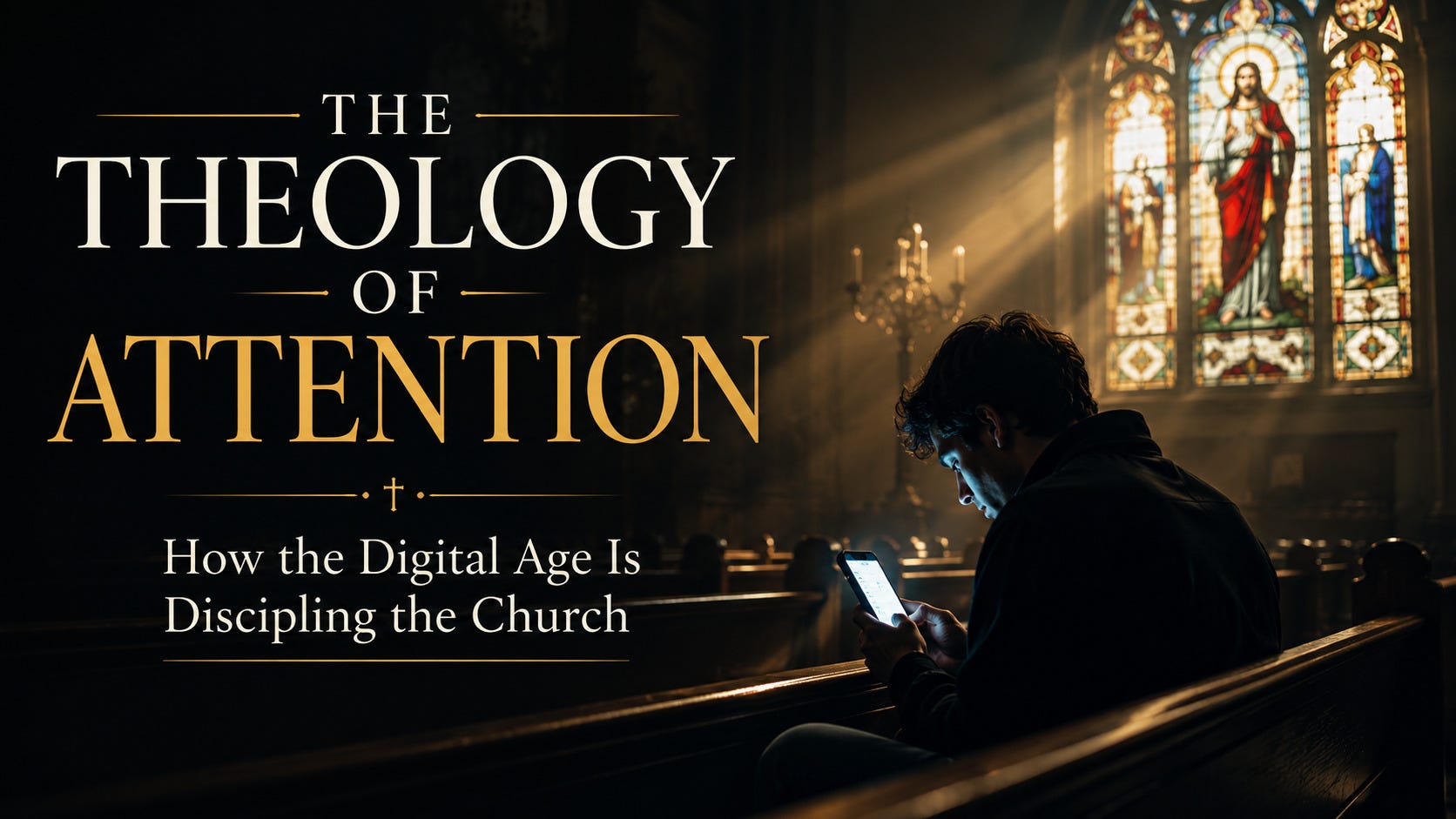
The Theology of Attention
How the Digital Age Is Discipling the Church Before the Church Disciples Anyone
The modern church often worries about losing people’s attention.
That fear is understandable.
Congregations are smaller in many places. Sermons compete with podcasts, streaming platforms, short-form video, political commentary, sports, gaming, and an endless flow of notifications. Church leaders know that people can leave a service mentally long before they leave the building.
So churches adapt.
They shorten sermons. They improve lighting. They build media teams. They study engagement. They learn what makes people click, share, stay, and return.
Some of this is wise.
Communication matters. Clarity matters. Good technology can help the church teach, worship, and reach people who would otherwise remain distant.
But there is a deeper problem.
The church is not merely competing for attention.
It is being formed by the systems that organise attention.
That difference matters.
The digital age does not simply offer new tools. It trains people to see, desire, compare, react, and judge in particular ways. It rewards speed. It intensifies emotion. It favours novelty. It pushes what is immediate ahead of what is enduring.
And churches are not immune.
The question is no longer only whether the church can hold attention.
The more serious question is this:
What kind of attention is the church teaching people to give?
Attention Is Never Neutral
Attention is often treated as a practical issue.
How do we keep people engaged?
How do we prevent distraction?
How do we make the sermon more memorable?
But attention is theological.
What we repeatedly attend to begins to shape what we love. What we love begins to shape what we become.
Augustine understood this long before the internet. Human beings are not only thinking creatures. We are desiring creatures. We move toward what we love. Our habits train those loves, often before we are fully conscious of what is happening.
The digital environment intensifies this formation.
A person opens a phone to check one message. Ten minutes later, the mind has passed through grief, comedy, outrage, advertising, envy, politics, worship music, and a video of someone making coffee.
Nothing has been held long enough to become wisdom.
Everything has been felt just long enough to create a reaction.
That is not merely distraction.
It is a way of life.
It trains the soul to expect constant stimulation. It weakens patience. It makes silence uncomfortable. It teaches us to move on before truth has had time to wound, heal, or transform us.
The church may condemn the content of digital culture while quietly adopting its habits.
That is the contradiction.
The Church Can Use Digital Tools and Still Be Used by Them
Technology is not morally simple.
A livestream can bring worship to someone who is sick.
A podcast can teach Scripture across continents.
A short video can introduce a person to the gospel.
A private online group can connect isolated believers.
These are real goods.
Yet tools also shape their users.
A platform built around attention capture does not become neutral because a Christian uses it. The church may carry the gospel into digital spaces, but those spaces still carry their own logic into the church.
That logic rewards:
speed over patience;
reaction over reflection;
personality over community;
visibility over faithfulness;
certainty over humility;
novelty over memory;
performance over presence.
The danger is subtle.
A church may begin by using social media to communicate.
Soon, communication becomes branding.
Branding becomes identity.
Identity becomes performance.
Then leaders start asking not only what is true but also what will travel.
Not only what people need, but also what they will share.
Not only what forms disciples but also what retains attention.
The shift can happen without anyone announcing it.
It often sounds like strategy.
Jesus Refused the Logic of Attention Capture
The ministry of Jesus was public.
Crowds followed him. People spoke about him. His words spread.
Yet Jesus did not build his ministry around retaining attention.
He often did the opposite.
He withdrew.
He spoke difficult words.
He allowed crowds to leave.
He refused to turn bread into spectacle.
He would not perform on demand.
He did not confuse visibility with obedience.
This is one of the sharpest differences between the gospel and digital culture.
Digital systems are built to reduce friction. Jesus often created it.
He asked people to wait.
He told the rich young ruler to surrender what he loved most.
He spoke in parables that required patience.
He let silence stand.
He refused to turn every moment into immediate clarity.
In John 6, many disciples leave after a difficult teaching. Jesus does not soften the message to protect the numbers. He turns to the Twelve and asks whether they will leave too.
That is not indifference.
It is truthfulness.
Jesus loved people too much to manipulate them into staying.
The church should notice that.
The Attention Economy Rewards the Wrong Kind of Authority
Digital platforms create new forms of authority.
Visibility looks like credibility.
Confidence looks like competence.
Followers look like evidence.
Repetition creates familiarity, and familiarity often feels like trust.
This helps explain the rise of religious personalities whose influence exceeds their accountability.
People hear them daily.
They feel close to them.
They know their voice, humour, opinions, family stories, frustrations, and preferences.
But mediated familiarity is not the same as a relationship.
A person can appear transparent while remaining unaccountable.
A leader can speak about vulnerability while controlling the narrative.
A ministry can seem personal while being structured around distance.
This matters because Christian authority is not meant to rest on visibility alone.
The New Testament links authority to character, truth, service, suffering, and responsibility within a community.
Digital authority often bypasses these tests.
A person can become spiritually influential without being known by a church, corrected by elders, tested over time, or trusted in ordinary relationships.
That should concern us.
The church does not need fewer voices.
It needs better ways of discerning which voices deserve trust.
Attention and the Loss of Depth
Christian faith depends on practices that resist speed.
Prayer is slow.
Repentance is slow.
Forgiveness is slow.
Spiritual maturity is slow.
Learning Scripture is slow.
Deep community is slow.
The kingdom of God often grows beneath visibility.
A seed enters the ground.
Yeast works through dough.
A shepherd searches for one sheep.
A father waits for a son to return.
These images do not fit the rhythm of constant acceleration.
They teach patience.
They assume hiddenness.
They reject the demand for immediate proof.
The church cannot form people deeply if it adopts the pace of the feed.
A sermon clip may inspire.
It cannot replace sustained teaching.
A comment section may connect.
It cannot replace embodied community.
A viral moment may awaken interest.
It cannot carry the weight of discipleship.
The church should use short forms carefully, but it must not become short-form in spirit.
The gospel needs room.
Truth needs time.
People need more than religious stimulation.
They need formation.
The Liturgical Power of Repetition
Digital culture prizes the new.
The church has always known the power of repetition.
Creeds are repeated.
Prayers are repeated.
Scripture is read again.
The Lord’s Supper returns.
The church year circles through Advent, Christmas, Lent, Easter, Pentecost, and Ordinary Time.
This repetition is not empty.
It forms memory.
It teaches the body.
It slows the mind.
It places the believer inside a story larger than the present moment.
Digital repetition works differently.
It repeats what provokes.
It reinforces what keeps attention.
It learns what angers, excites, frightens, or flatters the user.
Then it offers more.
Christian repetition should not trap people inside themselves.
It should lead them beyond themselves.
The repeated prayer teaches humility.
The repeated confession teaches truthfulness.
The repeated table teaches dependence.
The repeated gospel teaches grace.
The church must recover confidence in these slow forms of formation.
They may not feel impressive.
That does not make them weak.
What Churches Should Measure Instead
Churches will continue to measure engagement.
That is not the main problem.
The problem is allowing engagement to become the final measure.
A church should ask more demanding questions.
Are people becoming more patient?
Are they more capable of silence?
Can they remain present with suffering?
Are they learning to listen without preparing a reply?
Can they resist outrage?
Do they know Scripture beyond isolated verses?
Are they becoming less dependent on personality?
Are they able to love people who do not affirm them?
These are not easy to measure.
They are still more important than clicks.
A church may have high engagement and shallow formation.
It may have a large audience and little community.
It may have strong visibility and weak spiritual resilience.
Theology must interpret the numbers.
Numbers cannot interpret theology.
A Church of Holy Attention
The church does not need to retreat from digital life.
It needs to enter it without surrendering its soul.
That will require discipline.
Churches should create spaces where people are not constantly stimulated.
They should protect silence.
They should preach long enough for thought to deepen.
They should resist turning every sermon into content.
They should allow some acts of faithfulness to remain unseen.
They should teach people to read whole books of Scripture.
They should remind congregations that not everything valuable is shareable.
They should form leaders whose authority does not depend on constant visibility.
And they should recover the Christian practice of attending to the person in front of them.
That may be the most radical act of all.
To listen without checking a screen.
To pray without broadcasting it.
To serve without documenting it.
To remain when nothing dramatic is happening.
To give attention without demanding attention in return.
This is not withdrawal.
It is discipleship.
The Final Question
The digital age asks:
What can hold attention?
The gospel asks:
What is worthy of attention?
Those are not the same questions.
The church will lose its way if it becomes skilled at capturing attention but forgets how to direct attention toward Christ.
The task is not merely to be seen.
It is to teach people how to see.
Not merely to speak.
But to form people who can listen.
Not merely to reach.
But to remain.
The future of Christian witness may depend less on whether the church can compete with the noise and more on whether it can offer something the noise cannot.
Presence.
Patience.
Truth.
Silence.
Love.
And a life centred on Christ.
Author Note
Daniel J. Grace is an Australian independent researcher, journalist, and Christian writer. His research focuses on biblical theology, practical theology, ecclesiology, church leadership, and Christianity in the contemporary world.
ORCID: https://orcid.org/0000-0002-9259-8032.
© 2026 Daniel J. Grace. All rights reserved.
Originally published on Daniel J. Grace’s Substack. For more articles on Christian faith, biblical theology, church history, and discipleship, visit: