
The Seven Churches of Revelation: Christianity’s Rise, Transformation, and Survival in Anatolia
The Seven Churches of Revelation: Christianity's Rise, Transformation, and Survival in Anatolia

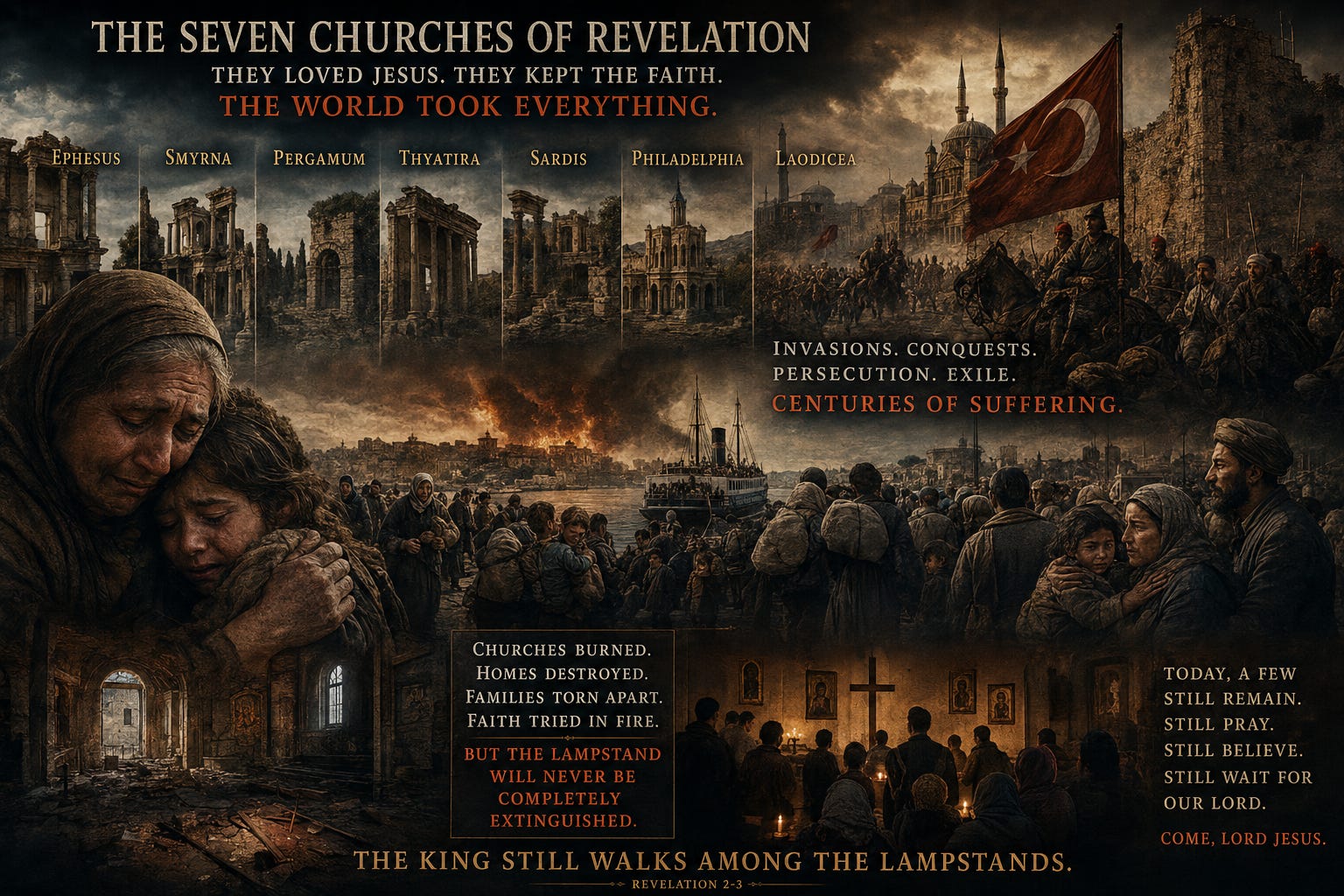
How Conquest, Empire, War, and Population Upheaval Changed the Land of the Seven Churches
Welcome, friend.
If you’ve been following this series on the Seven Churches of Revelation, you’ve already discovered that Ephesus, Smyrna, Pergamum, Thyatira, Sardis, Philadelphia, and Laodicea were far more than names on an ancient map. They were living communities of faith. They were fathers and mothers, merchants and craftsmen, widows and children. They gathered in homes, broke bread together, prayed for one another, and listened as the words of Jesus were read aloud from John’s Revelation.
For centuries, these churches flourished across what is now western Türkiye. Their bishops helped shape Christian doctrine. Their martyrs inspired generations. Their cities became centers of worship, learning, and pilgrimage.
Yet history rarely stands still.
The story of the Seven Churches after the Book of Revelation is not simply a story of growth. It is also a story of conquest, migration, political change, cultural transformation, and survival against enormous odds.
This article is not about blaming modern peoples or nations. The history of Anatolia is complex, involving Byzantines, Seljuks, Crusaders, Mongols, Ottomans, Greeks, Armenians, Turks, Arabs, and many others. Entire populations experienced suffering, displacement, and loss.
Rather, this is the story of what happened to the Christian communities that once burned brightly in the land of the lampstands.
It is a story of faith under pressure.
It is a story of ordinary believers trying to preserve their identity while the world around them changed.
And it is a reminder that while cities rise and fall, Christ remains faithful to His Church.
When the Lampstands Burned Bright
Imagine Ephesus around AD 100.
The Apostle John is old now. The church gathers quietly. Bread is broken. Psalms are sung. Prayers rise like incense.
Across Asia Minor, Christianity is growing.
In Smyrna, believers remember Polycarp’s courage.
In Pergamum, Christians worship under the shadow of pagan temples.
In Thyatira, tradespeople meet after long days of work.
In Philadelphia, families cling to Christ’s promise that an open door has been set before them.
These churches were not wealthy or powerful by worldly standards. Yet they possessed something far greater: hope.
Over the following centuries, Christianity spread throughout Anatolia. Magnificent churches replaced former temples. Pilgrims traveled from distant lands. Bishops from these cities participated in the great councils that helped define Christian doctrine.
To many believers, it must have seemed that Christianity would remain the dominant faith of the region forever.
History had other plans.
The Seljuk Arrival and a Changing World
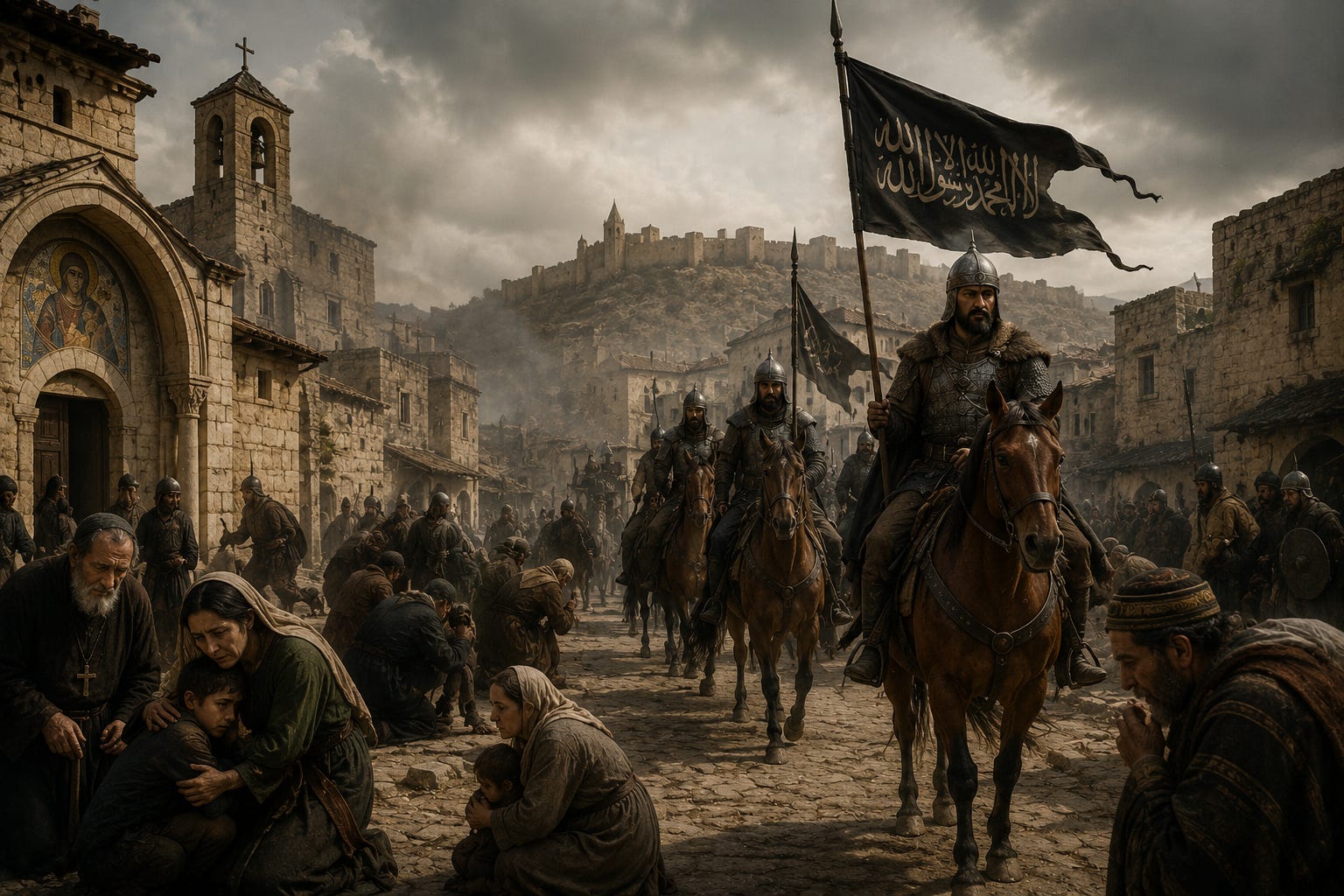
The turning point came in the eleventh century.
In 1071, Byzantine forces suffered a devastating defeat at the Battle of Manzikert.
The consequences were enormous.
Turkic groups from Central Asia gradually established themselves across much of Anatolia. New rulers, new languages, and new cultures entered regions that had been predominantly Greek-speaking and Christian for centuries.
The transformation was not immediate.
Many Christians remained in their towns and villages.
Some continued farming the same land their ancestors had cultivated for generations.
Church bells still rang.
Priests still celebrated the Eucharist.
Families still baptized their children.
Yet life became increasingly difficult for many Christian communities.
Some paid special taxes as non-Muslims.
Others experienced social and economic pressures.
Some converted over time, whether through conviction, opportunity, or necessity.
The process varied from region to region and from century to century.
The lampstands did not suddenly disappear.
Rather, their light slowly grew dimmer.
Philadelphia: The Last Lampstand
Among the Seven Churches, Philadelphia proved remarkably resilient.
Surrounded by Turkish-controlled territories, the city endured for generations after neighboring Christian strongholds had fallen.
Its people rebuilt after earthquakes.
They defended their walls.
They preserved their faith.
Historians sometimes describe Philadelphia as one of the last significant Byzantine Christian outposts in western Anatolia.
When the city eventually came under Turkish rule in the late fourteenth century, its long resistance became legendary.
The promise Jesus gave Philadelphia—”you have little strength, yet you have kept My word”—seemed almost prophetic.
Their endurance became a symbol of Christian perseverance.
Centuries Under Ottoman Rule
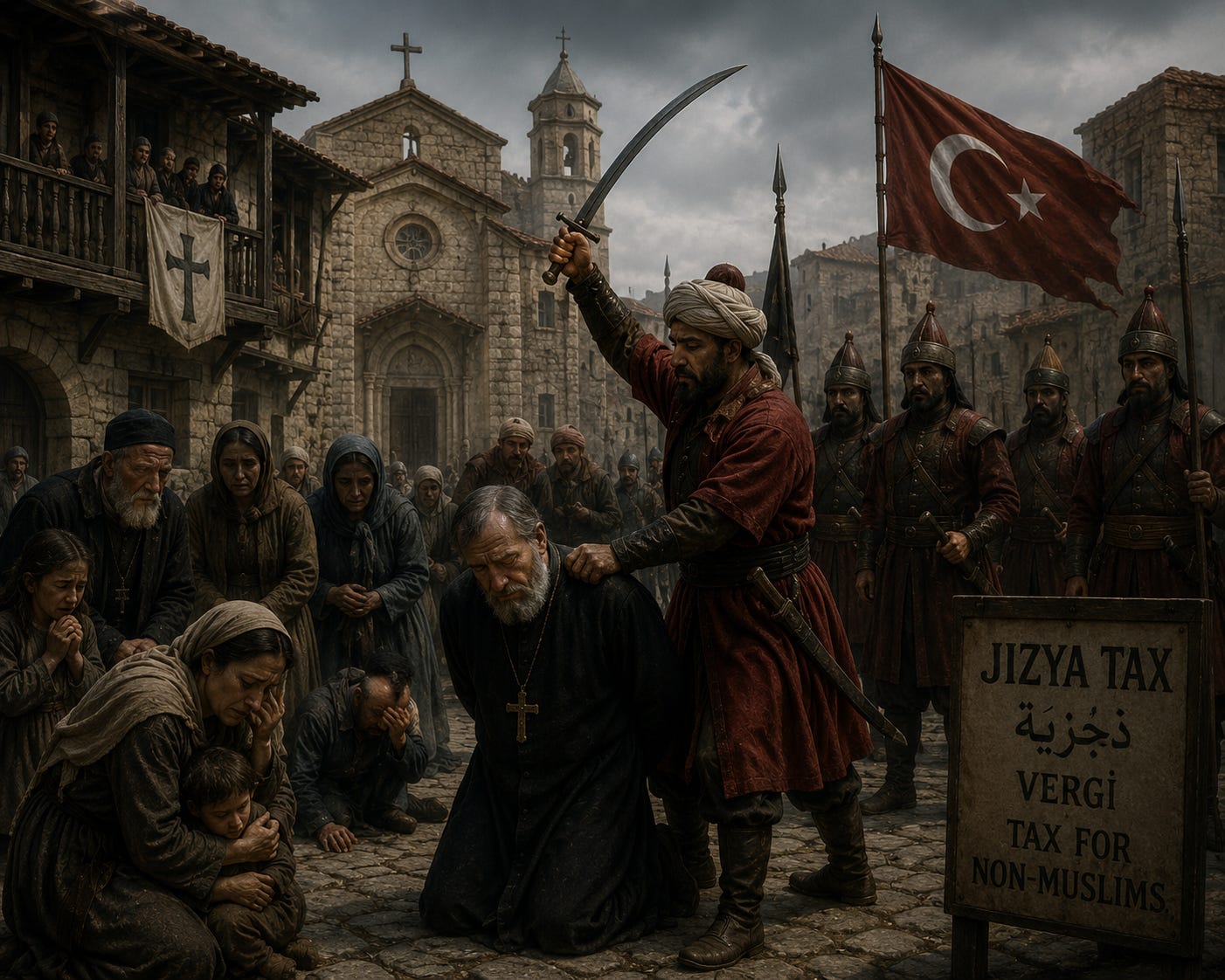
When the Ottoman Empire emerged, a new chapter began.
Christian communities continued to exist throughout the empire.
Greeks, Armenians, Syriacs, and others maintained churches, schools, monasteries, and traditions.
Life was often difficult, but Christian faith survived.
Families baptized children.
Priests celebrated the liturgy.
Churches preserved ancient languages and traditions.
For many believers, daily life involved balancing loyalty to their faith with the realities of living as religious minorities.
Some periods were relatively peaceful.
Others brought tension and hardship.
The experience varied greatly depending on the time, place, and local authorities.
Yet through it all, Christianity remained present.
The lampstands still flickered.
Smyrna and the Tragedies of the Twentieth Century
The final great transformation came during the collapse of the Ottoman Empire.
War, nationalism, revolution, and competing visions for the future reshaped the entire region.
Few cities illustrate this tragedy more clearly than Smyrna.
For centuries Smyrna had been one of the most vibrant Christian centers in the eastern Mediterranean.
Greeks, Armenians, Jews, Turks, Europeans, and others lived side by side.
Churches, schools, businesses, and neighborhoods flourished.
Then came the events of 1922.
The Great Fire of Smyrna destroyed much of the city and created a humanitarian catastrophe.
Eyewitnesses described scenes of fear, chaos, and desperate attempts to escape.
Thousands died.
Many more became refugees.
Families that had lived in Anatolia for generations suddenly found themselves homeless.
The subsequent population exchange between Greece and Türkiye permanently altered the religious landscape.
Entire Christian communities departed.
Ancient neighborhoods emptied.
Churches that had served generations disappeared almost overnight.
For many Christians, it felt like the end of an era stretching back to the apostles.
The Lampstands Today
Yet the story does not end with ruins.
Today, Christianity remains a small minority faith in Türkiye.
Ancient Armenian, Greek Orthodox, Syriac, Catholic, and Protestant communities still exist.
New believers continue to come to faith.
Small congregations gather quietly in cities once associated with the Seven Churches.
In Izmir, ancient Smyrna’s successor, Christians still worship.
Near Ephesus, believers still read Paul’s letters.
In Pergamum and Philadelphia, visitors still remember the words of Revelation.
The numbers are small.
The challenges are real.
But the Gospel remains.
The lampstands may be smaller than they once were, yet the flame has never completely gone out.
Why This Story Matters
The history of the Seven Churches reminds us that no earthly institution is guaranteed permanence.
Cities rise and fall.
Empires come and go.
Borders change.
Languages disappear.
Yet Christ remains.
The same Lord who walked among the lampstands in Revelation still walks among His people today.
The Christians of Anatolia endured wars, invasions, political upheavals, economic pressures, discrimination, migration, and exile.
Many lost homes.
Many lost family members.
Some lost everything except their faith.
Yet their witness continues to speak across the centuries.
Perhaps that is the deepest lesson of all.
The true Church is not a building, a city, or an empire.
It is a people.
And wherever believers gather in the name of Christ—whether in a cathedral, a village chapel, a house church, or a living room—the light of the lampstand continues to shine.
The New Jerusalem is still coming.
And no conquest, empire, fire, or war can extinguish that hope.
Come, Lord Jesus.
Dr. Daniel J. Grace
Faith • Civilization • Theology
Research • Journalism • Truth
🌐 danieljamesgrace.com
© 2026 Dr. Daniel J. Grace. All Rights Reserved.
No part of this article may be reproduced, distributed, transmitted, or published in any form or by any means without prior written permission from the author, except for brief quotations used in academic citation, review, or research purposes.