The Scandal of the Incarnate Screen: Christ’s Flesh in a World of Digital Ghosts
A Christian reflection on embodiment, technology, and the God who came close enough to touch the wounded.

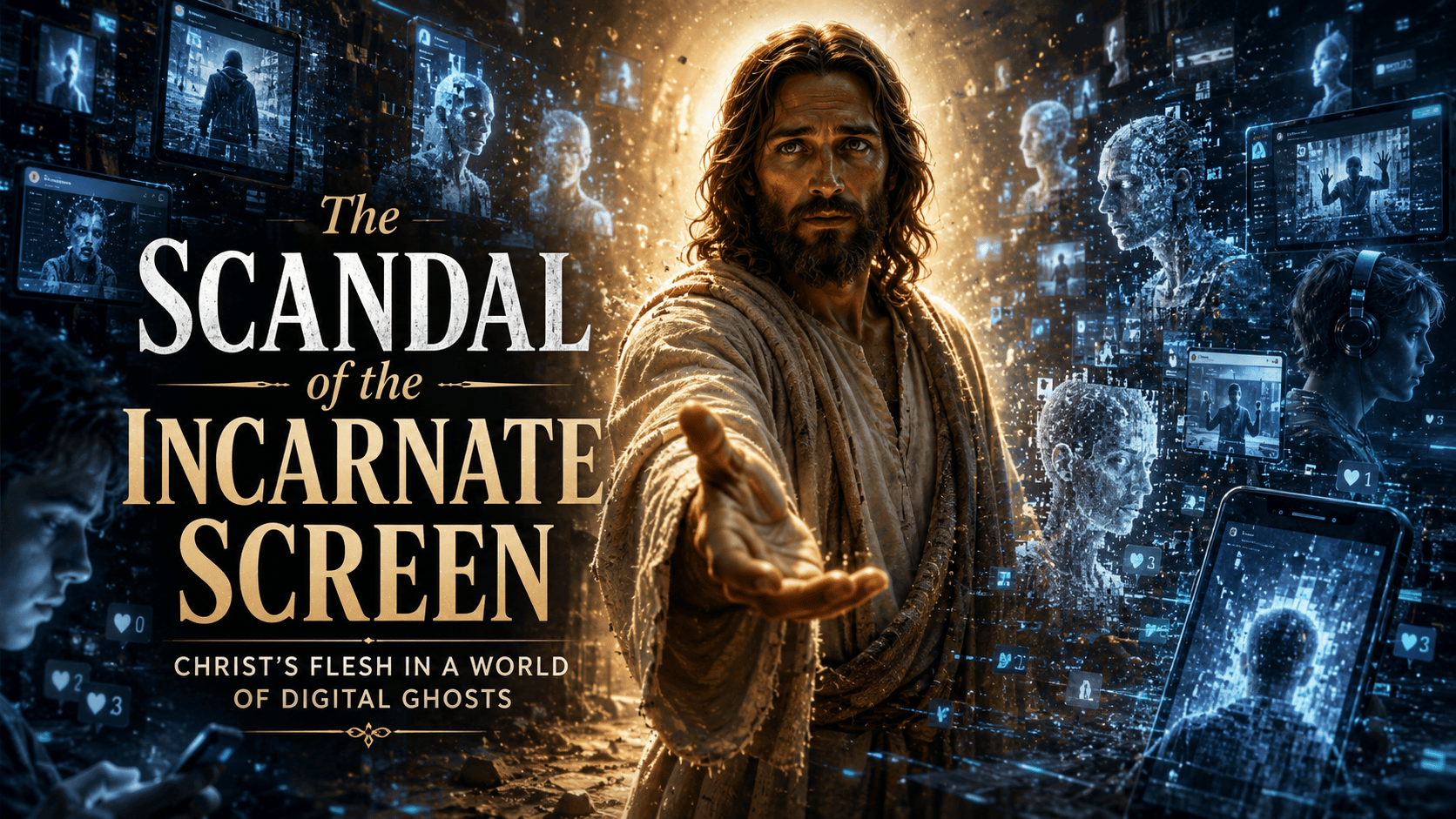
When screens make us ghosts, the Incarnation calls us back to flesh, presence, and costly love.
In a way, we are turning into ghosts with passwords.
I know it has a dramatic ring to it, but you need only look about you. Bodies are no longer required for much of what we do these days. We have profile pictures to speak for us and comments to argue through. Our love is expressed in hearts and emojis, our grief in posts, our confessions made from behind an anonymous handle. We befriend folks we have never put a hand on and let faceless voices be our guides.
Then there is artificial intelligence, which lets you hold a conversation with something that has the sound of presence but none of the substance. No breath to it. No skin or hunger or wounds. It has no mother and no dust on its feet.
We are making a strange world of it. I won’t stand here and cast the internet into the lake of fire; it is not all evil or without use. A digital tool can put the Scriptures in the hand of someone in a hospital at 2 in the morning, or carry a sermon across an ocean, or give voice to those who would otherwise be left out in the cold. God be thanked for that.
But there is a price to pay.
As life migrates to the screen, one can be forgiven for forgetting that Christianity is not some spiritual cloud or a religion of floating notions. It is not a brand, a feed, a livestream or a pithy quote set against a dark background.
It is rooted in the scandal of God taking on flesh. Real flesh.
The eternal Son didn’t just put out a statement. He came. He was born into the blood and crying and straw and smell and danger of it. He had hands and feet. He grew weary, he slept, he ate fish. He wept at a grave and made contact with people no one else would.
We have a habit of relegating the Incarnation to Christmas cards and the occasional doctrinal formulation. “The Word became flesh.” Fine words, true enough. But do they unsettle us? They should. For the Incarnation is a holy interruption, a protest against being saved from afar.
God did not issue a heavenly email to redeem the world. Christ did not put salvation on from a safe, glowing remove. He put himself within reach of a traitor’s kiss, close enough to be spurned, close enough to have his body broken.
And the modern digital soul quails at that.
We prefer distance and control. We like to be seen but not truly known. We want to edit ourselves, to pick our angle and our silence. We want community with none of the inconvenience, confession without having to look someone in the eye, ministry without the odour of humanity. The screen offers you a kind of presence without the burden of it. How tempting.
A pastor can address hundreds online and yet sidestep a hard word in the corridor. A church can have a slick digital operation and still not know the names of the hurting among them. You can post up about love while the person two rows over sits alone, or you can spend the night debating truth and not once pray for your opponent.
This goes beyond technology. It is a matter of discipleship.
The screen will teach you to value the image above the neighbour, the reaction over the relationship, the idea of love over the doing of it. But Christian love is physical in a stubborn way.
You don’t wash feet in theory. You don’t anoint the sick with a slogan. You can’t break bread as a concept.
Consider the leper. Jesus put his hand on him.
Let that sink in. In those days a leper was more than unwell; he was untouchable, marked by public shame and religious fear. Christ could have offered a clean little blessing from down the street. Instead he reached out and made contact.
That was theology in itself. It told us that holiness is not so delicate it cannot be handled, that human bodies are not to be discarded, and that even shame is no match for the mercy of God. The kingdom of God, it says, comes close enough to put your hand on what the rest of us would rather not.
You have to wonder how remote our ghostly age is in comparison.
We can certainly care from afar and at times we have to. Yet if all of our caring is done at a distance, you will find some part of you dries up. We lose the sense of another’s weight, the way one sits in silence with grief. We are prone to forget the ministry of a shoulder to be put upon, or a meal left at the door, or a prayer in the same room as someone who needs it. A visit that takes time.
Digital life has a way of making us quick. Love does not. It is slow work. It waits. It may be a poor listener at first but then it is better. It looks at faces and sees through an “I’m fine” when the eyes tell a different story. It shows up and stays put.
That is the import of the Incarnation for our ministry today. An efficient church can be digital-first and look alive while reaching far, but in forgetting bodies it forgets the very heart of the gospel. The church is no content machine. It is the body of Christ, not the concept or the platform of him.
And so bodies are of consequence. The old and the disabled, the sick and the tired, children and those in their grief. The awkward ones. Those who don’t sing well or stand long or make for good viewing on a livestream. We must not have a place where only the articulate and the digitally fluent seem to be real.
Christ came for the flesh. All of it.
In this we see a challenge to artificial intelligence that we are only beginning to grasp. AI can talk and put on a tone. It can do theology and draft a sermon or a pastoral reply, even a song. Some of it is useful. But it will never become flesh. It cannot repent or love God. It will not sit by your hospital bed with a trembling hand, nor can it be baptised or bear your grief. It can put words to mercy but it is not merciful. There is something to sober you in that.
There is no need for Christians to panic over technology; panic is seldom holy. But discernment is called for. What are these tools doing to our souls? Are they a means to love people or an excuse to hide? Do they serve the church or teach it to view ministry as a form of production?
An online sermon might bless you, but it is no substitute for the gathered people of God. A Bible app is fine for reading Scripture but it won’t make you obedient. A post can put heart in thousands yet it doesn’t replace the one God has placed before you.
The truth is, the digital world is built to reward disembodiment: speed, image, performance. The Incarnation is about faithfulness found in the flesh.
Think of a mother up with a child, or a pastor on a call with a man no one else has thought of, or a friend with soup. A believer dragging himself to church in a depression. A hand at a funeral, a whispered prayer, a meal after worship. None of it is much to the machine. But heaven is watching.
Perhaps we should get back to that. Not less of the technology per se, but more of the incarnation. More local love and tables and touch where it is right. More walking with people instead of just posting at them.
Christ had no contempt for the body and neither can we. He made his way into the world in the flesh, healed and fed and gave his body and rose in it. Our hope is not to be rid of embodiment but to have it redeemed. That is the faith, no side issue.
So use the screen if it serves love. Stream the sermon, send the word, reach out to the isolated. But don’t be a ghost. Don’t let your soul be reduced to an avatar or think that being seen is the same as being present. Don’t equate your digital reach with Christian love.
The Word was made flesh. Let that be the end of any age that wants salvation without nearness or love without its price.
Christ came within reach.
We have to as well.
© 2026 Daniel J. Grace. All rights reserved.
Written by Daniel J. Grace
Faith • Civilization • Theology
Independent Researcher and Author/MEAA Member
Official Website: https://www.danieljamesgrace.com
Amazon Book: https://www.amazon.com/dp/B0H4DG8C98