
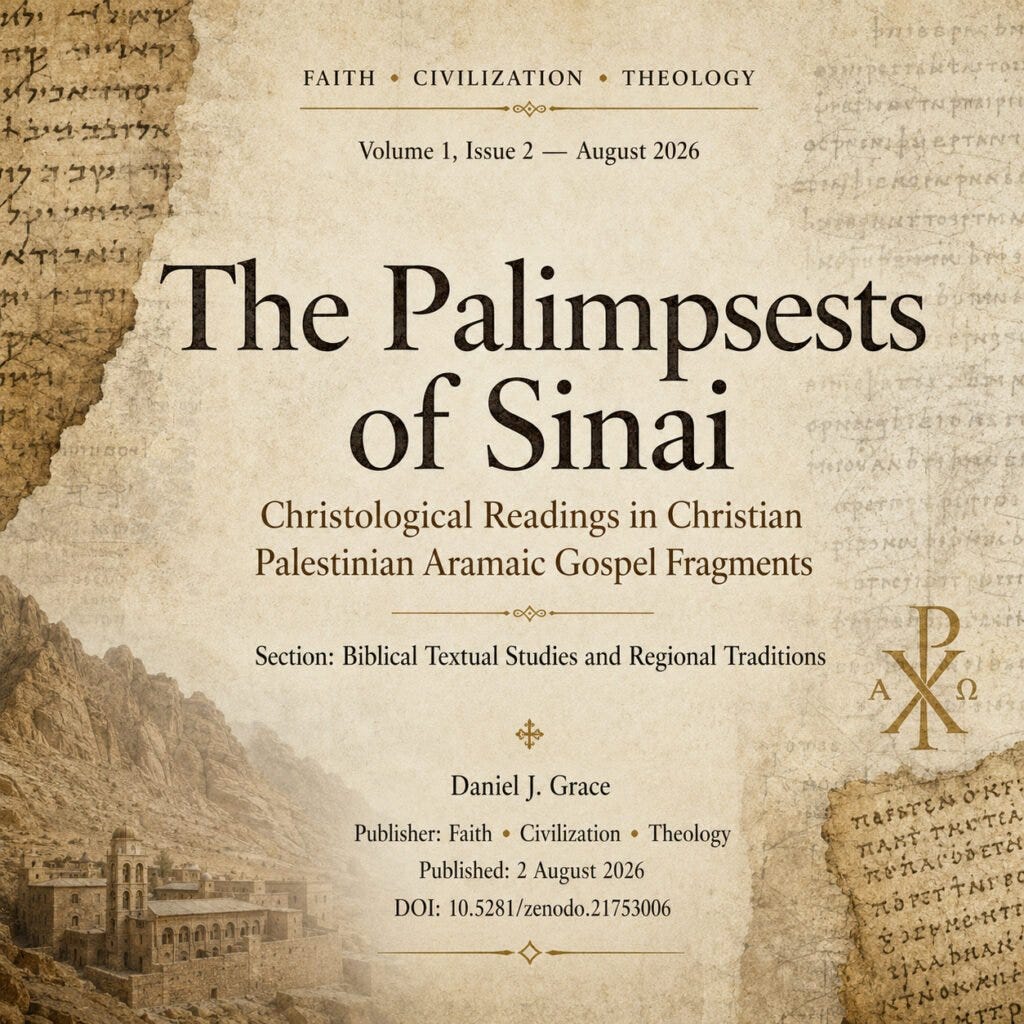
The Palimpsests of Sinai
Christological Readings in Christian Palestinian Aramaic Gospel Fragments

Faith • Civilization • Theology
Volume 1, Issue 2 — August 2026
Section: Biblical Textual Studies and Regional Traditions

Abstract
The Palimpsests of Sinai: The palimpsests preserved at St Catherine’s Monastery on Mount Sinai contain an important body of erased Christian Palestinian Aramaic Gospel material. These fragments, recovered through modern multispectral imaging, offer evidence not only for the history of biblical translation but also for the Christological memory of Palestinian Melkite communities between Late Antiquity and the early medieval period. This article examines how the identity of Jesus is expressed through translated titles such as Messiah, Lord, Son of God, and Son of Man, together with passages concerning his authority, incarnation, suffering, death, and resurrection. It argues that the fragments do not preserve an alternative or isolated Christology. Rather, they reveal the reception of canonical Gospel traditions within a distinctive Western Aramaic, liturgical, and monastic environment shaped by close dependence on Greek exemplars. Translation made familiar Gospel claims locally intelligible while preserving their broader ecclesial and theological framework. The article also considers the role of lectionary use, public proclamation, manuscript revision, and parchment reuse in the formation and survival of Christological memory. The erasure of these manuscripts reflects changing linguistic and practical conditions rather than clear evidence of doctrinal suppression. Their survival beneath later texts nonetheless preserves traces of communities whose literary language gradually disappeared. The Sinai fragments therefore stand as both textual witnesses and theological artefacts, recovering a Palestinian Christian voice that confessed the crucified and risen Christ through a nearly lost Aramaic tradition.
Keywords: Sinai palimpsests; Christian Palestinian Aramaic; Christology; Gospel fragments; St Catherine’s Monastery; Melkite Christianity; biblical translation; manuscript studies; Jerusalem lectionary; multispectral imaging.
1. Introduction: Christ Beneath the Erased Page
A manuscript can survive even after its words have been removed. At St Catherine’s Monastery on Mount Sinai, parchment leaves were sometimes scraped, washed, and reused when writing material became scarce. New texts were copied over the older writing, and the first text gradually disappeared beneath the surface. Yet it was rarely destroyed completely. Traces remained within the parchment. Centuries later, multispectral imaging has made many of those erased words visible again.
These recovered manuscripts are known as palimpsests. They preserve more than discarded writing. They preserve fragments of communities, languages, liturgies, and theological traditions that might otherwise have disappeared. The library of St Catherine’s contains more than 160 known palimpsest manuscripts. Their erased layers include texts written in Greek, Syriac, Georgian, Arabic, Christian Palestinian Aramaic, Latin, Armenian, Ethiopic, Slavonic, and Caucasian Albanian. Some survive nowhere else. The Sinai Palimpsests Project has used spectral imaging to recover thousands of previously unreadable pages and has identified hundreds of erased textual units within them.
Among the most important of these recovered materials are texts written in Christian Palestinian Aramaic. This was a Western Aramaic literary language used by Palestinian Christians, especially Melkite communities associated with monasteries, churches, and pilgrimage centres in Palestine and Sinai. It was written in a script related to Syriac but retained linguistic features rooted in the Aramaic environment of Palestine. The surviving corpus includes biblical translations, liturgical texts, homilies, saints’ lives, theological works, and apocryphal traditions. The Sinai discoveries have substantially enlarged that corpus, including works and textual witnesses that were previously unknown.
The Christian Palestinian Aramaic Gospel fragments deserve particular attention. They are often studied for what they reveal about biblical translation, textual variants, dialect history, or the relationship between Aramaic and Greek. Those questions remain essential. Yet the fragments also deserve to be read as witnesses to Christian belief. Every translation of a Gospel passage involves decisions about how the identity, authority, suffering, death, and resurrection of Jesus will be expressed in another language. Titles such as “Lord,” “Messiah,” “Son of God,” and “Son of Man” are not merely lexical items. They carry scriptural associations, liturgical memory, and theological meaning.
This does not mean that the fragments preserve an entirely separate Palestinian Christology. Christian Palestinian Aramaic translators generally worked from Greek biblical traditions and belonged to communities shaped by the doctrinal and liturgical world of Byzantine Christianity. Their texts should therefore not be treated as evidence for an isolated theology standing outside the wider church. Their significance lies elsewhere. They reveal how established Gospel claims about Christ were received, translated, proclaimed, and remembered within a distinctive Palestinian Christian setting.
Translation made the Gospel locally audible. Greek remained central to the theology and worship of the imperial church, but Christian Palestinian Aramaic allowed biblical texts to be encountered through a language connected with the region’s social and religious life. When Christological titles moved from Greek into Aramaic, they entered a linguistic world already saturated with biblical expressions concerning kingship, divine authority, covenant, suffering, and deliverance. Even where the translation remained close to its Greek exemplar, its words could carry resonances that were especially immediate for Aramaic-speaking hearers.
The physical survival of these texts adds another dimension to their theological importance. Many of the Christian Palestinian Aramaic writings were erased and replaced by later texts in other languages. This reuse reflected the practical value of parchment, changing linguistic conditions, and the needs of later manuscript communities. It should not automatically be interpreted as deliberate theological suppression. Nevertheless, the transformation of the manuscripts reflects a broader historical reality. Christian Palestinian Aramaic gradually ceased to function as a living literary language, while Greek, Syriac, Georgian, and Arabic assumed larger roles in the Christian cultures of the region.
The erased Gospel fragments therefore stand at the intersection of continuity and disappearance. The words about Christ remained physically present even after they could no longer be read. Their recovery allows a nearly lost Christian voice to be heard again. Beneath prayers, liturgical books, and later theological writings lie earlier acts of translation through which Palestinian Christians confessed Jesus as Lord, Messiah, Son, teacher, healer, crucified one, and risen one.
This article examines the Christological significance of Christian Palestinian Aramaic Gospel fragments associated with the Sinai manuscript tradition. It asks how the identity of Jesus is conveyed through translated titles, descriptions of divine authority, passion narratives, resurrection language, and passages concerning the relationship between the Father and the Son. It also considers the role of liturgical reading, monastic transmission, and manuscript reuse in preserving Christological memory.
The argument is that these fragments should be understood as both textual and theological witnesses. They contribute to the reconstruction of Gospel translation history, but they also show how Palestinian Melkite Christians received the person of Christ within their own linguistic environment. The theology found in these texts is not created by the palimpsest. It is revealed through it. What appears beneath the erased page is a local voice participating in the wider Christian confession while speaking from the religious landscape of Palestine and Sinai.
2. Sinai, Palimpsests, and the Recovery of Lost Texts
The survival of Christian Palestinian Aramaic Gospel fragments at Sinai cannot be separated from the manuscript culture of St Catherine’s Monastery. Established in the sixth century under the emperor Justinian, the monastery developed into one of the most important centres of Christian manuscript preservation in the eastern Mediterranean. Its geographical isolation helped protect its library, but isolation alone doesn’t explain the range of materials preserved there. Sinai stood within a network connecting Palestine, Egypt, Syria, Byzantium, the Caucasus, and the wider Christian East. Monks, pilgrims, scribes, translators, and visitors brought books into the monastery in many languages.
The resulting library reflects this multilingual world. Greek remained dominant, but Syriac, Georgian, Arabic, Christian Palestinian Aramaic, Armenian, Ethiopic, Slavonic, Latin, and Caucasian Albanian manuscripts also entered the collection. The palimpsests reveal this diversity with unusual clarity. More than 160 palimpsest manuscripts have been identified at St Catherine’s, preserving erased texts in at least ten languages. Before the modern imaging project began, only a very small number had been studied and published thoroughly. Multispectral photography has since made large portions of the concealed writing accessible to scholars.
A palimpsest was created when a previously written parchment leaf was prepared for reuse. The older ink might be scraped away, washed, rubbed, or treated by a combination of methods. The leaf was then folded, trimmed, reorganised, and written upon again. The later text is commonly called the overtext, while the erased writing beneath it is the undertext. Depending on the preparation process, the undertext may remain partly visible to the naked eye, appear only under particular lighting, or become readable through spectral imaging.
Parchment reuse was primarily practical. Animal skin was costly to produce, and older books could become damaged, incomplete, linguistically inaccessible, liturgically outdated, or no longer useful to a particular community. Their leaves remained valuable even when their original contents no longer served an immediate purpose. Reuse shouldn’t therefore be interpreted automatically as hostility toward the erased work. A Gospel fragment beneath a later manuscript doesn’t by itself prove doctrinal censorship or intentional destruction. More often, it reflects economic necessity and changing patterns of language, worship, education, and book ownership.
Yet the practical explanation doesn’t remove the historical meaning of the process. Decisions about which books could be dismantled and reused reveal changes within Christian communities. A manuscript written in Christian Palestinian Aramaic may have lost its usefulness when fewer readers could understand the language. A damaged lectionary might have been replaced by a Greek, Georgian, Syriac, or Arabic text serving the same liturgical purpose. The parchment continued to circulate, but the language of the first manuscript gradually disappeared from active use.
This makes the palimpsest a material record of cultural transition. It preserves both continuity and displacement. The later scribe didn’t necessarily intend to preserve the earlier text, yet the physical properties of parchment allowed portions of the erased ink to remain. The same leaf could therefore contain evidence from two different communities or periods. Its visible surface records one stage of Christian literary culture, while its hidden layer preserves another.
The importance of the Sinai discoveries increased substantially after the recovery of the monastery’s “New Finds” in 1975. These manuscripts and fragments had been stored within a blocked chamber and included previously unknown palimpsests. Subsequent study identified Christian Palestinian Aramaic biblical, liturgical, hagiographical, and theological undertexts among them. Recent scholarship continues to publish material from these finds, including previously unattested biblical passages and witnesses to the early Jerusalem lectionary tradition.
The recovery process requires more than taking an ordinary photograph. Multispectral imaging records a manuscript under different wavelengths of light. Ink, parchment, stains, erased writing, and later writing respond differently across the spectrum. Computational processing can then combine or enhance selected images, increasing the contrast between the undertext and the overtext. Letters that appear invisible or confused under normal illumination may become distinguishable.
Technology, however, doesn’t interpret the manuscript by itself. The resulting images must still be examined by specialists able to recognise scripts, languages, abbreviations, textual structures, and fragments of known works. A damaged sequence of letters may be identified through comparison with a Greek biblical passage, another Aramaic witness, or a known liturgical reading. Codicology and palaeography are equally important. Scholars examine the arrangement of columns, ruling patterns, folio dimensions, handwriting, quire structure, and the relationship between scattered fragments. The Sinai Palimpsests Project brought together an international group of manuscript specialists to undertake this work.
Christian Palestinian Aramaic material has been one of the major beneficiaries of this research. The project reports that Sinai preserves a large number of texts in this language, including works previously unattested and materials that substantially enlarge the surviving corpus. This matters because Christian Palestinian Aramaic ceased to function as a literary language centuries ago, and much of its written heritage survives only in fragmentary or overwritten form.
The Gospel evidence belongs to a wider textual tradition. The critical edition prepared by Christa Müller-Kessler and Michael Sokoloff collected accessible early Christian Palestinian Aramaic Gospel palimpsest fragments dating broadly from the fifth to the eighth centuries. Their work distinguished different revisions within the Synoptic Gospel material and emphasised the value of the version for reconstructing its Greek textual background.
This textual complexity is important for the present study. The fragments don’t represent a single manuscript, translator, or moment. They belong to a transmission history involving copying, revision, liturgical use, and possible adjustment to different Greek exemplars. Christological interpretation must therefore proceed carefully. A particular rendering may reflect the translator’s language, the wording of the underlying Greek text, an inherited revision, or the requirements of oral reading. It shouldn’t immediately be treated as a deliberate theological alteration.
At the same time, translation is never merely mechanical. Even close translations require choices concerning vocabulary, grammar, titles, pronouns, verbal aspect, and the relationship between clauses. Those choices affect how a passage sounds and how its claims about Jesus are heard. The Sinai fragments therefore permit a disciplined form of theological reading, provided that textual criticism, linguistic history, and manuscript context remain central.
The physical condition of the fragments also cautions against constructing an entire Christology from isolated readings. Many leaves are incomplete. Some preserve only a few lines. Others remain difficult to decipher even after imaging. The surviving corpus is uneven, and silence in the fragments doesn’t mean that a community rejected a doctrine or title. It may simply mean that the relevant passage hasn’t survived.
The responsible question isn’t whether Sinai has revealed a hidden Gospel or an unknown doctrine of Christ. It hasn’t. The more fruitful question is how familiar Gospel traditions were expressed in a Palestinian Aramaic Christian environment. The palimpsests allow that question to be asked because they restore portions of a language and textual culture that had almost vanished from view.
The recovery of the erased writing therefore performs two historical acts at once. It returns lost words to the study of the biblical text, and it restores evidence for the communities that copied, heard, and prayed those words. Beneath the later manuscripts lies not an abstract linguistic curiosity but the remains of Christian reading. The parchment preserves the moment when the Gospel moved from Greek into a Western Aramaic voice and became part of the worshipping memory of Palestinian Christianity.
3. Christian Palestinian Aramaic and the Melkite Communities
Christian Palestinian Aramaic belonged to the multilingual world of late antique Palestine. It was neither the only Aramaic variety used in the region nor simply a local form of Syriac. It represents a distinct Western Aramaic literary tradition associated with Christian communities in Palestine, Transjordan, and Sinai. Its surviving texts reveal a language shaped by local speech, biblical translation, Greek ecclesiastical culture, and contact with neighbouring Christian literary traditions.
Older scholarship sometimes called the language “Palestinian Syriac” because its script resembles Syriac writing. The term can be misleading, however, because Christian Palestinian Aramaic belongs linguistically to the Western Aramaic group, whereas classical Syriac belongs to Eastern Aramaic. The use of a Syriac-related script reflects scribal and ecclesiastical contact rather than linguistic identity. The language retained grammatical and lexical features associated with Palestinian Aramaic while developing a recognisable Christian literary form.
The designation “Christian Palestinian Aramaic” is therefore valuable because it identifies both the language and the communities that used it. The surviving corpus is overwhelmingly Christian. It includes biblical translations, lectionaries, homilies, liturgical prayers, theological writings, hagiography, and apocryphal works. Many texts survive only in fragments, and a substantial proportion were recovered from palimpsests. The Sinai collection is especially important because its erased undertexts have significantly enlarged the known corpus of the language.
The communities most closely associated with Christian Palestinian Aramaic are commonly described as Melkite. In late antiquity and the early medieval period, “Melkite” referred broadly to Christians who accepted the doctrinal position supported by the Byzantine emperor and the Council of Chalcedon. The word derives from a Semitic root connected with kingship and was used to identify those regarded as belonging to the emperor’s ecclesiastical party. It didn’t initially designate a separate denomination in the modern sense.
Palestinian Melkites participated in the theological and liturgical world of the Greek-speaking Byzantine Church. They recognised the authority of the Chalcedonian settlement and remained connected with the patriarchates and monasteries aligned with imperial orthodoxy. Yet this ecclesiastical allegiance didn’t make every Melkite community linguistically Greek. Christianity in Palestine operated through several languages. Greek carried considerable prestige in theology, administration, monastic learning, and formal liturgy, while Aramaic continued to serve local populations. Georgian, Syriac, Armenian, and eventually Arabic also became important within the region’s Christian institutions.
Christian Palestinian Aramaic occupied a particular place within this multilingual environment. It enabled Greek Christian texts to be received by communities whose linguistic world remained Western Aramaic. Its biblical translations often reveal close dependence on Greek exemplars, yet the act of translation brought those texts into a different network of meanings. Greek theological vocabulary had to be expressed through Aramaic words already shaped by Jewish Scripture, local religious speech, and earlier Christian usage.
This relationship between Greek authority and Aramaic reception is central to understanding the Gospel fragments. Their translators weren’t generally composing independent paraphrases. They were transmitting recognised Gospel texts into a local Christian language. The surviving early fragments, dated broadly between the fifth and eighth centuries, contain evidence of more than one revision of the Synoptic Gospels. This indicates that the Christian Palestinian Aramaic version underwent continuing comparison, correction, or adaptation rather than remaining fixed after a single act of translation.
Such revision may have arisen for several reasons. A translator or scribe might have encountered a different Greek manuscript. A liturgical community might have sought closer conformity with the Greek text read in church. Older vocabulary might have become unclear. Copyists could also introduce harmonisations or familiar expressions from parallel Gospel passages. The presence of revisions therefore reveals a living textual tradition rather than a static translation preserved without change.
The social setting of the language remains difficult to reconstruct fully. The surviving manuscripts tell us more about literary and ecclesiastical use than about ordinary conversation. Christian Palestinian Aramaic may have stood close to spoken Western Aramaic varieties, but a written biblical version develops conventions of its own. Its vocabulary and syntax were influenced by Greek, and scribes working in multilingual monasteries could also encounter Syriac, Georgian, and Arabic forms. It would therefore be mistaken to assume that every phrase in the Gospel fragments reproduces everyday Palestinian speech.
Nevertheless, the language’s regional character matters. Aramaic wasn’t foreign to the Gospel landscape. It belonged to the linguistic history of Palestine and to the wider world in which the earliest Jesus traditions had circulated. Christian Palestinian Aramaic manuscripts were copied centuries after the ministry of Jesus, so they can’t simply be treated as direct records of his spoken words. Yet they represent a later Palestinian Christian return of the Gospel into an Aramaic linguistic setting.
That return could produce a particular sense of proximity. Place names, Semitic titles, biblical idioms, and forms of address entered a language related to the linguistic world of the first-century region. This doesn’t make the translation more original merely because it is Aramaic. Its textual basis remained largely Greek, and its surviving forms belong to later Christian centuries. Still, its readers encountered the Greek Gospel through words that belonged to their own Palestinian Christian environment.
The term “Melkite” also requires caution when discussing Christology. Acceptance of Chalcedon provided an institutional and doctrinal framework, but it doesn’t mean that every Gospel translation was designed as an explicit defence of conciliar terminology. The Gospel fragments generally communicate Christology through narrative, titles, actions, scriptural fulfilment, suffering, death, and resurrection. They aren’t miniature theological treatises. Their importance lies in how communities shaped by Chalcedonian Christianity heard and transmitted the biblical foundations of their confession.
The Council of Chalcedon had affirmed that Jesus Christ was one and the same Son, acknowledged in two natures without confusion, change, division, or separation. Christian Palestinian Aramaic Gospel manuscripts don’t ordinarily reproduce this conciliar formula. Instead, they preserve the Gospel language from which later doctrinal reflection drew: Jesus forgives sins, commands creation, receives worship, speaks of the Father, identifies himself with the Son of Man, suffers bodily, dies, and rises.
For Melkite communities, such passages would have been heard within an established theological environment. A phrase didn’t need to mention Chalcedon directly to participate in Chalcedonian Christian memory. Liturgical repetition, preaching, feast days, creeds, hymns, and homilies connected Gospel narratives with broader claims about the incarnation and the identity of Christ. The translated Gospel therefore functioned within a larger system of theological interpretation.
Monastic communities were especially important in sustaining this system. Palestine and Sinai contained dense networks of monasteries connected with Jerusalem, the Judean desert, Gaza, the Jordan Valley, and the Sinai Peninsula. Monks moved between houses, carried books, translated texts, and participated in pilgrimage networks. St Catherine’s Monastery became a meeting place for these traditions. Its manuscripts preserve not only local Sinai production but materials brought from elsewhere.
The presence of Christian Palestinian Aramaic texts at Sinai doesn’t prove that every manuscript was copied there. Some may have originated in Palestine or in monasteries connected with Jerusalem and later entered the Sinai library. Codicological reconstruction is therefore essential. Script, parchment, page layout, textual sequence, and later reuse may provide clues regarding provenance, but fragmentary evidence often prevents certainty.
The language also survived across periods of significant political change. The early Christian Palestinian Aramaic Gospel tradition developed under Byzantine rule. After the seventh-century Arab conquests, Palestinian Christians continued to worship, copy texts, and maintain monasteries, but Arabic gradually became increasingly important. Greek remained active in many ecclesiastical settings, while Christian Palestinian Aramaic declined as a literary language. The Sinai Palimpsests Project notes that the language eventually fell out of use after the twelfth century.
Its decline wasn’t necessarily sudden. Languages can remain in liturgical or manuscript use after they cease to dominate ordinary speech. Older books may continue to be read by trained clergy even when younger generations use another language. Some texts may be copied because of inherited religious authority rather than because the language remains widely spoken. The survival of Christian Palestinian Aramaic into later centuries should therefore be understood as a changing continuum of speech, reading, worship, and scribal preservation.
The eventual reuse of its manuscripts reflects this transition. Once fewer readers could use them, damaged or obsolete books became available as parchment. Their erasure was part of the same multilingual history that had once produced them. Greek texts had been translated into Aramaic; later, Aramaic leaves could be overwritten with Georgian, Syriac, Arabic, or other Christian texts. The physical manuscript thus records successive stages of Christian cultural adaptation.
Christian Palestinian Aramaic Gospel fragments should therefore be read as the remains of a community negotiating continuity through language. The translators preserved a received Gospel, but they didn’t leave it untouched by the act of local expression. Greek phrases entered Western Aramaic grammar. Christological titles acquired Aramaic forms. Biblical actions and sayings became available for proclamation in a Palestinian Christian voice.
This voice was local without being isolated. It belonged to Melkite Christianity, participated in Byzantine doctrinal life, and remained connected with Greek Scripture. At the same time, it carried the memory of communities whose language and manuscripts would later become marginal. Their Gospel fragments reveal Christianity operating not through one sacred language but through translation, movement, and repeated reinterpretation.
The Christology of the fragments must be approached within this setting. It is neither an untouched survival from the first century nor a separate theological system hidden beneath Byzantine orthodoxy. It is the Gospel confession of Palestinian Christians articulated through a distinct Aramaic language. That combination of local speech and wider ecclesiastical allegiance gives the Sinai fragments their particular theological importance.
4. The Gospel Fragments and Their Textual History
The Christian Palestinian Aramaic Gospel fragments don’t survive as a single complete codex. They are scattered across palimpsest leaves, damaged manuscripts, lectionary remains, and fragments reused in later books. Their present condition is therefore the result of several historical processes: translation from Greek, copying within Palestinian Christian communities, revision against other exemplars, liturgical use, physical deterioration, parchment reuse, dispersal, and modern reconstruction.
This fragmentary survival has shaped the way the version is studied. Scholars cannot simply open one manuscript and read the four Gospels from beginning to end. The text must be assembled from witnesses that differ in date, script, completeness, textual affiliation, and purpose. Some fragments preserve continuous Gospel text. Others appear to have belonged to lectionaries arranged according to the church year. Some contain only a handful of readable lines. A few preserve passages that overlap with other Christian Palestinian Aramaic witnesses, making comparison possible.
The foundational modern critical work of Christa Müller-Kessler and Michael Sokoloff gathered the accessible early-period Gospel palimpsest fragments and arranged them as a textual corpus. Their edition covers witnesses dated broadly from the fifth to the eighth centuries and distinguishes different revisions within the Synoptic Gospel tradition. This distinction is important because Christian Palestinian Aramaic wasn’t transmitted as one completely uniform version. Its manuscripts preserve signs of revision, correction, and renewed comparison with Greek Gospel texts.
The word “revision” should be used carefully. It doesn’t necessarily imply a formal committee producing an entirely new authorised translation. A revision may emerge gradually. A scribe copying an older Aramaic manuscript could alter a phrase to agree more closely with a Greek exemplar. A liturgical reader might introduce wording familiar from another Gospel passage. A later copyist could replace an uncommon expression with a more recognisable one. Over time, such changes could produce distinguishable textual forms.
The surviving Synoptic material appears to reflect more than one layer of translation and revision. This complicates the search for an original Christian Palestinian Aramaic Gospel version. The earliest recoverable form may itself have been revised before the surviving manuscript was copied. A fragment dated palaeographically to the sixth century doesn’t necessarily preserve a translation first made in that century. The underlying translation could be earlier, while its wording might contain later adjustments.
This distinction between manuscript date and translation date is essential. A parchment leaf gives evidence for when a particular copy was probably written. Linguistic features, textual relationships, and comparison with other witnesses may suggest that the translated tradition behind it is older. Yet precise dating remains difficult because the corpus is incomplete and because scribes can preserve archaic forms long after they have disappeared from ordinary use.
One of the most significant witnesses is commonly known as Codex Climaci Rescriptus. It contains several erased Christian Palestinian Aramaic biblical manuscripts beneath later Syriac writing. Recent research has produced a fresh transcription of one of its early Gospel undertexts, dated approximately to the sixth century and containing portions of Matthew and Mark. The study confirms that the codex remains central to reconstructing the early Christian Palestinian Aramaic New Testament tradition.
The name “Codex Climaci Rescriptus” can give the misleading impression of a single original Christian Palestinian Aramaic Bible. In reality, the present codex was assembled from parchment leaves that had belonged to more than one earlier manuscript. When these leaves were erased and reused, materials of different origin could be brought together beneath one later overtext. Codicological analysis must therefore determine which leaves originally belonged together.
Handwriting, ruling, column width, folio size, ink distribution, and textual sequence help reconstruct these earlier units. Where two leaves share the same script and layout, scholars may be able to associate them with one manuscript. Where the hand or page design changes, another undertext codex may be present. The later physical binding doesn’t automatically represent the organisation of the erased books.
This matters for theological interpretation. A rendering found in Matthew on one leaf and another in Luke on a different leaf may come from separate manuscripts, periods, or revisions. They shouldn’t automatically be combined as if one translator made both choices. The Christian Palestinian Aramaic Gospel tradition is a corpus of related witnesses, not a single authorial document.
The textual history also involves the distinction between continuous-text manuscripts and lectionaries. A continuous Gospel codex normally follows the biblical sequence of chapters and passages. A lectionary reorganises selected readings according to Sundays, feast days, commemorations, and liturgical seasons. The same Gospel verse may therefore appear in different textual settings depending on whether it was copied for continuous study or public worship.
Lectionary evidence is particularly important for Christology because liturgical arrangement interprets Scripture through selection and repetition. Passages concerning the incarnation, baptism, transfiguration, passion, resurrection, and ascension acquire additional force when assigned to major feasts. A title such as “Son of God” may be encountered not only within its narrative context but within a cycle of worship that connects it with hymns, prayers, preaching, and sacramental practice.
At the same time, lectionaries can complicate textual comparison. Liturgical readings may begin or end differently from continuous manuscripts. Introductory phrases can be added for clarity. Pronouns may be replaced with names because the passage is heard apart from its original context. Parallel Gospel readings may influence one another. Such changes aren’t necessarily doctrinal alterations. They often arise from the practical needs of oral proclamation.
The early Christian Palestinian Aramaic Gospel witnesses are valuable for New Testament textual criticism because they translate Greek exemplars that may preserve readings differing from the later dominant Byzantine text. A version can therefore provide indirect evidence for a Greek reading no longer preserved, or only sparsely preserved, in surviving Greek manuscripts. Müller-Kessler and Sokoloff emphasised this importance when distinguishing revisions and tracing their relationship to Greek Gospel traditions.
Yet versional evidence must be handled cautiously. An Aramaic translation doesn’t always allow the Greek wording behind it to be reconstructed with certainty. One Aramaic expression may translate several Greek words. A translator may render freely, simplify a clause, make implicit grammar explicit, or follow normal Aramaic idiom rather than Greek word order. When the Aramaic text differs from familiar Greek manuscripts, the difference may reflect the exemplar, the translator, a later reviser, or a copying error.
The safest reconstructions occur where the Aramaic wording corresponds naturally to one particular Greek reading and where that reading is independently attested elsewhere. Greater uncertainty remains where several Greek forms could have produced the same translation. Textual critics must therefore distinguish between probable retroversion and theological speculation.
This caution is especially necessary when studying Christological passages. A variation involving “Jesus,” “Christ,” “Lord,” “Son,” or a pronoun may appear theologically significant. Sometimes it is. In other cases, it may reflect ordinary scribal expansion, liturgical clarification, or an ambiguity already present in the Greek tradition. No single variant should be treated as evidence for an entire community’s Christology without support from the broader textual pattern.
The Gospel fragments also belong to a period when Christian biblical texts circulated within an already developed doctrinal environment. The earliest surviving Christian Palestinian Aramaic manuscripts aren’t pre-conciliar records of an untouched Palestinian Christianity. They were copied during or after centuries of debate concerning the Trinity, incarnation, the relationship of Christ’s divinity and humanity, and the authority of the ecumenical councils.
This historical setting doesn’t make the fragments doctrinally unimportant. It means their Christology must be read on two levels. First, they translate the narrative Christology of the canonical Gospels. Second, they were copied and heard by communities whose interpretation had been shaped by later creeds, liturgies, and controversies. The wording of the Gospel remained ancient, but its reception continued to develop.
For example, a Gospel passage describing Jesus’ hunger, suffering, or death could be heard as testimony to his genuine humanity. A passage presenting him forgiving sins, commanding the sea, receiving worship, or rising from death could be heard as testimony to divine authority. A Melkite congregation didn’t need the translator to insert conciliar language into every verse. The liturgical and theological environment connected the narrative details with the church’s confession of one Christ who is fully divine and fully human.
The fragments should therefore not be searched for hidden doctrinal slogans. Their Christology appears chiefly through narrative translation. Jesus speaks, acts, heals, commands, suffers, dies, and rises. He is addressed through titles. He speaks of the Father. He identifies himself through scriptural images. The translator’s task was to preserve these relations in a language capable of carrying both the story and its theological weight.
The relationship between the Synoptic Gospels and John also requires caution. The early Christian Palestinian Aramaic corpus is unevenly preserved. The survival of more material from one Gospel doesn’t necessarily indicate that it was more important to the community. It may simply reflect the accidents of manuscript reuse and discovery. A codex containing John could have been lost entirely, while fragments of Matthew survived because their parchment was incorporated into a later book.
Fragmentation creates a temptation to turn accident into theology. Missing passages cannot be treated as rejected passages. An absent title cannot establish doctrinal avoidance. The undertexts preserve only what happened to remain on reusable leaves, what entered the monastery’s collections, what survived environmental damage, and what modern imaging has recovered.
The discoveries at Sinai continue to change the corpus. The monastery preserves more than 160 palimpsest manuscripts, and many erased texts have become readable only through multispectral imaging and specialised processing. The identification of undertexts remains an active scholarly task rather than a completed catalogue.
This continuing recovery means that older descriptions of Christian Palestinian Aramaic Gospel evidence may require revision. Newly identified leaves can extend a passage, connect fragments previously treated separately, reveal another manuscript hand, or preserve a reading unknown from earlier editions. A responsible theological study must therefore remain open to correction as the textual corpus grows.
The physical history of the fragments also reminds us that a biblical version is more than its reconstructed wording. These manuscripts were objects used by communities. They were copied by hand, carried between monasteries, read aloud, corrected, damaged, repaired, and eventually dismantled. Their margins, page layout, reading divisions, and signs of use may reveal how they functioned.
A carefully copied title, enlarged initial, punctuation mark, or liturgical division can affect oral performance. The reader needed to know where a sentence ended, where direct speech began, and where a public lesson stopped. Such features may seem secondary to the biblical wording, but they shaped how Christ’s speech and actions were heard by worshippers.
The textual history of the fragments is therefore inseparable from their theology. Translation transmitted the Gospel. Revision maintained its relationship with Greek authority. Lectionary arrangement placed it within worship. Manuscript reuse obscured it. Modern imaging recovered it. At each stage, the text passed through human decisions without becoming reducible to those decisions.
What survives is neither a pristine original nor a meaningless collection of scraps. It is a layered witness to the movement of the Gospel across languages, manuscripts, and centuries. The Christian Palestinian Aramaic fragments allow us to examine how the identity of Christ was carried through that movement. Their value lies precisely in this combination of continuity and variation: the same Gospel confession remained recognisable, while its expression was shaped by a Palestinian Aramaic Christian voice.
5. Christological Titles in Translation
Christology enters the Gospel narrative not only through extended statements about Jesus but through the titles by which he is named, addressed, questioned, confessed, and accused. “Christ,” “Lord,” “Son of God,” “Son of Man,” “Son of David,” “Teacher,” and “King” each place Jesus within a particular scriptural and theological field. When these titles were translated from Greek into Christian Palestinian Aramaic, they entered a language already carrying Jewish biblical vocabulary, Palestinian religious memory, and Christian liturgical usage.
The Christian Palestinian Aramaic Gospel witnesses are especially valuable because they preserve several textual layers rather than one completely uniform translation. The early Gospel corpus includes fragments from approximately the fifth to eighth centuries, and the critical edition distinguishes different revisions within the Synoptic tradition. A title may therefore appear differently according to manuscript, passage, translator, or revision. Any theological interpretation must first ask whether a rendering reflects the Greek exemplar, ordinary Aramaic usage, liturgical adaptation, or a deliberate attempt to clarify the identity of Jesus.
Translation doesn’t simply substitute one word for another. Titles carry ranges of meaning that rarely overlap perfectly between languages. The Greek Christos, for example, means “anointed one.” In the Gospels it functions as the Greek equivalent of the Hebrew and Aramaic messianic designation. A Christian Palestinian Aramaic translator could therefore render it through a familiar Semitic term for the Messiah rather than reproduce the Greek form mechanically. For an Aramaic-speaking Christian audience, this would connect Jesus directly with scriptural traditions of anointed kingship, divine election, and eschatological hope.
Such a rendering doesn’t create a new Christology. It restores the Semitic force already contained within the Greek title. Yet the effect on the hearer could be significant. The Greek word had become a recognised Christian designation and, in many contexts, almost part of Jesus’ name. Its Aramaic equivalent could make the title sound more explicitly royal and scriptural. It could remind the listener that “Christ” wasn’t originally a surname but a claim: Jesus is the one anointed by God and identified with Israel’s expected deliverer.
The title “Lord” presents a more complex problem. Greek kyrios can describe an owner, master, respected superior, ruler, or the Lord God. Its theological force depends heavily on context. In ordinary dialogue, a speaker may address Jesus respectfully. In scriptural quotations or scenes involving divine authority, the same title can carry much greater weight. The translator had to select an Aramaic equivalent capable of functioning across this range.
A form meaning “my lord” or “master” could remain an ordinary respectful address. In another context, however, the same vocabulary could participate in the language used for God. This overlap isn’t a weakness in the translation. It reflects the deliberate ambiguity found in the Greek Gospel itself. Readers and hearers are often led gradually from recognising Jesus as teacher or master toward perceiving authority that exceeds ordinary human categories.
The narrative setting determines much of the title’s force. When disciples address Jesus during a crisis, “Lord” may express dependence and trust. When Jesus commands illness, demons, wind, or sea, the title is reinforced by his actions. When a Gospel passage applies scriptural language concerning the Lord to Jesus, the designation enters an explicitly theological framework. Translation must therefore be read together with narrative action rather than treated as an isolated lexical item.
This is especially important in a liturgical setting. A title repeated in prayer and worship can acquire a confessional force beyond its most basic dictionary meaning. Christians who called upon Jesus as Lord in worship weren’t merely offering social respect. They were locating him within the sphere of divine sovereignty, salvation, judgment, and prayer. The Christian Palestinian Aramaic Gospel text would have been heard alongside creeds, hymns, petitions, and doxologies that shaped the congregation’s understanding of the title.
“Son of God” carries another cluster of meanings. In Jewish Scripture, sonship language can describe Israel, the Davidic king, the righteous person, angels, or a uniquely chosen servant of God. Within the Gospels, these associations remain present, but they are also transformed by the relationship between Jesus and the Father. The title appears at decisive moments: annunciation traditions, baptism, temptation, exorcism, confession, trial, crucifixion, and resurrection.
An Aramaic translation would preserve the relational structure of the title with particular directness. “Son” and “Father” belong to ordinary human vocabulary, yet the Gospel uses them to express an identity and relationship that cannot be reduced to biological descent. Jesus is presented as the Son who knows the Father, acts with the Father’s authority, fulfils the Father’s will, and is recognised through revelation.
The translator’s task was therefore not to provide a technical definition of divine sonship. The Gospel itself normally communicates this identity through narrative, speech, and relationship. Christian Palestinian Aramaic could express the title in familiar Semitic terms while leaving its full significance to unfold through the passage. The title’s force came from what the Son said and did, how the Father addressed him, and how other figures responded.
The Gospel scenes in which demons recognise Jesus are particularly revealing. Hostile spiritual beings sometimes identify him with titles that human characters understand only gradually. In such passages, “Son of God” is connected with supernatural authority. Jesus doesn’t receive the title merely because he belongs to a royal family or fulfils a social role. He is recognised as the one before whom destructive spiritual powers cannot remain hidden.
At the baptism and transfiguration, sonship is declared from above. These scenes connect identity with divine approval, election, and revelation. The words spoken concerning Jesus also echo scriptural language associated with kingship, servanthood, and beloved sonship. An Aramaic-speaking audience familiar with biblical patterns could hear several of these resonances at once.
The title “Son of Man” is more difficult. Its Greek form translates a Semitic expression that can mean a human being, an individual person, or the apocalyptic figure associated with Daniel’s vision. In the Synoptic Gospels, Jesus repeatedly uses the title for himself. Sometimes it is connected with earthly suffering and rejection. Elsewhere it refers to authority, future coming, judgment, or heavenly vindication.
When translated into Christian Palestinian Aramaic, the expression returned to a Semitic linguistic environment. This doesn’t mean that the translation reproduces the exact spoken form used by Jesus or resolves every debate about the title’s historical origin. The surviving manuscripts are later translations dependent largely on Greek Gospel texts. Nevertheless, Aramaic grammar could make the expression sound less foreign than it does in Greek or English.
That familiarity may also have increased its ambiguity. A Semitic expression meaning “human being” could sound ordinary, while the narrative context pointed toward Danielic authority and eschatological glory. The title could hold humiliation and exaltation together. The Son of Man has nowhere to lay his head, is delivered into human hands, suffers, dies, rises, forgives sins, exercises authority, and will come in glory.
This combination is central to Gospel Christology. Jesus’ humanity isn’t presented as a temporary appearance. He experiences rejection, vulnerability, bodily suffering, and death. Yet the same title is associated with heavenly authority and future judgment. The Christian Palestinian Aramaic translator didn’t need to resolve this tension by replacing the title with a more explicit doctrinal phrase. Preserving the Gospel expression allowed the tension itself to speak.
“Son of David” places Jesus within royal and messianic expectation. The title often appears in settings of need, healing, public acclamation, or conflict over Jesus’ identity. Those who call him Son of David appeal to the promise of a king from David’s line. Yet the Gospel narratives also push beyond a merely political understanding of Davidic descent.
Jesus accepts messianic recognition, but he doesn’t conform neatly to popular expectations of royal power. He heals rather than raises an army. He enters Jerusalem in humility. He is crowned through mockery and enthroned through crucifixion. The Davidic title is affirmed, but its meaning is reshaped by the pattern of suffering and resurrection.
In Aramaic, the title would carry an immediate Semitic form. The name David, the language of sonship, and the scriptural background of kingship required little cultural translation. Yet familiarity could sharpen rather than simplify the question. What kind of Davidic son is Jesus? The narrative answers not through a single definition but through the contrast between public expectation and the path Jesus follows.
The title “King of the Jews” belongs especially to the passion narrative. It may be spoken mockingly, politically, or judicially. Roman authorities could understand it as a claim to rival sovereignty. Religious opponents could use it within an accusation. Soldiers could turn it into ridicule. Yet the Gospel’s irony allows hostile speakers to announce more than they understand.
Translation preserves this irony when it keeps the royal designation clear. Jesus appears powerless, but the title remains. He is mocked as king, clothed as king, questioned as king, and executed beneath a royal accusation. The narrative therefore links kingship with suffering. His authority is revealed not through escape from death but through faithfulness within it.
“Teacher” or “Rabbi” may appear less explicitly Christological than “Lord” or “Son of God,” but it remains important. Jesus teaches with authority, interprets Scripture, announces the kingdom, answers opponents, and forms disciples. The title recognises a genuine dimension of his ministry. Yet the Gospel repeatedly shows that he is more than one teacher among others.
An Aramaic-speaking audience would recognise the social and religious meaning of a teacher or master. At the same time, the content of Jesus’ teaching distinguished him. He didn’t merely preserve inherited interpretation. He spoke with personal authority, defined the demands of discipleship, forgave sins, and placed response to himself at the centre of obedience to God.
The translation of such titles could also be affected by the needs of public reading. A title might be retained where the Greek text contained a pronoun if the passage was read independently and required a clearer subject. A personal name might be added to prevent confusion. Parallel Gospel language might influence the copyist. These changes can heighten Christological visibility without necessarily indicating deliberate doctrinal revision.
This is why textual comparison remains essential. The Christian Palestinian Aramaic Gospel fragments provide evidence for different revisions, and their value lies partly in the way they reflect underlying Greek textual traditions. A title present in one Aramaic witness but absent from another may derive from a different Greek reading rather than an independent theological choice.
The fragmentary condition of the manuscripts imposes another limit. Not every title survives in every Gospel or textual layer. It would be unsafe to count preserved occurrences and treat them as a complete statistical portrait of Palestinian Melkite belief. The surviving material is determined by accidents of damage, reuse, binding, preservation, discovery, and decipherment. Recent identifications continue to enlarge the known Christian Palestinian Aramaic corpus, showing that its boundaries remain open to further reconstruction.
Even with these limitations, the titles reveal a consistent pattern. Jesus is identified through categories rooted in Israel’s Scripture, but none remains untouched by the Gospel narrative. Messiah is interpreted through suffering. Lordship appears through service and authority. Sonship is expressed through obedience and unique relation to the Father. Kingship is revealed beneath mockery. The Son of Man unites humiliation with eschatological power.
The Christian Palestinian Aramaic translators didn’t invent this pattern. They transmitted it. Yet their work made it audible within another linguistic world. Terms with Semitic roots could recover associations partly hidden by Greek or later translation traditions. At the same time, Greek textual structure and Byzantine Christian interpretation continued to guide the version.
Christological titles in the Sinai fragments therefore stand between inheritance and reception. They preserve the canonical Gospel’s claims while showing how those claims were carried into Palestinian Christian speech. Their significance lies not in revealing a secret doctrine beneath the parchment but in demonstrating how translation itself became an act of theological continuity.
6. Son of God, Son of Man, Lord, and Messiah
The major Christological titles found in the Gospel tradition don’t function independently. They overlap, correct, and deepen one another. Jesus is confessed as Messiah, addressed as Lord, declared to be the Son of God, and repeatedly identifies himself as the Son of Man. No single title contains the whole Gospel portrait. Together, they form a network through which the identity of Jesus is gradually disclosed.
The Christian Palestinian Aramaic fragments preserve this network within a Western Aramaic linguistic setting. Their importance doesn’t rest on producing radically different titles from those found in Greek. The surviving version remains closely connected to Greek Gospel exemplars and reflects more than one stage of Synoptic revision. Its theological significance lies in the way the Greek titles were heard again through Semitic vocabulary and Palestinian Christian usage. The accessible early corpus dates broadly from the fifth to the eighth centuries, while Codex Climaci Rescriptus I preserves portions of Matthew and Mark in a manuscript assigned approximately to the sixth century.
The Son of God and the Father
“Son of God” is one of the clearest titles of Christian confession, yet the Gospels don’t introduce it as an abstract theological formula. Its meaning develops through scenes of revelation, obedience, conflict, suffering, and authority. The title is spoken by heavenly voices, disciples, demons, opponents, and witnesses to the crucifixion. Each setting contributes something different.
At Jesus’ baptism, sonship is declared from heaven. The scene joins divine approval with scriptural language of kingship, election, and belovedness. Jesus doesn’t appoint himself as Son. His identity is announced by the Father. The declaration also prepares the reader for the temptation narrative, where the adversary challenges Jesus precisely at the point of sonship: “If you are the Son of God.” The issue isn’t only whether Jesus possesses power. It is what kind of Son he will be.
Jesus refuses to use sonship as self-serving privilege. He won’t turn stones into bread merely to escape hunger. He won’t compel divine protection through spectacle. He won’t receive kingdoms through worship of another power. Sonship is therefore defined by faithful obedience to the Father rather than the display of autonomous power.
This distinction would have mattered strongly within a Melkite Christian environment. The divine Son is powerful, but his power isn’t separated from filial obedience. He acts in unity with the Father. The Gospel narrative therefore resists two opposite reductions. Jesus isn’t merely an inspired human being who receives temporary favour, but neither is he portrayed as a divine figure whose humanity and obedience are unreal.
The Christian Palestinian Aramaic language could express the Father–Son relationship through ordinary familial vocabulary. That simplicity shouldn’t be mistaken for theological weakness. The familiarity of the words gives the relationship its force. Jesus speaks of “my Father” with an intimacy and authority that distinguishes his sonship from the general description of God as Father of the faithful.
In passages where Jesus distinguishes “my Father” from “your Father,” the grammar carries theological weight. His relationship is unique, even while he brings disciples into relationship with God. The Son reveals the Father because he knows the Father in a way that others don’t. The title therefore concerns not only status but knowledge, mission, and mutual relation.
The Synoptic saying that no one knows the Son except the Father, and no one knows the Father except the Son and those to whom the Son chooses to reveal him, presents one of the strongest expressions of this relationship. Knowledge of God is mediated through the Son. Jesus doesn’t stand beside revelation as one teacher among others. He belongs within the act of revelation itself.
The translation of this saying into Aramaic would return the language of knowing, fatherhood, and sonship to a Semitic grammatical environment. Yet its theological claim remains striking. The Son isn’t simply a recipient of hidden knowledge. He is the one through whom the Father becomes known.
The title also appears in scenes of spiritual conflict. Demons identify Jesus as the Son of God before many human characters understand him. Their recognition isn’t saving faith, but it confirms that his authority extends beyond the visible world. The unclean spirits know that his presence threatens their power.
Jesus’ command that they remain silent also prevents hostile voices from controlling the disclosure of his identity. The Gospel doesn’t allow correct terminology alone to define discipleship. A demon may name Jesus accurately and still oppose him. Christological confession requires more than lexical recognition. It involves trust, obedience, and participation in the path Jesus follows.
At the crucifixion, sonship reaches its most paradoxical expression. Jesus appears abandoned, humiliated, and powerless. Opponents use his claimed identity as grounds for mockery. If he is the Son of God, they suggest, he should save himself. The temptation at the beginning of the ministry returns at its end: prove sonship through escape from suffering.
Jesus again refuses that definition. He doesn’t cease to be the Son because he suffers. The passion reveals a sonship expressed through obedience unto death. The title can therefore no longer be understood simply as immunity from weakness. It is disclosed through faithfulness within weakness.
For later Palestinian Christians shaped by Chalcedonian teaching, these passages could sustain confession of both Christ’s divinity and genuine humanity. The Son exercises divine authority, yet he hungers, suffers, cries out, and dies. The Gospel doesn’t solve this relationship through philosophical explanation. It narrates it.
The Son of Man: Humanity, Suffering, and Glory
“Son of Man” is the title Jesus most characteristically uses for himself in the Synoptic Gospels. Its meaning remains deliberately layered. In a Semitic setting, an expression of this kind can refer generally to a human being. In Danielic imagery, however, “one like a son of man” receives dominion and approaches the divine throne. The Gospel use of the title holds ordinary humanity, suffering, authority, and eschatological glory together.
Christian Palestinian Aramaic brings this title into a language closely related to the Semitic world from which the expression emerged. This doesn’t make the later translation an independent record of Jesus’ original pronunciation. The surviving fragments are Christian translations of Greek Gospel texts and belong to centuries later than the events narrated. Nevertheless, the Aramaic form could preserve the natural connection between the expression and the idea of a human person more readily than Greek or English.
That linguistic familiarity may have allowed the title’s theological movement to unfold gradually. At first, the hearer may encounter language that sounds modest or indirect. The Son of Man travels without security. He eats with those considered sinful. He faces rejection. He will be handed over and killed.
Yet the same Son of Man forgives sins, possesses authority over the Sabbath, will rise from death, come with angels, sit in judgment, and be vindicated before God. Humanity and heavenly authority aren’t assigned to two different figures. They belong to the same person.
The healing of the paralytic makes this connection especially clear. Jesus first declares the man’s sins forgiven. His opponents recognise that forgiveness belongs to God. Jesus then heals the man so that those present may know that the Son of Man has authority on earth to forgive sins.
The miracle doesn’t merely prove that Jesus is a successful healer. It confirms authority over the deeper condition represented by sin. The title “Son of Man” therefore appears in a context where visible action reveals invisible authority.
The saying concerning the Sabbath follows a similar pattern. The Son of Man is lord even of the Sabbath. The claim doesn’t abolish the sacred character of the Sabbath. It places Jesus in a position of interpretive and personal authority over an institution rooted in creation and covenant.
For an Aramaic-speaking Palestinian Christian audience, the Sabbath carried deep biblical and cultural associations. To hear that the Son of Man possesses authority in relation to it would therefore be more than a minor legal statement. It concerns the identity of the one who interprets the divine purpose of sacred time.
The passion predictions form another central group. Jesus teaches that the Son of Man must suffer, be rejected, killed, and raised. The necessity expressed by “must” doesn’t make the violence morally good. It places the passion within the fulfilment of God’s saving purpose and the pattern of Scripture.
The title that evokes heavenly authority is therefore joined to rejection. Glory isn’t reached by avoiding suffering. The Son of Man is vindicated through the path of suffering. This challenges every expectation that messianic authority must be immediately visible as political or military triumph.
The saying that the Son of Man came not to be served but to serve, and to give his life for many, brings authority and self-giving together. His greatness is expressed through service. His death is interpreted as purposeful and representative, not merely accidental.
In liturgical reading, such passages would shape the congregation’s understanding of the passion. The crucifixion wasn’t simply the defeat of a teacher. It was the self-giving of the Son of Man whose authority is revealed through service and whose death belongs to the movement toward resurrection and vindication.
The eschatological Son of Man sayings complete the pattern. The one who is rejected will come in glory. The one judged by human authorities will exercise judgment. The one who appears powerless will be confessed before angels.
This reversal is fundamental to Gospel Christology. Earthly appearances don’t exhaust Jesus’ identity. His suffering is real, but it isn’t final. The same title carries the movement from humiliation to glory.
Lordship and Divine Authority
The title “Lord” requires close attention because its meaning ranges from polite address to divine sovereignty. Not every occurrence carries the same theological force. A person seeking healing may call Jesus “lord” in a manner that could also mean “master” or “sir.” Elsewhere, narrative action or scriptural context gives the title a far stronger significance.
Christian Palestinian Aramaic faced the same range of meaning. An Aramaic term of respect could address a human superior, while closely related forms could belong to religious speech about God. The translator therefore often preserved an ambiguity already present in Greek.
The ambiguity allows the reader to grow into recognition. A speaker may begin by approaching Jesus as a respected healer. The narrative then shows him acting with an authority that transforms the meaning of the address.
The calming of the storm is a clear example. The disciples appeal to Jesus in fear. He rebukes the wind and sea, and creation obeys him. The scene echoes scriptural descriptions of God ruling chaotic waters. The disciples’ question—“Who then is this?”—shows that the act exceeds normal prophetic power.
The title and the action interpret one another. “Lord” isn’t given its full Christological force by dictionary definition alone. It acquires that force because the one addressed commands what Scripture associates with divine sovereignty.
Exorcism scenes work similarly. Jesus doesn’t overcome demons through ritual manipulation or appeal to a higher human authority. His word itself is effective. The spirits obey. His lordship is enacted through command.
The same authority appears in healing, forgiveness, teaching, and judgment. Yet Gospel lordship is never merely domination. Jesus defines authority through service. He washes, feeds, heals, receives the marginalised, and gives his life.
This prevents the title from being absorbed into ordinary imperial categories. In the Roman world, “lord” could express political hierarchy and domination. The Gospel proclaims a Lord whose kingship is revealed through self-giving.
For Melkite Christians living within the Byzantine imperial order, this distinction would have remained important. Their ecclesiastical identity was historically linked with imperial orthodoxy, but the Gospel itself placed every earthly ruler beneath the judgment of Christ’s lordship. The emperor might be called king, but he wasn’t the crucified and risen Lord.
Scriptural quotation could intensify the title further. Where language originally referring to the Lord God is applied within the Gospel narrative to Jesus, the text creates a close relationship between the identity of Jesus and the divine action of Israel’s God. Translation must handle such passages carefully because the same Aramaic title may carry both ordinary and sacred uses.
It would be unsafe to argue that every use of “Lord” proves a fully explicit later doctrine of Christ’s divine nature. The Gospels reveal identity narratively. Yet it would be equally mistaken to reduce the title to politeness where the surrounding passage assigns Jesus divine prerogatives.
The cumulative pattern matters. Jesus commands creation, forgives sins, receives prayerful appeal, judges, raises the dead, and is confessed after resurrection. Lordship becomes the language through which these actions are gathered.
Messiah and the Reinterpretation of Kingship
The title “Messiah” was especially natural in Aramaic. Greek Christos translated the Semitic idea of the anointed one. When restored to an Aramaic form, the title could recover its direct association with royal anointing and scriptural expectation.
Yet the Gospels repeatedly refuse to let “Messiah” remain an undefined slogan. Different characters may use the same title while imagining very different forms of salvation. The central question isn’t only whether Jesus is Messiah, but what his messiahship means.
Peter’s confession provides the clearest example. He identifies Jesus as the Messiah. Jesus then immediately teaches that the Son of Man must suffer, be rejected, killed, and rise. Peter accepts the title but resists its interpretation.
The narrative exposes the inadequacy of correct words without a transformed understanding. Peter can say “Messiah” while still imagining glory without the cross. Jesus joins messiahship to suffering so firmly that opposition to the passion becomes opposition to God’s purpose.
The Christian Palestinian Aramaic translation would make the messianic title linguistically familiar, but the narrative would prevent familiarity from becoming simplification. The Messiah isn’t merely a restored earthly monarch. His victory passes through rejection and death.
This reinterpretation continues in the entry into Jerusalem. Jesus enters publicly and receives royal acclamation, yet his mode of entry is humble. He doesn’t arrive as a military conqueror. The sign of kingship is present, but its form is transformed.
During the trial, messianic and royal claims become politically dangerous. “Messiah,” “King of the Jews,” and accusations concerning sovereignty converge. Roman power treats the claim as a potential threat, while opponents use imperial anxiety to secure execution.
The crucifixion then becomes the ironic enthronement of the Messiah. He is clothed, crowned, hailed, and displayed beneath a royal title, but every sign is turned into mockery. The reader, however, sees more than the mockers understand.
The Messiah’s throne is the cross. This doesn’t glorify cruelty. It reveals that human violence cannot prevent divine kingship from being manifested through faithful love.
The resurrection vindicates this messianic identity. The crucified one hasn’t been exposed as a false claimant. God raises him. Suffering and kingship are therefore held together without allowing either to cancel the other.
Titles in Mutual Interpretation
The four titles considered here must finally be read together.
“Messiah” identifies Jesus with scriptural hope and anointed kingship. “Son of God” expresses his unique relationship with the Father. “Lord” gathers his authority, sovereignty, and place within worship. “Son of Man” joins genuine humanity, suffering, heavenly vindication, and judgment.
Each title guards against a reduction produced by the others when read alone. Messiah without Son of Man might be reduced to political triumph. Son of Man without Lord might be heard only as human weakness. Lord without the passion could become domination. Son of God without obedience could be detached from the actual Gospel narrative.
Together, the titles produce a Christology of identity revealed through action. Jesus is known through what he does, how he relates to the Father, how he receives suffering, how he exercises authority, and how God vindicates him.
The Christian Palestinian Aramaic fragments don’t preserve a separate Christological system built around these titles. They preserve the canonical pattern through translation. Their different manuscripts and revisions also require restraint: a reading in one fragment may reflect a particular Greek exemplar or scribal layer rather than a deliberate theological programme. The corpus itself is composite and fragmentary, and Codex Climaci Rescriptus contains material drawn from several earlier manuscripts rather than one original Aramaic Gospel book.
Even so, translation made the titles locally resonant. Messiah returned to explicitly Semitic royal language. Son of Man entered an Aramaic expression capable of holding ordinary humanity and Danielic glory together. Father and Son sounded through familiar relational words. Lordship moved between respect, authority, and divine sovereignty.
The result wasn’t a different Christ, but a distinct act of Christian reception. Palestinian Christians heard the Gospel’s claims through a language tied to their region, worship, and biblical memory. Beneath the erased page, the titles still perform their original narrative work. They lead the hearer from recognition to confession, from expectation to correction, and from the suffering Jesus to the crucified and risen Lord.
7. Incarnation, Authority, Suffering, and Resurrection
Christology in the Gospel fragments isn’t confined to titles. It emerges through the whole narrative movement of Jesus’ life: his birth, teaching, miracles, suffering, death, and resurrection. The identity of Christ is disclosed through action. He enters human history, exercises authority, accepts vulnerability, and is vindicated beyond death.
The Christian Palestinian Aramaic fragments preserve this narrative Christology in a form shaped by translation. Their surviving witnesses are incomplete and belong to different manuscripts and revisions, so no single fragment can carry the whole argument. Yet taken together, they allow us to see how Palestinian Christians encountered the Gospel’s central claims through an Aramaic literary language. The early corpus preserves Gospel material from approximately the fifth to eighth centuries, while Codex Climaci Rescriptus I contains portions of Matthew and Mark in a manuscript dated around the sixth century.
The Incarnation as Narrative Presence
The canonical Gospels don’t all describe the incarnation in the same way. Matthew and Luke narrate conception, birth, genealogy, divine promise, and fulfilment. Mark begins with the public ministry of Jesus. John presents the incarnation through the language of the eternal Word becoming flesh. The Christian Palestinian Aramaic Gospel tradition preserves this diversity rather than reducing it to one formula.
Where infancy material survives, the identity of Jesus is revealed through divine initiative. His birth belongs to the fulfilment of promise. He is connected with David, Israel, prophetic expectation, and God’s saving action. The narrative doesn’t begin with an ordinary human figure who later acquires divine status. From the beginning, Jesus’ identity is interpreted through revelation.
The language of conception and birth also protects the reality of his humanity. Jesus enters the world through human dependence. He is born, named, carried, protected, and placed within a family and people. The incarnation isn’t presented as a temporary divine disguise. The Gospel locates Christ within genealogy, geography, political danger, and bodily life.
For Palestinian Christians, these narratives belonged to familiar landscapes. Bethlehem, Jerusalem, Galilee, the Jordan, and the wilderness weren’t distant mythological settings. They formed part of the region’s sacred geography and living memory. Reading the Gospel in Christian Palestinian Aramaic would have brought the story into a language connected with those places.
This local resonance must not be confused with direct historical continuity. The surviving translations were copied centuries after the first century and depend primarily on Greek Gospel texts. Yet the movement of the Gospel back into a Western Aramaic language could create a distinctive sense of nearness. The incarnation was proclaimed in a language belonging to the land in which the narrative was set.
The Aramaic vocabulary of birth, sonship, flesh, body, spirit, and dwelling carried ordinary human meanings before it carried theological ones. That was precisely its strength. The incarnation could be confessed not through an artificial sacred code but through words used for life, family, suffering, and death.
Authority Expressed Through Action
Jesus’ authority is one of the most persistent features of Gospel Christology. It appears in teaching, healing, exorcism, forgiveness, command over nature, interpretation of Scripture, and the calling of disciples. The narratives rarely stop to define the metaphysical source of this authority. They show it.
Jesus teaches differently from ordinary interpreters. He doesn’t merely cite earlier authorities. He speaks with direct personal force. His words summon obedience, expose hidden motives, redefine purity, and announce the kingdom of God.
Translation into Christian Palestinian Aramaic had to preserve this force. Verbal forms, commands, questions, and direct speech all shaped how Jesus sounded when read aloud. A weak or overly indirect rendering could alter the impact of a scene even without changing its basic content. The translator’s task therefore carried theological significance.
The healing narratives also reveal authority through immediacy. Jesus touches, speaks, commands, and restores. Illness doesn’t negotiate with him. Demons recognise his presence and submit to his word. These stories don’t present Jesus merely as a mediator who asks another power to act. His own speech becomes effective.
This doesn’t mean that the Gospels separate Jesus from the Father. His authority remains relational and obedient. Yet the manner in which he acts distinguishes him from ordinary prophets. Prophets may announce what God will do. Jesus often speaks and the event follows.
The forgiveness of sins is especially important. When Jesus declares sins forgiven, the controversy concerns divine prerogative. His opponents understand the theological implication. The subsequent healing confirms that his invisible claim possesses visible authority.
The miracle therefore functions as Christological disclosure. Jesus isn’t simply compassionate. He acts within a sphere associated with God’s own authority to forgive and restore.
Command over nature carries similar significance. When Jesus stills the storm, the narrative echoes biblical descriptions of God ruling the sea. The disciples’ question, “Who is this?” isn’t answered by another title alone. It is answered by the act itself.
The Christian Palestinian Aramaic hearer encountered such scenes within a biblical language shaped by Semitic imagery. Sea, wilderness, wind, bread, mountain, and light carried scriptural associations. Translation could therefore preserve not only the immediate story but its wider theological world.
Authority and Service
The Gospel never allows authority to remain detached from service. Jesus’ power is exercised for healing, restoration, teaching, and liberation. He receives those whom others exclude. He feeds the hungry. He touches the unclean. He refuses to define greatness through domination.
This pattern reaches its clearest expression when Jesus interprets his own mission through service and self-giving. The Son of Man comes not to be served but to serve. Authority is therefore revealed through the willingness to give life for others.
This distinction was important within every imperial Christian setting. Melkite communities were connected with Byzantine ecclesiastical structures, but the Gospel measured all political and religious authority against the pattern of Christ. The true Lord doesn’t imitate worldly rulers who exercise power for self-preservation. He gives himself.
The Aramaic translation could make this contrast direct. Terms for lordship, service, slavery, ransom, giving, and life belonged to ordinary social experience. Their theological force emerged from the reversal Jesus announced: the one who is greatest becomes servant.
Genuine Human Suffering
The passion narratives are indispensable to the Christology of the fragments because they prevent every attempt to make Jesus’ humanity unreal. He experiences fear, sorrow, physical violence, humiliation, abandonment, and death. The Gospel doesn’t present suffering as an illusion.
This was especially significant in later doctrinal contexts. Debates concerning the person of Christ often turned on how divinity and humanity were related. The Gospel narrative doesn’t use the later technical language of councils, but it gives the church the material that such debates attempted to protect.
Jesus becomes hungry. He grows tired. He grieves. He is wounded. He dies. These aren’t decorative details surrounding a divine action untouched by human experience. They belong to the identity of the one proclaimed as Son and Lord.
For a Christian Palestinian Aramaic audience, the bodily language of suffering would have been heard without abstraction. The vocabulary of flesh, blood, hands, wounds, thirst, crying, and death made the passion concrete. Translation placed the crucifixion within ordinary human language even while its significance exceeded ordinary death.
The Gospel’s treatment of fear and anguish is equally important. In Gethsemane, Jesus doesn’t perform invulnerability. He prays in distress. His obedience is not effortless. The will of the Son is expressed through surrender to the Father within suffering.
This scene resists two opposite errors. Jesus isn’t a powerless victim with no purpose, and he isn’t a divine actor untouched by fear. His obedience is real because the suffering is real.
The passion also exposes the nature of human authority. Religious accusation, political calculation, public manipulation, military violence, and mockery converge against Jesus. The one who heals others is treated as dangerous. The one who speaks truth is condemned through false witness.
The narrative therefore possesses a political dimension without becoming a simple political programme. The cross reveals how institutions can preserve themselves through injustice. At the same time, Jesus refuses to reproduce their violence.
The Cross as Christological Revelation
The crucifixion isn’t merely the tragic end of Jesus’ ministry. The Gospels interpret it through messianic, royal, sacrificial, covenantal, and scriptural patterns. Yet they don’t allow one image to exhaust its meaning.
Jesus is mocked as king. He is identified as the Messiah. He gives his life for many. His blood is connected with covenant. Scripture is fulfilled. Darkness, confession, torn boundaries, and signs of judgment surround his death.
The title placed above the cross is intended as accusation. Within the narrative, however, it becomes proclamation. The condemned Jesus is presented as king precisely when he appears stripped of all royal power.
This is Gospel irony at its deepest. Human authorities believe they are disproving his claim. The narrative shows them enacting its hidden meaning. His kingship isn’t founded upon escape from suffering but upon faithfulness through it.
The Christian Palestinian Aramaic translation had to preserve this irony through short speeches, insults, titles, and narrative contrast. Small differences in pronouns or explicit names could affect who appears to speak and what the reader understands. Textual comparison is therefore necessary before assigning theological intention to any single wording.
The composite character of the surviving corpus is again important. Codex Climaci Rescriptus itself contains leaves from earlier manuscripts, and the early Christian Palestinian Aramaic Gospel tradition preserves distinguishable Synoptic revisions. A phrase in one passion fragment may belong to a particular textual layer rather than a universal Aramaic rendering.
Even so, the broad narrative pattern remains stable. Jesus suffers as the one already identified through divine sonship and authority. The cross doesn’t cancel the earlier revelation. It transforms the hearer’s understanding of it.
Divine sonship doesn’t mean exemption from pain. Lordship doesn’t mean domination. Messiahship doesn’t mean immediate political victory. Kingship doesn’t mean self-preservation.
The cross redefines each title.
Death as Real Death
The burial narratives confirm the reality of death. Jesus’ body is taken down, handled, wrapped, and placed in a tomb. Witnesses observe where he is laid. The narrative insists upon continuity between the crucified body and the one later proclaimed risen.
This matters because resurrection isn’t the survival of a teaching or the continuation of influence. The Gospel presents it as God’s action upon the one who truly died.
The bodily details also protect the humanity of Christ. Death isn’t passed over quickly as though unworthy of divine identity. It is entered completely.
For communities acquainted with martyrdom, disease, political instability, and mortality, this mattered pastorally as well as doctrinally. The Gospel proclaimed a Christ who hadn’t remained distant from bodily vulnerability. He had entered death itself.
The erased physical condition of the manuscripts gives this proclamation an unintended symbolic resonance. The words concerning burial and disappearance were themselves buried beneath later writing. Yet material traces remained. Modern imaging now recovers texts once thought lost. The analogy must not be pressed into proof or confused with resurrection, but it helps explain why the palimpsests possess such imaginative power. What was hidden wasn’t absent.
Resurrection and Vindication
The resurrection completes the Gospel’s Christological movement. It vindicates Jesus’ identity, confirms his authority, transforms the meaning of the cross, and opens the proclamation beyond the immediate circle of disciples.
The empty tomb by itself creates astonishment and fear. The resurrection message interprets the absence. Jesus hasn’t merely been removed. He has been raised.
The passive form “has been raised” directs attention toward divine action. The Father vindicates the Son. At the same time, the risen Jesus appears, speaks, commissions, and exercises authority. Resurrection is therefore both an act of God upon Jesus and the revelation of Jesus’ continuing lordship.
For the disciples, the resurrection corrects previous misunderstanding. They had imagined messiahship without suffering or interpreted death as final defeat. The risen Christ shows that the passion belonged within the saving movement of God.
This doesn’t erase the wounds or make the cross irrelevant. Resurrection vindicates the crucified one. The one raised is the same one rejected and killed.
That continuity is central to Christian confession. The Gospel doesn’t present resurrection as replacement. God doesn’t abandon the suffering Jesus and reveal another spiritual figure. The crucified Christ is the risen Lord.
The Christian Palestinian Aramaic Gospel tradition carried this proclamation into liturgical memory. Resurrection passages weren’t merely read as historical endings to Gospel books. They belonged to Paschal worship, weekly proclamation, baptismal identity, and the hope of the dead.
A lectionary context could intensify this meaning. When resurrection texts were heard during feasts, vigils, or Sunday services, their wording was surrounded by hymns, prayers, light, procession, and communal response. Christology was therefore formed not only by reading but by repeated embodied worship.
The surviving fragments don’t always preserve enough context to reconstruct the precise liturgical setting of every passage. Some belong to continuous Gospel manuscripts, others to lectionary traditions, and some remain difficult to classify. The Sinai palimpsest corpus contains manuscripts from numerous languages and forms of Christian use, and its recovery continues to depend upon multispectral imaging and specialist reconstruction.
Resurrection and Mission
The resurrection narratives also move toward mission. The disciples are sent to proclaim, teach, baptise, bear witness, and gather communities. Christological confession therefore produces public responsibility.
Jesus’ authority after resurrection is expressed universally. The one whose ministry unfolded in the towns and landscapes of Palestine is proclaimed beyond them. Yet the mission doesn’t abandon the local story. It carries the crucified and risen Christ from a particular history into many languages.
Christian Palestinian Aramaic itself became part of that mission. The Greek Gospel entered a Western Aramaic Christian environment so that Christ could be proclaimed, heard, remembered, and worshipped there. Translation was one form of the missionary movement described within the Gospel.
This makes the later disappearance of the language historically poignant but not theologically meaningless. Christian Palestinian Aramaic ceased to function as a major literary language, yet the confession carried through it didn’t disappear. It moved into Greek, Arabic, Syriac, Georgian, and other traditions.
The palimpsests preserve one stage of that movement. Their undertexts show that the Gospel’s mission didn’t proceed through a single linguistic line. It passed across languages, scripts, monasteries, and political worlds.
One Narrative, One Christ
Incarnation, authority, suffering, and resurrection must finally be read as one narrative. The child born within Israel’s story is the teacher who speaks with authority. The healer who commands sickness is the servant who accepts suffering. The crucified king is the risen Lord.
The Gospel doesn’t permit these moments to be assigned to separate identities. The same Jesus acts throughout.
This unity is especially important for Christological interpretation. His humanity isn’t limited to birth and suffering, while divinity is reserved for miracles and resurrection. The whole person acts. The one who commands the storm also sleeps from exhaustion. The one who forgives sins also experiences rejection. The one raised from death is the one whose body was buried.
Later doctrinal language attempted to protect precisely this unity. The Christian Palestinian Aramaic fragments don’t normally state conciliar definitions, but they preserve the narrative grammar from which such definitions arose.
Their contribution is therefore neither speculative nor marginal. They show Palestinian Christian communities receiving the one Gospel movement from incarnation to resurrection within their own language. The fragments reveal a Christology embodied in story: divine authority without denial of humanity, genuine suffering without final defeat, and resurrection without erasure of the cross.
Beneath the overwritten parchment, this narrative remains. Christ enters human life, acts with authority, gives himself in suffering, passes through death, and is proclaimed risen. The erased words recover not a different Gospel, but another voice bearing witness to the same crucified and living Christ.
8. Translation Choices and Greek Gospel Traditions
The Christian Palestinian Aramaic Gospel fragments were produced within a translation culture in which Greek remained the principal textual authority. Their translators didn’t work from a surviving first-century Aramaic Gospel, nor do the fragments provide direct transcripts of Jesus’ spoken words. They represent later Palestinian Christian translations of recognised Greek Gospel traditions. Their importance lies partly in the evidence they preserve for those Greek exemplars and partly in the way Greek Christian language was reshaped within Western Aramaic.
The critical edition of the early Gospel fragments identifies more than one revision within the Christian Palestinian Aramaic Synoptic tradition. This indicates that the translation wasn’t produced once and transmitted without change. It was copied, checked, corrected, and sometimes brought into closer relationship with other Greek manuscripts. The surviving fragments therefore preserve a history of translation rather than a single fixed version.
This layered history requires a careful distinction between three forms of variation. A difference may originate in the Greek exemplar used by the translator. It may arise from the translator’s attempt to express Greek naturally in Aramaic. It may also result from later revision, liturgical adaptation, or scribal transmission. These possibilities often overlap, and the surviving fragment may not provide enough evidence to separate them with certainty.
Greek as the Primary Exemplar
Most Christian Palestinian Aramaic biblical literature was translated from Greek. The language developed within Melkite communities whose theology, liturgy, and ecclesiastical identity remained closely connected with Byzantine Christianity. Greek Scripture therefore provided not only a textual source but also an authoritative theological environment.
This dependence can be observed in vocabulary, syntax, word order, and the treatment of biblical names and titles. Greek constructions sometimes leave traces in Christian Palestinian Aramaic even where they don’t represent the most idiomatic Western Aramaic expression. Recent linguistic research continues to describe the corpus as predominantly translated from Greek and marked by Greek lexical borrowing and syntactic influence.
Yet dependence on Greek doesn’t mean that the translation was mechanical. The translator had to decide how closely to follow the source language. A highly literal rendering might preserve Greek structure but sound unnatural or obscure in Aramaic. A freer rendering might communicate the sense more clearly while making reconstruction of the Greek exemplar more difficult.
Biblical translators often moved between these two demands. They respected the wording of the recognised source while ensuring that the passage could be read and understood. The result could be close correspondence in one verse and greater freedom in the next.
Christological passages intensified this responsibility. A decision involving “Lord,” “Son,” “Christ,” “Spirit,” “worship,” or “authority” could affect how Jesus’ identity was heard. The translator didn’t necessarily intend to create a doctrinal emphasis, but ordinary linguistic choices could still carry theological consequences.
The Problem of Retroversion
One of the major scholarly uses of the Christian Palestinian Aramaic version is retroversion: reconstructing the probable Greek wording that stood behind the translation. The early Gospel edition describes the version as important for biblical criticism because its distinguishable revisions can provide evidence for Greek textual forms.
Retroversion is most reliable where the Aramaic wording corresponds closely to one known Greek reading. Suppose two Greek textual traditions differ in vocabulary, grammar, or the presence of a phrase. If the Aramaic translation naturally reflects one of them, it may support the existence of that reading in the translator’s exemplar.
The process becomes less certain where one Aramaic word could represent several Greek terms. Greek may distinguish concepts that Aramaic expresses through one broader word. Conversely, Aramaic grammar may require an explicit pronoun, possessive form, or connecting expression absent from Greek. Such additions don’t necessarily reveal a longer Greek source.
Word order also requires caution. A translator may preserve Greek sequence because of reverence for the source, or rearrange the sentence to suit Aramaic grammar. Neither practice is completely consistent across a manuscript. A close word-for-word alignment in one passage doesn’t guarantee the same translation method everywhere.
For this reason, the Aramaic fragment must be compared with a range of Greek witnesses rather than only with a familiar modern printed New Testament. The printed text is itself an editorial reconstruction. The translator may have used a manuscript containing a reading preserved only in a minority of surviving Greek witnesses.
Translation and Christological Variation
Textual variants involving Christological language naturally attract attention. A manuscript might contain “Jesus Christ” where another has “Jesus,” “the Lord” where another has a pronoun, or “Son of God” where another form is shorter. Such differences can appear to strengthen or weaken an explicit claim about Jesus.
They cannot be interpreted responsibly without examining the entire textual history. A fuller title may already have stood in the Greek exemplar. It may have entered through liturgical clarification. A scribe may have expanded a name out of reverence or to prevent ambiguity. Alternatively, a shorter form may reflect normal omission rather than theological discomfort.
Theological significance is possible, but it must be demonstrated rather than assumed. A single expanded title doesn’t establish that the translator was intentionally intensifying Christology. A single omission doesn’t establish opposition to the title. Patterns across multiple passages and manuscripts are more valuable than isolated readings.
The same principle applies to pronouns. In a continuous narrative, Greek may use “he” because the subject is clear from the preceding verse. A lectionary passage removed from that context may replace it with “Jesus” or “the Lord.” The change makes the reading intelligible when proclaimed independently. It may also make Christological identity more explicit, but its primary purpose can remain practical.
Lord and the Range of Kyrios
The translation of Greek kyrios illustrates the difficulty particularly well. The term may mean “sir,” “master,” “owner,” or “Lord” in a theological sense. Aramaic likewise offers forms whose significance changes according to context.
A translator could preserve the lexical ambiguity of the Greek while relying on narrative context to establish the force of the title. When a petitioner respectfully approaches Jesus, the Aramaic expression may remain open to an ordinary social meaning. When the same Jesus commands the sea, forgives sins, or receives a scriptural designation associated with God, the title acquires greater theological weight.
A revision could alter the rendering without necessarily changing the underlying Christology. One translator might prefer a common respectful form, while another chooses vocabulary more closely aligned with ecclesiastical language. The difference may reveal linguistic habit, liturgical convention, or closer dependence upon a particular Greek expression.
The safest interpretation therefore examines title, action, and scriptural context together. Christological meaning emerges cumulatively rather than from the title in isolation.
Messiah and Christos
Greek Christos had become a deeply established Christian title, but its basic meaning remained “anointed one.” Christian Palestinian Aramaic could render it with the familiar Semitic designation for Messiah.
This translation restores the etymological meaning of the Greek title, but it may also change how the phrase is perceived. In Greek Christian usage, “Christ” could function almost as part of the personal name “Jesus Christ.” An Aramaic messianic term may more immediately evoke kingship, anointing, Davidic promise, and eschatological hope.
The shift doesn’t change the referent. It changes the linguistic route by which the hearer reaches it. The Palestinian Aramaic audience encountered the title through vocabulary rooted in the same Semitic scriptural world from which the Greek term had originally been translated.
Yet the Gospel narrative continues to interpret the title. The Messiah suffers, serves, is rejected, and rises. Familiarity with the word doesn’t allow the hearer to impose an uncorrected political expectation upon Jesus. Translation makes the title locally intelligible, while the story transforms its meaning.
Sonship and Relational Language
Greek and Aramaic can both express “Father” and “Son” directly, but their grammatical patterns aren’t identical. Possessive relationships, definiteness, emphasis, and pronouns may require different constructions.
A Greek phrase such as “my Father,” “the Father,” or “his Father” may be rendered in ways shaped by Aramaic suffixes or separate pronouns. These differences can affect emphasis. An explicit possessive form may sound more relational, while a definite title may sound more formal.
Such distinctions should not be converted too quickly into doctrinal claims. They may arise from grammar. Still, grammar is part of meaning. The repeated expression of the relation between Father and Son contributes to how the Gospel’s Christology is heard.
The translator’s task becomes particularly delicate where Jesus distinguishes his own sonship from the disciples’ relationship with God. A rendering that preserves this distinction supports the narrative’s presentation of Jesus as uniquely related to the Father while also bringing others into filial relationship.
The Christian Palestinian Aramaic tradition therefore shows how doctrinally important relations can be carried through ordinary grammatical choices. Translation isn’t theology added after the text. It is one of the forms through which the text’s theology becomes audible.
Son of Man and the Return to Aramaic
The translation of “Son of Man” presents a distinctive case because the Greek expression itself reflects a Semitic background. In Christian Palestinian Aramaic, the title entered a language in which a comparable expression could sound grammatically natural.
This return to Aramaic doesn’t provide direct access to the exact historical wording spoken by Jesus. The translators were rendering a Greek Gospel centuries later. Nevertheless, the title’s semantic range may have sounded less artificial in Aramaic than in Greek.
The phrase could evoke an ordinary human being while also carrying the Danielic association of a human-like figure receiving dominion. The Gospel’s own use moves between earthly vulnerability, suffering, authority, future coming, and judgment.
A translator might preserve the expression closely precisely because its ambiguity was meaningful. Replacing it with an explanatory title such as “Messiah” or “heavenly judge” would narrow the Gospel’s presentation. Literal continuity allowed the Palestinian Aramaic hearer to encounter the full movement from humanity to glory.
Greek Syntax and Aramaic Expression
Greek and Aramaic organise sentences differently. Greek participles, infinitives, subordinate clauses, and verbal tenses don’t always have exact Aramaic equivalents. The translator may need to turn one Greek construction into several finite verbs or replace a participle with a relative clause.
Such restructuring can influence the pace of a Gospel scene. Greek may compress several actions into one sentence, while Aramaic presents them sequentially. The translated narrative can therefore sound more immediate or more explicit even while communicating the same events.
Direct speech also requires adjustment. Greek reporting clauses may be rendered through standard Aramaic expressions introducing speech. Names and subjects may be repeated to maintain clarity. These changes can give Jesus’ words greater narrative prominence without deliberately altering their theological content.
Questions are especially important. The Gospels often reveal identity through questions: “Who is this?” “Who do you say that I am?” “Are you the Christ?” “Are you the Son of God?” The force of these scenes depends upon word order, emphasis, and the distinction between an open question and one expecting agreement.
Where the fragment is sufficiently clear, the Aramaic syntax can show how such questions were heard. Yet fragmentary preservation and Greek influence make it difficult to reconstruct spoken intonation with confidence.
Lexical Borrowing and Theological Vocabulary
Christian Palestinian Aramaic sometimes borrowed Greek words, especially for ecclesiastical, administrative, or specialised concepts. Borrowing could occur when no established local equivalent carried the desired meaning or when the Greek term had become familiar through liturgy and church life.
A loanword may signal close participation in Byzantine Christian culture. It can preserve the technical force of a Greek theological or ecclesiastical expression. At the same time, excessive borrowing could make a text less accessible to readers with limited Greek knowledge.
Translators therefore operated along a spectrum. Some ideas were rendered through native Western Aramaic vocabulary. Others used forms shared with Syriac or broader Christian Semitic usage. Still others retained Greek elements.
This vocabulary reveals that Christian Palestinian Aramaic wasn’t isolated. It developed through sustained interaction with Greek and later Arabic, while remaining rooted in a Western Aramaic linguistic tradition.
The Christological effect of this interaction is significant. Greek supplied the immediate textual framework. Aramaic supplied the language of local reception. Ecclesiastical vocabulary connected the translation with the broader church, while native expressions allowed the Gospel to speak within Palestinian linguistic memory.
Possible Contact with Other Semitic Versions
Although Greek was primary, scholars must remain open to contact with other Semitic biblical traditions. Christian scribes lived in multilingual environments. Syriac manuscripts, liturgical formulas, oral traditions, and neighbouring translations could influence vocabulary or revision.
Research on Christian Palestinian Aramaic Old Testament fragments has sometimes identified Greek exemplars alongside possible use of Syriac versions during revision. Such findings don’t automatically apply to every Gospel fragment, but they demonstrate that translation communities could consult more than one textual tradition.
A rendering resembling Syriac may arise from several causes. The two languages share Semitic vocabulary. Scribes may have known Syriac liturgy. A revision may have consciously consulted a Syriac text. The resemblance may also be coincidental.
Claims of dependence therefore require detailed lexical and textual comparison. Shared Semitic wording alone is insufficient.
Where such contact can be established, it enriches rather than diminishes the fragments’ importance. It shows Palestinian Christian translators operating within a network of Greek and Semitic biblical cultures. The Gospel moved not only from one source language into one target language but through communities accustomed to hearing Scripture in several forms.
Revision as Ecclesial Responsibility
Revision is sometimes treated as corruption of an earlier translation. In the context of Christian Palestinian Aramaic, it can also be understood as an attempt to maintain fidelity.
A scribe comparing an older Aramaic text with a Greek Gospel may have believed that correction was necessary. The purpose could be to remove accumulated copying errors, bring the version into conformity with the text used in worship, or clarify wording that had become difficult.
This process reflects an ecclesial understanding of Scripture. The translation belonged to a worshipping community rather than to an individual translator alone. It could therefore be corrected as the community’s textual needs changed.
Revision also reveals that Greek authority remained active. Christian Palestinian Aramaic wasn’t allowed to drift entirely into an independent Gospel tradition. Repeated comparison with Greek preserved its connection with the wider Melkite church.
At the same time, no act of revision could eliminate local linguistic character. Every corrected phrase still had to function in Aramaic. Fidelity was negotiated between source and audience.
Translation Without an Alternative Christology
The existence of different readings shouldn’t be exaggerated into evidence for competing Christs. The fragments don’t disclose a secret Palestinian theology hidden from the Greek church. Their broad Christological pattern remains recognisably canonical and Melkite.
Jesus is Messiah, Son, Lord, Son of Man, teacher, healer, crucified one, and risen one. Variations affect how particular passages are phrased, but they don’t overturn the narrative identity of Jesus.
This continuity is important precisely because translation could have introduced greater divergence. The Christian Palestinian Aramaic tradition demonstrates that linguistic adaptation and theological continuity weren’t opposites. The Gospel could become locally intelligible without ceasing to belong to the wider Christian textual tradition.
The fragments therefore challenge two simplistic views. They cannot be treated as transparent copies of Greek in which translation makes no difference. Nor can they be treated as independent theological compositions in which every variation reflects doctrinal innovation.
They stand between these extremes. They are translated witnesses whose wording was shaped by Greek exemplars, Aramaic grammar, liturgical use, scribal revision, and historical circumstance.
Theological Meaning in the Act of Translation
The theological importance of translation lies finally in its capacity to make confession possible in another language. The translator enabled Palestinian Christians to hear Jesus addressed as Lord, confessed as Messiah, declared Son, and revealed through suffering and resurrection.
Every successful rendering joined two worlds. It retained the authority of the Greek Gospel while allowing its claims to live within Western Aramaic speech. The translated words didn’t merely report Christian theology. They became part of prayer, proclamation, memory, and worship.
The different revisions show that this work remained unfinished. Each generation inherited a text and faced the question of how faithfully it represented the Gospel. Correction and adaptation were signs that the version continued to matter.
The Christian Palestinian Aramaic fragments thus preserve more than textual variants. They preserve acts of responsibility toward Scripture. Translators and scribes attempted to carry the identity of Christ across linguistic boundaries without dissolving either the source or the receiving language.
Their achievement is visible even in fragmentary form. Beneath later writing, Greek Gospel traditions survive in an Aramaic voice. The voice isn’t identical with its source, yet it remains recognisably bound to it. Through that relationship, translation became one of the principal means by which Palestinian Christians received and confessed the person of Christ.
9. Liturgical Reading and the Formation of Christological Memory
The Christian Palestinian Aramaic Gospel fragments were not created only for private study. Much of the surviving corpus belongs to a liturgical world in which Scripture was selected, arranged, proclaimed aloud, and interpreted through the annual cycle of worship. The existence of an early Jerusalem lectionary tradition in Christian Palestinian Aramaic shows that Gospel translation was closely connected with public reading in Palestinian churches and monasteries from approximately the fifth to seventh centuries.
A lectionary does more than preserve biblical passages. It places them within time. A Gospel text assigned to Christmas, Epiphany, Palm Sunday, Holy Week, Easter, Ascension, or a saint’s commemoration is heard in relation to that occasion. The selection, beginning, ending, and repetition of a reading shape how the congregation remembers Jesus.
This doesn’t mean that the lectionary creates a different Christology from the Gospel. It organises the Gospel’s Christological claims within worship. Passages about incarnation are heard during feasts of birth and manifestation. Passion narratives are proclaimed during Holy Week. Resurrection accounts are associated with Paschal worship. Texts concerning glory, judgment, discipleship, and mission return at appointed moments in the liturgical year.
The result is a form of theological memory. Worshippers may not hear an entire Gospel book continuously in one sitting. Instead, they encounter recurring scenes and sayings over many years. Christ is remembered through a structured pattern: promised, born, baptised, transfigured, acclaimed, betrayed, crucified, raised, and exalted.
The Jerusalem Lectionary Tradition
The early Jerusalem lectionary developed within a church whose worship was deeply connected with the geography of the Holy City and surrounding sacred sites. Biblical events could be commemorated near places associated with their traditional location. The reading of Scripture therefore interacted with movement, architecture, pilgrimage, prayer, and local memory.
Christian Palestinian Aramaic witnesses to this tradition are particularly important because they show that the Jerusalem liturgical system was not confined to Greek-speaking worshippers. The Gospel readings were made available in a Western Aramaic Christian language associated with Melkite communities of Palestine and neighbouring regions. The surviving Palestinian Syriac, or Christian Palestinian Aramaic, Gospel lectionary tradition was reconstructed from manuscripts connected with Sinai and Jerusalem.
Greek likely retained liturgical and institutional prestige, but translation allowed the same cycle of readings to reach another linguistic community. This was not merely practical accommodation. It enabled worshippers to inhabit the church year through words they could understand directly.
The Jerusalem lectionary also reflects the authority of local tradition. Particular readings were assigned to particular commemorations because the church perceived theological relationships between biblical text, sacred time, and sacred place. A passage was not selected randomly. Its liturgical position interpreted it.
For example, a Gospel account of the resurrection heard in ordinary continuous reading remains a resurrection narrative. Heard at the Paschal vigil or on Easter morning, it also becomes a proclamation addressed to a gathered community celebrating Christ’s victory over death.
The wording remains biblical, but the liturgical setting intensifies its confessional function.
Public Proclamation and Oral Reception
A manuscript prepared for liturgical use was meant to be heard. This changes the way its language should be approached. Modern scholars often encounter the fragment visually, line by line, through edited transcriptions or enhanced images. The original congregation encountered the text through a reader’s voice.
Pronunciation, rhythm, pause, emphasis, and repetition shaped meaning. Titles such as “Lord,” “Messiah,” “Son of God,” and “Son of Man” were not silent lexical units. They were spoken before a community.
The reader’s task required clarity. A passage removed from its continuous narrative might begin with an introductory formula. A pronoun could be replaced by the name “Jesus” so that listeners immediately understood the subject. A place or speaker might be identified more explicitly. Such adaptations could arise from liturgical necessity rather than doctrinal revision.
Yet liturgical clarification could still affect Christological reception. Replacing “he” with “the Lord” makes Jesus’ identity more explicit. Repeating his name at the opening of a reading places him immediately at the centre of attention.
These changes should not automatically be treated as deliberate theological amplification. They may reflect normal lectionary practice. Nevertheless, the practical and theological effects cannot always be separated. The form that makes a passage easier to hear may also make its confession clearer.
Repetition and Recognition
Christological memory is formed through repetition. A person who hears the baptism of Jesus each year learns to associate his sonship with the heavenly declaration. A person who repeatedly hears the transfiguration learns to connect glory with the beloved Son and with the command to listen to him.
The same pattern appears in the passion. Repeated proclamation of betrayal, trial, mockery, crucifixion, burial, and resurrection prevents the cross from becoming an isolated symbol detached from narrative. The congregation remembers who suffered, why conflict developed, how Jesus responded, and how the story moved toward vindication.
Repetition also joins titles with events. “Messiah” becomes associated with rejection and resurrection. “Lord” becomes associated with service. “Son of God” becomes associated both with divine authority and suffering. “King” is heard beneath mockery and crucifixion.
Over time, these associations become part of communal instinct. A title is no longer understood only through a dictionary definition. It carries the weight of the passages in which the congregation has repeatedly heard it.
This is one reason why liturgy can preserve theological balance. A community hearing only miracle stories might emphasise power without suffering. A community hearing only passion texts might overlook authority, teaching, and resurrection. The church year brings different aspects of the Gospel into relation.
Feast Days and Christological Interpretation
The major Christological feasts organise the identity of Jesus through narrative sequence.
At celebrations of the nativity and manifestation of Christ, Gospel readings present divine promise, birth, naming, worship, baptism, and revelation. Jesus is located within human genealogy and political history, yet his identity is declared through divine initiative.
At the transfiguration, hidden glory becomes visible. The suffering path has not yet reached its end, but the disciples are given a sign that the one who will be rejected is also the beloved Son.
During Holy Week, royal and messianic language is placed beside betrayal, service, judgment, and death. The liturgical sequence prevents triumphal entry from being separated from the cross.
At Easter, resurrection passages reinterpret everything that came before. The crucified one is not replaced by another figure. The same Jesus is proclaimed risen.
At Ascension and Pentecost, Christological memory expands toward heavenly authority, mission, and the Spirit’s work in the church.
The lectionary therefore arranges a narrative Christology across sacred time. No single feast contains the whole confession. The annual cycle repeatedly gathers the parts into one identity.
Sacred Geography and Local Memory
Palestinian liturgy possessed an unusually strong geographical dimension. Jerusalem and its surrounding regions were associated with places remembered as sites of Jesus’ passion, burial, resurrection, ascension, and other biblical events.
For Christians who lived in or travelled through Palestine, Gospel readings could be heard in physical proximity to the landscapes they described. The distance between text and place was reduced.
Christian Palestinian Aramaic strengthened this local dimension. The Gospel was proclaimed not only in the land connected with its narrative but in a language belonging to Palestinian Christian communities.
Again, this does not make the translation a direct survival of first-century speech. The manuscripts are later, and their textual basis is predominantly Greek. Yet the combination of language, place, and liturgy gave the Gospel a distinctive local embodiment.
A reading about Jerusalem heard in Jerusalem, or a passion narrative proclaimed near places associated with the passion, entered communal memory differently from the same text heard in a distant region. The local worshipper did not merely imagine a remote biblical landscape. The present city and the remembered Gospel city overlapped.
This overlap could also create tension. The Jerusalem of Christian worship existed within changing political, religious, and social conditions. Sacred sites endured through imperial transitions, conflict, reconstruction, and the growth of other religious communities. Liturgical proclamation connected the present Christian community with a Gospel past while also asserting continuity amid change.
Monastic Reading
The Sinai fragments also belong to monastic culture. Monasteries preserved books, trained readers, observed liturgical cycles, and maintained patterns of daily prayer. Scripture was encountered both communally and privately.
Monastic reading was not always silent in the modern sense. Texts could be recited, memorised, repeated, and heard during services or meals. The distinction between reading and prayer was often less rigid than in modern academic practice.
Gospel passages therefore entered the monk’s memory through repeated use. Sayings of Jesus could shape obedience, humility, poverty, watchfulness, hospitality, and endurance. Christology was not only a doctrine concerning who Jesus is. It also defined the form of life expected from those who followed him.
The Christ who serves becomes the model of service. The Christ who prays becomes the model of prayer. The Christ who resists temptation becomes the model of spiritual struggle. The Christ who accepts suffering becomes the model of perseverance.
This ethical and ascetic reception does not replace doctrinal confession. It expresses its consequences. To confess Jesus as Lord while refusing his pattern of humility would produce a contradiction between worship and life.
The Gospel and the Psalms
Liturgical Christology was formed through more than Gospel readings. Psalms, prophetic texts, prayers, hymns, and homilies surrounded the Gospel lesson. The congregation therefore heard Jesus within a broader scriptural field.
A passion reading could be associated with psalms of suffering, accusation, trust, and vindication. A royal Gospel title could resonate with psalms concerning the anointed king. Resurrection worship could draw upon language of deliverance, life, light, and divine victory.
The Christian Palestinian Aramaic corpus includes biblical and liturgical texts beyond the Gospels, and Sinai preserves Christian material in numerous languages and genres. The palimpsests reveal the multilingual manuscript environment in which such scriptural relationships were sustained.
This wider setting is important because Gospel Christology was rarely heard in isolation. Scripture interpreted Scripture. A title or event acquired additional depth through the readings and prayers surrounding it.
The translator of a Gospel lesson may not have inserted an explicit Old Testament explanation. The liturgy could supply that connection through another reading or chant.
Homiletic Interpretation
After Scripture was read, preaching could interpret it. The surviving Christian Palestinian Aramaic corpus includes patristic, theological, and homiletic materials as well as biblical texts. This suggests that translation served not only the public proclamation of Scripture but also its explanation.
A homily could connect Gospel narrative with creed, doctrine, moral exhortation, and feast. It could explain how Christ’s birth reveals incarnation, how his baptism manifests the Trinity, how the cross accomplishes salvation, or how resurrection grounds Christian hope.
Such interpretation shaped what worshippers heard when the Gospel returned the following year. The biblical text and the church’s explanation reinforced one another.
This does not mean that every congregation possessed a fully systematic understanding of Christological doctrine. Liturgical formation is often cumulative rather than analytical. People learn through recurring words, images, actions, and celebrations.
A worshipper may not be able to reproduce the language of Chalcedon, yet may know from the liturgical cycle that the one born of Mary is the beloved Son, the one who suffers is the Lord, and the one crucified is the one raised by God.
Liturgical Translation and Ecclesial Unity
The use of Christian Palestinian Aramaic also reveals how linguistic diversity could exist within ecclesial unity. Melkite Christians participated in the broader Byzantine theological tradition while worshipping through more than one language.
Translation did not necessarily signal separation from Greek authority. It could be the means by which that authority was communicated locally. The lectionary preserved the structure of Jerusalem worship while making its readings accessible in Aramaic.
This challenges the idea that doctrinal unity requires one liturgical language. The same Gospel cycle could be proclaimed in Greek and Christian Palestinian Aramaic, and eventually in Georgian, Arabic, and other languages.
Differences inevitably entered through translation, pronunciation, local custom, and manuscript transmission. Yet the continuous title of the Gospel, the major feasts, and the shared confession of Christ connected these communities.
The multilingual character of St Catherine’s library gives material evidence for this reality. Its palimpsests preserve erased texts in at least ten languages, showing that Sinai participated in a broad network of Christian textual exchange.
The Limits of Liturgical Reconstruction
The surviving fragments do not allow every reading to be assigned confidently to a precise feast, church, or ceremony. Some manuscripts preserve clear lectionary structures. Others are too damaged or incomplete to classify securely.
A Gospel fragment may contain a passage commonly used liturgically without itself coming from a lectionary. Continuous-text codices could also be used in worship. The presence of a familiar feast reading does not by itself establish the manuscript’s function.
The relationship between Sinai and Jerusalem must also be reconstructed carefully. A manuscript found at Sinai may have been copied elsewhere. A Palestinian lectionary may have travelled with monks or pilgrims. The present location of the fragment is not automatically its place of production.
It would therefore be misleading to claim that every Christian Palestinian Aramaic Gospel undertext reflects one fixed Sinai liturgy. The evidence points instead to a connected Palestinian and Sinaitic manuscript world in which Jerusalem traditions circulated through monasteries and communities.
The early Jerusalem lectionary witnesses demonstrate the existence of a structured Christian Palestinian Aramaic liturgical tradition, but the surviving corpus remains fragmentary.
Memory Beneath the Page
The liturgical use of the fragments gives their later erasure particular historical significance. These were not merely abandoned exercises in translation. At least some had once carried readings intended for worship.
Their words may have been proclaimed aloud before communities. They marked feasts, instructed believers, and placed the identity of Christ within the rhythm of the year.
When the parchment was reused, the visible liturgical function of the earlier manuscript ended. Yet traces of the readings remained beneath the surface. The page preserved a memory no longer accessible to those who used the overtext.
Modern imaging has recovered the words, but it cannot reproduce the original voices, congregations, buildings, processions, or prayers. The manuscript gives us the textual remains of an event that was once oral and communal.
This limitation should produce humility. We can reconstruct readings and identify liturgical systems, but we cannot fully recover how a sixth-century Palestinian congregation heard a particular title or responded emotionally to a feast.
Still, the fragments reveal enough to show that Christological memory was not formed by manuscripts alone. It was formed when manuscripts became proclamation.
The Christian Palestinian Aramaic Gospel entered the life of the church through repeated hearing. Its titles were spoken. Its narratives were assigned to sacred days. Its passion was remembered. Its resurrection was celebrated.
The palimpsests therefore preserve more than translated Christological vocabulary. They preserve remnants of a liturgical process through which communities learned who Christ was. Beneath the erased page lies not only a text about Jesus but the trace of a church remembering him.
10. Erasure, Reuse, and the Survival of Palestinian Christianity
The physical condition of the Sinai fragments belongs to their historical meaning. The Christian Palestinian Aramaic Gospel texts survive because earlier writing was erased and the parchment reused. Their preservation is therefore inseparable from an apparent act of disappearance. The text remained only because the material on which it had been written continued to be valuable.
A palimpsest contains at least two histories. The undertext records the production and use of an earlier manuscript. The overtext records the later community that prepared the parchment again and gave it another purpose. The two texts may differ in language, date, genre, and place of origin, yet they occupy the same material object.
This layered structure makes the palimpsest an unusually powerful witness to cultural change. It shows that one Christian literary tradition could decline while another expanded. It also demonstrates that decline did not always mean complete destruction. A language might cease to be read, yet traces of its books could remain physically embedded within the manuscripts of later communities.
Parchment as a Valuable Material
Parchment required considerable labour and resources. Animal skins had to be selected, cleaned, stretched, scraped, dried, cut, ruled, and prepared for writing. A completed manuscript represented not only intellectual and religious effort but substantial material investment.
When a book became damaged, incomplete, outdated, or difficult to read, its parchment could still retain considerable value. Reusing it was often practical. The original ink could be washed, rubbed, or scraped away, and the leaves could be trimmed, refolded, and assembled into another codex.
The creation of a palimpsest should therefore not automatically be described as vandalism. The later scribe may not have opposed the theology of the earlier manuscript. The decision may have reflected scarcity, economic pressure, changing liturgical needs, or the declining usefulness of a language.
This distinction is especially important for Gospel fragments. The erasure of a Christian Palestinian Aramaic Gospel does not by itself prove hostility toward the Gospel or an attempt to suppress a particular Christology. In many cases, the parchment was reused for another Christian text.
The same material could therefore serve Christian reading twice. An earlier community copied the Gospel in Aramaic. A later community used the parchment for prayer, theology, biblical commentary, or another liturgical work.
The manuscript’s second life did not preserve the first text intentionally, but it prevented the parchment from being discarded entirely.
Erasure and the Decline of Usefulness
A manuscript becomes vulnerable to reuse when fewer people can read it or when its liturgical form no longer corresponds to current practice. Christian Palestinian Aramaic gradually lost its position as an active literary language. The Sinai Palimpsests Project notes that it fell out of use after the twelfth century, while a substantial portion of its surviving corpus now remains in erased manuscript layers.
The decline of a literary language rarely occurs at one identifiable moment. Different forms of use can disappear at different speeds. A language may cease to dominate ordinary speech while remaining active in worship. It may survive among trained clergy after most laypeople have shifted to another language. It may continue to be copied for traditional reasons even when comprehension is narrowing.
Christian Palestinian Aramaic probably passed through several such stages. Greek remained important within Melkite theology and worship. Arabic gained increasing social, administrative, and literary importance after the seventh century. Syriac and Georgian also circulated through monastic and pilgrimage networks.
As these languages became more useful, an older Aramaic manuscript might no longer justify repair or recopying. Its contents could still be respected while its physical leaves were reassigned.
The difference between respect for a text and continued use of a manuscript is important. A community may affirm the authority of the Gospel while no longer being able to read one particular translation. Replacing an Aramaic lectionary with a Greek or Arabic version does not necessarily represent doctrinal change. It may represent linguistic adaptation.
The Gospel remained. Its language changed.
From Aramaic to Arabic
The growing role of Arabic was one of the most significant developments in the later history of Palestinian Christianity. Christian communities increasingly adopted Arabic for theology, biblical translation, correspondence, and worship. This transition did not happen immediately after the Arab conquests. Greek, Aramaic, Syriac, Georgian, and other languages continued in use for extended periods.
Over time, however, Arabic offered wider communication within the new political and cultural environment. Christian writers used it to defend doctrine, translate Scripture, compose theology, and communicate across communities.
The emergence of Christian Arabic did not simply end Palestinian Christian tradition. It became one of the means through which that tradition continued. Ideas, liturgical practices, biblical readings, and theological memories could move from older languages into Arabic.
Christian Palestinian Aramaic manuscripts may therefore have lost immediate usefulness while elements of the communities that produced them survived through another language. The disappearance of the written language should not be equated with the disappearance of Palestinian Christianity itself.
This distinction prevents a romantic but inaccurate reading of the palimpsests. The erased page does not necessarily mark the extinction of a community. It records a shift in the language through which Christian life was sustained.
Manuscripts in Motion
The presence of Christian Palestinian Aramaic undertexts at Sinai also reflects the movement of manuscripts. Books travelled with monks, pilgrims, refugees, scholars, clergy, and merchants. A manuscript produced in Palestine could later enter a Sinaitic collection. A damaged book could be dismantled far from the place in which it was first copied.
St Catherine’s library contains manuscripts in numerous languages because the monastery stood within broad networks connecting Palestine, Egypt, Syria, Byzantium, Arabia, the Caucasus, and other regions. Its more than 160 known palimpsests preserve erased writing in ten languages, demonstrating the exceptional range of textual cultures represented there.
The present location of a fragment therefore does not reveal its entire history. A Gospel leaf may have passed through several communities before being erased. Its original codex may have been damaged during travel. Its leaves may have been separated and incorporated into more than one later volume.
Codex Climaci Rescriptus illustrates this complexity. Its Christian Palestinian Aramaic undertexts include portions of Matthew and Mark from an early manuscript, but the later codex contains reused leaves originating from earlier manuscript units rather than one simple original book.
The theological reader must respect this codicological history. Fragments now bound together may not have belonged together originally. Their later physical association cannot be treated as evidence that one translator, scribe, or community produced every undertext.
The palimpsest is a collection of histories, not a single uninterrupted composition.
Erasure Without Total Loss
The attempt to remove the earlier writing was often effective enough to make the parchment usable, but not effective enough to destroy every trace. Ink penetrated the surface. Chemical interaction altered the skin. Scraping left uneven marks. Letters remained faintly visible beneath the later script.
For centuries, some undertexts could be partly recognised by the naked eye. Others remained almost inaccessible. Modern multispectral imaging records the leaves under different wavelengths and processes the images to distinguish erased ink from parchment, stains, and overtext. The Sinai project has used these methods to recover previously unreadable material from brittle manuscripts whose preservation requires careful physical support.
Recovery does not reverse erasure completely. Some letters remain uncertain. Parts of leaves are missing. Ink may have disappeared beyond reconstruction. Later writing can obscure the earlier text. The reconstructed Gospel is therefore never identical with the manuscript before palimpsestation.
What survives is partial.
This partiality has theological and historical consequences. The modern reader encounters sentences interrupted by damage, titles without full narrative context, and passages reconstructed through comparison with Greek or other versions.
The fragment asks for disciplined restraint. It permits recovery, but not complete possession.
The Temptation to Symbolise the Palimpsest
The physical image of sacred words surviving beneath erasure naturally invites symbolic interpretation. A Gospel hidden beneath later writing can appear to represent suppressed memory, forgotten faith, or resurrection from disappearance.
Such imagery can be meaningful, but it must remain secondary to historical explanation. A palimpsest is not a resurrection. Multispectral imaging does not restore a dead community. The erased Gospel did not survive through divine exemption from material history but through the chemical and physical properties of parchment and ink.
Nevertheless, the symbolism arises because the historical reality itself is striking. Words once considered lost remain present in a form that later readers can recover. The material object preserves more than those who reused it intended.
For Christian interpretation, this can suggest the persistence of memory beneath cultural change. Yet the scholarly argument must not depend upon the metaphor.
The palimpsest’s importance is already substantial without romanticising it. It preserves evidence for biblical translations, dialects, liturgical traditions, manuscript production, and communities otherwise poorly documented.
Linguistic Disappearance and Theological Continuity
The disappearance of Christian Palestinian Aramaic did not mean that the Christological confession expressed through it vanished. The canonical Gospel continued to be read in Greek, Syriac, Georgian, Arabic, Armenian, and other languages.
The titles examined in the fragments—Messiah, Lord, Son of God, and Son of Man—continued to shape worship beyond the life of the language. The narratives of incarnation, authority, passion, and resurrection remained central to Palestinian and wider Eastern Christianity.
This distinction between linguistic disappearance and theological continuity is essential. Languages are historical instruments. They carry confession, but no single translation contains the whole life of the church.
Christian Palestinian Aramaic gave a particular community a distinctive voice. When that voice declined, the Christian message it had carried moved through other forms. The loss remains significant because every language expresses relationships and scriptural resonances differently. Translation can continue the confession without reproducing every feature of the earlier linguistic world.
The palimpsests therefore reveal both continuity and loss. The Gospel survived. A particular Palestinian Aramaic way of hearing it largely did not.
What Was Lost
The recovered fragments cannot restore the complete social world of their readers. We do not know the names of most translators, scribes, readers, or congregations. We cannot hear their pronunciation or reconstruct every local interpretation.
Many manuscripts disappeared without reuse. Others may remain unidentified. Complete works may have been lost through decay, fire, conflict, neglect, or the ordinary breakdown of materials.
Even within surviving palimpsests, the erased text represents only a small proportion of what once existed. The known early Christian Palestinian Aramaic Gospel corpus consists of accessible fragments from manuscripts dating broadly from the fifth to the eighth centuries, not a complete library.
The surviving evidence should therefore not be mistaken for the original scale of the tradition. It is the visible remainder of a much larger textual culture.
This has consequences for claims about Christology. The fragments cannot tell us everything Palestinian Melkite Christians believed. They do not preserve every Gospel passage, theological debate, sermon, hymn, or prayer.
They allow us to hear part of a voice, not its entire vocabulary.
What Survived
Yet what survives is substantial enough to challenge older assumptions. Christian Palestinian Aramaic was not merely a marginal spoken dialect without literary depth. Its corpus included biblical translations, lectionaries, theology, hagiography, homilies, and liturgical writing.
The Sinai project has identified many previously unattested texts in the language, considerably enlarging the known corpus.
The Gospel fragments show that Palestinian Christians invested serious labour in translating, copying, revising, and reading Scripture. Different revisions demonstrate continuing engagement with Greek textual traditions. Lectionary materials show participation in organised worship. The manuscripts’ movement reflects connection with wider monastic networks.
The survival of the undertexts therefore changes how Palestinian Christianity is imagined. It was not linguistically uniform or dependent upon one literary centre. It participated in a multilingual Christian world while maintaining a recognisable local Aramaic tradition.
The Palimpsest as Evidence of Adaptation
The reuse of Christian Palestinian Aramaic manuscripts should finally be understood as part of the same history of adaptation that first created them.
The Greek Gospel was translated because a community needed Scripture in Aramaic. Later communities used other languages because their needs had changed. Both acts involved the movement of Christian tradition across linguistic boundaries.
Translation and palimpsestation appear to move in opposite directions. Translation gives a text a new linguistic body. Palimpsestation removes that body from visible use.
Yet both reveal that manuscripts belong to changing communities. No written form remains useful automatically. It must be read, copied, taught, and transmitted.
The Christian Palestinian Aramaic Gospel survived for a time because communities continued to perform those acts. It declined when they no longer did so in the same language.
The parchment then entered another cycle of use.
Survival Beyond Intention
The most remarkable feature of the Sinai fragments is that they survived without later scribes intending to preserve them as Christian Palestinian Aramaic texts. The overtext was the valued visible manuscript. The undertext became an accidental archive.
This accidental preservation complicates simple narratives of loss. Human choices erased the writing, but material conditions retained it. Later technological and scholarly choices recovered it.
The manuscript’s history therefore includes three distinct communities:
The first translated, copied, and read the Gospel.
The second erased and reused the parchment.
The third photographed, processed, transcribed, edited, and interpreted the hidden text.
Each community approached the same object with different purposes.
The modern scholarly community cannot return the manuscript to its first life. It can, however, recognise that the erased layer belongs to the cultural and religious history of Palestinian Christianity.
A Voice Recovered, Not Recreated
The recovery of Christian Palestinian Aramaic Gospel fragments restores evidence, but it does not recreate the vanished community. Scholarship can identify language, compare translations, reconstruct codices, and examine theological vocabulary. It cannot reproduce the full world in which the text once lived.
This limitation should not diminish the achievement. It defines it accurately.
What has been recovered is a textual voice. It speaks through fragments, damaged syntax, translated titles, and lines once hidden beneath later writing.
That voice confirms that Palestinian Christians heard the Gospel in a Western Aramaic language, interpreted it within Melkite worship, and transmitted a recognisable confession of Christ across centuries of political and linguistic change.
The palimpsests therefore bear witness to more than the durability of parchment. They reveal the vulnerability and adaptability of Christian tradition.
Languages decline. Books are dismantled. Communities change. Yet traces remain, sometimes in forms no one intended.
Beneath the later page, Palestinian Christianity has not been restored in its entirety. But it has become audible again.
11. Theological and Textual Significance
The Christian Palestinian Aramaic Gospel fragments matter because they bring several fields of study into one body of evidence. They belong to New Testament textual criticism, the history of biblical translation, Palestinian Christianity, liturgical studies, manuscript culture, and Christology. Their value does not depend upon revealing an unknown Gospel or a radically different doctrine of Christ. Their importance lies in showing how the canonical Gospel was transmitted, heard, and theologically inhabited within a nearly lost Palestinian Christian language.
The fragments are therefore significant in two related ways. Textually, they preserve evidence for Greek Gospel traditions, early translation practices, revision, and liturgical transmission. Theologically, they show how the identity of Christ was confessed through a Western Aramaic language shaped by Palestinian geography, Melkite worship, scriptural memory, and multilingual Christian life.
These two dimensions should not be separated. Translation choices influence theological reception, while theological commitments influence the care with which sacred texts are copied, revised, and proclaimed. The fragments demonstrate that textual history is never merely technical. It concerns communities that believed these words disclosed the identity and saving work of Christ.
A Witness to the History of the Gospel Text
The Christian Palestinian Aramaic version is valuable for reconstructing the history of the Greek New Testament because it may preserve readings derived from Greek manuscripts no longer extant. Where an Aramaic rendering corresponds clearly to a particular Greek variant, it can provide indirect evidence for the textual form known to the translator.
This evidence is especially useful when the Aramaic witness is early. A translation copied in the sixth century may reflect a Greek exemplar older than the surviving manuscript itself. It therefore offers a window into the circulation of Gospel texts within the eastern Mediterranean before the later Byzantine form became dominant.
Yet the version cannot be treated as a transparent reproduction of Greek. Translation intervenes. Aramaic grammar, vocabulary, idiom, and liturgical use all shape the result. The Greek text behind the version must be reconstructed cautiously and probabilistically.
The existence of distinguishable revisions within the Christian Palestinian Aramaic Synoptic tradition confirms that the textual history was active rather than static. Scribes and translators did not merely reproduce one inherited version mechanically. They compared, corrected, adapted, and sometimes brought the Aramaic text into closer alignment with Greek exemplars.
This process reveals a continuing concern for textual fidelity. Revision shows that the version remained accountable to a broader scriptural tradition. The Gospel belonged to the community, but it was not treated as freely alterable.
Translation as Interpretation
Every translation interprets. It must decide how to carry meaning from one language into another. In the Gospel fragments, this interpretive act becomes especially important where Christological titles, divine actions, scriptural quotations, and relational language are involved.
The translator had to decide how to express “Messiah,” “Lord,” “Son of God,” “Son of Man,” “Father,” “kingdom,” “authority,” “worship,” “forgiveness,” and “resurrection.” Some terms had close Semitic equivalents. Others required broader contextual judgment.
The result was not a theological commentary added beside the Gospel. It was theology embedded within linguistic form.
A title such as “Messiah” could sound more directly connected with anointing and Davidic kingship in Aramaic than in later Christian usage of the Greek-derived word “Christ.” “Son of Man” could enter a natural Semitic expression while retaining the Gospel’s movement between human vulnerability and heavenly authority. “Lord” could preserve the ambiguity between respectful address and divine sovereignty.
These are not accidental details. They affect how the narrative is heard.
The fragments therefore remind scholars that Christology is not communicated only through explicit doctrinal sentences. It is carried through grammar, titles, verbal relationships, narrative sequence, and the cumulative force of repeated scenes.
A Local Christology Without Isolation
The Christian Palestinian Aramaic Gospel tradition was local, but it was not isolated. It belonged to Palestinian and Sinaitic communities shaped by Melkite Christianity and the wider Byzantine church. Its texts were primarily translated from Greek and circulated within multilingual monastic and liturgical networks.
The fragments therefore do not support the idea of a hidden Palestinian Christology detached from the canonical and conciliar traditions of the church. Their Gospel remains recognisable. Jesus is proclaimed as Messiah, Son, Lord, Son of Man, teacher, healer, crucified one, and risen one.
What makes the tradition distinctive is not doctrinal separation but linguistic and cultural reception.
The Gospel was heard through a language tied to Palestine. Place names, kinship terms, scriptural titles, and Semitic expressions entered a local Christian environment. The result was a form of Christological understanding grounded in the same canonical narratives but shaped by a different linguistic imagination.
This distinction matters. A theology can be local without becoming sectarian. The Christian Palestinian Aramaic fragments show how universal Christian confession could take root within a particular language and region.
Narrative Christology and Conciliar Memory
The fragments also demonstrate the importance of narrative Christology. They do not usually present technical definitions of person, nature, essence, or union. Their primary theological form is story.
Jesus is born, baptised, tempted, teaches, heals, forgives, commands, suffers, dies, is buried, and rises. His identity emerges through these actions and through the titles attached to them.
Later doctrinal formulations sought to protect the unity disclosed within this narrative. The one who suffers is the same one who exercises divine authority. The one born within human history is the same one confessed as Son and Lord. The one buried is the same one raised.
For Melkite communities shaped by Chalcedon, the Gospel could be heard within a theological framework that affirmed Christ’s full divinity and full humanity. Yet the fragments do not reduce the Gospel to conciliar terminology. They preserve the narrative foundation from which doctrinal reflection proceeds.
This is significant because doctrine can become abstract when separated from Scripture. The fragments return Christology to scenes, voices, bodies, relationships, and actions.
They show that the confession of Christ was not merely learned through formal definitions. It was formed by hearing the Gospel repeatedly.
Christology Through Worship
The liturgical use of Christian Palestinian Aramaic Gospel texts gives them further significance. Christological belief was shaped through public proclamation, feast days, prayer, and repetition.
A congregation did not encounter “Son of God” only as a theological term. It heard the title at baptismal, transfiguration, passion, and resurrection readings. It heard “Messiah” beside suffering. It heard “Lord” beside service. It heard “King” beneath mockery.
The liturgical cycle taught the community how the titles related to one another.
This means that Christological memory was formed cumulatively. No single passage carried the whole confession. The annual sequence gathered incarnation, ministry, passion, resurrection, ascension, and mission into one account of Christ.
The Christian Palestinian Aramaic lectionary tradition therefore contributes to theology not by adding new doctrine but by showing how doctrine was embodied in repeated communal hearing.
The text became confession when it was proclaimed.
The Importance of the Aramaic Setting
The Aramaic character of the fragments naturally attracts attention because Jesus and his earliest followers lived within an Aramaic-speaking environment. This connection must be handled carefully.
The Christian Palestinian Aramaic manuscripts are not direct recordings of Jesus’ speech. They were translated from Greek centuries later. They cannot be used as automatic evidence for the exact wording of first-century sayings.
Yet the Aramaic setting remains important.
The Gospel returned through translation to a language belonging to the broader linguistic family of first-century Palestine. Expressions connected with sonship, humanity, kingship, lordship, and messianic expectation entered a Semitic linguistic environment once again.
This return could recover nuances partly obscured by Greek or modern translation, though it could also introduce new interpretive possibilities. The value lies not in claiming unmediated access to Jesus’ original language but in observing how a later Palestinian Christian community heard Greek Gospel traditions through Aramaic forms.
The fragments therefore stand between origin and reception. They are not first-century witnesses, but they preserve a later Palestinian Christian engagement with the linguistic world from which the Gospel emerged.
Evidence for Multilingual Christianity
The Sinai palimpsests also challenge simplified pictures of eastern Christianity. The region was not divided neatly into single-language communities. Greek, Syriac, Christian Palestinian Aramaic, Georgian, Arabic, Armenian, and other languages circulated through overlapping networks.
A monastery could preserve books from several traditions. A scribe might know more than one language. A translation could be revised against Greek while also showing contact with another Semitic version. A manuscript produced in Palestine could later be reused at Sinai.
Christian identity therefore moved through linguistic plurality.
The same Christ was proclaimed in different languages, but not in identical ways. Each language carried its own grammar, scriptural associations, rhythms, and theological vocabulary.
The Christian Palestinian Aramaic fragments preserve one of these voices. Their recovery broadens the history of Christianity by restoring a tradition that had been overshadowed by better-preserved Greek, Syriac, and Arabic sources.
Theological Continuity Across Linguistic Change
The decline of Christian Palestinian Aramaic raises an important theological question. What happens when a language of Christian confession disappears?
The fragments show that the loss of a language does not necessarily mean the loss of the faith it carried. Palestinian Christianity continued through Greek, Arabic, Syriac, and other traditions. The Gospel remained central even as the linguistic form of its proclamation changed.
Yet something was still lost.
Every language shapes meaning differently. Its idioms, sounds, forms of address, and cultural associations cannot be transferred completely into another language. The disappearance of Christian Palestinian Aramaic therefore meant the loss of a distinctive way of hearing the Gospel.
The palimpsests preserve part of that lost hearing.
They remind modern theology that Christian continuity is not the same as cultural sameness. The faith persists by translation, but translation always involves both preservation and transform
Material Theology
The physical manuscript also contributes to theological reflection. The Gospel fragments survive not as clean, complete books but as erased undertexts. Their condition exposes the vulnerability of Christian memory.
Sacred texts depend upon material objects. Parchment can be damaged, washed, cut, rebound, and forgotten. A language can become unreadable. A community’s books can survive only by accident.
This material vulnerability prevents romantic accounts of perfect transmission. The Gospel was preserved through human labour, institutional care, scribal correction, reuse, and later technological recovery.
At the same time, the survival of the fragments reveals the endurance of material traces. Erasure was incomplete. The parchment carried a memory beyond the intentions of those who reused it.
Theologically, the palimpsest should not be turned into a simple allegory. Yet it does remind us that Christian memory often survives in partial, fragile, and layered forms.
The church does not inherit the past as an untouched object. It receives fragments, traditions, translations, and material witnesses requiring interpretation.
A Corrective to Sensationalism
The Sinai palimpsests have sometimes been described publicly through the language of hidden Gospels, lost secrets, or suppressed Christianity. Such descriptions can attract attention, but they distort the evidence.
The Christian Palestinian Aramaic fragments do not reveal a secret Jesus excluded from the canonical tradition. They preserve canonical Gospel passages translated and used by recognisably Christian communities.
Their importance is greater than sensationalism allows.
They show how ordinary acts of translation, copying, worship, correction, and manuscript reuse preserve theological history. They reveal not conspiracy but continuity under changing conditions.
The real discovery is not that Palestinian Christians believed in a different Christ. It is that they confessed the canonical Christ in a language whose literary world had nearly disappeared.
A Corrective to Textual Reductionism
The fragments also correct a purely technical approach to textual criticism. Variants, scripts, codices, and translation layers matter, but they belonged to worshipping communities.
A title was not only a lexical item. It was spoken in prayer. A resurrection passage was not only evidence for a Greek reading. It was proclaimed during worship. A lectionary division was not only a codicological feature. It shaped communal memory.
Textual study becomes historically fuller when it asks how manuscripts functioned.
Theology, likewise, becomes more concrete when it remembers that doctrine was carried through handwritten pages, local languages, and public reading.
The fragments therefore call for an integrated method. Philology must inform theology. Codicology must inform historical interpretation. Liturgical context must inform the reading of Christological language.
No single discipline can exhaust the evidence.
The Limits of the Evidence
The significance of the fragments must be balanced by clear limits.
The corpus is incomplete. Many passages are missing. Some readings remain uncertain. The manuscripts belong to different dates, hands, revisions, and contexts. Not every fragment can be assigned confidently to a particular community or liturgical use.
The surviving evidence cannot provide a complete systematic Christology of Christian Palestinian Aramaic Christianity.
It cannot tell us how every believer understood the titles. It cannot prove that one translation choice represented a deliberate doctrinal programme. It cannot turn absence into rejection.
A responsible account must therefore avoid overgeneralisation.
The fragments provide windows, not a complete building.
What the Fragments Allow Us to Say
Despite these limits, several conclusions remain secure.
Christian Palestinian Aramaic Christians possessed a serious literary and liturgical Gospel tradition. Their texts were closely connected with Greek exemplars but were not linguistically passive copies. Their translators and scribes revised the version, preserved its relationship with the wider church, and made the Gospel intelligible within a Palestinian Aramaic setting.
The Christology of the fragments is canonical, narrative, relational, and liturgical.
Jesus is known through titles, but the titles are interpreted by his actions. His authority does not erase his suffering. His humanity does not cancel his heavenly identity. His messiahship is revealed through service. His kingship passes through the cross. His resurrection vindicates the one who truly died.
This pattern belongs to the Gospels themselves, but the fragments show how it was received in a distinctive Christian language.
The Wider Importance of Recovery
The recovery of the palimpsests also carries significance for the study of communities often left at the margins of Christian history. Large theological narratives tend to privilege languages with extensive surviving corpora, major institutions, and famous authors.
Christian Palestinian Aramaic survives unevenly. Many works are anonymous. Much of the corpus is fragmentary. Its communities did not leave behind the same volume of preserved theological writing as Greek or Syriac Christianity.
The palimpsests therefore help correct the imbalance created by survival.
They reveal that absence from the archive does not mean absence from history. A community may have translated, worshipped, taught, and reflected deeply even when only fragments remain.
The recovery of these texts enlarges the Christian past by restoring voices that were nearly lost.
Christ Beneath the Text
The deepest significance of the fragments lies finally in the fact that their subject remained recognisable despite erasure, translation, and historical distance.
The manuscripts differ. The language changed. The parchment was reused. The communities disappeared or adapted. Yet the Gospel identity of Jesus remains visible.
He is the Son who reveals the Father.
He is the Son of Man who suffers and is vindicated.
He is the Messiah whose kingship is redefined by service.
He is the Lord whose authority restores rather than destroys.
He is crucified, buried, and raised.
The palimpsests do not give modern readers a new Christ. They recover another historical voice confessing the same Christ.
That is their textual and theological importance.
12. Conclusion: Christ Beneath the Erased Page
The Christian Palestinian Aramaic Gospel fragments from Sinai preserve a small but important part of Palestinian Christian history. They survive in damaged leaves, erased undertexts, scattered codices, and liturgical remains. Their physical condition is incomplete, but their historical significance is substantial. They show that the Gospel was translated, copied, revised, proclaimed, and remembered in a Western Aramaic Christian language closely connected with the religious world of Palestine and Sinai.
These fragments do not reveal an alternative Gospel or a hidden Christology. Their theological world remains recognisably canonical and Melkite. Jesus is confessed as Messiah, Lord, Son of God, and Son of Man. He teaches with authority, forgives sins, commands creation, suffers bodily, dies, and rises. The importance of the fragments lies not in doctrinal novelty but in local reception.
Translation made the Gospel audible within a Palestinian Aramaic environment. Greek remained the principal textual authority, but the act of translation carried Christological titles and narratives into another linguistic world. Familiar Semitic terms could recover associations with kingship, sonship, humanity, covenant, and scriptural fulfilment. At the same time, Aramaic grammar, liturgical use, and scribal revision shaped the way the text was heard.
The fragments also reveal that Christology was formed through narrative rather than through isolated titles alone. Messiahship was interpreted through suffering. Lordship was expressed through service. Divine sonship was joined to obedience. The Son of Man united human vulnerability with heavenly authority. Kingship appeared beneath mockery and crucifixion. Resurrection vindicated the same Jesus who had truly died.
Liturgical reading strengthened these associations. Gospel passages were not preserved only for private study. They were proclaimed in churches and monasteries, repeated through feast days, and joined with prayer, psalmody, preaching, and communal memory. Christological confession therefore developed through hearing as well as reading.
The physical history of the palimpsests adds another dimension. Christian Palestinian Aramaic manuscripts were erased when their language, format, or condition no longer served the needs of later communities. Their reuse should not automatically be understood as theological suppression. It reflects the changing linguistic and practical realities of eastern Christianity.
Yet erasure did not produce complete loss. The parchment retained traces of the earlier writing. Modern imaging has allowed those traces to become readable again. The undertexts now preserve evidence for communities whose language gradually disappeared but whose theological life formed part of the wider Christian tradition.
The palimpsests therefore stand at the intersection of survival and loss. The Gospel continued in Greek, Arabic, Syriac, Georgian, and other languages, but a distinctive Palestinian Aramaic way of hearing it largely faded. What survives beneath the later writing is not the whole tradition, but enough to show that it once possessed literary depth, liturgical organisation, and theological continuity.
These fragments also remind modern scholarship that textual history and theology cannot be separated completely. Manuscripts were copied because communities believed their words mattered. Translation choices affected theological reception. Liturgical divisions shaped memory. Scribal revisions reflected responsibility toward an authoritative text.
The Christian Palestinian Aramaic Gospel fragments should therefore be studied as both textual witnesses and theological artefacts. Their vocabulary contributes to the history of Gospel translation. Their variants illuminate Greek textual traditions. Their manuscript forms reveal the movement of books. Their liturgical use shows how Christological memory was sustained.
Most importantly, they recover another Christian voice.
That voice does not speak with the completeness of a surviving library. It comes through broken lines, uncertain letters, erased ink, and reconstructed pages. Yet its central confession remains clear.
The Christ proclaimed beneath the erased page is the same Christ known through the canonical Gospel: the Son who reveals the Father, the Messiah whose kingship passes through suffering, the Son of Man who is rejected and vindicated, the Lord who serves, the crucified one who is raised.
The palimpsests of Sinai do not give us a different Jesus.
They allow us to hear, once again, how Palestinian Christians confessed him.
Bibliography
Brock, Sebastian P. “The Palestinian Syriac Version.” In The Text of the New Testament in Contemporary Research: Essays on the Status Quaestionis, edited by Bart D. Ehrman and Michael W. Holmes. Grand Rapids: Eerdmans, 1995.
Desreumaux, Alain. “Codicology: Christian Palestinian Aramaic Manuscripts.” In The Syriac World, edited by Daniel King. London: Routledge, 2019.
Lewis, Agnes Smith, and Margaret Dunlop Gibson. The Palestinian Syriac Lectionary of the Gospels. London: Kegan Paul, Trench, Trübner, 1899.
Müller-Kessler, Christa. “Codex Climaci Rescriptus I.” Aramaic Studies 22, no. 1 (2024): 12–73.
Müller-Kessler, Christa. “Codex Sinaiticus Rescriptus: A Collection of Christian Palestinian Aramaic Manuscripts.” Le Muséon 127, nos. 3–4 (2014): 263–309.
Müller-Kessler, Christa. “The Early Jerusalem Lectionary Tradition in Christian Palestinian Aramaic.” Le Muséon 135, nos. 1–2 (2022): 1–36.
Müller-Kessler, Christa, and Michael Sokoloff. The Christian Palestinian Aramaic New Testament Version from the Early Period: Gospels. A Corpus of Christian Palestinian Aramaic 2A. Groningen: Styx Publications, 1998.
Müller-Kessler, Christa, and Michael Sokoloff. The Christian Palestinian Aramaic Old Testament and Apocrypha Version from the Early Period. A Corpus of Christian Palestinian Aramaic 1. Groningen: Styx Publications, 1997.
Müller-Kessler, Christa, and Michael Sokoloff. The Christian Palestinian Aramaic New Testament Version from the Early Period: Acts of the Apostles and Epistles. A Corpus of Christian Palestinian Aramaic 2B. Groningen: Styx Publications, 1998.
Müller-Kessler, Christa, and Michael Sokoloff. The Christian Palestinian Aramaic New Testament Version from the Early and Middle Periods. Leiden: Brill, 2025.
Sokoloff, Michael. A Dictionary of Christian Palestinian Aramaic. Orientalia Lovaniensia Analecta 234. Leuven: Peeters, 2014.
Sinai Palimpsests Project. “About the Project.” St Catherine’s Monastery of the Sinai, Early Manuscripts Electronic Library, and UCLA Library.
Sinai Palimpsests Project. “Palimpsests and Scholarship.” St Catherine’s Monastery of the Sinai, Early Manuscripts Electronic Library, and UCLA Library.
Sinai Palimpsests Project. “Technologies.” St Catherine’s Monastery of the Sinai, Early Manuscripts Electronic Library, and UCLA Library.
Sinai Manuscripts Digital Library. “Christian Palestinian Aramaic Undertexts.” UCLA Library.
Copyright and Publication Notice
© 2026 Daniel J. Grace. All rights reserved.
This article is published by Faith • Civilization • Theology as an academic research publication. The author retains copyright ownership of this work. Permission is granted for academic citation, research, and educational use with appropriate acknowledgment of the author and original publication source.
For permissions, republication requests, and further information, please contact:
Daniel J. Grace
Website: https://danieljamesgrace.com Journal: https://faithcivilizationtheology.com
Published in Faith • Civilization • Theology
An Independent Christian Journal
Issue Information
Faith • Civilization • Theology
Volume 1, Issue 2 — August 2026
Article Section: Biblical Textual Studies and Regional Traditions
DOI: 10.5281/zenodo.21753006
Recommended citation:
Grace, Daniel J. “The Palimpsests of Sinai: Christological Readings in Christian Palestinian Aramaic Gospel Fragments.” Faith • Civilization • Theology 1, no. 2 (2026). https://doi.org/10.5281/zenodo.21753006.