
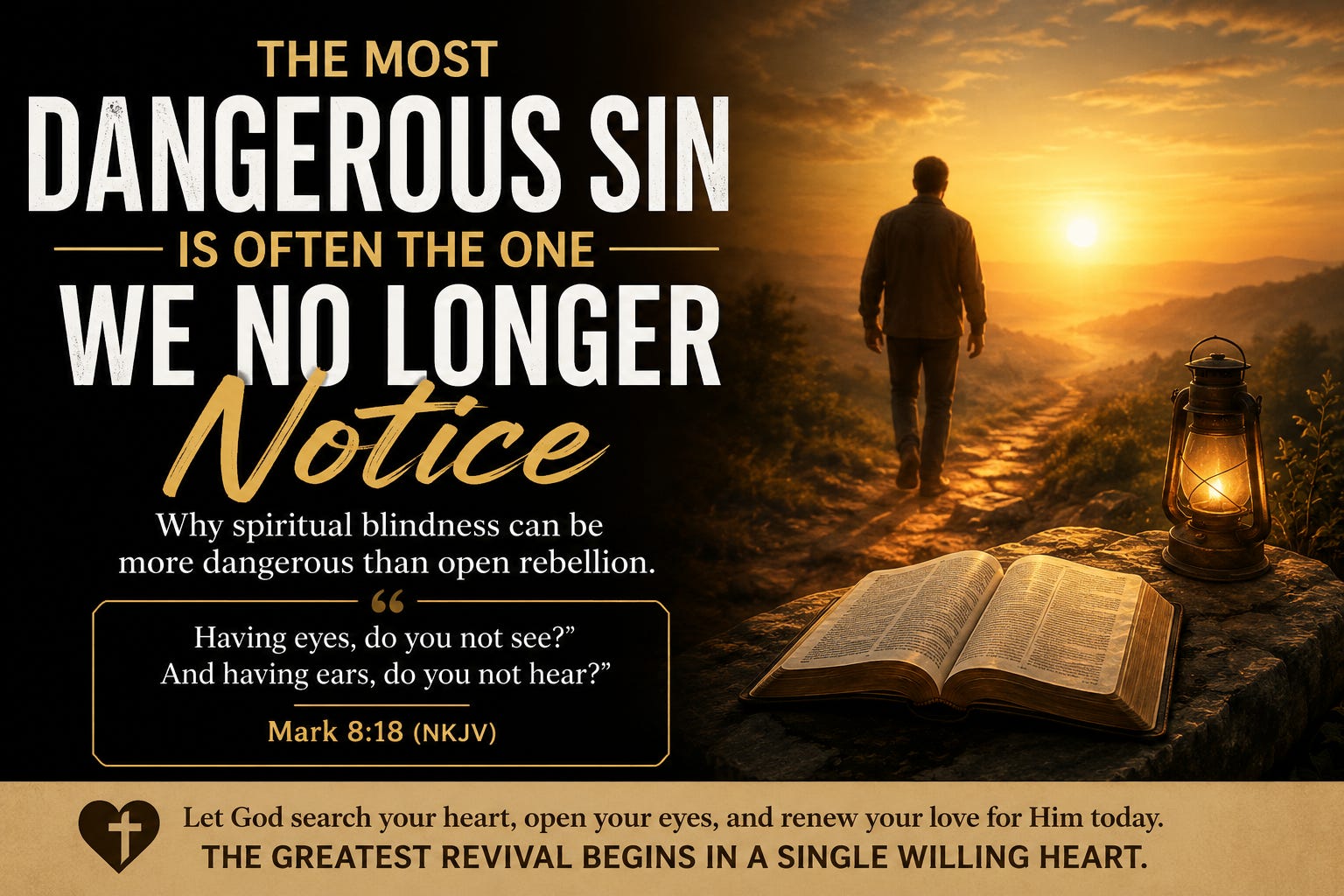
The Most Dangerous Sin Is Often the One We No Longer Notice
Subtitle: Why spiritual blindness can be more dangerous than open rebellion.

We often imagine the greatest dangers to the Christian life as obvious sins—hatred, greed, violence, immorality, or unbelief. These are certainly serious, and Scripture never treats them lightly.
But there is another danger that is quieter.
It grows slowly.
It rarely announces itself.
And because it develops gradually, we often fail to recognize it.
That danger is spiritual blindness.
The Pharisees of Jesus’ day were deeply religious. They knew the Scriptures. They prayed publicly. They fasted regularly. They defended tradition with remarkable zeal.
Yet they failed to recognize the very Messiah they had spent generations awaiting.
Their greatest problem was not a lack of religious activity.
It was a heart that had slowly become unable to see what God was doing.
Jesus warned them with solemn words:
“Having eyes, do you not see? And having ears, do you not hear?” (Mark 8:18, NKJV)
This warning reaches beyond the first century.
It reaches us.
Spiritual blindness does not usually begin with rejecting Christ.
It often begins with becoming comfortable.
We stop examining our own hearts.
We become more interested in winning arguments than growing in humility.
We notice everyone else’s failures while ignoring our own.
We become busy with Christian activity while neglecting personal communion with God.
Eventually, we may continue looking religious while our hearts slowly drift away from the One we claim to follow.
This is why repentance is not only for those outside the Church.
It is for believers.
Repentance is not merely turning from obvious sins.
It is allowing God to reveal the hidden places of pride, self-sufficiency, resentment, complacency, and spiritual indifference.
King David understood this when he prayed,
“Search me, O God, and know my heart; Try me, and know my anxieties; And see if there is any wicked way in me, And lead me in the way everlasting.” (Psalm 139:23–24, NKJV)
Notice that David did not simply ask God to forgive what he already knew.
He asked God to reveal what he could not yet see.
That is a dangerous prayer.
But it is also a transforming prayer.
Every generation of Christians faces the temptation to believe that spiritual decline happens only to others.
History tells a different story.
Churches can lose their first love.
Believers can tolerate compromise.
Communities can become spiritually comfortable.
The warnings given to the Seven Churches of Revelation remain surprisingly relevant today because the human heart has not changed.
Yet the good news is greater than the warning.
Christ still calls people back.
He still restores.
He still opens blind eyes.
He still renews weary hearts.
The Christian life is not about pretending we have already arrived.
It is about continually allowing Christ to reshape us.
Perhaps the most important prayer we can pray is not,
“Lord, change the world.”
But,
“Lord, begin with me.”
The greatest victories in the Christian life often begin quietly—in repentance, humility, and a renewed desire to know Christ more deeply.
May we never become so familiar with Christianity that we stop listening to Christ Himself.
Because the most dangerous sin is often not the one that shocks us.
It is the one we have quietly learned to ignore.
Closing Reflection
Before asking God to change someone else’s heart today, ask Him to search your own.
Sometimes the greatest revival begins in a single willing heart.
Dr. Daniel J. Grace
Faith • Civilization • Theology
Research • Journalism • Truth
📚 Amazon Author Page
✉️ Contact© 2026 Dr. Daniel J. Grace. All Rights Reserved.
No part of this article may be reproduced, distributed, transmitted, republished, or adapted in any form or by any means without the prior written permission of the author, except for brief quotations used for academic citation, review, or scholarly research, with appropriate attribution.