
The Lasting Legasy Of The Seven Churches.... Part Three
Smyrna and Pergamum – Persecution, Pagan Thrones, and the Seed of the Church

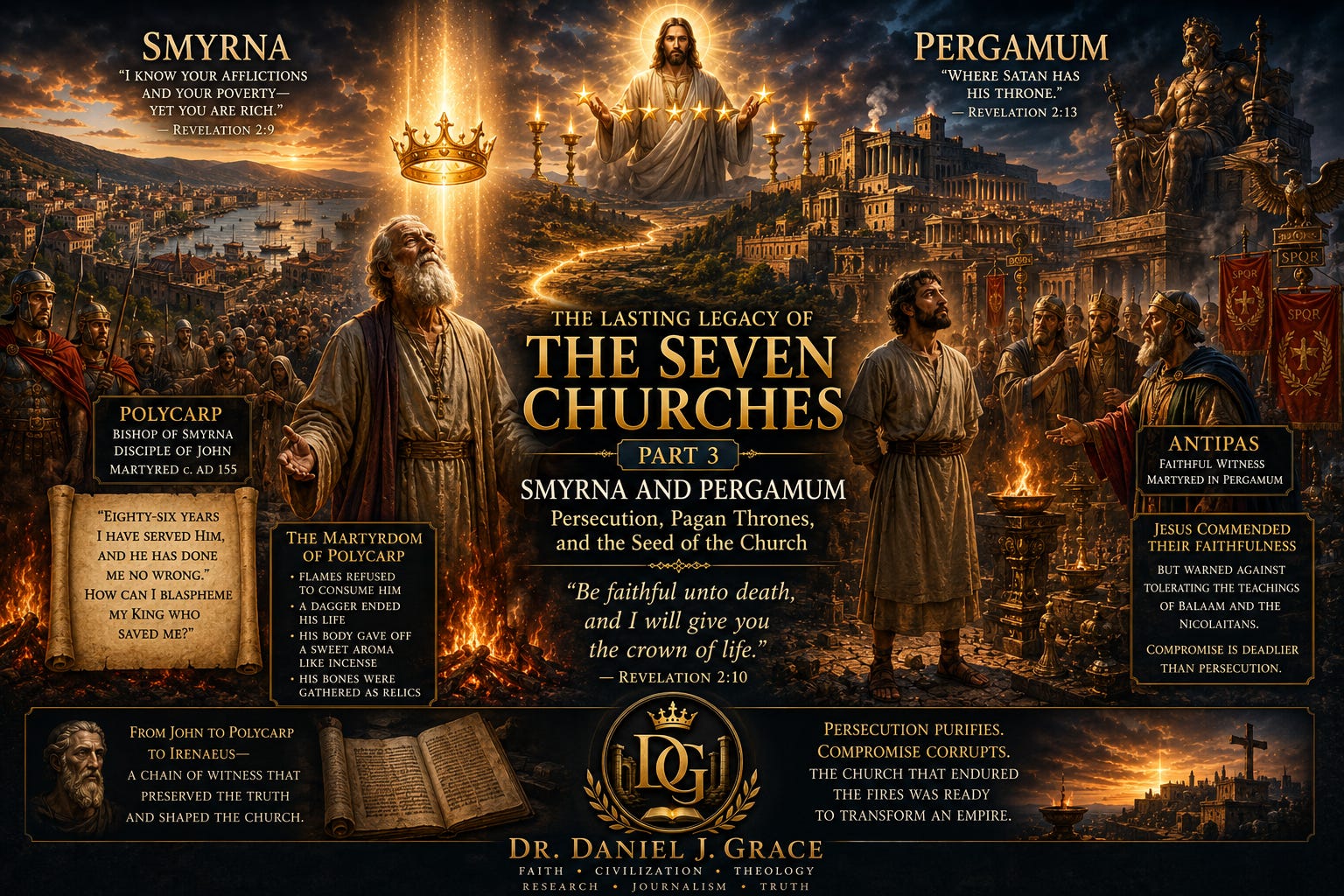
Part 3: Smyrna and Pergamum – Persecution, Pagan Thrones, and the Seed of the Church
Among the seven churches of Revelation, Smyrna and Pergamum stand as powerful examples of two very different battles faced by early Christians.
Smyrna endured persecution from outside the Church.
Pergamum struggled with compromise from within.
One was tested by suffering.
The other was tested by temptation.
Together, their stories helped shape the future of Christianity and provided lessons that remain relevant nearly two thousand years later.
Smyrna: The Church Rich in Faith
Modern-day İzmir stands where ancient Smyrna once flourished.
It was a prosperous and beautiful city, famous for its harbour, commerce, and loyalty to Rome. Yet despite the city’s wealth, the Christian community remained poor and often faced hostility from both civic authorities and religious opponents.
When Jesus addressed Smyrna in Revelation 2:8–11, He offered no rebuke.
Instead, He gave encouragement.
“I know your afflictions and your poverty—yet you are rich.” (Revelation 2:9)
Christ introduced Himself as:
“The First and the Last, who died and came to life again.”
This description carried special significance for believers facing imprisonment, persecution, and the possibility of death.
Jesus promised them something greater than earthly security:
“Be faithful unto death, and I will give you the crown of life.” (Revelation 2:10)
The legacy of Smyrna would ultimately be written in the blood of its martyrs.
Polycarp: The Bishop Who Refused to Deny Christ
No figure is more closely associated with Smyrna than Polycarp.
According to early Christian tradition, Polycarp had known the Apostle John and became one of the most respected leaders of the second-century Church.
Around AD 155, during a period of persecution, Roman authorities arrested the elderly bishop and demanded that he swear loyalty to Caesar and renounce Christ.
Polycarp refused.
His response became one of the most famous declarations in Christian history:
“Eighty-six years I have served Him, and He has done me no wrong. How can I blaspheme my King and my Saviour?”
The account of his death survives in a document known as The Martyrdom of Polycarp, one of the earliest Christian writings outside the New Testament.
The narrative describes his calm courage before the authorities and his unwavering faith in the face of execution.
The story spread rapidly throughout the Christian world.
For believers facing persecution, Polycarp became a model of faithfulness unto death.
His witness inspired generations of Christians who would later suffer under Roman emperors and other hostile rulers.
The Seed of the Church
The influence of Smyrna extended far beyond a single martyrdom.
The example of Polycarp helped establish a pattern that shaped Christian identity for centuries.
His life demonstrated that faithfulness was more valuable than survival.
His death showed that persecution could not destroy the Church.
In fact, persecution often strengthened it.
Centuries later, the North African theologian Tertullian would famously write:
“The blood of the martyrs is the seed of the Church.”
That statement perfectly captures Smyrna’s legacy.
Attempts to suppress Christianity frequently produced the opposite result.
The courage of martyrs inspired new converts, strengthened struggling believers, and demonstrated the authenticity of Christian faith.
Smyrna proved that suffering could become a powerful witness to the Gospel.
The Chain of Apostolic Witness
Polycarp’s importance extends beyond his martyrdom.
He also served as a vital link between the apostolic generation and the emerging Church.
His surviving Letter to the Philippians contains numerous references to New Testament writings and demonstrates how early Christians understood and preserved apostolic teaching.
One of Polycarp’s most famous disciples was Irenaeus of Lyons.
Irenaeus would become one of the most influential theologians of the second century and a major defender of orthodox Christianity against various heretical movements.
Through this chain of transmission—John to Polycarp, Polycarp to Irenaeus—the teachings of the apostles were preserved and passed to future generations.
This continuity became one of the foundations of Christian orthodoxy.
Pergamum: Faithfulness in Satan’s Shadow
While Smyrna faced persecution, Pergamum faced another danger.
Jesus described Pergamum as the place:
“Where Satan has his throne.” (Revelation 2:13)
The exact meaning remains debated among scholars.
Some believe the phrase refers to the city’s massive Altar of Zeus, which dominated the acropolis.
Others point to Pergamum’s role as a major centre of emperor worship.
Still others highlight the famous Asklepion, a healing sanctuary associated with serpent symbolism.
Whatever the precise reference, the message is clear.
Pergamum stood at the centre of powerful pagan religious influence.
Christians there lived under constant pressure to conform.
Antipas and the Cost of Witness
Despite these challenges, Jesus praised the believers of Pergamum.
They had remained loyal to His name even during persecution.
Among them was a faithful witness named Antipas.
Revelation records:
“Antipas, my faithful witness, who was put to death in your city.” (Revelation 2:13)
Although little is known about him outside church tradition, Antipas became an enduring symbol of Christian courage.
His example reminds us that faithfulness often comes with a cost.
The church in Pergamum did not deny Christ even when doing so might have saved lives.
Yet unlike Smyrna, Pergamum also received a warning.
The Danger of Compromise
Jesus rebuked the church for tolerating teachings associated with Balaam and the Nicolaitans.
These groups encouraged compromise with pagan culture, particularly in matters involving idolatry and sexual immorality.
The temptation was understandable.
Participation in trade guilds often required attendance at pagan feasts.
Refusing could result in economic hardship, social exclusion, or loss of business opportunities.
Many Christians faced enormous pressure to adapt their faith to fit the surrounding culture.
Jesus warned that such compromise was more dangerous than persecution itself.
History repeatedly demonstrates this truth.
Persecution often strengthens faith.
Compromise slowly weakens it.
The church can survive external opposition.
It struggles when it abandons its convictions.
Learning, Culture, and Christian Witness
Pergamum was also known for its intellectual life.
Its library was one of the largest in the ancient world and rivalled that of Alexandria.
The city attracted scholars, philosophers, and educators from across the Roman Empire.
As Christianity expanded, believers in places like Pergamum learned how to engage the intellectual culture around them without surrendering their faith.
This became an important part of the Church’s mission.
Christian thinkers increasingly interacted with philosophy, literature, and public life while maintaining their commitment to biblical truth.
Pergamum demonstrated that Christians could engage culture without being absorbed by it.
Two Churches, One Enduring Message
The combined legacy of Smyrna and Pergamum helped shape Christian history in profound ways.
Smyrna taught that suffering can strengthen and expand the Church.
Pergamum taught that compromise often poses a greater threat than persecution.
One church resisted fear.
The other was called to resist accommodation.
Both lessons remain essential today.
Throughout the centuries, believers have continued to draw inspiration from Polycarp’s courage and warning from Pergamum’s struggles.
The ruins of Smyrna’s agora and Pergamum’s acropolis still stand as reminders of these ancient communities.
Empires have risen and fallen.
Temples have crumbled.
The Gospel has endured.
The witness of Smyrna and Pergamum continues to challenge Christians in every generation.
Will we remain faithful when facing opposition?
Will we resist compromise when culture pressures us to conform?
The same questions that confronted these churches still confront us today.
Coming Next
In Part Four, we turn to two of the most overlooked churches of Revelation: Thyatira and Sardis. Their stories reveal the dangers of spiritual compromise, false teaching, complacency, and the subtle decline that can occur even when a church appears successful from the outside.
Dr. Daniel J. Grace
Faith • Civilization • Theology
Research • Journalism • Truth
🌐 danieljamesgrace.com
© 2026 Dr. Daniel J. Grace. All Rights Reserved.
No part of this article may be reproduced, distributed, transmitted, or published in any form or by any means without prior written permission from the author, except for brief quotations used in academic citation, review, or research purposes.