
The Lasting Legacy Of The Seven Churches..... Part Two
Ephesus – The Apostolic Mother Church That Shaped Doctrine for Millennia

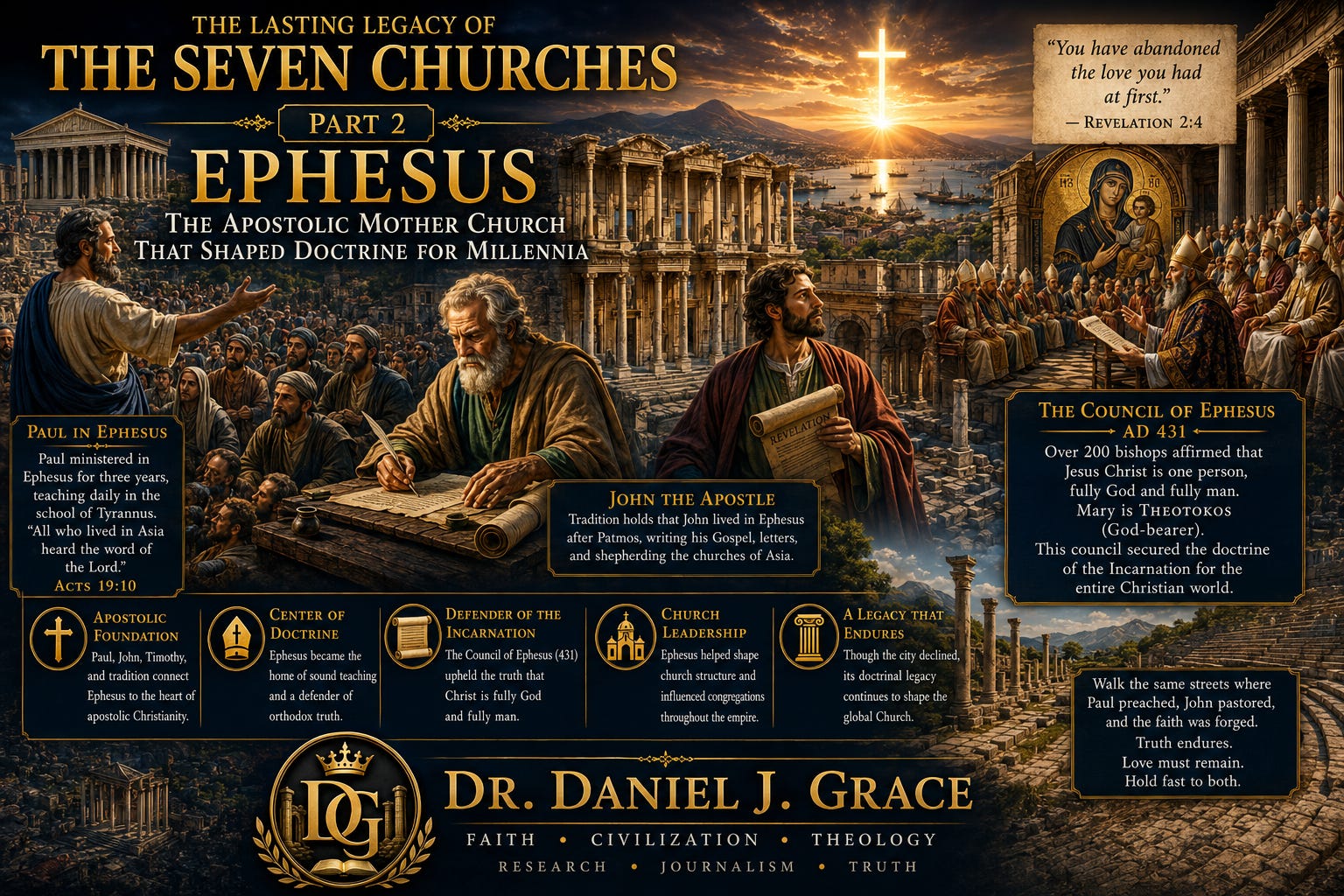
Part 2: Ephesus – The Apostolic Mother Church That Shaped Doctrine for Millennia
Among the seven churches of Revelation, Ephesus stood above the rest.
It was the crown jewel of Roman Asia.
A thriving port city on the Aegean coast, Ephesus was famous throughout the ancient world for its wealth, influence, and magnificent architecture. The city was home to the Temple of Artemis, one of the Seven Wonders of the Ancient World, a massive theatre capable of seating approximately 25,000 people, and bustling commercial districts that connected Asia Minor with the wider Roman Empire.
Yet Ephesus is remembered today not because of its pagan glory, but because it became one of the most important centres of early Christianity.
No other city among the seven churches exercised such a profound influence on Christian doctrine, leadership, and theological development.
The legacy of Ephesus continues to shape the Church nearly two thousand years later.
The Church Founded by Paul
The story of the Ephesian church begins with the Apostle Paul.
During his third missionary journey, Paul spent approximately three years ministering in Ephesus, making it the longest single ministry location recorded in the Book of Acts.
His work transformed the region.
Luke records:
“All who lived in Asia heard the word of the Lord, both Jews and Greeks.” (Acts 19:10)
The impact was extraordinary.
Miracles occurred.
New believers publicly burned books associated with magic and occult practices.
The Gospel spread rapidly throughout the province.
At the same time, opposition grew.
The success of Christianity threatened the city’s lucrative trade connected to the worship of Artemis. A riot erupted in the great theatre as silversmiths feared the loss of income from the sale of religious idols.
Acts 19 provides one of the clearest pictures of the conflict between Christianity and pagan culture in the first century.
From the very beginning, the Ephesian church stood at the centre of that struggle.
A Church Commended and Corrected
When Jesus addressed Ephesus in Revelation 2:1–7, He praised many aspects of the congregation.
They worked hard.
They persevered under pressure.
They tested false teachers.
They rejected error.
They refused to tolerate those who sought to corrupt the faith.
Christ specifically commended their opposition to the Nicolaitans, a group associated with compromise, idolatry, and moral corruption.
Yet despite their doctrinal strength, Jesus identified a serious spiritual problem.
“You have abandoned the love you had at first.” (Revelation 2:4)
The Ephesian church had preserved truth but allowed its passion to fade.
Their commitment to sound doctrine remained strong, but their devotion had cooled.
This tension would become one of the most enduring lessons of Ephesus.
Orthodoxy without love is never enough.
Truth must be accompanied by devotion.
Faithfulness requires both conviction and affection for Christ.
The Home of Apostolic Christianity
Church tradition associates Ephesus with some of the most important figures of the New Testament.
The Apostle John is believed to have spent his later years in and around the city, overseeing churches throughout the region after his exile on Patmos.
Many early Christian writers connected Ephesus with the composition and circulation of John’s Gospel and epistles.
Church tradition also holds that Timothy, Paul’s trusted co-worker, served as a leading pastor or bishop in Ephesus.
According to later Christian tradition, Mary, the mother of Jesus, may have spent her final years near the city under John’s care. While historians debate the details, the tradition remains deeply rooted in Christian memory, and a site known as the House of Mary continues to attract pilgrims from around the world.
By the second century, Ephesus had become one of the leading centres of Christianity in the Roman Empire.
Its influence extended far beyond its city walls.
The Council That Shaped Christian Doctrine
The most significant moment in the later history of Ephesus occurred in AD 431.
Nearly three and a half centuries after the Book of Revelation was written, bishops from across the Christian world gathered in Ephesus for the Third Ecumenical Council.
The meeting was called by Emperor Theodosius II to address one of the most important theological controversies in Christian history.
At the centre of the debate stood Nestorius, Patriarch of Constantinople.
Nestorius objected to the title Theotokos (”God-bearer” or “Mother of God”) being applied to Mary.
He preferred the term Christotokos (”Christ-bearer”), fearing that the former title blurred the distinction between Christ’s divine and human natures.
Opposing him was Cyril of Alexandria, who argued that Jesus Christ is one person possessing both a fully divine and fully human nature.
Because Christ is one person, the Church affirmed that Mary could rightly be called Theotokos.
The issue was far more than a debate about terminology.
At stake was the identity of Jesus Himself.
Was Christ divided into two separate persons?
Or was He one person who was both fully God and fully man?
The Council of Ephesus decisively rejected Nestorianism and affirmed the orthodox doctrine of the Incarnation.
The council upheld the Nicene faith and reinforced truths that continue to be embraced across the Christian world.
The decisions made in Ephesus influenced centuries of theological reflection and laid important foundations for later councils, including Chalcedon in AD 451.
Every Christian tradition that confesses Christ as fully God and fully man owes something to the theological battles fought in Ephesus.
A Legacy of Leadership
Ephesus also played a major role in shaping church organisation.
By the second century, the city had become a centre of regional Christian leadership.
Its bishops exercised significant influence over surrounding congregations.
Ignatius of Antioch, writing in the early second century, praised the unity and faithfulness of the Ephesian believers.
The city’s leadership model helped influence the development of church structures throughout the Roman Empire.
As Christianity expanded, Ephesus remained one of its most respected centres.
The city became a bridge between the apostolic generation and the developing Church of the following centuries.
The Rise and Decline of a Great City
Archaeological discoveries reveal how dramatically Ephesus changed over time.
The small house churches of the first century eventually gave way to large basilicas and public places of worship after Christianity gained legal recognition under Constantine.
Yet the city’s earthly glory would not last forever.
Over the centuries, the harbour gradually filled with silt, damaging trade and weakening the local economy.
Political instability, invasions, and changing trade routes accelerated the city’s decline.
The once-great metropolis slowly faded.
Today, visitors can walk among the remarkable ruins of Ephesus.
The Library of Celsus still stands.
The great theatre where the riot of Acts 19 occurred remains visible.
A solitary column marks the site where the Temple of Artemis once dominated the skyline.
The city that challenged Christianity disappeared.
The faith it opposed survived.
The Enduring Lesson of Ephesus
The legacy of Ephesus reaches far beyond archaeology.
Its influence can be found in Christian doctrine, church leadership, biblical scholarship, and the theological foundations of the faith itself.
Yet perhaps its most important lesson comes from the warning Jesus gave in Revelation.
The church that defended truth was also called to recover its first love.
Doctrine matters.
Theology matters.
Truth matters.
But all of these must be rooted in genuine love for Christ.
Ephesus reminds us that orthodoxy without devotion becomes cold, while devotion without truth becomes unstable.
The healthiest church is one that holds both together.
The story of Ephesus continues to challenge every generation of Christians.
Hold fast to the truth.
Guard the faith.
But never lose your first love.
Coming Next
In Part Three, we travel north to Smyrna—the suffering church that remained faithful under persecution and whose most famous bishop, Polycarp, became one of the greatest martyrs of the early Christian world. His courage would inspire believers for centuries and help define what it means to remain faithful unto death.
Dr. Daniel J. Grace
Faith • Civilization • Theology
Research • Journalism • Truth
🌐 danieljamesgrace.com
© 2026 Dr. Daniel J. Grace. All Rights Reserved.
No part of this article may be reproduced, distributed, transmitted, or published in any form or by any means without prior written permission from the author, except for brief quotations used in academic citation, review, or research purposes.