
The Lasting Legacy Of The Seven Churches.... Part Five
How Seven Churches Helped Shape Christian History

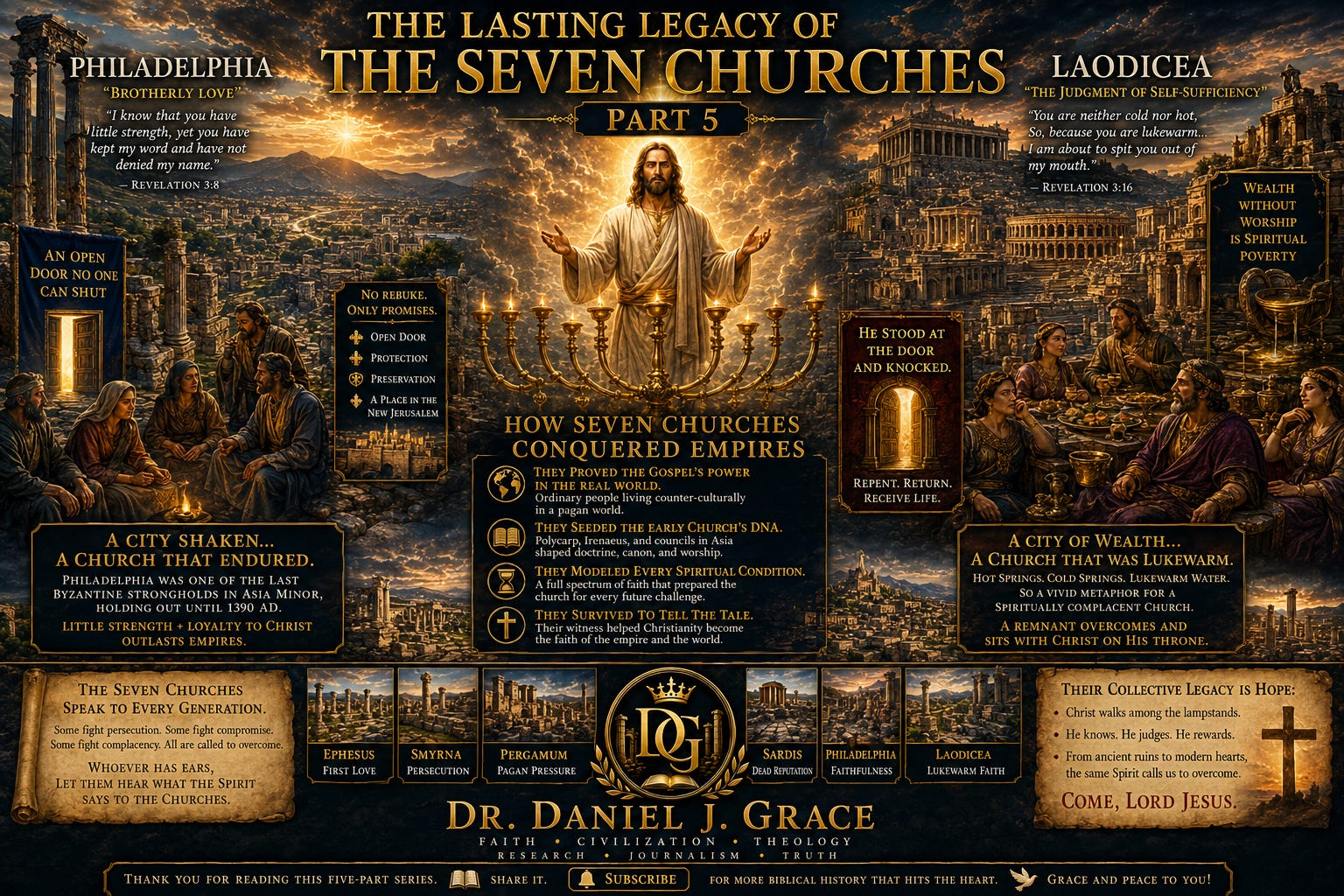
Part 5: Philadelphia, Laodicea, and the Global Ripple
As the Book of Revelation draws toward its conclusion, two churches stand in sharp contrast to one another.
One possessed little strength but remained faithful.
The other possessed great wealth but became spiritually complacent.
Together, Philadelphia and Laodicea provide the final lessons in the story of the seven churches and help us understand how these small congregations left a lasting mark on world history.
Philadelphia: Faithfulness in Weakness
Among the seven churches, Philadelphia received one of Christ’s most encouraging messages.
Unlike many of the others, the church received no rebuke.
Jesus acknowledged their limitations:
“I know that you have little strength.” (Revelation 3:8)
Yet despite their weakness, they had remained faithful.
They kept Christ’s word.
They did not deny His name.
For this reason, Jesus promised them an open door that no one could shut.
He also promised protection, vindication, and a permanent place in God’s kingdom.
The city itself provides an important backdrop to these promises.
Located in a region prone to earthquakes, Philadelphia experienced repeated destruction and rebuilding.
Its inhabitants understood uncertainty.
Buildings collapsed.
Homes were abandoned.
Lives were disrupted.
Yet the city endured.
The Christian community followed the same pattern.
History records that Philadelphia remained a significant Christian centre long after many neighbouring cities declined.
Indeed, it survived as one of the last Byzantine strongholds in western Asia Minor before eventually falling under Ottoman control in the late fourteenth century.
Its endurance became a powerful symbol of perseverance.
The church’s legacy is simple but profound:
Faithfulness matters more than strength.
History often celebrates power, wealth, and influence.
Philadelphia reminds us that Christ values loyalty above all.
A small, faithful church can leave a greater legacy than a large, influential one.
Laodicea: The Danger of Spiritual Self-Sufficiency
If Philadelphia represents perseverance, Laodicea represents complacency.
Laodicea was wealthy.
It was famous for banking, textile production, and a medical school known for producing eye treatments.
The city enjoyed prosperity and self-confidence.
After a devastating earthquake in AD 60, the citizens rebuilt without requesting imperial assistance.
They were proud of their independence.
The church reflected the spirit of the city.
When Jesus addressed Laodicea in Revelation 3:14–22, His words were among the strongest in the entire book.
“You are neither cold nor hot.”
The church was lukewarm.
Not openly hostile to Christ.
Not passionately devoted to Him.
Simply comfortable.
Their wealth had created an illusion of spiritual health.
They believed they needed nothing.
Christ exposed the truth:
“You do not realise that you are wretched, pitiful, poor, blind and naked.” (Revelation 3:17)
The imagery would have struck the Laodiceans with particular force.
A city famous for wealth was spiritually poor.
A city known for eye medicine was spiritually blind.
A city proud of its clothing industry was spiritually naked.
Yet even in this severe rebuke, hope remained.
Christ stood at the door and knocked.
The invitation was still open.
Repentance was still possible.
Victory was still available.
Laodicea’s legacy has echoed through every generation of church history.
Whenever Christians become comfortable, prosperous, and self-sufficient, the warning of Laodicea returns.
Its message remains one of the most relevant in Revelation.
The Global Ripple of the Seven Churches
Taken individually, each church offers a unique lesson.
Together, they reveal something much larger.
They demonstrate the extraordinary power of the Gospel to transform ordinary lives and influence history.
These churches existed in a region saturated with pagan religion, emperor worship, economic pressure, and cultural opposition.
Yet Christianity not only survived—it expanded.
The influence of Asia Minor reached far beyond its borders.
Through leaders such as Polycarp, Irenaeus, Ignatius, and countless unnamed believers, the experiences of these churches helped shape Christian doctrine, worship, leadership, and biblical interpretation.
The region became one of the great centres of early Christianity.
Major theological debates were fought there.
Church councils met there.
Missionaries were trained there.
Biblical manuscripts were copied and preserved there.
The spiritual foundations laid in Asia Minor contributed significantly to the development of Byzantine Christianity and later Christian traditions throughout Europe and beyond.
A Mirror for Every Generation
One reason the seven churches continue to speak so powerfully is that they represent the full spectrum of spiritual conditions.
Every church can find itself somewhere among the seven.
Ephesus reminds us not to lose our first love.
Smyrna teaches courage in suffering.
Pergamum warns against compromise.
Thyatira exposes the danger of tolerating false teaching.
Sardis challenges spiritual complacency.
Philadelphia encourages perseverance.
Laodicea confronts self-sufficiency.
Some interpreters have viewed the seven churches as representing successive periods of church history.
Others understand them primarily as timeless spiritual portraits.
Whatever position one adopts, the relevance remains undeniable.
The same struggles faced by these first-century believers continue to confront Christians today.
Persecuted believers around the world still identify with Smyrna and Philadelphia.
Affluent congregations still hear the warning of Laodicea.
Every church is called to listen to what the Spirit says.
The Enduring Legacy
The seven churches were not perfect.
Most received correction.
Several faced serious spiritual problems.
Yet Christ did not abandon them.
Instead, He called them to overcome.
To each church He offered promises that point beyond the present age—to the Tree of Life, the New Jerusalem, eternal fellowship with God, and participation in His kingdom.
Their collective legacy is therefore not one of perfection, but of hope.
The risen Christ walks among the lampstands.
He knows His people.
He corrects them.
He strengthens them.
He rewards faithfulness.
Two thousand years later, the ruins of these cities remain scattered across western Türkiye.
The theatres, marketplaces, temples, and churches have largely fallen silent.
Yet their message continues to echo throughout the world.
From ancient Asia Minor to modern homes, churches, and communities across every continent, the same call remains:
“Whoever has ears, let them hear what the Spirit says to the churches.”
The story of the seven churches is ultimately our story.
Their victories encourage us.
Their failures warn us.
Their endurance inspires us.
And their hope points us toward the same future.
Come, Lord Jesus.
Final Thoughts
Thank you for reading this five-part series.
If these remarkable churches have deepened your appreciation for Christian history, strengthened your faith, or renewed your sense of wonder at God’s work through ordinary people, consider sharing the series with others.
The story of the seven churches is far more than ancient history.
It is living testimony that God often uses small, imperfect, and seemingly insignificant communities to change the course of the world.
Grace and peace to you—
Just as it was to the seven churches.
Dr. Daniel J. Grace
Faith • Civilization • Theology
Research • Journalism • Truth
🌐 danieljamesgrace.com
© 2026 Dr. Daniel J. Grace. All Rights Reserved.
No part of this article may be reproduced, distributed, transmitted, or published in any form or by any means without prior written permission from the author, except for brief quotations used in academic citation, review, or research purposes.