
The Lasting Legacy of the Seven Churches... Part One
How Seven Ancient Congregations Changed World History

Introduction
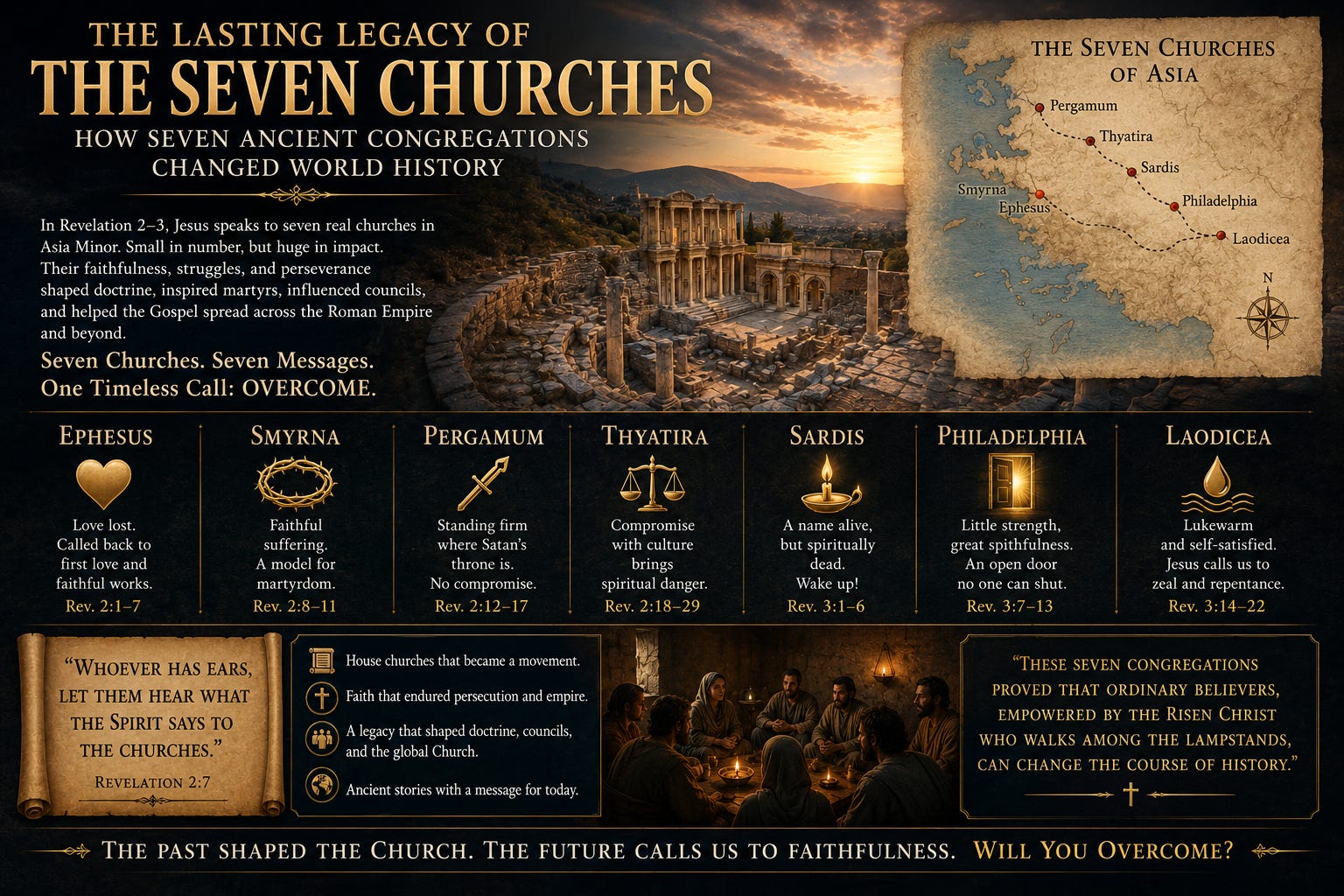
In Revelation chapters 2 and 3, Jesus addresses seven real churches located in the Roman province of Asia Minor, in what is now western Türkiye: Ephesus, Smyrna, Pergamum, Thyatira, Sardis, Philadelphia, and Laodicea.
These were not grand cathedrals filled with thousands of worshippers.
They were small congregations meeting in homes, workshops, and upper rooms. Their members included merchants, craftsmen, widows, slaves, freedmen, and ordinary families seeking to remain faithful to Christ in a world dominated by Rome.
Yet their influence would extend far beyond their own generation.
These churches became part of the foundation upon which Christianity spread throughout the Roman Empire and eventually across the world. Their faithfulness—and sometimes their failures—helped shape Christian doctrine, martyrdom traditions, church leadership, and the endurance of the faith through centuries of persecution and change.
The region of Asia Minor played a central role in the development of early Christianity. Several New Testament writings were addressed to churches in this area, and many of the most influential figures of the early Church lived, ministered, or taught there. Church fathers walked these streets. Major theological debates were settled here. Councils met here. Missionaries were trained here.
The challenges faced by these seven churches remain strikingly familiar.
Lost love.
Persecution.
Compromise.
Tolerance of error.
Spiritual complacency.
Faithful endurance.
Lukewarm devotion.
The same struggles continue to confront the Church today.
This series explores the lasting legacy of these seven congregations and examines how a handful of ordinary believers helped shape world history.
Drawing from Scripture, archaeology, early Christian writings, and historical records, we will discover why these churches still matter nearly two thousand years later.
This is not merely ancient history.
It is a story that continues to speak.
Part One
Why These Seven Small Churches Rewrote History
It is easy to read Revelation chapters 2 and 3 as seven short letters and move quickly to the dramatic visions that follow.
Yet these churches were chosen deliberately.
The seven cities formed a natural circuit along a major Roman road that connected the most important urban centres of western Asia Minor. A messenger carrying John’s Revelation could travel from Ephesus to Smyrna, Pergamum, Thyatira, Sardis, Philadelphia, and finally Laodicea in sequence.
Their locations were strategic.
They stood at the crossroads of commerce, culture, politics, and religion.
Ephesus possessed one of the largest harbours in the region and was home to the Temple of Artemis, one of the Seven Wonders of the Ancient World.
Pergamum was famous for its library and imperial cult.
Laodicea prospered through banking and trade.
Philadelphia sat along important commercial routes.
These were not isolated villages.
They were influential cities within one of the most important regions of the Roman Empire.
The Apostle Paul spent approximately three years ministering in Ephesus. During that time, Christianity spread rapidly throughout the surrounding region.
Luke records:
“All the residents of Asia heard the word of the Lord, both Jews and Greeks.” (Acts 19:10)
By the time John wrote Revelation from Patmos around AD 95, these churches represented a mature and growing Christian presence within Asia Minor.
Their legacy begins with both geography and timing.
Asia Minor was not a remote frontier.
It was a centre of intellectual, economic, and religious life.
Magnificent temples dominated city skylines.
Emperor worship was increasingly promoted.
Trade guilds often required participation in pagan ceremonies.
Roman authority was visible everywhere.
Yet within this environment, small groups of Christians refused to bow before idols or acknowledge Caesar as Lord.
Their resistance would shape history.
Faithfulness That Changed the World
Archaeological discoveries and early Christian writings reveal that these churches did far more than survive.
They multiplied.
House churches became networks of congregations.
Local elders became influential bishops.
Letters circulated between churches and were copied throughout the empire.
The region eventually became one of the most important centres of post-apostolic Christianity.
Without the perseverance demonstrated by believers in these churches, Christianity might have remained a small movement on the margins of the Roman world.
Instead, it became a faith that outlasted the empire itself.
Each church contributed a unique lesson to Christian history.
Ephesus
Ephesus taught the importance of doctrinal faithfulness while warning against the danger of losing one’s first love.
Smyrna
Smyrna became a model of faithful suffering and inspired generations of Christians through its martyrdom traditions.
Pergamum
Pergamum demonstrated the cost of standing firm in a culture hostile to Christian convictions.
Thyatira
Thyatira warned believers about the dangers of compromising truth for social acceptance or economic security.
Sardis
Sardis exposed the difference between reputation and spiritual reality.
Philadelphia
Philadelphia showed how faithfulness and perseverance can overcome apparent weakness.
Laodicea
Laodicea revealed the spiritual dangers that often accompany wealth, comfort, and self-sufficiency.
Together, these churches became a mirror through which every generation of Christians could examine itself.
A Message for Every Generation
Jesus concluded each letter with the same challenge:
“Whoever has ears, let them hear what the Spirit says to the churches.”
Notice the plural.
The message was never intended for one congregation alone.
Every church was meant to learn from the others.
The lessons given to Ephesus belonged to Smyrna.
The warnings given to Laodicea belonged to Philadelphia.
The encouragement given to Smyrna belonged to every suffering believer throughout history.
Early Christian leaders understood this.
Irenaeus, who learned from Polycarp of Smyrna, treated Revelation as authoritative Scripture and drew upon its teachings regularly.
The witness of these churches inspired Christians throughout the Roman world, from Asia Minor to North Africa, Italy, and Gaul.
Their example became part of the living memory of the Church.
The Legacy Continues
By the time Christianity was legalised under Constantine in the fourth century, Asia Minor already possessed deep Christian roots.
Major theological gatherings took place in the region, including the Council of Ephesus in AD 431.
The influence of these churches helped shape Christian doctrine, worship, and identity for centuries.
Although many of the original congregations eventually declined or disappeared amid political upheaval and changing historical circumstances, their legacy survived.
Pilgrims still travel the ancient Seven Churches route today.
The ruins of theatres, marketplaces, temples, and churches continue to tell their story.
Most importantly, the spiritual lessons remain.
The same questions still confront believers:
Will we remain faithful?
Will we resist compromise?
Will we persevere through hardship?
Will we overcome?
The seven churches changed world history because ordinary believers trusted the risen Christ who walks among the lampstands.
Their story is not merely a chapter of ancient history.
It is part of the story of the global Church itself.
In Part Two, we will begin with the most influential of them all: Ephesus—the apostolic centre whose legacy continues to echo throughout Christian history.
Dr. Daniel J. Grace
Faith • Civilization • Theology
Research • Journalism • Truth
🌐 danieljamesgrace.com
© 2026 Dr. Daniel J. Grace. All Rights Reserved.
No part of this article may be reproduced, distributed, transmitted, or published in any form or by any means without prior written permission from the author, except for brief quotations used in academic citation, review, or research purposes.