
The House Churches of Asia Minor
How Christians Worshipped Before Church Buildings Existed

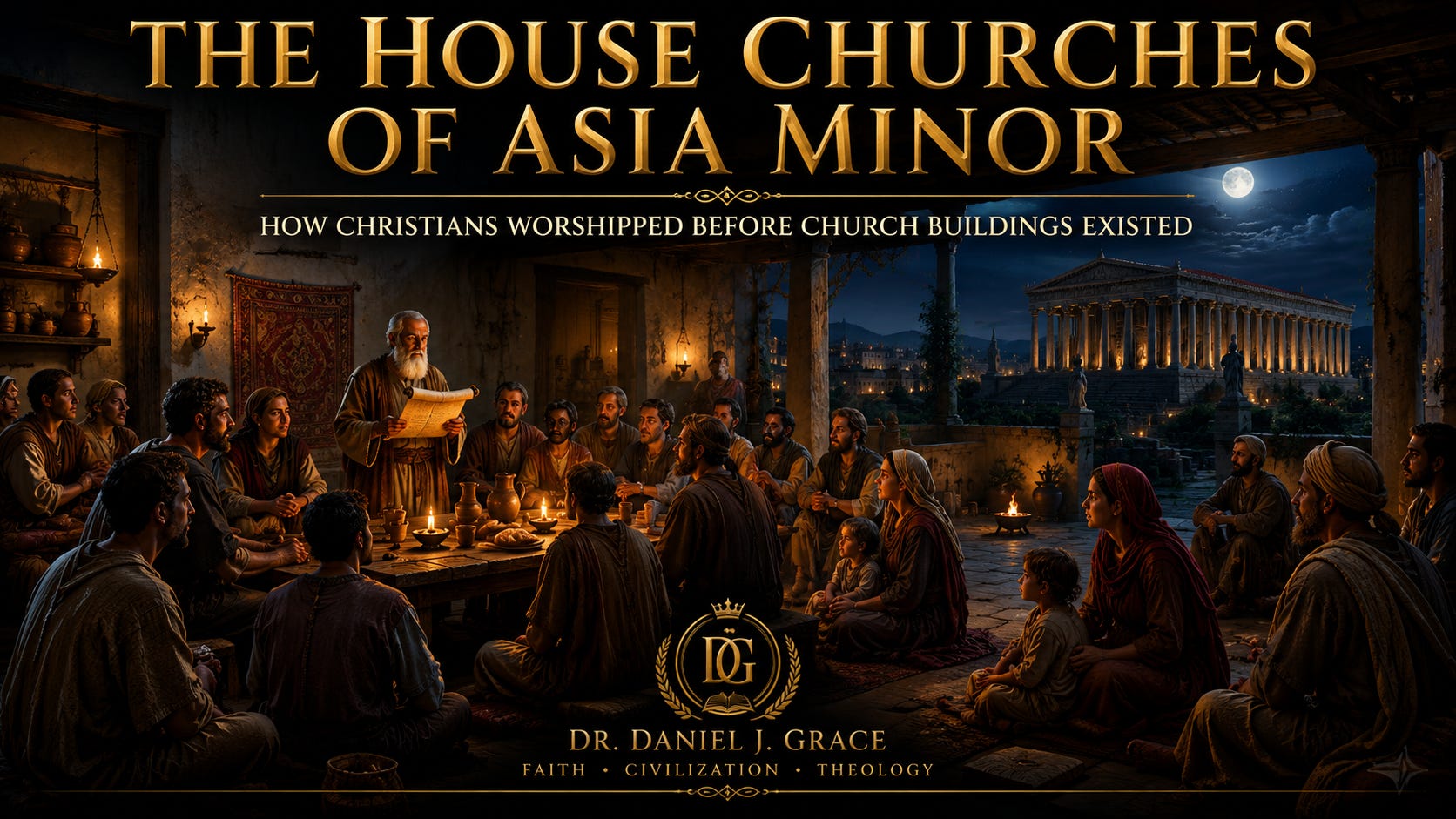
The Hidden World of Early Christian Gatherings in the Seven Churches of Revelation
When modern Christians think about church, they often imagine a dedicated building with a sanctuary, pulpit, choir, classrooms, offices, and perhaps a large congregation gathered for worship. Yet the believers who first received the Book of Revelation knew nothing of such buildings. The churches of Ephesus, Smyrna, Pergamum, Thyatira, Sardis, Philadelphia, and Laodicea met in homes, courtyards, workshops, and private residences scattered throughout the cities of Asia Minor.
For nearly three centuries after the death and resurrection of Jesus Christ, Christianity spread throughout the Roman Empire without purpose-built church structures. The faith grew through networks of ordinary believers who opened their homes, shared meals, studied Scripture, prayed together, and proclaimed the Gospel in everyday settings.
Understanding the world of the house churches helps us understand not only the Seven Churches of Revelation but also the remarkable growth of Christianity during its earliest centuries.
The First Christian Gathering Places
The earliest Christians were primarily Jewish followers of Jesus. Initially, many continued attending synagogues while also meeting separately in homes to break bread and remember Christ.
As Christianity expanded among Gentiles throughout Asia Minor, believers increasingly gathered in private residences. These homes became the first centres of Christian worship, discipleship, fellowship, and mission.
The Apostle Paul frequently mentions churches meeting in homes.
In Romans 16:5 he greets the church that met in the house of Prisca and Aquila.
In Colossians 4:15 he refers to the church meeting in the home of Nympha.
In Philemon 1:2 he greets the church gathering in Philemon’s house.
These references reveal that house churches were not exceptions but the normal pattern of Christian life throughout the first century.
Why Christians Met in Homes
Several factors contributed to the development of house churches.
First, Christianity was a small and often misunderstood movement. Believers lacked the financial resources necessary to construct large public buildings.
Second, periodic persecution made public visibility dangerous. Meeting in homes provided a degree of safety and flexibility.
Third, the home itself reflected the deeply relational nature of early Christianity. The church was understood not as a building but as a community of believers united in Christ.
The Greek word “ekklesia,” translated as church, referred to an assembly of people rather than a physical structure.
For the earliest Christians, the church was wherever God’s people gathered.
House Churches in Ephesus
Ephesus was one of the largest and most important cities in the Roman Empire. It contained magnificent public buildings, theatres, temples, and commercial centres.
Yet the Christian community likely met in multiple homes scattered throughout the city.
Paul ministered in Ephesus for several years and established a strong network of believers. Given the city’s size, it is probable that numerous house churches existed, each connected through shared leadership and common faith.
The church addressed in Revelation was therefore not a single congregation meeting in one location but a collection of Christian communities spread throughout the city.
This pattern may have existed in many of the Seven Churches.
What House Church Worship Looked Like
Early Christian worship differed significantly from many modern services.
Believers gathered around meals.
Scripture was read aloud.
Letters from apostles were shared and discussed.
Prayers were offered.
Hymns and spiritual songs were sung.
Testimonies were given.
The Lord’s Supper was celebrated.
Teaching occurred through discussion and instruction rather than formal sermons alone.
Participation was often more communal than institutional.
The atmosphere resembled an extended spiritual family gathered around a shared table.
These gatherings strengthened relationships and reinforced the sense of belonging that characterised early Christian communities.
The Role of Hospitality
Hospitality occupied a central place in early Christian life.
Opening one’s home to fellow believers involved sacrifice.
Hosts provided space, food, protection, and practical support.
Many house church leaders were individuals of means who used their resources to advance the Gospel.
Women frequently played important roles in hosting and supporting Christian gatherings.
Lydia in Philippi, Priscilla in Ephesus, and Nympha in Colossae demonstrate how homes became centres of ministry and mission.
Hospitality transformed ordinary residences into places of worship and discipleship.
In many respects, the growth of Christianity depended upon faithful believers willing to share what they possessed.
Challenges Faced by House Churches
House churches enjoyed many advantages, but they also faced challenges.
Space was limited.
Most Roman homes could accommodate only a modest number of people.
As congregations grew, multiple house churches became necessary.
False teaching could spread quickly through informal networks.
Leadership disputes sometimes emerged.
Economic differences between rich and poor believers occasionally created tensions.
Persecution posed an ongoing threat.
A house church could attract unwanted attention from local authorities or hostile neighbours.
Despite these difficulties, Christianity continued expanding throughout Asia Minor and beyond.
Leadership in the House Churches
Leadership within house churches was often personal and relational.
Elders, overseers, and deacons guided congregations through teaching, pastoral care, and practical service.
Because gatherings were relatively small, leaders knew members personally.
Spiritual growth occurred through close relationships rather than large-scale programmes.
The messages to the Seven Churches in Revelation reveal that leadership carried significant responsibility.
Christ held church leaders accountable for the spiritual condition of their congregations.
Faithful leaders encouraged perseverance.
Unfaithful leaders tolerated compromise and error.
The house church model required leaders to be examples as well as teachers.
House Churches During Persecution
The churches of Smyrna and Philadelphia experienced significant opposition.
Throughout the Roman Empire, Christians periodically faced suspicion and persecution.
House churches provided flexibility during these difficult times.
Believers could meet quietly, change locations, and maintain fellowship despite external pressure.
This decentralised structure helped Christianity survive.
Unlike a movement dependent upon large public buildings, the church could continue gathering wherever believers were present.
The faith spread through homes, families, friendships, and personal relationships.
Persecution often strengthened rather than weakened these communities.
Archaeological Evidence
Archaeological discoveries provide valuable insights into early Christian gatherings.
One of the most famous examples is the house church at Dura-Europos in Syria, dating to the third century.
Although located outside Asia Minor, it demonstrates how ordinary homes were adapted for Christian worship.
Archaeological evidence from Ephesus, Sardis, and other cities reveals the types of residences where believers likely met.
These homes varied in size and wealth, reflecting the diversity of early Christian communities.
Some gatherings occurred in larger homes owned by wealthier believers.
Others met in modest settings.
The Gospel united people from different social and economic backgrounds.
From House Churches to Church Buildings
The transition from house churches to dedicated church buildings occurred gradually.
As Christianity expanded and persecution lessened, larger meeting spaces became necessary.
The conversion of Emperor Constantine in the fourth century transformed Christianity’s public position within the empire.
Church construction increased dramatically.
Basilicas and public worship centres appeared throughout the Roman world.
Yet the house church era had already established the foundations of Christian faith and practice.
The church had grown from a small movement into a global faith without relying on impressive buildings.
Its strength lay in people, not structures.
Lessons for the Modern Church
The experience of the house churches offers important lessons for contemporary Christians.
First, the church is fundamentally a community rather than a building.
Second, relationships remain central to spiritual growth.
Third, hospitality continues to be a powerful ministry.
Fourth, faithfulness does not depend upon resources or facilities.
Finally, Christianity flourishes when believers actively participate in the life of the church rather than merely attend religious events.
The earliest Christians changed the world through homes, meals, conversations, prayer, Scripture, and faithful witness.
Their example reminds us that the church’s greatest strength has never been its buildings but its people.
Conclusion
The Seven Churches of Revelation emerged from a world where Christianity existed primarily through house churches. Long before cathedrals, basilicas, and church campuses appeared, believers gathered in ordinary homes throughout Asia Minor.
These simple gatherings became the foundation upon which Christian civilisation was built.
Within living rooms, courtyards, workshops, and family homes, the Gospel was preached, disciples were formed, prayers were offered, and communities of faith were established.
The house churches of Asia Minor demonstrate that the power of Christianity never depended upon magnificent structures. It depended upon faithful believers willing to open their homes, share their lives, and follow Christ together.
Their legacy continues to challenge and inspire the Church today.

Dr. Daniel J. Grace
Faith • Civilization • Theology
Research • Journalism • Truth
🌐 danieljamesgrace.com
© 2026 Dr. Daniel J. Grace. All Rights Reserved.
No part of this article may be reproduced, stored in a retrieval system, distributed, transmitted, published, or reproduced in any form or by any means, whether electronic, mechanical, photocopying, recording, or otherwise, without the prior written permission of the author, except for brief quotations used for academic citation, review, commentary, or research purposes as permitted by applicable copyright law.
This work is protected under international copyright and intellectual property laws. Unauthorised use, reproduction, or distribution of this material may result in legal action.