

The Holy Spirit, Revival, and Spiritual Renewal in the Modern World
How the Holy Spirit Renews the Church with Power, Holiness, Prayer, and Faithful Witness in a Changing Age

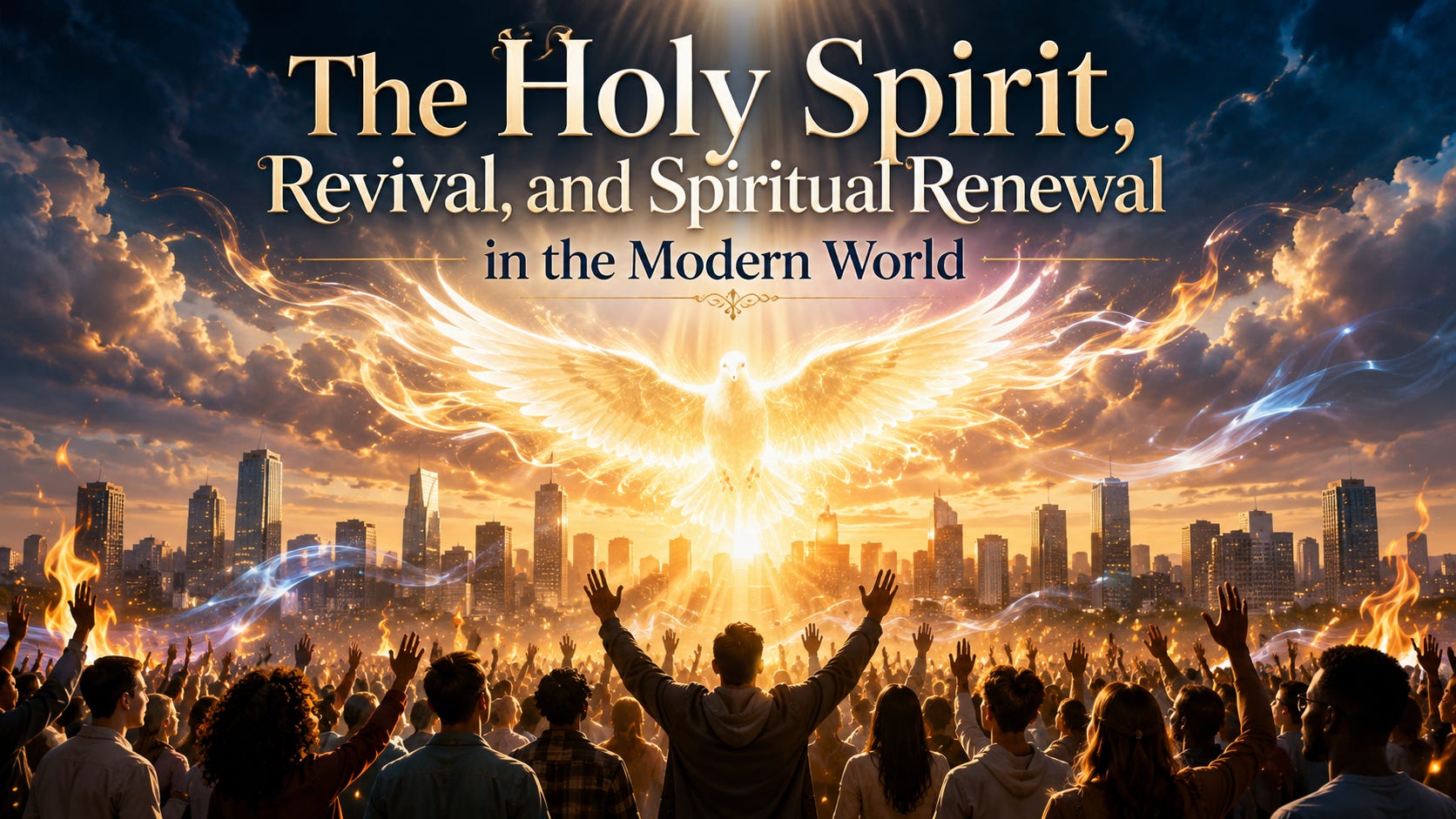
Bible Verse
“Not by might nor by power, but by My Spirit.”
Says the Lord of hosts.
Zechariah 4:6, NKJV
The Holy Spirit, Revival, and Spiritual Renewal in the Modern World
The modern Church needs renewal.
It does not need merely better programmes, stronger branding, larger platforms, more professional music, sharper marketing, cleaner websites, smarter technology, more impressive buildings, or more influential personalities. These things may have limited usefulness, but they cannot provide spiritual life. They cannot convict the heart of sin. They cannot create holiness. They cannot raise the spiritually dead. They cannot make Christ beautiful to the soul. They cannot renew the Church.
Only God can do that.
The Church needs the Holy Spirit.
This truth must be recovered with seriousness. Christianity is not merely a moral system, historical tradition, religious institution, cultural identity, intellectual worldview, or social community. It is life in the living God through Jesus Christ by the power of the Holy Spirit. Without the Spirit, religion becomes external. Worship becomes performance. Preaching becomes speech. Sacraments become empty rituals. Mission becomes strategy. Leadership becomes management. Theology becomes information. Community becomes organisation.
The Holy Spirit imparts life.
He convicts the world of sin, righteousness, and judgement. He glorifies Jesus Christ. He brings new birth. He pours the love of God into the heart. He leads believers into truth. He gives gifts for the building up of the Church. He empowers witnesses. He forms holiness. He intercedes with groanings too deep for words. He produces fruit: love, joy, peace, longsuffering, kindness, goodness, faithfulness, gentleness, and self-control.
The Church cannot be the Church without the Spirit.
This reality is why the words of Zechariah remain urgent: not by might, nor by power, but by My Spirit. Human strength is not enough. Institutional power is not enough. Political influence is not enough. Money is not enough. Education is not enough. Emotion is not enough. Talent is not enough. The Church lives by the Spirit of God.
The modern world often tempts the Church to forget its mission.
When churches face decline, they may seek renewal through technique alone. When they face cultural pressure, they may seek security through politics. When they face distrust, they may seek image repair. When they face competition, they may seek entertainment. When they face financial pressure, they may seek business models. When they face spiritual dryness, they may seek emotional stimulation.
But spiritual renewal is not manufactured.
It is received.
This does not mean Christians do nothing. They pray, preach, repent, worship, teach, organise, serve, give, plan, and witness. But they do these things in dependence on God. Means matter, but the Spirit gives life through them. Prayer is not a technique. Preaching is not a performance. Worship is not production. Mission is not marketing. Revival is not an event created by human pressure.
Revival is a work of God.
Christians have used the word ‘revival’ in different ways. Occasionally it refers to a season when believers are awakened to repentance, prayer, holiness, worship, and mission. Occasionally it refers to many people being converted in a short period. Occasionally it refers to renewed spiritual hunger in a church or region. Occasionally it has been used loosely for energetic meetings, emotional worship, or religious enthusiasm.
The word must be handled carefully.
Not every emotional gathering is a revival.
Not every large crowd is a revival.
Not every dramatic testimony is a revival.
Not every spiritual manifestation is revival.
Not every famous movement is a revival.
True revival must be tested by fruit.
Does it exalt Jesus Christ?
Does it lead to repentance from sin?
Does it deepen love for Scripture?
Does it produce holiness?
Does it strengthen prayer?
Does it increase love for God and for neighbour?
Does it lead to mission?
Does it humble the proud?
Does it restore the wounded?
Does it produce lasting fruit?
Does it build the Church in truth?
These questions matter because spiritual excitement can be deceptive. Human emotion is powerful. Music, crowds, atmosphere, expectation, personality, and social pressure can create intense experiences. Some experiences may genuinely involve God’s touch. Others may be mainly psychological, cultural, or even manipulative. Discernment is needed.
The Holy Spirit is not opposed to emotion.
Christianity is not cold. The Spirit may bring joy, tears, conviction, trembling, peace, boldness, and deep affection for God. The Psalms are emotional. The early Church prayed with urgency. Believers may feel deeply moved in worship. Love for Christ is not merely intellectual.
But emotion is not the final test of truth.
A person may cry and not repent. A person may feel excited and not become holy. A person may enjoy worship and still refuse obedience. A person may experience intensity and still lack love. Therefore, emotion must be received with gratitude where genuine but tested by Scripture and fruit.
The Spirit of God does not contradict the Word of God.
This principle is essential. Any claimed renewal, prophecy, teaching, vision, sign, or spiritual movement must be tested against Scripture. The Holy Spirit inspired the Scriptures. He does not lead the Church away from them. He does not make sin holy. He does not deny Christ. He does not flatter pride. He does not excuse abuse. He does not create confusion that destroys truth.
Discernment protects revival from deception.
Some Christians fear the language of the Spirit because they have seen excess, manipulation, false prophecy, emotional pressure, prosperity teaching, or spiritual abuse. Their concern is understandable. The name of the Spirit has sometimes been used to silence questions, excuse disorder, or elevate leaders beyond accountability.
But abuse should not lead to rejection of the Spirit’s work.
The answer to false fire is not cold religion.
The answer is true, fire.
The Church needs both openness and discernment. It must not quench the Spirit, and it must test all things. It must desire spiritual gifts, and it must pursue love. It must pray for renewal, and it must submit to Scripture. It must welcome the Spirit’s power, and it must reject manipulation.
The Holy Spirit is holy.
The Spirit must shape everything. Spiritual renewal is not mainly about feeling powerful. It is about becoming holy. The Spirit does not come to entertain the Church but to glorify Christ and transform His people. The evidence of the Spirit’s work is not only spiritual gifts but also spiritual fruit.
Love.
Joy.
Peace.
Longsuffering.
Kindness.
Goodness.
Faithfulness.
Gentleness.
Self-control.
These are not small things. They are signs of the character of Christ being formed in believers. A church may speak much about power, but if it lacks love, gentleness, truth, and self-control, something is wrong. A leader may claim anointing, but if he is proud, greedy, manipulative, or abusive, the claim must be tested.
The Spirit forms Christlike people.
Revival begins with repentance.
This concept is often forgotten. Many people want renewal without repentance, power without holiness, blessing without surrender, worship without obedience, and joy without confession. But when God truly renews His people, sin is brought into the light. Pride is humbled. Hidden compromise is exposed. Idols are named. Relationships are repaired. The poor are remembered. The wounded are protected. The Church becomes serious before God.
Repentance is not the enemy of revival.
It is one of its signs.
The modern Church must repent of many things: prayerlessness, biblical ignorance, consumerism, racism, sexual sin, abuse cover-up, greed, spiritual pride, political idolatry, neglect of the poor, celebrity worship, shallow discipleship, false teaching, and loss of love for Christ. Renewal cannot be built on denial.
A church that wants revival but refuses repentance is asking for excitement, not renewal.
The Spirit convicts because God loves His Church. Conviction may be painful, but it is mercy. The surgeon’s knife wounds to heal. The Spirit exposes sin in order to restore life. The Church should therefore not fear conviction. It should fear hardness of heart.
Prayer is central to renewal.
Throughout Christian history, prayer has often been at the heart of movements of renewal. Believers cry out to God. They confess weakness. They seek His face. They pray for mercy, holiness, boldness, conversion, and the outpouring of the Spirit. Prayer is dependence expressed.
A prayerless church may still be busy.
It may run services, publish content, hold meetings, manage budgets, organise events, and maintain institutions. But without prayer, it is spiritually weak. Prayerlessness reveals self-reliance. It says, perhaps without words, “We can do this ourselves.”
The Church cannot do this work itself.
It cannot save sinners.
It cannot renew hearts.
It cannot heal deep wounds.
It cannot defeat spiritual darkness.
It cannot raise the dead.
It must pray.
Prayer is not a supplement to the mission. It is part of the mission. Prayer prepares the witness, opens doors, strengthens courage, softens hearts, and aligns the Church with God. The early Church prayed when threatened, and God shook the place where they gathered. They did not ask first for comfort but for boldness.
The modern Church should pray like this again.
Not only, “Lord, keep us safe.”
But, “Lord, make us faithful.”
Not only, “Lord, bless our plans.”
But, “Lord, purify our hearts.”
Not only, “Lord, grow our church.”
But, “Lord, glorify Christ.”
Not only “Lord, remove pressure.”
But, “Lord, fill us with the Spirit.”
Worship is also renewed by the Spirit.
True worship is not performance for religious consumers. It is the people of God offering praise, prayer, confession, thanksgiving, lament, and obedience to the Lord. The Spirit lifts hearts to Christ. He makes Scripture living. He awakens reverence. He gives joy. He creates unity. He reminds believers of grace.
Modern worship can be tempted toward production.
Lights, sound, design, musicianship, and excellence can serve worship when rightly ordered. But they can also become substitutes for spiritual depth. A worship service can be emotionally powerful and spiritually shallow. A church can create atmosphere without reverence. A song can move a crowd without teaching truth.
The Spirit renews worship by turning attention to God.
When the Spirit works, people do not merely admire the music. They behold Christ. They do not merely feel something. They surrender. They do not merely attend. They worship.
This can happen in a cathedral, a house church, a small rural chapel, a prison cell, a persecuted gathering, an online meeting, or a hospital room. The Spirit is not limited by style. He is not controlled by instruments, volume, architecture, or tradition. He works where Christ is honoured and where hearts are humbled before God.
Renewal also restores love for Scripture.
The Spirit who inspired the Word gives hunger for the word. A revived church does not become bored with Scripture. It reads, studies, memorises, preaches, obeys, and treasures the Bible. It does not treat Scripture as decoration or quotation material. It sits under the Word.
This principle is one reason false revival must be rejected.
If a movement produces spiritual excitement but weakens obedience to Scripture, it is not true renewal. If people claim the Spirit while ignoring the Bible, they are in danger. If new revelations become more important than Scripture, the Church is being led away from truth.
The Spirit leads us into truth.
He also imparts gifts.
The New Testament teaches that the Spirit imparts gifts to the Church for the building up of the body. These gifts include teaching, serving, leadership, mercy, exhortation, giving, prophecy, tongues, healing, wisdom, knowledge, faith, administration, and other forms of grace-enabled service. Christians have differed over how some gifts function today, but all should agree that the Spirit equips the body of Christ.
Gifts are given for service, not pride.
A spiritual gift is not a trophy. It is not proof of superiority. It is not a platform for self-exaltation. It is entrusted with the good of others. The body needs many gifts. The eye cannot say to the hand, “I have no need of you.” Visible gifts should not despise hidden ones. Public gifts should not overshadow humble service.
The Church often celebrates platform gifts while neglecting quiet gifts.
Preaching, music, leadership, writing, and public influence may receive attention. But mercy, hospitality, intercession, generosity, administration, caregiving, encouragement, and hidden service are precious. The Spirit builds the Church through the whole body.
A renewed Church honours all Spirit-given services.
Spiritual gifts must be governed by love.
Paul places the great chapter on love in the middle of his teaching about gifts. Without love, tongues, prophecy, knowledge, sacrifice, and faith become empty. Love is not optional softness. It is the necessary shape of Spirit-filled life.
This is a major test.
A church may claim powerful gifts but lack love. A leader may claim prophetic authority but speak with cruelty. A movement may celebrate miracles but ignore the poor. Such things should alarm the Church. The Spirit of Christ produces Christ’s love.
Discernment is especially necessary with prophecy and claims of revelation.
The Bible commands believers not to despise prophecies but also to test all things. This means both openness and caution. Prophetic claims must never be treated as equal to Scripture. They must be tested by Scripture, character, fruit, accountability, and the witness of mature believers. False prophecy can deeply harm people by directing life decisions, creating fear, manipulating relationships, or promising what God has not promised.
The name of God must not be used carelessly.
Saying “God told me” is serious.
Leaders and believers should speak humbly. They should avoid using spiritual language to control others. They should be willing to be tested. They should not punish people for asking questions. The Holy Spirit does not need manipulation to be powerful.
Healing also requires wisdom.
Christians should pray for healing because God is compassionate and able. The ministry of Jesus included healing. The Church should bring sick bodies and wounded minds before God. Testimonies of healing should be received with gratitude.
But healing ministry must never become cruel.
The sick should not be shamed if healing does not come. People with disabilities should not be treated as spiritually inferior. Chronic pain sufferers should not be told simplistically that they lack faith. Medical care should not be rejected in the name of spirituality. False claims of healing should not be used to build platforms.
God heals.
God also sustains.
God uses medicine.
God gives grace in weakness.
Full healing awaits resurrection.
A mature church can pray boldly for healing while caring tenderly for those who continue to suffer.
Revival also renews the mission.
When the Spirit fills the Church, believers become witnesses. Pentecost leads to proclamation. Prayer leads to boldness. Renewal leads outward. A church that wants spiritual experience but has no concern for the lost has misunderstood the Spirit’s work.
The Holy Spirit glorifies Christ and empowers our witness to him.
Therefore, renewal should lead to evangelism, discipleship, compassion, justice, and mission. Believers become less ashamed of the gospel. They speak with courage. They serve the poor. They cross cultural boundaries. They pray for nations. They send missionaries. They care for neighbours. They long for people to know Jesus.
Revival that turns inward and becomes fascinated with itself is in danger.
True renewal sends the Church outward in love.
The Spirit also creates unity.
At Pentecost, people from many nations heard the mighty works of God. The curse of Babel is not answered by erasing languages but by proclaiming Christ across them. The Spirit forms one body from many peoples. He breaks down hostility. He creates fellowship.
A renewed Church should therefore resist division, racism, tribalism, class pride, nationalism, and denominational arrogance. Unity does not mean ignoring truth. False teaching must be resisted. But unnecessary rivalry grieves the Spirit. Prideful competition between churches and leaders contradicts renewal.
The Spirit does not come to build personal kingdoms.
He builds the body of Christ.
Renewal also affects holiness in ordinary life.
Sometimes people imagine revival as dramatic meetings only. But the Spirit’s renewal touches kitchens, workplaces, marriages, friendships, money, sexuality, speech, parenting, suffering, and hidden habits. A revived believer becomes more faithful in ordinary life.
They tell the truth.
They forgive.
They repent.
They honour their body.
They care for their family.
They work honestly.
They give generously.
They pray secretly.
They resist temptation.
They serve without applause.
They love difficult people.
This is revival at ground level.
The modern Church must not separate spiritual power from ordinary obedience. A person may shout in worship but be cruel at home. A person may speak in spiritual language but cheat in business. A person may attend revival meetings but consume pornography in secret. A person may claim passion for God but refuse reconciliation. These contradictions must be addressed.
The Spirit renews the whole person.
Revival also brings tears for sin.
Modern religion often avoids sorrow. It wants celebration without confession, victory without mourning, and encouragement without repentance. But biblical renewal often includes godly sorrow. People see the holiness of God and the seriousness of sin. They stop making excuses. They cry out for mercy.
This sorrow is not despair.
It leads to life, for it leads to Christ. The gospel does not leave people crushed under guilt. It brings them to the cross, where forgiveness is found. True conviction and true grace belong together.
The Spirit wounds to heal.
The Church must recover the place of confession. Public worship should include confession of sin. Private prayer should include confession. Leaders should model repentance. Communities should practise reconciliation. Without confession, churches become skilled at image and weak in holiness.
Renewal also brings joy.
Not shallow happiness, but deep joy in God. The forgiven heart sings. The restored soul rejoices. The Church that sees Christ again becomes alive in worship. Joy is a fruit of the Spirit. It is not dependent on comfort. Persecuted believers may have joy. Poor believers may have joy. Suffering believers may have joy. Joy comes from God.
The modern world needs this joy.
Many people are entertained but not joyful. Stimulated but empty. Connected but lonely. Busy but anxious. The joy of the Spirit is different. It is rooted in reconciliation with God. It can exist with tears. It is strong because Christ is risen.
Renewal also deepens love.
This challenge may be the greatest test. Do believers love God more? Do they love one another more? Do they love enemies more? Do they care for the poor more? Do they become more patient, kind, forgiving, and generous? Do they protect the vulnerable? Do they serve without needing praise?
Where the Spirit works, love grows.
Not sentimental love only. Holy love. Truthful love. Sacrificial love. Courageous love. Love that reflects the cross.
This principle is why revival cannot be measured only by meetings. It must be measured by transformed people and communities over time.
History shows that revivals can bring both blessing and disorder. Some movements produce deep fruit. Others fade quickly. Some begin with genuine renewal but later become distorted by pride, emotionalism, poor leadership, commercialisation, false teaching, or a lack of discipleship. Such experiences should make Christians neither cynical nor gullible.
Discernment must continue after the excitement begins.
The question is not only, “What happened in the meeting?”
The question is, “What fruit remains?”
Are churches stronger?
Are sinners converted?
Are believers holier?
Are families restored?
Are the poor cared for?
Is Scripture loved?
Is Christ exalted?
Are leaders humble?
Is mission strengthened?
Is love deeper?
Lasting fruit matters.
The Church must also distinguish revival from nostalgia. Some believers long for a past revival as though God must repeat the same forms. But the Spirit is not bound to our memories. God may renew His Church in ways that are familiar or surprising. The issue is not whether renewal looks exactly like the past. The issue is whether it is faithful to Christ and Scripture.
Christians should honour history, but they should seek God now.
The Church must also avoid the commercialisation of revival.
When spiritual movements become brands, products, conferences, celebrity platforms, or fundraising machines, danger grows. The work of God must not be treated as a market opportunity. Testimonies must not be exploited. Worship must not become merchandise. The poor must not be manipulated. The Spirit must not be used to sell religious excitement.
Jesus drove money-changers from the temple.
The Church must tremble before making holy things into business.
This statement does not mean ministries cannot have costs, books, conferences, music, or resources. But motives, methods, and accountability matter. The question is whether the work serves Christ and His people or whether Christ’s name is being used to serve ambition.
Renewal must also be pastoral.
When people are deeply moved spiritually, they need discipleship. New believers need teaching. Repentant sinners need support. Wounded people need care. Those delivered from addictions need community. People experiencing spiritual gifts need accountability. Emotional experiences need interpretation. Without pastoral care, revival can leave people confused.
The Spirit renews through the body.
This means churches must be ready to care for fruit. Evangelism must be followed by discipleship. Confession must be followed by restoration. Healing prayer must be followed by community. Conviction must be followed by teaching. Spiritual hunger must be fed with Scripture.
Revival is not a substitute for the Church.
It should renew the Church.
The Holy Spirit also renews hope.
In times of decline, scandal, secularism, persecution, or spiritual dryness, believers can become discouraged. They may feel the Church is weak, the culture is hostile, and the future is dark. The Spirit lifts the eyes to Christ. He reminds the Church that Jesus is risen, the gospel is powerful, and the kingdom is coming.
Renewal often begins when believers stop trusting themselves and cry out to God.
This cry is needed today.
Lord, renew Your Church.
Lord, purify Your people.
Lord, restore love for Christ.
Lord, awaken prayer.
Lord, heal the wounded.
Lord, expose hidden sin.
Lord, protect the vulnerable.
Lord, raise humble leaders.
Lord, empower mission.
Lord, fill us with Your Spirit.
Such prayer is not weakness. It is the beginning of dependence.
The modern world does not need a church that merely performs religion. It needs a church alive in God. It needs believers who know Scripture and burn with love. It needs worship that is reverent and joyful. It needs leaders who are humble and holy. It needs communities filled with prayer and mercy. It needs a mission empowered by the Spirit. It needs truth spoken with courage. It needs holiness that is visible in ordinary life.
It needs the Spirit’s renewal.
But renewal begins with surrender.
The Church cannot ask for the Spirit while clinging to idols. It cannot ask for holiness while it protects sin. It cannot ask for power while seeking self-glory. It cannot ask for mission while it loves comfort. It cannot ask for unity while it feeds rivalry. It cannot ask for revival while refusing repentance.
The prayer for renewal must include the prayer of surrender:
Lord, begin with us.
Search us.
Cleanse us.
Humble us.
Fill us.
Send us.
The Holy Spirit is not given so that the Church may become impressive. He is given so that Christ may be glorified. This is the centre. Any revival that does not glorify Jesus Christ is false or incomplete. Any spiritual experience that centres on the self is misguided. Any renewal that does not lead to love for Christ is not a true renewal.
The Spirit shines the light on Jesus.
When the Spirit renews, people say not, “How amazing we are“, but “How glorious Christ is”. They boast not in their power, but in the cross. They seek not their fame, but His name. They do not build towers to themselves but altars of worship.
This is the renewal the Church needs.
Not by might.
Not by power.
But it is by the Spirit of the Lord.
The future of the Church does not depend ultimately on human brilliance. It depends on God. This truth gives humility and hope. Humility, because we cannot renew ourselves. Hope, because God can renew even dry bones.
The Spirit can awaken dead churches.
The Spirit can convert stubborn hearts.
The Spirit can humble proud leaders.
The Spirit can heal wounded believers.
The Spirit can raise missionaries.
The Spirit can restore prayer.
The Spirit can purify worship.
The Spirit can empower witnesses.
The Spirit can make Christ beautiful again to a distracted church.
Therefore, the Church must seek Him.
Not as a force to control.
Not as an experience to consume.
Not as a brand to be marketed.
But as the holy presence of God.
The Church must pray, wait, repent, obey, discern, and receive.
The modern world is spiritually hungry, even when it does not know how to name its hunger. It needs more than religion. It needs God. And the Church, if it is to witness faithfully, must itself be renewed by the Spirit of God.
May the Church be awakened.
May Christ be glorified.
May the Spirit be poured out.
May sinners be saved.
May the wounded be healed.
May the proud be humbled.
May the poor be remembered.
May the nations hear.
May holiness return.
May love abound.
May the Church live again.
What We Learn
We learn that the Church cannot renew itself through strategy, branding, technology, personality, money, or institutional reform alone. True renewal comes from God through the Holy Spirit.
We learn that the Holy Spirit imparts life, glorifies Jesus Christ, convicts of sin, forms holiness, empowers witness, gives gifts, and produces spiritual fruit.
We learn that revival must be tested by Scripture, repentance, holiness, love, humility, mission, lasting fruit, and the exaltation of Jesus Christ.
We learn that spiritual excitement is not always spiritual renewal. Emotion may accompany the Spirit’s work, but emotion alone is not the test of truth.
We learn that spiritual gifts are given for service and must be governed by love, discernment, Scripture, and accountability.
We learn that true renewal begins with repentance, prayer, surrender, and dependence on God.
We learn that the modern world needs a Church alive in the Spirit: holy, prayerful, truthful, loving, discerning, courageous, and centred on Jesus Christ.
Dr Daniel J. Grace
Faith • Civilization • Theology
Research • Journalism • Truth
© 2026 Dr Daniel J. Grace. All Rights Reserved.
No part of this article may be reproduced, distributed, transmitted, or published in any form or by any means without prior written permission from the author, except for brief quotations used in academic citation, review, or research purposes.
This is a needed distinction. The church cannot manufacture revival through atmosphere, branding, intensity, or better religious production. The Spirit is not a force we can manage, and any renewal that leaves people more impressed with themselves than with Christ has already lost its way.
I would only add that dependence on the Spirit is not passivity. We do not create spiritual life, but we do place ourselves again and again where grace has promised to meet us: in Scripture, prayer, confession, the gathered church, the Table, service, and costly obedience.
Perhaps revival is not first a dramatic interruption of ordinary discipleship, but God breathing fresh life into those ordinary means until repentance becomes real, love becomes durable, the wounded are cared for, and the church is sent out with less noise and more holiness.