
The Holy Spirit and the Seven Churches Part Two
What “Hear What the Spirit Says” Means Today

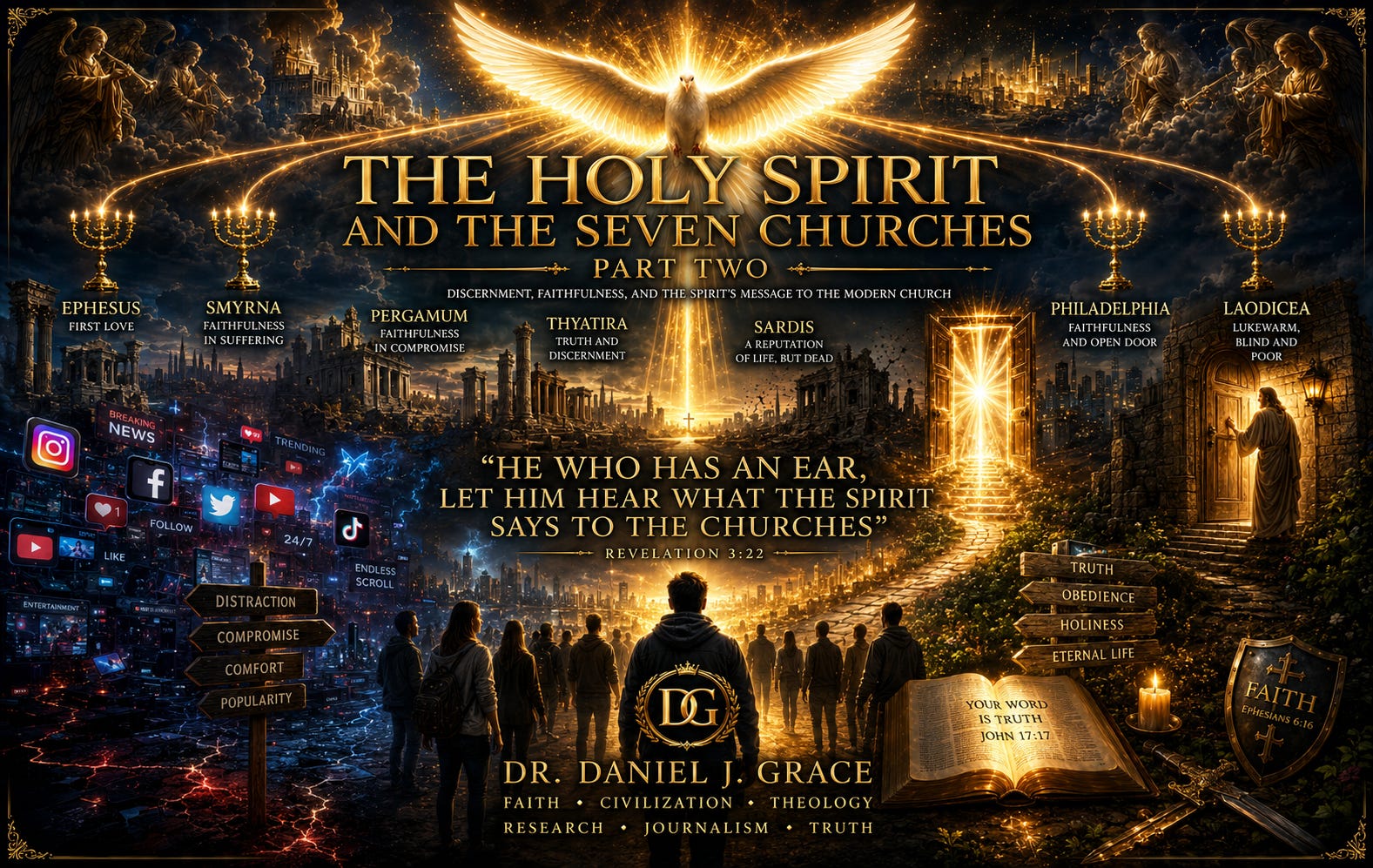
The Voice of the Spirit: Messages from Revelation for the Church Today
In Revelation chapters 2 and 3, the risen Lord Jesus Christ walks among the seven golden lampstands and speaks with piercing clarity to each historic congregation. Every single letter ends with the identical, urgent invitation:
“He who has an ear, let him hear what the Spirit says to the churches.”
These are not merely ancient letters preserved in Scripture. They are living messages inspired by the Holy Spirit and intended for every generation of believers.
The Holy Spirit who spoke through John on Patmos has not fallen silent.
He still speaks.
He still warns.
He still encourages.
He still convicts.
He still guides.
Yet in an age filled with digital noise, cultural pressure, endless information, and religious activity, many believers struggle to distinguish the voice of the Spirit from the countless voices competing for their attention.
The final three churches—Sardis, Philadelphia, and Laodicea—provide profound insight into what the Holy Spirit is saying to the Church today.
The Spirit and Sardis
To the church in Sardis the Holy Spirit delivers one of the most sobering warnings found anywhere in Scripture:
“I know your deeds; you have a reputation of being alive, but you are dead.”
(Revelation 3:1)
Sardis was a wealthy city known for its past glory and military strength. Yet its greatest weakness was complacency.
The church reflected the city.
From the outside everything appeared healthy.
Activities continued.
Programs existed.
People gathered.
The church possessed a reputation for life.
But the Holy Spirit saw something different.
He saw spiritual exhaustion.
He saw unfinished works.
He saw declining devotion.
He saw a congregation surviving on memories rather than living in present fellowship with God.
The Spirit therefore commands:
“Wake up! Strengthen what remains and is about to die.”
This is perhaps one of the most relevant messages for the modern Church.
Many churches possess impressive buildings, professional leadership, and successful ministries.
Yet external success does not necessarily indicate spiritual vitality.
A church may have a strong reputation while lacking the fresh presence of God.
The Spirit is not impressed by appearances.
He searches hearts.
He evaluates spiritual reality.
The message to Sardis reminds believers that the Holy Spirit desires genuine life rather than religious performance.
The Spirit calls sleeping churches to awaken.
He calls complacent believers to repentance.
He calls every generation to seek authentic spiritual renewal.
The Spirit and Philadelphia
Unlike Sardis, Philadelphia receives no rebuke.
Instead, it receives encouragement.
The church possessed little worldly strength.
It was not wealthy.
It was not politically influential.
It was not powerful according to human standards.
Yet Christ says:
“You have kept My word and have not denied My name.”
The Spirit celebrates faithfulness.
The church had endured opposition.
It had experienced hardship.
Yet it remained loyal to Christ.
Because of this faithfulness, the Spirit declares:
“I have placed before you an open door that no one can shut.”
This promise reveals a remarkable truth.
The Holy Spirit often works through people who appear weak in the eyes of the world.
God is not limited by resources.
He is not restricted by numbers.
He is not dependent upon worldly influence.
The Spirit delights in using humble and faithful servants.
Philadelphia reminds modern believers that success in God’s kingdom is measured by obedience rather than popularity.
Many Christians become discouraged because they feel insignificant.
Yet the Spirit’s message remains unchanged:
Remain faithful.
Keep His word.
Do not deny His name.
Hold fast.
The church that perseveres receives the Spirit’s approval.
The Spirit and Laodicea
The final church receives perhaps the strongest rebuke.
Laodicea was prosperous.
It was wealthy.
It was comfortable.
It believed it needed nothing.
Yet Christ exposes a devastating reality:
“You do not realise that you are wretched, pitiful, poor, blind and naked.”
The church possessed material abundance but spiritual poverty.
The Spirit describes it as lukewarm.
Neither cold nor hot.
Neither fully committed nor completely opposed.
Simply comfortable.
This condition remains one of the greatest dangers facing Christians today.
Many believers live in societies of extraordinary prosperity.
Comfort becomes normal.
Convenience becomes expected.
Faith slowly transforms from passionate devotion into religious routine.
Yet the Spirit refuses to leave believers in this condition.
Even in rebuke there is grace.
Christ says:
“Those whom I love I rebuke and discipline.”
The purpose of correction is restoration.
The Spirit calls Laodicea to repentance.
He offers spiritual riches.
He offers true vision.
He offers renewed fellowship.
The image of Christ standing at the door and knocking remains one of the most powerful in Scripture.
The Spirit continues to knock on the doors of lukewarm hearts.
The invitation remains open.
The Holy Spirit and Discernment
One of the Spirit’s primary ministries is discernment.
Modern Christians encounter endless voices.
Social media influencers.
Political commentators.
Religious personalities.
Cultural trends.
Popular opinions.
Not every voice originates from God.
The Spirit therefore equips believers to distinguish truth from error.
Scripture commands:
“Test the spirits to see whether they are from God.”
Discernment is not cynicism.
It is not suspicion.
It is spiritual wisdom.
The Holy Spirit guides believers into truth.
He reveals deception.
He exposes false teaching.
He protects the Church from compromise.
Without discernment, churches become vulnerable to confusion.
With discernment, believers remain anchored in truth.
The Spirit Versus Cultural Compromise
Every church in Revelation faced cultural pressure.
The surrounding society promoted values contrary to God’s kingdom.
The same challenge exists today.
The culture constantly invites believers to compromise.
To soften conviction.
To ignore holiness.
To redefine truth.
To prioritise acceptance over faithfulness.
Yet the Holy Spirit consistently calls the Church toward transformation rather than conformity.
The Spirit does not adapt Himself to culture.
He transforms culture through the power of the Gospel.
When Christians compromise, spiritual influence declines.
When Christians remain faithful, the light of Christ shines more brightly.
Philadelphia demonstrates faithfulness.
Sardis demonstrates complacency.
Laodicea demonstrates compromise.
The Spirit invites believers to choose faithfulness.
The Spirit in the Modern Church
The modern Church possesses extraordinary resources.
Technology.
Education.
Communication.
Global influence.
Yet resources alone cannot produce spiritual life.
The Church was never designed to operate merely through human ability.
It was designed to function through the power of the Holy Spirit.
The Book of Acts demonstrates this reality repeatedly.
Ordinary believers changed the world because the Spirit empowered them.
The same Spirit remains available today.
The Church’s greatest need is not better marketing.
Not larger budgets.
Not improved strategies.
The Church’s greatest need is renewed dependence upon the Holy Spirit.
Without Him, ministry becomes human effort.
With Him, ministry becomes divine partnership.
Digital-Age Distractions
One challenge unique to our generation is constant distraction.
People carry entire worlds within their pockets.
News.
Entertainment.
Messages.
Videos.
Notifications.
Opinions.
The result is continuous noise.
The Spirit often speaks through stillness.
Prayer.
Meditation.
Reflection.
Scripture.
Silence.
These disciplines become increasingly difficult in a distracted world.
Yet they remain essential.
Many believers hear hundreds of voices each day while rarely creating space to hear God’s voice.
The Spirit does not compete with every distraction.
Believers must intentionally cultivate spiritual attentiveness.
The ability to hear the Spirit requires deliberate focus.
Why Many Churches Hear Many Voices but Not the Spirit
The tragedy of many modern churches is not a lack of information.
It is a lack of spiritual listening.
Churches hear cultural voices.
Political voices.
Economic voices.
Entertainment voices.
Personal opinions.
Yet sometimes neglect the Spirit’s voice.
This happens when prayer becomes secondary.
When Scripture becomes optional.
When popularity becomes more important than obedience.
When activity replaces intimacy.
The Spirit is not absent.
The problem is often that believers are listening elsewhere.
The churches of Revelation remind us that hearing the Spirit requires humility.
Repentance.
Faithfulness.
Patience.
Obedience.
The Spirit continues to speak.
The challenge is whether the Church remains willing to listen.
The Spirit’s Message to Today’s Believers
If the Holy Spirit were summarising His message to the modern Church, it might sound remarkably similar to the messages given two thousand years ago.
To Sardis:
Wake up.
To Philadelphia:
Remain faithful.
To Laodicea:
Repent and return.
To all believers:
Hear what the Spirit says.
The Spirit calls Christians back to first love.
Back to holiness.
Back to prayer.
Back to faithfulness.
Back to truth.
Back to dependence upon God.
His message has not changed because human needs have not changed.
The Spirit still desires transformed lives.
Spirit-filled churches.
Faithful disciples.
Holy communities.
And courageous witnesses.
Conclusion
The messages to Sardis, Philadelphia, and Laodicea are far more than historical records.
They are living words from the Holy Spirit to the Church in every generation.
The Spirit still walks among the lampstands.
He still examines hearts.
He still offers correction.
He still grants encouragement.
He still calls believers toward deeper faithfulness.
Most importantly, He still speaks.
The question is not whether the Spirit is speaking.
The question is whether we are listening.
In an age filled with distractions, compromise, and competing voices, the Church’s greatest need is renewed attentiveness to the Holy Spirit.
May every believer hear His voice.
May every church respond in obedience.
And may the words spoken through Revelation continue to echo throughout the world:
“He who has an ear, let him hear what the Spirit says to the churches.”
Dr. Daniel J. Grace
Faith • Civilization • Theology
Research • Journalism • Truth
🌐 danieljamesgrace.com
© 2026 Dr. Daniel J. Grace. All Rights Reserved.
No part of this article may be reproduced, distributed, transmitted, or published in any form or by any means without prior written permission from the author, except for brief quotations used in academic citation, review, or research purposes.