
The Hidden Cost of Idolatry
The Hidden Cost of Idolatry: Ancient Gods, Modern Idols, and the Battle for the Human Heart

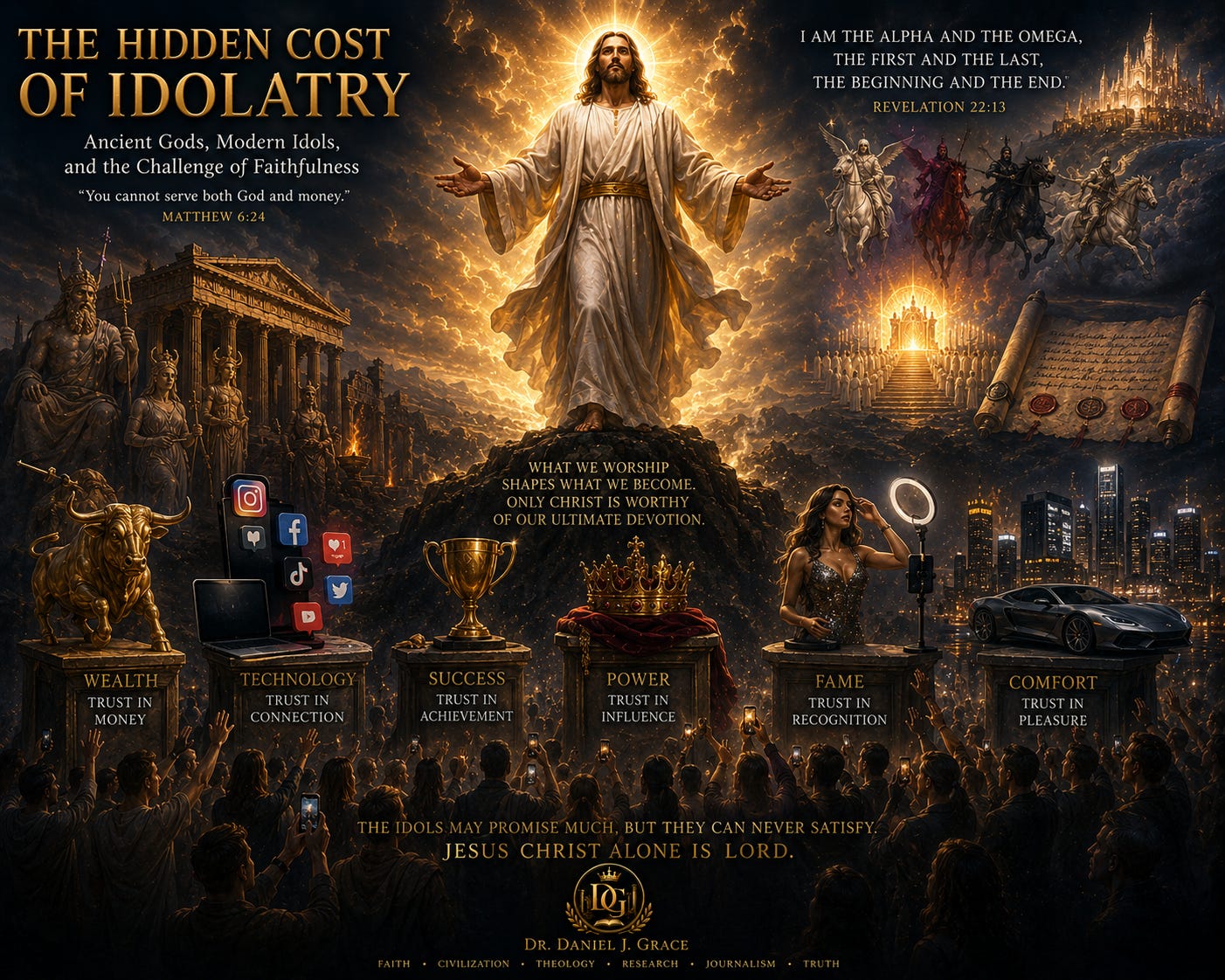
Why the Greatest Threat to Faith May Not Be What We Worship—But What We Trust
When modern readers encounter the book of Revelation, they often imagine a world far removed from their own. They picture pagan temples, Roman emperors, incense offerings, and ancient gods whose names have long faded into history.
Yet beneath the surface lies a startling truth.
The idols of the first century have not disappeared.
They have simply changed their names.
The churches of Ephesus, Smyrna, Pergamum, Thyatira, Sardis, Philadelphia, and Laodicea lived in a culture saturated with idolatry. Massive temples dominated city skylines. Economic life was connected to religious devotion. Political loyalty was often expressed through worship. Pagan festivals shaped social life and community identity.
To follow Christ in such an environment required courage, discernment, and unwavering faithfulness.
The challenge facing believers today is remarkably similar.
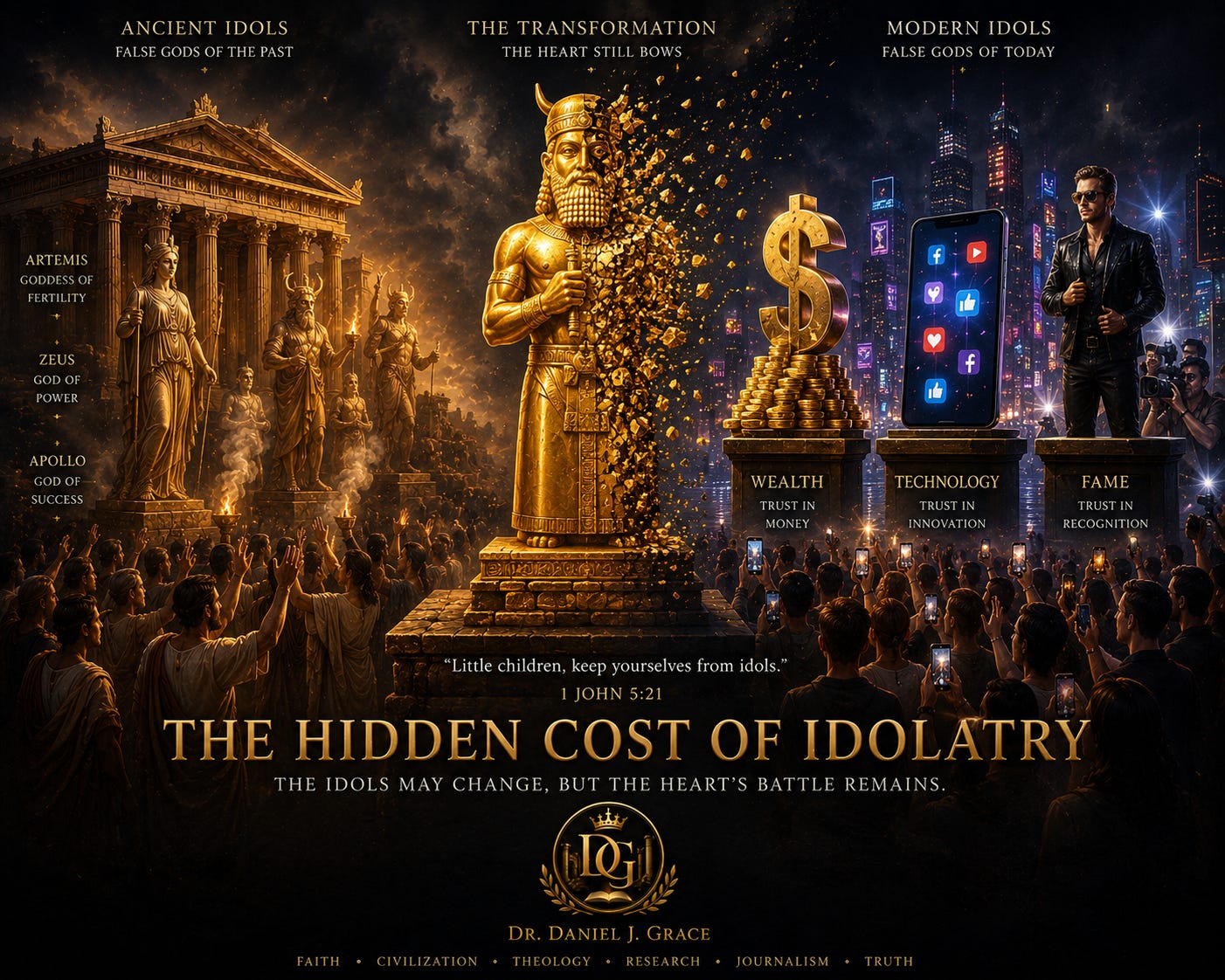
Although few people bow before statues of Zeus or Artemis, modern society remains filled with idols competing for human devotion.
The greatest danger is that many of these idols appear respectable, beneficial, and even necessary.
Understanding Ancient Idolatry
For the first Christians, idolatry was not merely a theological issue.
It affected every aspect of life.
In Ephesus, the magnificent Temple of Artemis attracted visitors from across the Roman world. The city’s economy depended heavily upon religious tourism and idol-making.
In Pergamum, emperor worship reinforced political loyalty and civic identity.
In Thyatira, trade guilds often required participation in pagan feasts dedicated to various deities.
For many believers, refusing to participate meant losing customers, business opportunities, social acceptance, and economic security.
Idolatry was not simply about statues.
It was about allegiance.
The question was simple:
Who deserves ultimate loyalty?
That same question confronts every generation.
The Nature of Modern Idolatry
Most people imagine idols as physical objects.
The Bible presents a much deeper understanding.
An idol is anything that takes the place that belongs to God alone.
Anything that controls our identity, priorities, fears, hopes, or devotion can become an idol.
Tim Keller famously described an idol as something we look to for meaning, significance, security, or fulfillment apart from God.
In this sense, modern society is overflowing with idols.
They may not be carved from stone.
But they can still capture the human heart.
The Idol of Success
Success is one of the most admired values in contemporary culture.
From childhood, people are taught to pursue achievement, advancement, recognition, and influence.
There is nothing inherently wrong with success.
Scripture contains many examples of faithful individuals who prospered.
The problem arises when success becomes a substitute for God.
Many people measure their worth entirely by accomplishments.
Their careers become their identity.
Their value depends upon promotion, recognition, or financial achievement.
When success becomes ultimate, disappointment becomes devastating.
The idol demands endless sacrifice.
Families suffer.
Relationships deteriorate.
Spiritual life declines.
And yet the pursuit continues.
The idol is never satisfied.
The Idol of Wealth
The city of Laodicea provides one of the clearest examples of this danger.
Known for its banking industry and economic prosperity, Laodicea believed it had everything it needed.
Christ challenged this illusion.
“You say, ‘I am rich, have become wealthy, and have need of nothing’—and do not know that you are wretched, miserable, poor, blind, and naked.” (Revelation 3:17)
Money itself is not evil.
The Bible consistently teaches responsible stewardship.
However, wealth becomes dangerous when it creates self-sufficiency.
Many people place greater trust in bank accounts than in God.
Financial security becomes a replacement for spiritual dependence.
The hidden cost is subtle.
As wealth increases, prayer often decreases.
Comfort replaces faith.
Security replaces trust.
The idol quietly takes its place upon the throne of the heart.
The Idol of Technology
Technology has transformed human civilization.
Never before have people possessed such access to information, communication, and entertainment.
Technology can be used for tremendous good.
It can spread the Gospel, educate communities, and connect people across continents.
Yet technology can also become an idol.
Many individuals reach for their phones before they seek God.
Notifications receive immediate attention.
Prayer receives whatever time remains.
People are constantly connected yet increasingly lonely.
They consume endless content while neglecting spiritual formation.
Technology itself is not the problem.
The issue is whether it serves us or rules us.
The idol promises connection but often delivers distraction.
The Idol of Self
Perhaps the most powerful idol of the modern age is the self.
Contemporary culture encourages individuals to place personal desires above all other considerations.
Authenticity becomes the highest virtue.
Self-expression becomes the ultimate goal.
Personal preference becomes the final authority.
Yet Christianity presents a radically different vision.
Jesus calls His followers to deny themselves, take up their cross, and follow Him.
The Gospel does not place the self at the center.
It places Christ at the center.
When self becomes the supreme authority, truth becomes relative.
Conviction becomes optional.
Obedience becomes negotiable.
The result is spiritual confusion and instability.
The idol of self promises freedom.
It often delivers bondage.
The Idol of Political Power
The Roman Empire demanded loyalty from its citizens.
Emperor worship blurred the lines between politics and religion.
Christians often suffered because they refused to grant Caesar the devotion that belonged to God.
Modern societies face similar temptations.
Political ideologies frequently become objects of ultimate trust.
People begin expecting governments to solve problems that only spiritual transformation can address.
Political identity can become stronger than Christian identity.
When this occurs, division increases and faithfulness declines.
Believers are called to engage responsibly in civic life.
Yet their ultimate citizenship remains in the Kingdom of God.
No earthly system deserves the allegiance that belongs to Christ alone.
Why Idolatry Is So Attractive
Idolatry rarely appears evil at first.
That is why it is so dangerous.
Most idols begin as good things.
Work becomes success.
Success becomes identity.
Money becomes security.
Technology becomes dependency.
Influence becomes pride.
Comfort becomes complacency.
The transition often occurs gradually.
People rarely wake up one day and decide to abandon God.
Instead, competing loyalties slowly gain influence over the heart.
This is why Scripture repeatedly warns believers to guard their affections.
What captures our attention eventually shapes our devotion.
The Hidden Cost
Idolatry always promises more than it can deliver.
Ancient idols promised prosperity, protection, fertility, and success.
Modern idols make similar promises.
Yet every idol eventually disappoints.
Success never feels sufficient.
Wealth never guarantees peace.
Technology never eliminates loneliness.
Power never removes insecurity.
The idol demands sacrifice but never provides satisfaction.
Only God can bear the weight of ultimate trust.
Everything else eventually collapses under expectations it was never designed to fulfill.
The Faithfulness of the Early Church
The believers of Revelation understood this reality.
Many refused participation in emperor worship despite enormous pressure.
Others rejected economic opportunities that required compromise.
Some suffered persecution rather than surrender their loyalty to Christ.
Their example remains profoundly relevant.
Faithfulness often carries a cost.
Yet compromise carries a greater one.
The churches that remained faithful demonstrated that allegiance to Christ is worth more than comfort, prosperity, popularity, or security.
What Faithfulness Looks Like Today
Faithfulness does not require withdrawing from society.
Christians are called to engage culture while remaining devoted to God.
They can succeed in business without worshipping success.
They can possess wealth without trusting wealth.
They can use technology without becoming controlled by it.
They can participate in civic life without making politics their religion.
The key is maintaining proper priorities.
Christ remains King.
Everything else remains secondary.
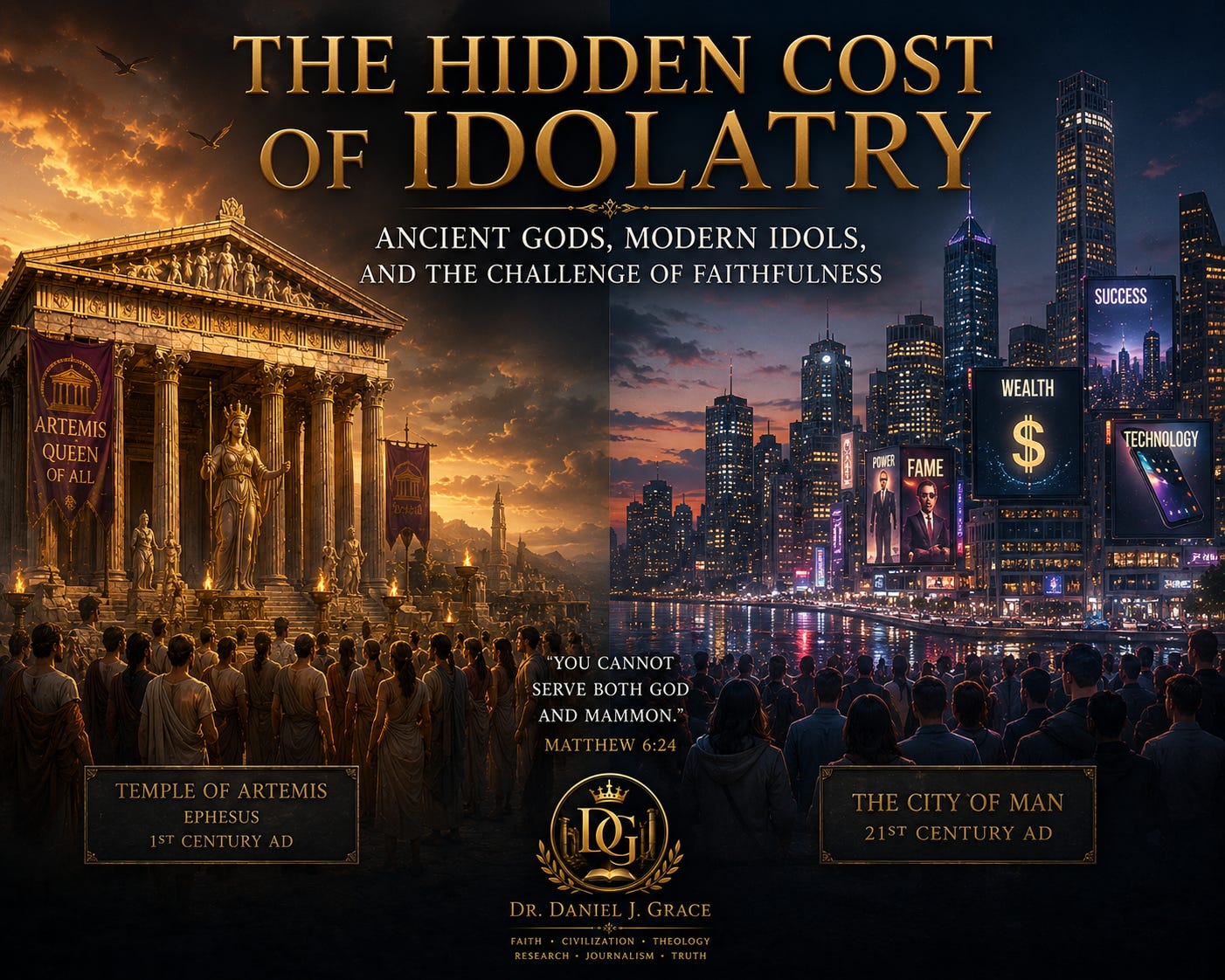
The temples of Artemis, Zeus, Apollo, and the Roman emperors have largely vanished.
Their columns lie in ruins.
Their worshippers are gone.
Yet the deeper challenge of idolatry remains.
Every generation must answer the same question faced by the seven churches:
Who sits upon the throne of our hearts?
The idols may change.
The struggle remains.
The call of Revelation is not merely to reject false gods but to remain faithful to the true God.
Only Christ deserves ultimate allegiance.
Only Christ can satisfy the deepest longings of the human soul.
And only Christ offers a Kingdom that will never fall.
The challenge facing believers today is the same challenge that confronted the churches of Asia Minor:
To live faithfully in a world filled with competing loyalties, and to ensure that nothing—no success, wealth, technology, power, or comfort—takes the place that belongs to God alone.
Dr. Daniel J. Grace
Research • Journalism • Theology
Copyright Notice
© 2026 Dr. Daniel J. Grace. All Rights Reserved.
This work is the intellectual property of Dr. Daniel J. Grace. No part of this publication may be reproduced, distributed, transmitted, stored in a retrieval system, or published in any form or by any means, electronic, mechanical, photocopying, recording, or otherwise, without prior written permission from the author, except for brief quotations used in academic review, research, criticism, or educational citation with proper attribution.
The views, interpretations, and analyses presented in this work are those of the author and are intended for educational, historical, theological, and research purposes.
All article text, original concepts, research interpretations, graphics, logos, cover designs, and accompanying visual materials remain the property of Dr. Daniel J. Grace unless otherwise stated.
For permissions, licensing inquiries, translations, republication requests, or academic use beyond standard citation practices, contact the author directly.
Author: Dr. Daniel J. Grace
Fields: Faith, Civilization, Theology, Research, Journalism, and Cultural Studies
All Rights Reserved.