The Heresy of Hustle: Why Jesus Would Be Fired by the Modern Church Board
In an era obsessed with scale, optimisation, and metrics, Christ’s slow and hidden ministry is a radical insult to our corporate idols.

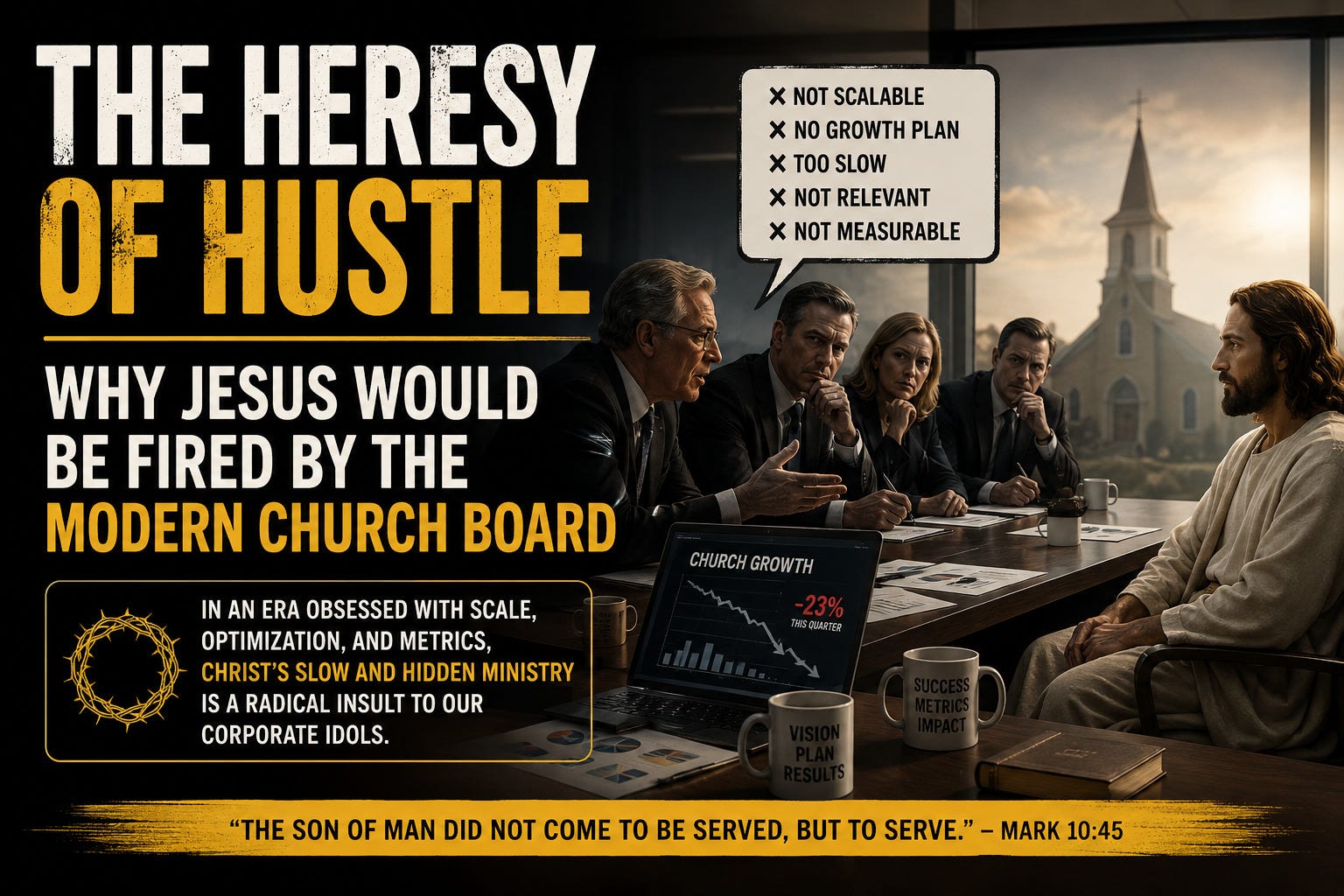
Jesus would not survive many church board meetings today.
That sounds harsh.
Maybe it is.
But imagine Him sitting quietly at the end of a polished conference table while a few tired men and women scroll through reports, budgets, attendance charts, engagement graphs, volunteer shortages, giving patterns, leadership pipelines, social media reach, conversion targets, and the annual ministry growth strategy.
Someone clears his throat.
“Lord, we appreciate your heart. We really do. But we need to talk about scalability.”
Another adds, with a careful smile, “Your ministry has potential, but it lacks structure.”
Someone else, probably the one holding the spreadsheet, leans forward.
“Why only twelve?”
And there it is.
The ancient scandal.
The Son of God came into the world and refused to act like a religious CEO.
He did not build a brand in Jerusalem. He did not secure institutional sponsorship from the Sanhedrin. He did not launch a multi-site teaching campaign across the Roman Empire. He did not produce a five-year expansion plan. He did not turn miracles into market leverage. He did not heal the sick and then ask His disciples to capture testimonials for promotional use.
He often told people to be quiet.
That alone would confuse us.
In our world, if something holy happens, somebody must post it. If a life is changed, it must be packaged. If a tear falls at the altar, it must become a story, a clip, a donor update, a ministry report, a proof point.
Jesus healed people and sometimes said, “Tell no one.”
The modern church would call that poor communication strategy.
Christ called it obedience.
We have built a culture where constant visible productivity is mistaken for faithfulness. The busier the calendar, the healthier the church appears. The more crowded the platform, the more “anointed” the ministry seems. The more polished the graphics, the more serious the mission feels. We talk about impact as though the Kingdom of God were a quarterly report.
But Jesus moved slowly.
Painfully slowly, by our standards.
Thirty hidden years. Three public years. Long walks between villages. Meals with nobodies. Private conversations that had no audience. A night talk with Nicodemus. A well-side conversation with a Samaritan woman. Children on His lap. Tears at a grave. Breakfast on a beach.
No stage lights.
No brand kit.
No ministry funnel.
Just presence.
And that is what makes Him so dangerous to our age. Jesus exposes the heresy of hustle: the belief that God is most glorified when we are most visibly productive.
It sounds spiritual at first. That is why it works.
We tell ourselves we are doing it for the Kingdom. We are reaching more people. We are maximizing gifts. We are stewarding opportunity. We are using the tools of the age. All of that can be true in part. The church should not be lazy. Sloppiness is not holiness. Poor planning is not the Holy Spirit.
But something has gone wrong when pastors are praised for exhaustion and ordinary faithfulness feels too small to count.
Something has gone wrong when a minister feels guilty for being unseen.
Something has gone wrong when prayer becomes preparation for the “real work” rather than the work itself.
Something has gone wrong when the shepherd smells more like a manager than like sheep.
The modern church has not always rejected Jesus openly. That would be too obvious. We have done something subtler. We have kept His name while quietly replacing His pace.
Christ says, “Come to Me.”
Hustle says, “Prove yourself.”
Christ says, “Abide.”
Hustle says, “Expand.”
Christ says, “Take up your cross.”
Hustle says, “Build your platform.”
Christ says, “Go into your room and shut the door.”
Hustle says, “Make sure someone sees the fruit.”
This is not only a pastoral problem. It is a discipleship problem. It reaches the whole body. Ordinary believers now feel the pressure to have a measurable spiritual life. How many chapters did you read? How many ministries are you involved in? How many people have you reached? How much content have you produced? How much visible fruit can you show?
And quietly, under all of this, the soul becomes thin.
Very thin.
A woman caring for her elderly mother feels useless because she is not “doing ministry” in the official sense. A man praying alone before work thinks his faith is insignificant because nobody knows. A tired pastor visiting three hospital rooms wonders if he is failing because Sunday attendance dipped. A young believer feels behind because everyone else seems louder, sharper, more confident, more productive, more called.
This is the cruelty of religious hustle. It baptizes anxiety and calls it zeal.
Yet the Gospels keep embarrassing us.
Jesus leaves crowds.
He withdraws to lonely places.
He sleeps in a boat.
He spends time with people who cannot advance His public profile. He allows interruptions. He refuses political shortcuts. He wastes, in the eyes of efficiency, enormous amounts of time on single souls.
A blind beggar.
A bleeding woman.
A tax collector in a tree.
A thief dying beside Him.
No serious growth strategist would recommend this.
But heaven did.
The Kingdom is not built like an empire, even when Christians forget the difference. Empires count bodies, territory, money, influence, compliance. The Kingdom begins like seed in soil. Hidden. Small. Easily dismissed. It grows while no one is clapping.
Jesus compared the Kingdom to yeast, seeds, treasure buried in a field, a pearl found by one searching heart. Not machinery. Not empire. Not a religious corporation with better slogans.
We should tremble a little at that.
Because much of what we call success may be only noise wearing church clothes.
Of course, numbers are not evil. Every number can represent a person loved by God. The book of Acts counts people at times. Good administration matters. A church should care whether people are being reached, fed, baptized, taught, protected, and loved.
But numbers become idols when they start deciding what counts as obedience.
They become idols when leaders begin shaping ministry around what can be reported rather than what Christ commanded.
They become idols when the unseen work of God is treated as failure because it cannot be graphed.
They become idols when the pastor’s soul is sacrificed to maintain the appearance of momentum.
A church can grow large and still be faithful.
A church can remain small and still be dead.
Size is not the point.
The point is lordship.
Who sets the pace? Who defines success? Who tells us what matters? Who has the right to interrupt our plans?
If the answer is not Jesus, then our theology is already in trouble, no matter how orthodox our website sounds.
There is a frightening possibility that we have learned to admire the Jesus of the Bible while preferring the methods of Pharaoh. More bricks. Less straw. Faster. Bigger. Again.
And the exhausted servants keep making bricks.
Pastors know this pressure. Many feel it in their bones. They are expected to preach like scholars, lead like executives, counsel like therapists, market like influencers, manage like administrators, raise funds like development officers, and remain spiritually radiant through it all.
Then, when they collapse, we call it burnout.
Sometimes it is.
Sometimes it is something darker: a church culture that used a shepherd until he bled, then asked why he did not manage his boundaries better.
That is not the way of Christ.
Jesus never treated people as fuel for a mission machine. He loved them. He challenged them, yes. He sent them, yes. He rebuked them when needed. But He also fed them, restored them, touched them, wept with them, and told weary disciples to come away and rest.
Rest was not a productivity hack.
It was trust.
To rest is to admit that God remains God when we stop moving. To pray in secret is to declare that unseen communion matters more than visible performance. To love one person well is to reject the lie that scale is the only measure of significance.
This is where the church must recover its nerve.
We do not need a lazy church. We need a faithful one.
We do not need leaders who despise planning. We need leaders who refuse to worship planning.
We do not need smaller dreams. We need holier ones.
The question is not whether we should use tools, organize ministries, or communicate well. We should. The question is whether those things serve the love of Christ or slowly replace it.
Because the board would probably have questions for Jesus.
Why did You offend influential people instead of networking with them?
Why did You spend so much time with the poor, the sick, and the morally complicated?
Why did You let the rich young ruler walk away?
Why did You not clarify Your brand before the rumors spread?
Why did You allow Judas into leadership?
Why did You keep speaking in parables when clearer messaging would have improved retention?
Why did You choose fishermen?
Why did You die at thirty-three?
From a corporate religious perspective, the cross looks like failure.
No momentum.
No protection of reputation.
No visible victory.
No impressive donor confidence.
Just a beaten man outside the city, mocked by the powerful, abandoned by friends, nailed to wood.
And yet this is the wisdom of God.
The church was born from what the world called waste. Salvation came through what looked inefficient. Life came through death. Victory hid under shame. The seed fell into the ground.
That is Christianity.
Not hustle with hymns.
Not ambition with Bible verses.
Not empire with a cross logo.
The church does not need to become less active. It needs to become less frantic. It needs to recover the difference between obedience and performance, between fruitfulness and visibility, between holy labour and anxious striving.
Some ministries need to slow down before they lose their souls.
Some pastors need permission to be human.
Some churches need fewer events and more prayer.
Some believers need to learn that caring for a child, visiting a lonely neighbour, forgiving an enemy, reading Scripture quietly, and remaining faithful in obscurity are not lesser forms of Christian life.
They may be closer to Jesus than the things we keep applauding.
The heresy of hustle tells us that hiddenness is failure.
Jesus tells us the Father sees in secret.
That should be enough.
It will not be enough for the idol in us. The idol wants proof. It wants applause. It wants upward movement. It wants the intoxicating feeling that we are indispensable.
But the Spirit leads us another way.
Downward.
Into humility.
Into patience.
Into love.
Into the strange freedom of being unnecessary to God’s survival and yet deeply invited into His work.
The modern church board may not know what to do with such a Jesus. He is too slow. Too uncompromising. Too unconcerned with optics. Too willing to lose crowds. Too gentle with the broken. Too severe with the proud. Too hidden for our metrics and too holy for our ambitions.
But He is still Lord of the church.
Not the market.
Not the algorithm.
Not the annual report.
Not the platform.
Jesus.
And if He would be fired by our systems, then perhaps the problem is not with Jesus.
Perhaps the boardroom needs repentance.

© 2026 Daniel J. Grace. All rights reserved.
Written by Daniel J. Grace
Faith • Civilization • Theology
Independent Researcher and Author/MEAA Member
Official Website: https://www.danieljamesgrace.com
Amazon Book: https://www.amazon.com/dp/B0H4DG8C98