

The Gospel After the Algorithm
Why Jesus Christ Cannot Be Optimized, Branded, or Reduced to Content

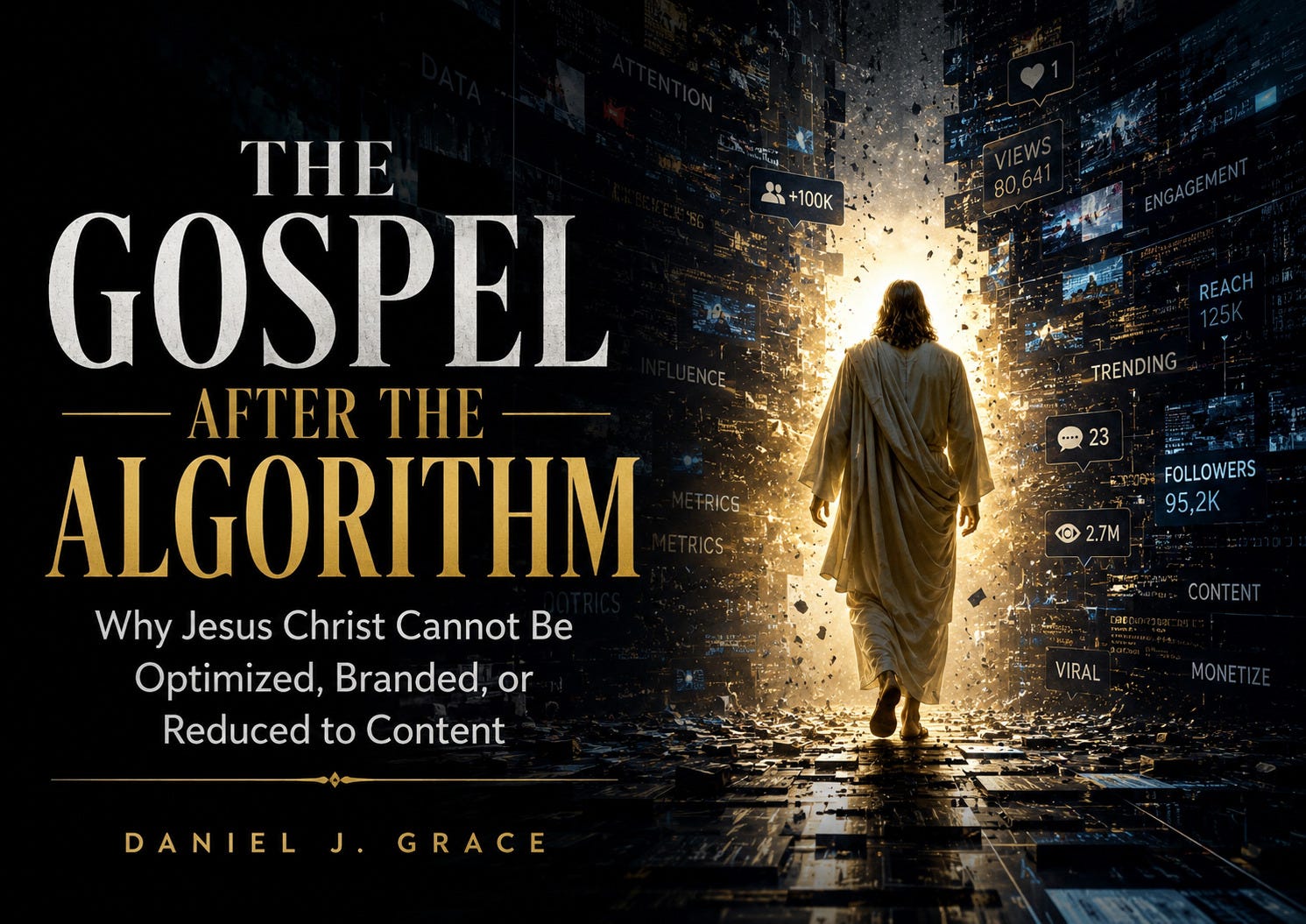
The Gospel After the Algorithm
Why Jesus Christ Cannot Be Optimized, Branded, or Reduced to Content
The modern world doesn’t simply ask whether Christianity is true. It asks whether Christianity performs.
Does it attract attention? Does it grow quickly? Does it produce engagement? Can it be packaged into a sixty-second video, measured by clicks, and promoted through the machinery of digital culture?
These questions now shape more of Christian life than many churches are willing to admit.
We live inside systems designed to reward speed, visibility, emotional intensity, and repetition. Algorithms decide what rises, what disappears, and what becomes socially real. Churches, ministries, writers, and Christian leaders often feel they have no choice but to participate. Visibility appears necessary for survival.
Yet Jesus Christ remains strangely resistant to the logic of optimization.
He refuses to become content.
He refuses to be reduced to a brand.
He refuses to measure human worth through reach, influence, productivity, or public recognition.
Christ enters a world obsessed with scale and chooses incarnation. He enters a culture shaped by imperial power and chooses a manger. He gathers disciples, but He doesn’t build an audience in the modern sense. He withdraws from crowds. He speaks in parables that confuse casual listeners. He gives time to people who offer Him no strategic advantage.
At almost every point, Jesus violates the instincts of the algorithmic age.
The Algorithm Wants Attention
The algorithm doesn’t love or hate anyone. It has no soul. Its purpose is selection.
It observes behaviour, predicts desire, and keeps people engaged. It learns what provokes fear, anger, admiration, envy, or curiosity. It then offers more of the same.
This creates a spiritual environment in which attention becomes currency.
The person who is seen appears important. The person who trends appears authoritative. The person with the largest audience appears most worthy of trust.
Christian communities aren’t immune to this logic. We can begin to confuse popularity with anointing, visibility with faithfulness, and rapid growth with divine approval.
The New Testament gives us no permission to make these equations.
Paul describes Christ as the One who “made Himself of no reputation, taking the form of a bondservant” (Philippians 2:7, NKJV). The movement of the incarnation is downward. Christ doesn’t seize recognition. He empties Himself. He doesn’t manipulate attention. He gives Himself in love.
The algorithm says, “Become visible.”
Christ says, “Whoever desires to come after Me, let him deny himself, and take up his cross, and follow Me” (Mark 8:34).
Those are not the same gospel.
Jesus Wasn’t Building a Personal Brand
Personal branding has become so normal that we rarely question its spiritual assumptions.
A brand requires consistency, recognisability, differentiation, and emotional association. It tells the public what to expect. It reduces complexity into an identity that can be communicated quickly.
But Jesus can’t be reduced in this way.
He is gentle and confrontational. He welcomes children and rebukes religious leaders. He weeps at a tomb and overturns tables in the temple. He speaks of mercy, judgement, forgiveness, holiness, sacrifice, and eternal life.
He can’t be made safe for every audience.
He can’t be transformed into a mascot for political tribes, commercial interests, or therapeutic spirituality. Every attempt to brand Christ eventually produces a smaller Christ.
The Jesus of social respectability is too polite.
The Jesus of nationalism is too tribal.
The Jesus of prosperity is too useful.
The Jesus of private spirituality is too detached from public injustice.
The Jesus of activism without redemption is too human.
The real Christ remains Lord.
That word matters. Lordship means Jesus isn’t a tool we use to strengthen our identity. He is the One before whom every identity must be judged.
The Hidden Life of Christ
Modern Christian culture often focuses on the public ministry of Jesus. We remember the sermons, healings, miracles, confrontations, crucifixion, and resurrection.
But the Gospels also confront us with a profound silence.
Jesus lived approximately thirty years before beginning His public ministry. Most of His earthly life was hidden.
There were no crowds. No recorded sermons. No visible movement. No ministry platform. No public evidence that the kingdom of God had entered history through Him.
Yet those hidden years weren’t wasted.
The eternal Son of God inhabited ordinary human life. He grew. He learned. He worked. He lived in a family and a local community. He submitted to the slow conditions of embodiment.
This should disturb every Christian culture that treats hiddenness as failure.
The algorithm tells us that unseen work doesn’t matter. Christ’s life tells us otherwise.
Prayer in a closed room matters.
Faithfulness without applause matters.
Caring for an elderly parent matters.
Reading Scripture when nobody knows matters.
Serving a small congregation matters.
Writing something true that never goes viral matters.
A life doesn’t become meaningful when it becomes visible. It becomes meaningful when it is offered to God.
The Church Has Learned to Count
Churches have always counted people. The book of Acts records numerical growth. Numbers aren’t inherently unspiritual.
The problem begins when measurement becomes theology.
Attendance, giving, followers, views, conversions, engagement, and expansion can provide useful information. But they can’t reveal the whole truth of a community’s faithfulness.
A church may be growing while becoming spiritually hollow.
A ministry may be influential while becoming morally compromised.
A leader may be celebrated while becoming incapable of repentance.
A small congregation may appear unsuccessful while embodying extraordinary courage, holiness, and love.
Christ’s evaluation of the seven churches in Revelation makes this unmistakable. Some churches had reputations that didn’t match their spiritual condition. Sardis had a name that it was alive, but Christ said it was dead. Laodicea believed it was rich and in need of nothing, yet Christ described it as spiritually poor, blind, and naked.
Public reputation and divine judgement aren’t the same thing.
The algorithm sees engagement.
Christ sees the heart.
The algorithm measures reaction.
Christ measures faithfulness.
The algorithm rewards what keeps people watching.
Christ calls people to endure, repent, love, and overcome.
Content Can Speak About Christ Without Revealing Him
Christian content has never been more available.
Sermons, podcasts, articles, courses, clips, devotionals, books, and theological debates surround us. A person can consume Christian material for hours every day without becoming more like Jesus.
Information isn’t transformation.
A person can know the language of discipleship while avoiding the cost of discipleship. We can discuss prayer without praying, debate holiness without becoming holy, and defend biblical authority without obeying Scripture.
This isn’t an argument against Christian media. Writing, teaching, publishing, and digital ministry can serve the Church powerfully. The problem is substitution.
Content becomes dangerous when consuming it feels like following Christ.
Jesus didn’t say, “Watch Me.”
He said, “Follow Me.”
Following involves movement, surrender, imitation, obedience, and trust. It can’t be completed by scrolling.
The digital world makes Christianity available, but it can also make Christianity appear easier than it is. The cross becomes a symbol, the gospel becomes a slogan, and discipleship becomes a stream of inspirational fragments.
Christ doesn’t offer fragments. He asks for the whole life.
The Temptation to Manufacture Urgency
The online world rewards urgency.
Everything must be breaking, shocking, prophetic, dangerous, historic, or unprecedented. Calm language disappears. Careful thought struggles to compete. Christian voices can feel pressured to exaggerate in order to be heard.
This produces a theology of constant emergency.
Every election becomes the final battle.
Every cultural change becomes the collapse of civilisation.
Every disagreement becomes apostasy.
Every public figure becomes either a saviour or an enemy.
But Jesus was never controlled by manufactured urgency.
He could respond immediately to suffering, yet He also refused to be hurried by the expectations of others. He stayed where He was when He heard Lazarus was sick. He slept during a storm. He withdrew to pray while crowds searched for Him.
Christ possessed urgency without anxiety.
He knew the seriousness of His mission, but He wasn’t governed by panic. His identity came from the Father, not from public demand.
The Church needs this freedom again.
We don’t need to become indifferent. We need to become discerning. Not every trend deserves a sermon. Not every controversy requires a statement. Not every moment of silence is cowardice.
Sometimes silence is prayer.
Sometimes slowness is wisdom.
Sometimes refusing to react is an act of spiritual resistance.
Christ Is More Than Relevant
Churches are often told they must remain relevant.
There is truth in this. The gospel must be communicated intelligibly. Christians shouldn’t hide behind outdated language or refuse to understand the culture around them.
But relevance is a dangerous master.
A church that exists mainly to appear relevant will eventually become unable to challenge the world it is trying to reach.
Jesus was deeply present within His culture, but He wasn’t controlled by it. He understood religious traditions, political tensions, economic suffering, social exclusion, and imperial power. Yet He spoke from the kingdom of God.
He didn’t merely answer the questions people were asking. He exposed the desires beneath those questions.
He didn’t offer a more religious version of the existing order. He announced a new creation.
Christianity doesn’t survive because it keeps up with every cultural change. It survives because Jesus Christ is risen.
That claim can’t be optimized.
It can be proclaimed, denied, trusted, mocked, or worshipped. But it can’t be reduced to relevance.
A Church That Refuses to Perform
What would it mean for the Church to resist algorithmic Christianity?
It wouldn’t mean abandoning technology. It wouldn’t mean rejecting social media, websites, publishing, video, or digital communication.
It would mean refusing to let these tools define success.
A faithful church might use the algorithm without becoming like the algorithm.
It would value truth over virality.
It would value character over charisma.
It would value repentance over reputation management.
It would value the vulnerable over the influential.
It would value patient formation over rapid expansion.
It would remember that the kingdom often grows like a seed hidden in the soil.
Christian leaders would be free to admit weakness. Writers would be free to produce careful work that doesn’t chase trends. Churches would be free to serve communities without turning every act of compassion into promotional material.
The goal would be visibility. The goal would be integrity.
The Gospel After the Algorithm
The algorithm will continue changing.
Platforms will rise and disappear. Audiences will migrate. Strategies will become outdated. Today’s successful methods will eventually look ancient.
Jesus Christ remains the same.
He doesn’t need to be reinvented for every generation. He must be proclaimed faithfully within every generation.
The future of Christianity won’t be secured by better branding, louder messaging, or more sophisticated systems of attention. It will be found where it has always been found: in Christ crucified and risen, in Scripture, in prayer, in worship, in repentance, in the breaking of bread, and in communities learning to love one another.
The Church doesn’t need to defeat the algorithm.
It needs to remember that the algorithm isn’t Lord.
Jesus is.

Daniel J. Grace
Independent Christian writer and researcher
ORCID: 0000-0002-9259-8032
https://www.danieljamesgrace.com
Originally published on Dr. Daniel J. Grace’s Substack. For more articles on Christian faith, biblical theology, church history, and discipleship, visit:
© 2026 Daniel J. Grace. All rights reserved.