
The Forgotten Roads of Revelation How Roman Roads Connected the Seven Churches and Spread Christianity
The Highways of Empire That Became the Pathways of the Gospel

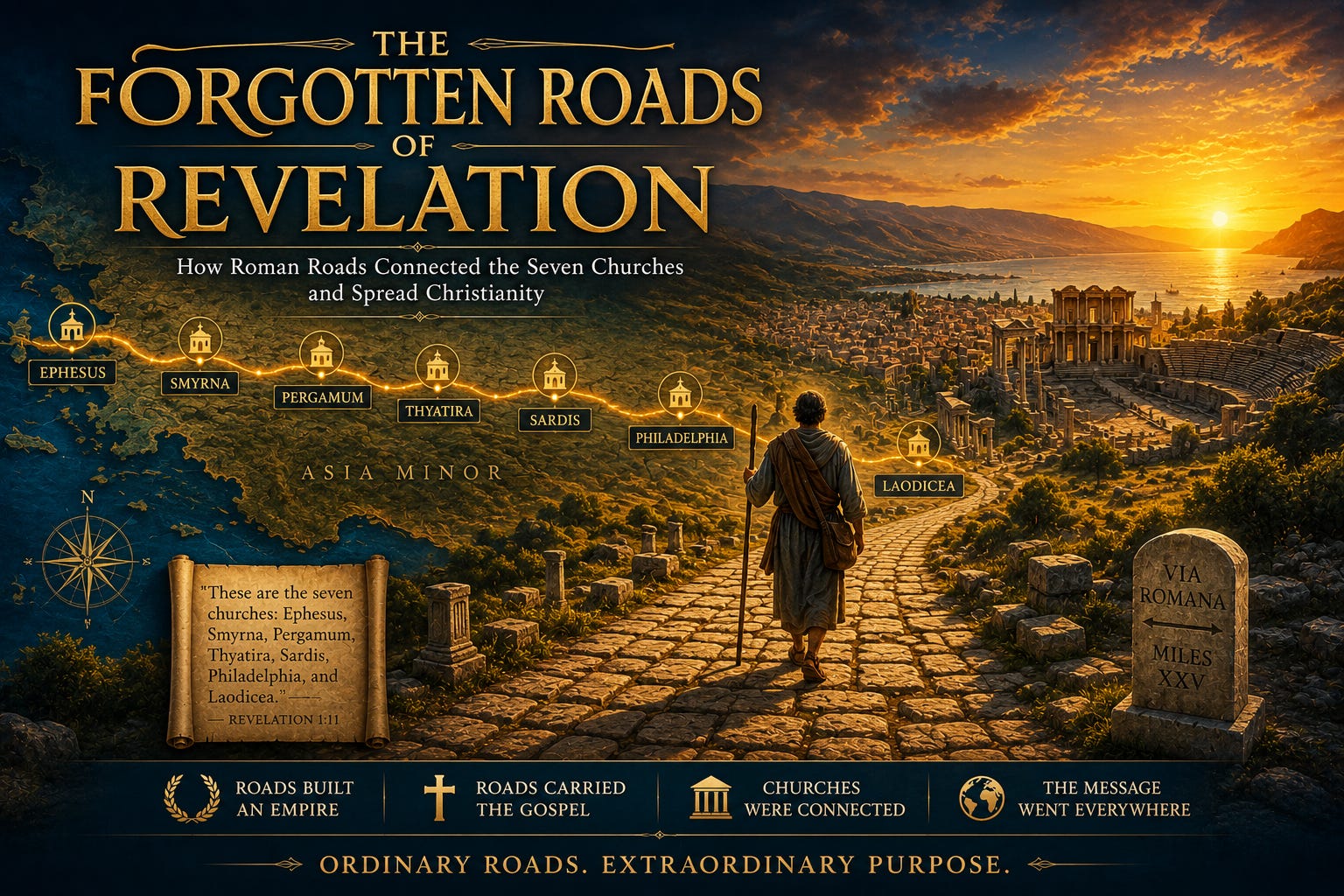
The rapid spread of Christianity during the first century remains one of history’s most remarkable developments. Within a few decades of the death and resurrection of Jesus Christ, Christian communities had appeared throughout Asia Minor, Greece, Syria, Egypt, and even Rome itself. While divine providence and missionary zeal played central roles, the physical infrastructure of the Roman Empire also contributed significantly to this expansion. Among the most important elements of that infrastructure were the Roman roads. These carefully engineered highways connected cities, provinces, military centers, and commercial markets across the empire. The Seven Churches of Revelation—Ephesus, Smyrna, Pergamum, Thyatira, Sardis, Philadelphia, and Laodicea—were all linked through an extensive road network that enabled communication, travel, trade, and missionary activity. This article examines how Roman roads shaped the spread of Christianity and why the geography of Asia Minor remains essential for understanding the growth of the early Church.
Introduction
When readers study the Seven Churches of Revelation, they often focus on theology, prophecy, persecution, or the spiritual condition of the churches themselves.
Yet one important question is rarely asked:
How did Christianity travel from city to city in the first place?
The answer is surprisingly practical.
Long before modern highways, railways, airports, and digital communication, the Roman Empire built one of the greatest transportation systems in human history.
These roads connected vast territories stretching from Britain to the Middle East.
Merchants used them.
Soldiers marched upon them.
Government officials traveled along them.
Missionaries preached beside them.
The Roman road system became one of the most important tools through which Christianity spread throughout the ancient world.
In many ways, the roads of Rome became the highways of the Gospel.
The Roman Empire and Transportation
Before the rise of Rome, long-distance travel was often difficult and dangerous.
Roads were poorly maintained.
Journeys could take weeks or months.
Trade routes frequently depended upon local conditions and seasonal weather.
Rome changed this reality.
The empire invested heavily in transportation infrastructure.
Engineers constructed durable roads using multiple layers of stone and gravel. Many were designed to withstand centuries of use.
At its height, the Roman road network extended more than 400,000 kilometers, including approximately 80,000 kilometers of major paved highways.
These roads connected provinces, military outposts, commercial centers, and important cities.
Travel became faster, safer, and more predictable than ever before.
For the first time in history, large numbers of people could move efficiently across enormous distances.
Asia Minor: A Strategic Region
Asia Minor occupied a crucial position within the Roman Empire.
Located between Europe and the Middle East, it served as a bridge between East and West.
Major trade routes crossed the region.
Ports connected Asia Minor to Greece, Rome, Egypt, and Syria.
Merchants transported goods, ideas, languages, and cultures through its cities.
It is no coincidence that many of Christianity’s earliest and most influential churches emerged in this region.
The Apostle Paul spent years ministering throughout Asia Minor.
The Apostle John later served in Ephesus.
The Seven Churches addressed in Revelation were all located within this strategically connected landscape.
Without understanding the geography of Asia Minor, it is impossible to fully understand the spread of early Christianity.
Ephesus: The Gateway City
Among the Seven Churches, Ephesus occupied perhaps the most important position.
Located near the Aegean coast, Ephesus possessed one of the most significant harbors in the Roman world.
Ships arrived carrying travelers, merchants, and goods from across the empire.
Roads extended inland from the harbor, linking Ephesus to major cities throughout Asia Minor.
Paul recognized the strategic importance of Ephesus.
Rather than treating it as merely another mission stop, he established an extended ministry there.
According to the Book of Acts, Paul spent several years teaching in Ephesus.
As a result, the Gospel spread throughout the surrounding region.
Ephesus functioned as a missionary hub.
People who encountered Christianity in the city carried its message along Roman roads to other communities.
The Circular Route of Revelation
One fascinating feature of Revelation is the order in which the Seven Churches are listed.
The sequence follows a logical travel route.
Beginning at Ephesus, the route moves north to Smyrna, then to Pergamum.
From Pergamum it turns southeast toward Thyatira, Sardis, Philadelphia, and finally Laodicea.
This pattern mirrors the road system connecting these cities.
Many scholars believe a messenger carrying the Book of Revelation would naturally have followed this route.
The arrangement was not random.
The churches formed a connected network linked by transportation infrastructure.
The message of Revelation was designed to circulate among communities that were already physically connected.
Smyrna and Commercial Connectivity
Smyrna was another major port city.
Its harbor made it one of the wealthiest cities in Asia Minor.
Roads connected Smyrna to inland markets and neighboring regions.
This commercial activity created opportunities for cultural exchange and communication.
Christianity often spread through existing social and economic networks.
Merchants who traveled between cities carried news, ideas, and beliefs.
The road linking Ephesus and Smyrna became more than a commercial route.
It became a pathway for Christian influence.
Pergamum and Imperial Power
Pergamum served as an administrative and political center.
The city was known for emperor worship, religious institutions, and government authority.
Its location along important roads increased its regional influence.
Travelers passing through Pergamum encountered one of the most significant urban centers in Asia Minor.
For Christians, this created both opportunities and challenges.
The same roads that carried the Gospel also carried imperial ideology.
Believers living in Pergamum found themselves at the intersection of faith, politics, and culture.
Yet despite these pressures, Christianity continued to spread.
Thyatira: The Crossroads of Trade
Although smaller than Ephesus or Pergamum, Thyatira occupied a strategic location on important trade routes.
Travelers moving between major cities frequently passed through the region.
The city’s economy depended heavily upon commerce and trade guilds.
These connections made Thyatira an important link within the larger network of churches.
Roads did more than transport people.
They connected communities.
Christians in Thyatira were not isolated.
They belonged to a growing movement that extended throughout Asia Minor and beyond.
Roads as Mission Fields
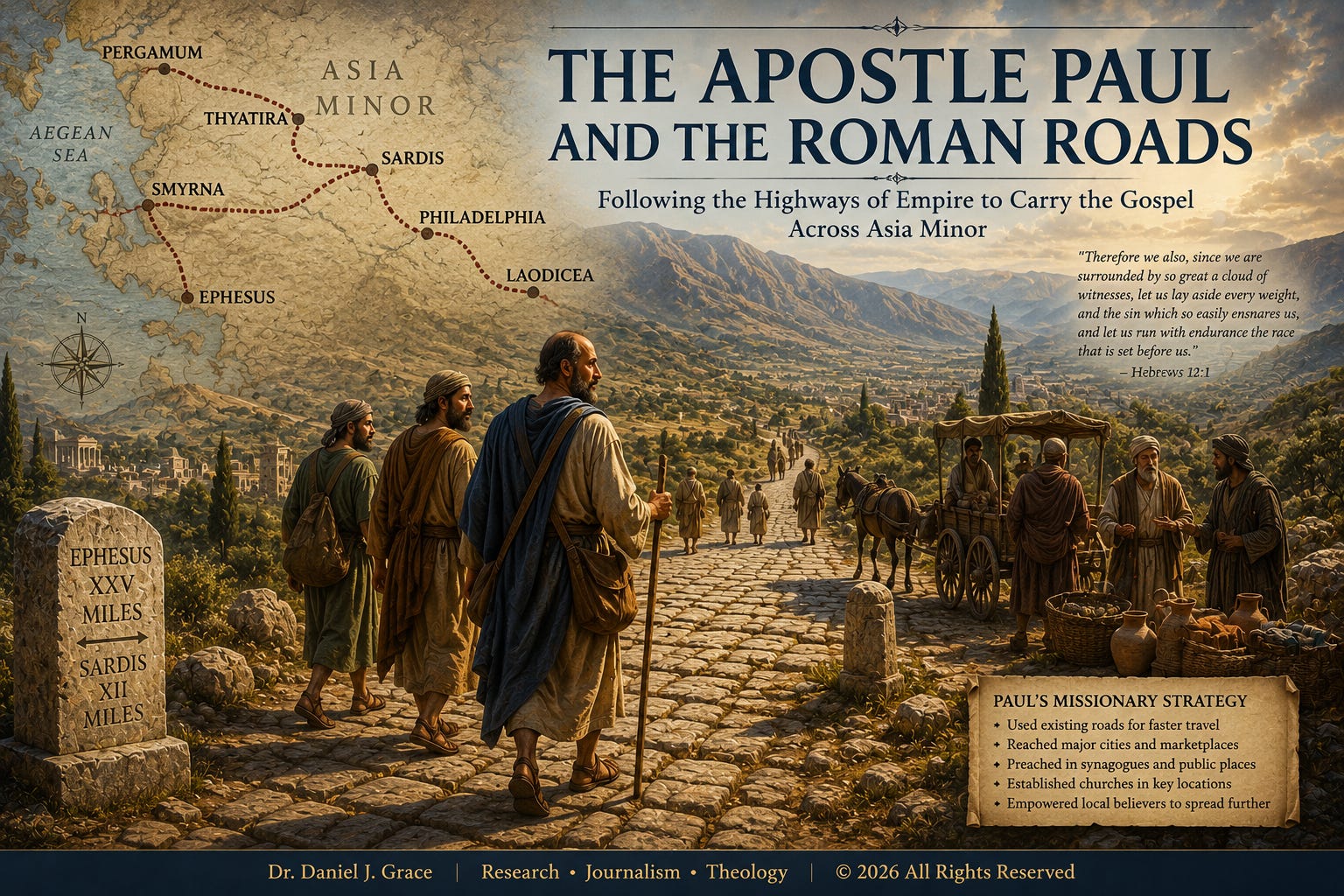
The Roman roads themselves became mission fields.
Travelers spent days or weeks journeying between destinations.
Conversations occurred in inns, marketplaces, rest stations, and along the roadways.
Missionaries used these opportunities to share the Gospel.
Paul’s journeys demonstrate this clearly.
His missionary strategy frequently followed major transportation routes.
Rather than targeting isolated settlements, he focused on connected urban centers.
Once Christianity became established in these cities, local believers carried the message outward into surrounding regions.
The roads amplified missionary efforts far beyond what any individual preacher could accomplish alone.
Sardis: The Watchful City
Sardis occupied a strategic location at the junction of several important roads in western Asia Minor.
For centuries it had served as the capital of the ancient Kingdom of Lydia and remained an important commercial center during Roman times.
Travellers moving between the interior of Asia Minor and the coastal regions frequently passed through Sardis.
Its position gave the city economic importance and military significance.
The church in Sardis benefited from these connections. News, travellers, merchants, and ideas constantly flowed through the city.
Yet Revelation reveals a spiritual paradox.
Despite its advantageous position and impressive reputation, the church was spiritually weak.
Christ declared:
“You have a reputation of being alive, but you are dead.”
The roads brought prosperity and visibility, but they could not guarantee spiritual vitality.
The lesson remains relevant today. A church may possess influence, resources, and public recognition while quietly neglecting its spiritual health.
Philadelphia: The Missionary Gateway
Among the Seven Churches, Philadelphia may have been the most strategically positioned for missionary expansion.
Located near the frontier between different cultural regions, Philadelphia functioned as a gateway city.
Roman roads extended eastward into less Hellenised territories, creating opportunities for cultural exchange and communication.
The city had originally been established to spread Greek language and culture into surrounding regions.
Ironically, the same transportation networks later helped spread Christianity.
When Christ told the church:
“I have set before you an open door.”
the phrase may have carried geographic significance.
Philadelphia stood at an open door between regions, peoples, and cultures.
Its location transformed it into a launching point for influence far beyond its own city limits.
The church possessed little worldly power, yet its strategic position allowed it to contribute significantly to the expansion of the Gospel.
Laodicea: Wealth on the Highway
Laodicea became one of the wealthiest cities in Asia Minor partly because of its location.
Several major roads intersected near the city.
Merchants transported textiles, agricultural products, medical goods, and financial resources through the region.
Its prosperity depended upon connectivity.
Trade generated wealth.
Roads generated opportunity.
Banks generated influence.
Yet Revelation demonstrates that prosperity created spiritual dangers.
The church became self-sufficient and complacent.
The roads that brought wealth could not provide spiritual maturity.
The lesson remains powerful today.
Technology, transportation, and economic success can create opportunities, but they cannot replace dependence upon God.
The Apostle Paul and the Roman Roads
No individual used the Roman transportation network more effectively than the Apostle Paul.
His missionary journeys reveal extraordinary strategic awareness.
Paul consistently targeted cities connected by major roads and trade routes.
He understood that ideas spread most effectively through connected communities.
From Antioch to Ephesus, from Philippi to Corinth, Paul followed pathways that linked important urban centers.
Once churches were established, local believers carried the Gospel into surrounding areas.
This multiplication effect transformed Christianity from a small movement into an international faith.
Paul may not have built the roads, but he understood how to use them.
The Roman Empire unintentionally provided the infrastructure for Christian expansion.
The Pax Romana and the Spread of Christianity
The Roman roads functioned effectively because of a broader political reality known as the Pax Romana, or Roman Peace.
For approximately two centuries, Rome maintained relative stability throughout much of the Mediterranean world.
Although conflicts and local disturbances occurred, the empire provided greater security than many earlier periods.
Roads were maintained.
Trade flourished.
Travel became safer.
Communication improved.
This environment enabled missionaries, merchants, and travellers to move across vast distances.
The spread of Christianity benefited enormously from these conditions.
Without Roman stability, the rapid expansion of the early Church would have been significantly more difficult.
Archaeological Evidence Today
Modern archaeology continues to reveal the sophistication of Roman transportation systems.
Sections of Roman roads remain visible throughout modern Turkey.
Ancient milestones, bridges, paving stones, and road foundations have survived for nearly two thousand years.
Visitors to the regions surrounding Ephesus, Pergamum, Sardis, and Philadelphia can still trace portions of these ancient routes.
These discoveries remind us that the events described in Revelation occurred within real places inhabited by real people.
The Seven Churches were not isolated communities existing only in religious texts.
They formed part of a vibrant network connected through roads, trade, communication, and shared experience.
The Digital Roads of the Twenty-First Century
The Roman roads of the first century have largely disappeared.
Yet humanity has created new roads.
The internet.
Social media.
Digital publishing.
Online education.
Global communication networks.
These systems connect billions of people across continents in ways the Romans could never have imagined.
The early Christians used the most advanced communication infrastructure available in their time.
The modern Church faces a similar opportunity.
The question is not whether technology exists.
The question is whether believers will use these new pathways with the same vision and commitment demonstrated by the apostles.
Just as Roman roads carried the Gospel across Asia Minor, digital networks now carry ideas across the world in seconds.
Lessons from the Forgotten Roads
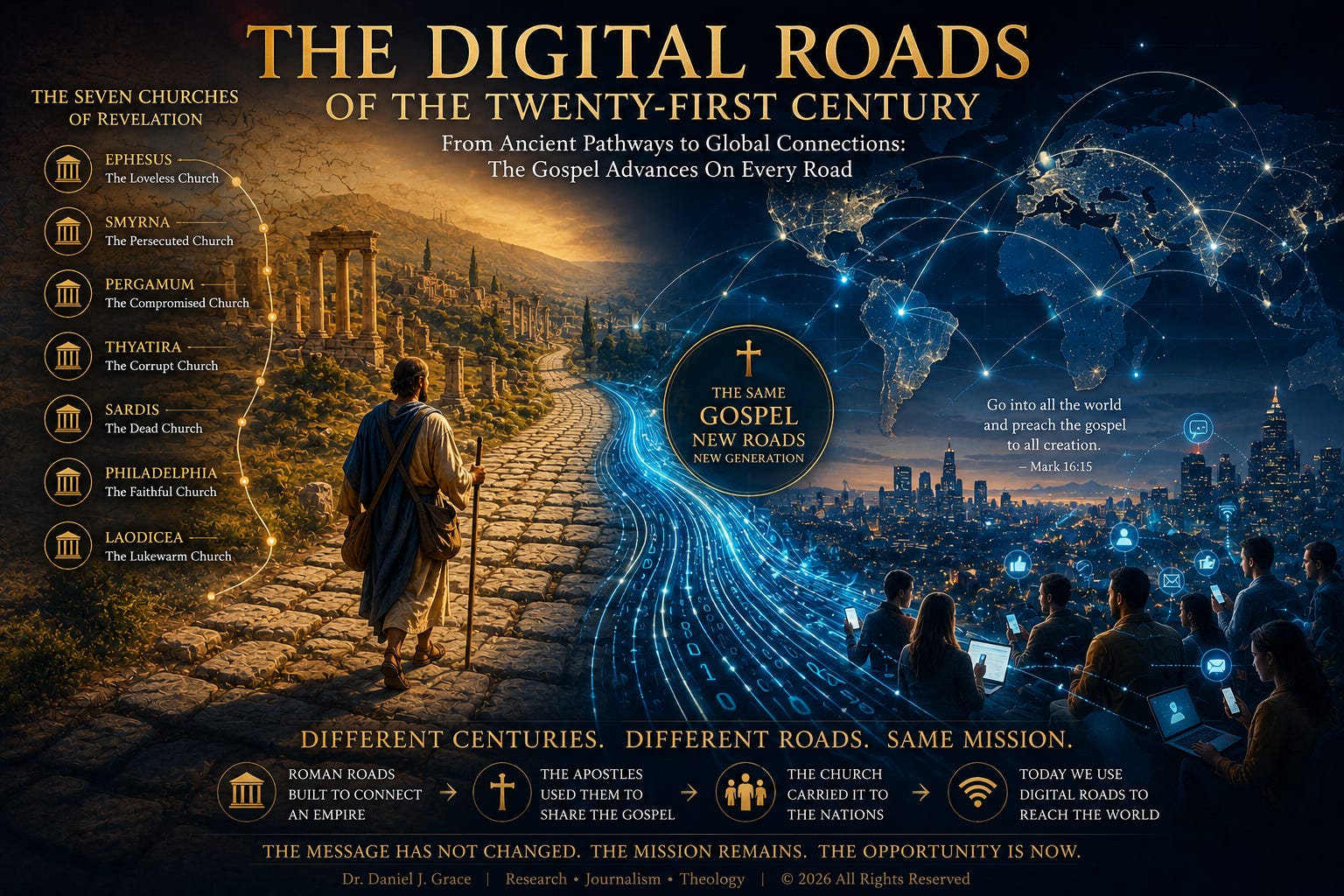
The story of the Roman roads teaches several important lessons.
First, God often works through ordinary structures and systems.
Roads were built for military and commercial purposes, yet they became instruments of evangelism.
Second, geography matters.
The locations of the Seven Churches were not accidental.
Their positions along major transportation routes contributed to their influence.
Third, strategic thinking has always played a role in Christian mission.
The apostles recognised opportunities and used existing networks to advance the Gospel.
Finally, every generation receives new pathways.
The challenge is learning how to use them wisely.
Conclusion
The roads connecting the Seven Churches were far more than ancient highways.
They formed the physical framework through which Christianity expanded across Asia Minor and beyond.
Merchants traveled them.
Soldiers marched upon them.
Government officials administered provinces through them.
Most importantly, missionaries carried the message of Jesus Christ along them.
The churches of Ephesus, Smyrna, Pergamum, Thyatira, Sardis, Philadelphia, and Laodicea were connected not only by faith but also by roads that enabled communication, fellowship, and growth.
Today the stones of many Roman roads lie buried beneath the soil of modern Turkey.
Yet their legacy remains.
They remind us that God often uses ordinary pathways to accomplish extraordinary purposes.
The forgotten roads of Revelation helped change the ancient world.
Their story continues to challenge modern believers to use the pathways available to them in service of the Gospel.
Dr. Daniel J. Grace
Research • Journalism • Theology
© 2026 Dr. Daniel J. Grace. All Rights Reserved.