

The Forgotten Christians of the Black Sea
Faith, Family, and the Forgotten Christian Heritage of the Laz People

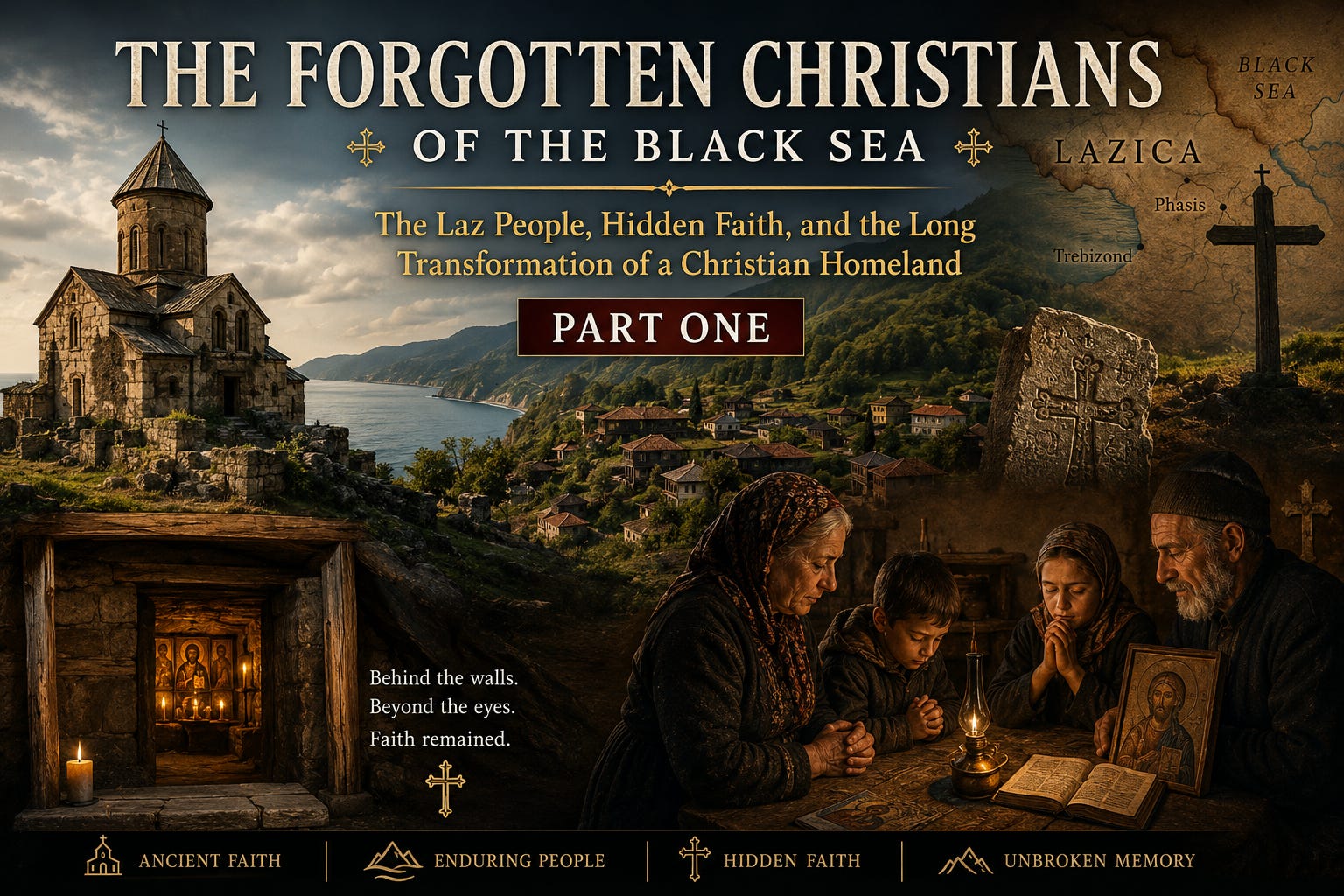
Part One : The Laz People, Hidden Faith, and the Long Transformation of a Christian Homeland
“Some stories survive in books. Others survive in families.”
Welcome, friend.
This is not merely a story about history.
It is a story about people.
It is a story about fishermen crossing the Black Sea before dawn, mothers whispering prayers to their children, grandparents preserving memories no official document ever recorded, and families who carried faith through centuries of political and cultural change.
It is also, in part, my family’s story.
The Laz people of the eastern Black Sea coast are often remembered today for their language, hospitality, music, and strong connection to the mountains and sea. Yet few people know that for many centuries the Laz were overwhelmingly Christian, connected to the wider world of Byzantine and Georgian Orthodoxy.
Over time, that world changed.
Empires rose and fell. Borders shifted. New rulers arrived. Communities adapted, survived, migrated, converted, and sometimes disappeared.
Some of the changes came through political realities. Some came through economic pressures. Some came through war. Others occurred gradually over generations.
The result was one of the most remarkable religious transformations in the history of the Black Sea region.
Today most Laz people identify as Muslim, yet memories of an older Christian heritage still survive in family stories, local traditions, ruined churches, forgotten cemeteries, and occasionally in unexpected places.
In my own family, stories were passed down of a hidden prayer room near the family home, concealed behind rural buildings where worship could take place away from public attention. Whether every detail can be verified by historians is impossible to know today. Yet such stories form part of the lived memory of many families throughout the Black Sea region.
This article explores both the documented history and the human experience behind those memories.
It is not written to accuse modern peoples or nations.
History is rarely simple.
The Black Sea coast has been home to Greeks, Laz, Georgians, Armenians, Turks, Pontic peoples, and many others.
Rather, this is an attempt to remember those ordinary men and women who lived through enormous changes while trying to preserve faith, family, and identity.
Their story deserves to be told.
When Christianity Came to the Black Sea
Long before the arrival of the Ottoman Empire, the eastern Black Sea region formed part of a vibrant Christian world.
The ancestors of the Laz people lived within the Kingdom of Lazica, strategically located between the Byzantine and Persian Empires.
By the fifth and sixth centuries Christianity had become firmly established throughout the region.
Historical records describe close relationships between Laz rulers and Constantinople. Churches were built. Bishops served local communities. Monasteries appeared in mountain valleys and coastal settlements.
For generations Christianity became deeply woven into daily life.
Children were baptized.
Church bells marked the rhythm of the week.
Feast days brought communities together.
The faith was not an imported identity—it became part of the culture itself.
A fisherman preparing his nets at sunrise might cross himself before setting out to sea.
A grandmother might teach prayers in the local language beside the fireplace.
The Christian faith became part of the landscape itself.
A Region Between Empires
The Black Sea was never isolated.
For centuries the region stood at the crossroads of competing powers.
Persians, Byzantines, Georgians, Seljuks, Mongols, and later Ottomans all left their mark.
Each political change affected local communities.
Yet throughout much of the medieval period Christian identity remained strong.
Even after the fall of Constantinople in 1453, Christian communities continued to exist throughout the Black Sea region.
The transformation that followed was gradual rather than immediate.
Ottoman Rule and Religious Change
When Ottoman authority expanded into the eastern Black Sea region, Christian communities entered a new reality.
The Ottoman Empire governed diverse populations through systems that allowed religious minorities to continue practising their faith while occupying a different legal and social position from the Muslim majority.
Many Christian communities remained active for centuries.
Churches continued functioning.
Families preserved traditions.
Religious festivals survived.
At the same time, economic pressures, taxation, social mobility, local politics, and changing circumstances encouraged gradual conversion in many regions.
The process varied enormously from village to village and from century to century.
Some communities retained Christianity.
Others gradually adopted Islam.
Still others preserved elements of older traditions while publicly identifying with the new religious order.
History rarely moved in straight lines.
The Mystery of Hidden Faith
Among the most fascinating chapters of Black Sea history are the traditions surrounding crypto-Christians.
Historians have documented crypto-Christian communities in several parts of the Ottoman Empire, particularly among Greek-speaking populations of the Pontus region.
Family traditions from the broader Black Sea world—including some Laz families—sometimes speak of hidden worship, concealed icons, secret prayers, and private religious observances.
While the historical evidence varies from place to place, these stories reveal something important:
People often sought ways to preserve identity during times of uncertainty.
In my own family’s memory, stories survived of a hidden chapel-like room near rural buildings where prayers could be offered away from public attention.
Whether every detail can be historically verified is less important than what the story meant.
It reminded later generations that faith was something precious—something worth protecting.
For many families across the Black Sea region, hidden faith became part of their cultural memory.
The Human Cost of Transformation
Historical change is often described through battles, treaties, and emperors.
Yet the real story is found elsewhere.
It is found in families.
A father deciding how to protect his children.
A mother preserving traditions inside the home.
A grandfather telling stories of earlier generations.
A village watching familiar customs slowly disappear.
The transformation of the Black Sea region was not simply political.
It was personal.
Some people embraced change willingly.
Others resisted.
Many simply adapted to survive.
The result was a gradual reshaping of an entire civilization.
What Remains Today
Today the Laz people remain one of the most vibrant cultures of the Black Sea.
Their language survives.
Their music survives.
Their hospitality survives.
Their connection to the sea and mountains survives.
And in some families, memories survive as well.
The churches may be gone.
The monasteries may be ruins.
Yet history has not entirely erased the past.
Across Türkiye, Georgia, Europe, Australia, and the wider diaspora, descendants continue exploring their heritage and asking questions about their ancestors.
Some discover forgotten family stories.
Others discover old church sites.
Still others rediscover the Christian faith itself.
A Final Reflection
Perhaps the greatest lesson of the Laz story is that identity is never entirely erased.
Empires rise and fall.
Governments change.
Languages evolve.
Religions spread.
Yet human memory remains powerful.
The story of the Black Sea Christians is not ultimately about defeat.
It is about endurance.
It is about ordinary people carrying hope through difficult generations.
And it reminds us that the God who watched over fishermen on the Black Sea centuries ago still watches over His people today.
The mountains remain.
The sea remains.
And faith—sometimes hidden, sometimes visible—continues to find a way to survive.
Come, Lord Jesus.

Dr. Daniel J. Grace
Faith • Civilization • Theology
Research • Journalism • Truth
🌐 danieljamesgrace.com
© 2026 Dr. Daniel J. Grace. All Rights Reserved.
No part of this article may be reproduced, distributed, transmitted, or published in any form or by any means without prior written permission from the author, except for brief quotations used in academic citation, review, or research purposes.