
The Eternal Kingdom, the New Jerusalem, and the Final Hope of the Church Part Three
From the Seven Churches to the Throne of God

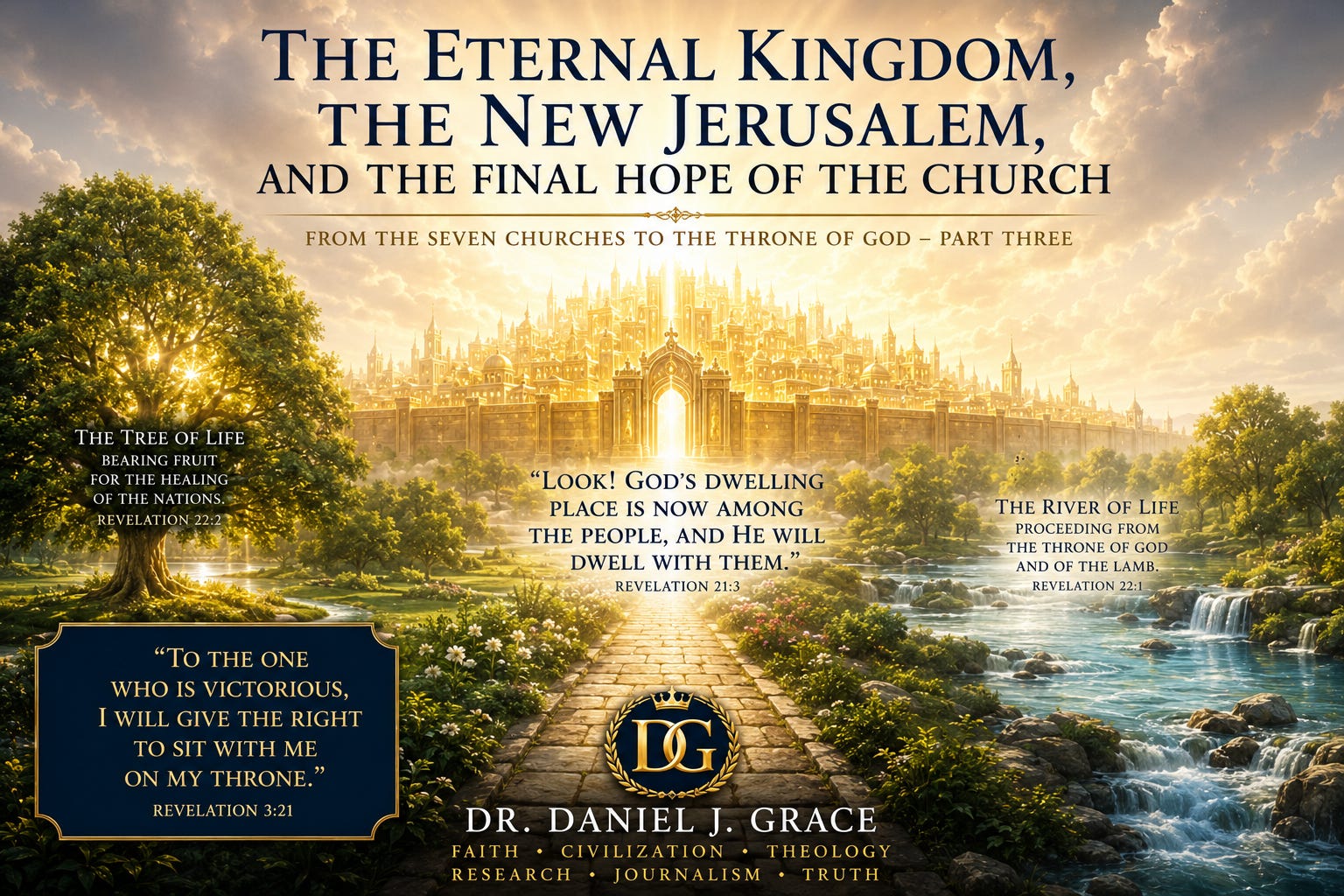
The Destination of Revelation
The Book of Revelation begins with seven imperfect churches struggling in a fallen world.
Ephesus had lost its first love.
Smyrna faced persecution.
Pergamum lived where Satan’s throne was located.
Thyatira tolerated corruption.
Sardis possessed a reputation without spiritual life.
Philadelphia endured faithfully despite weakness.
Laodicea had become lukewarm through prosperity.
Yet Revelation never leaves believers trapped within the struggles of the present age.
The purpose of the book is not merely to expose problems. Its purpose is to reveal the victory of Christ and the future prepared for God’s people.
The story begins with churches on earth.
It ends with God’s people dwelling forever in His presence.
The final chapters of Revelation reveal the fulfilment of every promise given to the seven churches. The Tree of Life returns. The faithful receive their reward. Death is defeated. Tears disappear. The kingdom of God is fully established.
The destination of Revelation is not fear.
The destination is hope.
A New Heaven and a New Earth
After the defeat of Satan, the final judgment, and the destruction of evil, John witnesses an extraordinary vision.
“Then I saw a new heaven and a new earth.” (Revelation 21:1)
The old creation, damaged by sin, suffering, death, and rebellion, passes away.
God is not merely repairing the old world.
He is creating something entirely renewed.
Throughout history, humanity has longed for a perfect society.
Empires have promised peace.
Political systems have promised justice.
Technology has promised progress.
Yet every human attempt ultimately fails because the deepest problem is not external.
The deepest problem is sin.
Only God can create the perfect kingdom.
The new heaven and new earth represent the complete restoration of creation under God’s eternal rule.
Everything broken will be healed.
Everything corrupted will be renewed.
Everything lost will be restored.
The New Jerusalem Descends
John then sees the most magnificent city in Scripture.
“I saw the Holy City, the New Jerusalem, coming down out of heaven from God.”
Unlike ancient Babylon, which symbolised rebellion, pride, and human arrogance, the New Jerusalem represents God’s perfect kingdom.
The city descends from heaven because salvation comes from God.
Humanity cannot build its way into paradise.
Paradise comes from God Himself.
John describes the city as:
“Prepared as a bride beautifully dressed for her husband.”
The imagery is deeply personal.
The New Jerusalem is not merely architecture.
It represents the eternal union between God and His redeemed people.
The Church is no longer struggling, persecuted, divided, or imperfect.
The Bride is finally complete.
The marriage between Christ and His people reaches its fulfilment.
God Dwells Among His People
One of the greatest promises in all Scripture follows:
“Look! God’s dwelling place is now among the people, and He will dwell with them.”
This has always been God’s desire.
In Eden, God walked with humanity.
In the Tabernacle, God dwelt among Israel.
In the Temple, His presence filled the sanctuary.
In Christ, God became flesh and lived among humanity.
In the New Jerusalem, the separation caused by sin is finally removed forever.
No temple is required.
No veil remains.
No distance exists.
God Himself is present.
The greatest blessing of heaven is not gold streets.
It is not crowns.
It is not rewards.
The greatest blessing is God Himself.
The redeemed will see His face.
No More Death, Sorrow, or Pain
Perhaps the most beloved words in Revelation are found here:
“He will wipe every tear from their eyes.”
For thousands of years humanity has lived under the shadow of suffering.
Disease.
War.
Persecution.
Loneliness.
Grief.
Death.
Every generation has experienced pain.
Every family has known loss.
Yet God’s final kingdom removes these realities forever.
John writes:
“There will be no more death or mourning or crying or pain.”
Death itself is defeated.
The last enemy is destroyed.
The scars of history are healed.
The brokenness of creation is reversed.
What began in Genesis with a curse ends in Revelation with restoration.
The Fulfilment of the Seven Promises
One of the most beautiful features of Revelation is how the promises given to the seven churches find their fulfilment in the eternal kingdom.
Ephesus
Christ promised access to the Tree of Life.
In Revelation 22, the Tree of Life stands beside the River of Life, bearing fruit for God’s people.
Smyrna
Christ promised protection from the second death.
In the eternal kingdom, the second death has no power over God’s redeemed people.
Pergamum
Christ promised hidden manna and a new name.
In God’s kingdom, believers experience complete fellowship with Christ and receive their eternal identity.
Thyatira
Christ promised authority and the Morning Star.
The faithful reign with Christ and share in His victory.
Sardis
Christ promised white garments.
The saints stand before God clothed in purity and righteousness.
Philadelphia
Christ promised a permanent place in God’s presence.
The New Jerusalem becomes their eternal home.
Laodicea
Christ promised a place upon His throne.
The redeemed reign with Christ forever.
Every promise finds its fulfilment.
Every hope becomes reality.
Every struggle reaches its conclusion.
The River of Life
Flowing through the centre of the city is the River of Life.
It proceeds from the throne of God and of the Lamb.
This river symbolises eternal life, blessing, abundance, and divine presence.
Unlike earthly rivers, which eventually dry up, this river never ceases.
Its source is God Himself.
Beside the river stands the Tree of Life.
The tree bears fruit continually.
Its leaves bring healing to the nations.
The imagery deliberately echoes Eden.
Humanity lost access to the Tree of Life because of sin.
Now access is restored forever.
The story comes full circle.
Paradise lost becomes paradise regained.
The Face of God
Perhaps the most astonishing promise in Scripture appears near the end of Revelation.
“They will see His face.”
Throughout biblical history, direct access to God’s glory was impossible.
Moses saw only a partial revelation.
The High Priest entered the Holy of Holies only once each year.
The divine presence remained veiled.
In eternity, the veil is removed completely.
The redeemed see God face to face.
Perfect fellowship is restored.
Nothing greater can be imagined.
The goal of salvation is not merely escaping judgment.
The goal is communion with God.
The Kingdom That Never Ends
Every earthly kingdom eventually falls.
Egypt faded.
Babylon collapsed.
Greece disappeared.
Rome declined.
Empires rise and fall throughout history.
Only one kingdom endures forever.
The kingdom of Christ.
His reign is eternal.
His authority is absolute.
His victory is complete.
No enemy remains.
No rebellion survives.
No darkness exists.
The throne remains occupied forever by the Lamb who was slain.
Conclusion: The Final Hope of the Church
The Book of Revelation begins with seven struggling churches.
It ends with one victorious people.
The journey from Ephesus to the New Jerusalem reveals God’s redemptive plan.
The churches faced real challenges.
Believers endured suffering.
Many were tempted to compromise.
Some grew spiritually cold.
Others remained faithful despite weakness.
Yet Christ remained present among them.
The Lamb remained upon the throne.
The kingdom remained secure.
This is the ultimate message of Revelation.
History is moving toward God’s appointed destination.
Christ will return.
Evil will be defeated.
Death will disappear.
The kingdom will come in its fullness.
The New Jerusalem will descend.
God will dwell with His people.
And the faithful will reign with Christ forever.
The final words of Revelation remain the prayer of the Church throughout every generation:
“Amen. Come, Lord Jesus.”
End of the Trilogy
Dr. Daniel J. Grace
Faith • Civilization • Theology
Research • Journalism • Truth
🌐 danieljamesgrace.com
© 2026 Dr. Daniel J. Grace. All Rights Reserved.
No part of this article may be reproduced, distributed, transmitted, or published in any form or by any means without prior written permission from the author, except for brief quotations used in academic citation, review, or research purposes.