
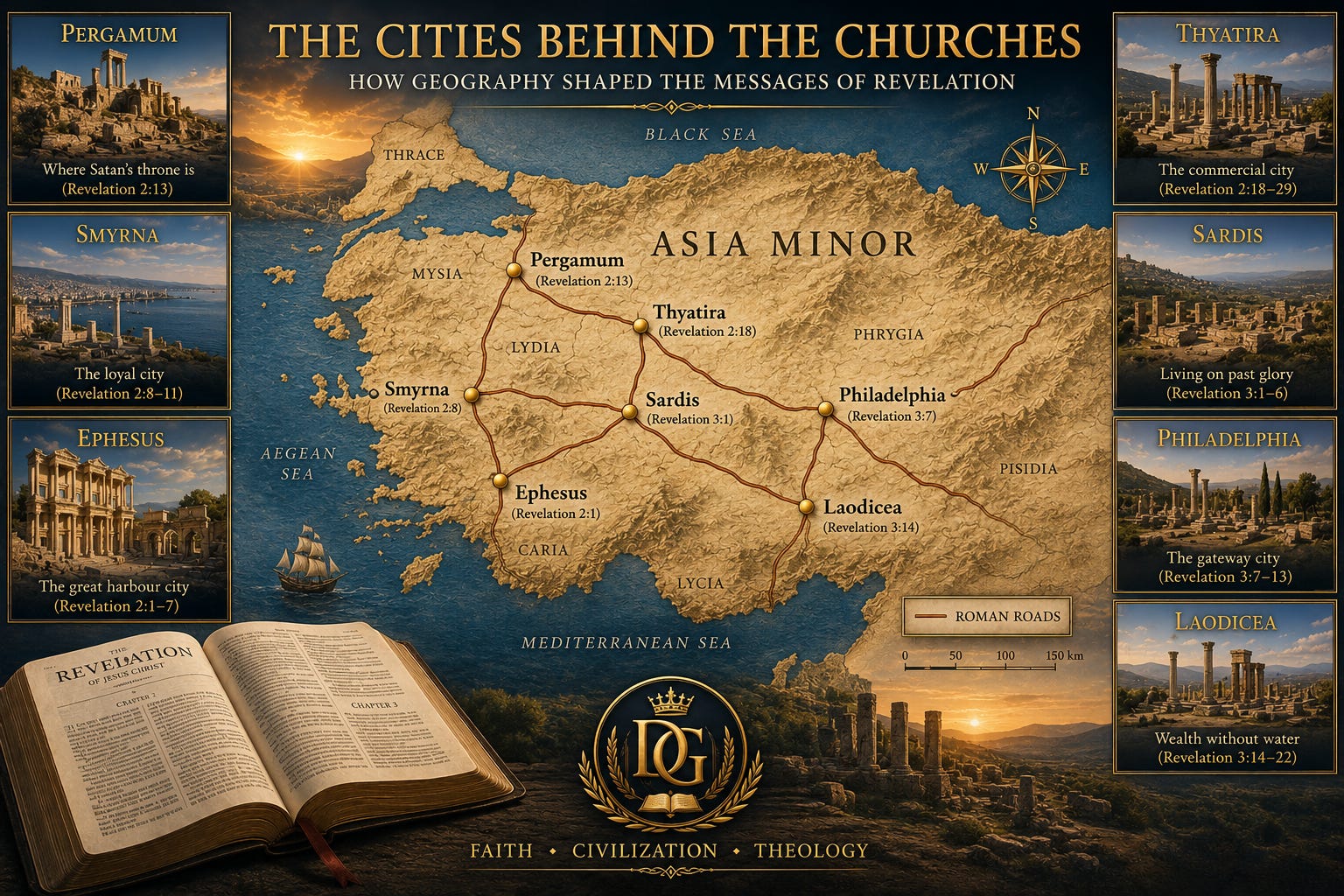
The Cities Behind the Churches
How Geography Shaped the Messages of Revelation

Why the Locations of the Seven Churches Matter
When many people read the letters to the Seven Churches in Revelation, they focus primarily on the spiritual messages. They consider themes such as faithfulness, compromise, perseverance, repentance, and hope.
Yet something equally important is often overlooked.
The cities themselves.
The messages to Ephesus, Smyrna, Pergamum, Thyatira, Sardis, Philadelphia, and Laodicea were not randomly assigned. Each church existed within a unique geographical, political, economic, and cultural environment.
Understanding these cities helps readers understand why Christ addressed each church in a particular way.
Geography shaped culture.
Culture shaped challenges.
Challenges shaped the messages.
The Seven Churches were not isolated congregations. They were communities deeply connected to the world around them.
Ephesus: The Great Harbour City
Ephesus was one of the most important cities in the Roman Empire.
Located near the Aegean coast, it served as a major commercial and transportation hub. Merchants, travellers, sailors, and government officials passed through its busy streets.
The city was also famous for the Temple of Artemis, one of the Seven Wonders of the Ancient World.
Ephesus enjoyed influence, wealth, and prestige.
Yet despite its advantages, Christ warned the church:
“You have left your first love.”
The geography of Ephesus helps explain this warning.
Busy commercial centres often become places of constant activity.
The church worked hard, defended sound doctrine, and remained active.
Yet activity had gradually replaced devotion.
The bustling environment of Ephesus mirrored the church’s spiritual condition.
They were busy but drifting.
Smyrna: The Loyal City
Smyrna occupied a beautiful natural harbour and enjoyed strong economic connections throughout the Roman world.
More importantly, Smyrna was fiercely loyal to Rome.
The city actively promoted emperor worship and possessed a strong imperial identity.
For Christians, this created challenges.
Refusing to participate in emperor worship could result in exclusion, persecution, and economic hardship.
This explains why Christ encouraged Smyrna:
“Do not fear.”
The city’s political environment created pressure upon believers to compromise.
Yet the church remained faithful despite suffering.
Geography had placed them in a strategic and prosperous city, but also one of the most dangerous locations for Christian witness.
Pergamum: Where Satan’s Throne Is
Pergamum served as the administrative capital of Roman Asia.
The city contained temples dedicated to various gods and maintained one of the most significant centres of emperor worship in the region.
Christ described Pergamum as the place “where Satan’s throne is.”
This statement likely reflected the city’s intense concentration of religious and political power.
Massive temples dominated the skyline.
Imperial authority shaped daily life.
Pagan worship surrounded believers.
The church lived at the centre of competing loyalties.
Its geographical setting explains why compromise became such a significant issue.
The pressure to conform existed everywhere.
Thyatira: The Commercial City
Unlike some of the larger cities, Thyatira was primarily known for trade and industry.
The city contained numerous trade guilds representing merchants, craftsmen, and artisans.
Participation in these guilds often involved pagan religious ceremonies.
Economic success frequently required involvement in activities that conflicted with Christian convictions.
This helps explain the concerns raised in Christ’s message.
Believers faced difficult choices between financial security and spiritual faithfulness.
The geography of Thyatira created a direct connection between commerce and compromise.
Economic pressures became spiritual pressures.
Sardis: Living on Past Glory
Sardis was once one of the richest and most powerful cities in Asia Minor.
Built upon a steep hill, it appeared almost impossible to conquer.
Its natural position created confidence and security.
Yet history tells a different story.
The city was captured more than once because its inhabitants became careless and overconfident.
Christ’s message reflects this history:
“You have a reputation of being alive, but you are dead.”
The city and the church shared a similar problem.
Both relied upon past achievements.
Both possessed impressive reputations.
Yet beneath the surface, weakness had developed.
The geography of Sardis reinforced a dangerous sense of security.
Philadelphia: The Gateway City
Philadelphia occupied a strategic position along important trade routes connecting different regions of Asia Minor.
The city functioned as a gateway between cultures.
It also experienced frequent earthquakes.
Life in Philadelphia involved uncertainty.
Buildings collapsed.
People often lived with instability.
Against this backdrop, Christ promised:
“I have set before you an open door.”
For believers living in a gateway city, the image of an open door carried special significance.
The church possessed limited strength but remarkable faithfulness.
Their location provided opportunities for influence despite their modest resources.
Geography had positioned them for mission.
Laodicea: Wealth Without Water
Laodicea was among the wealthiest cities in the Roman world.
It prospered through banking, textile production, and medicine.
The city became so wealthy that after a devastating earthquake in AD 60, it rebuilt itself without financial assistance from Rome.
Yet Laodicea possessed one significant weakness.
Its water supply.
Water travelled through aqueducts from distant sources and arrived lukewarm.
Neither refreshing like cold mountain water nor useful like hot mineral springs.
Christ used this local reality when addressing the church:
“You are lukewarm.”
The believers immediately understood the comparison.
Every day they experienced the city’s disappointing water supply.
The geography of Laodicea provided a perfect illustration of spiritual complacency.
Geography and Spiritual Lessons
The Seven Churches demonstrate an important principle.
God speaks into real historical circumstances.
The messages were not abstract theological ideas disconnected from everyday life.
They addressed specific people living in specific places.
Harbours influenced Ephesus and Smyrna.
Government power shaped Pergamum.
Commerce affected Thyatira.
History influenced Sardis.
Trade routes benefited Philadelphia.
Water systems defined Laodicea.
Geography became part of the message.
Why Geography Still Matters Today
Understanding geography transforms how Revelation is read.
The churches were not merely symbols.
They were real communities facing real challenges.
Their environment influenced their opportunities, pressures, and struggles.
The same remains true today.
Modern cities shape behaviour.
Economic systems influence priorities.
Technology affects relationships.
Culture impacts beliefs.
Just as geography shaped the Seven Churches, contemporary environments continue to shape modern believers.
The lessons of Revelation remain relevant because human beings still live within environments that influence faith.
Conclusion
The Seven Churches cannot be fully understood apart from the cities in which they existed.
Ephesus was busy.
Smyrna was loyal to Rome.
Pergamum was powerful.
Thyatira was commercial.
Sardis was complacent.
Philadelphia was strategic.
Laodicea was wealthy.
Each city’s geography helped shape its unique spiritual challenges.
The messages of Revelation were carefully tailored to those realities.
This historical context deepens our understanding of Scripture and reminds us that faith is always lived within a particular place and time.
The cities may have changed.
The Roman Empire may have disappeared.
Yet the relationship between culture, environment, and spiritual life remains remarkably familiar.
The geography behind the churches continues to illuminate the message before the churches.
Dr. Daniel J. Grace
Faith • Civilization • Theology
Research • Journalism • Truth
🌐 danieljamesgrace.com
© 2026 Dr. Daniel J. Grace. All Rights Reserved.