

The Church Was Never Called to Be Impressive
There is something strange happening in modern Christianity.

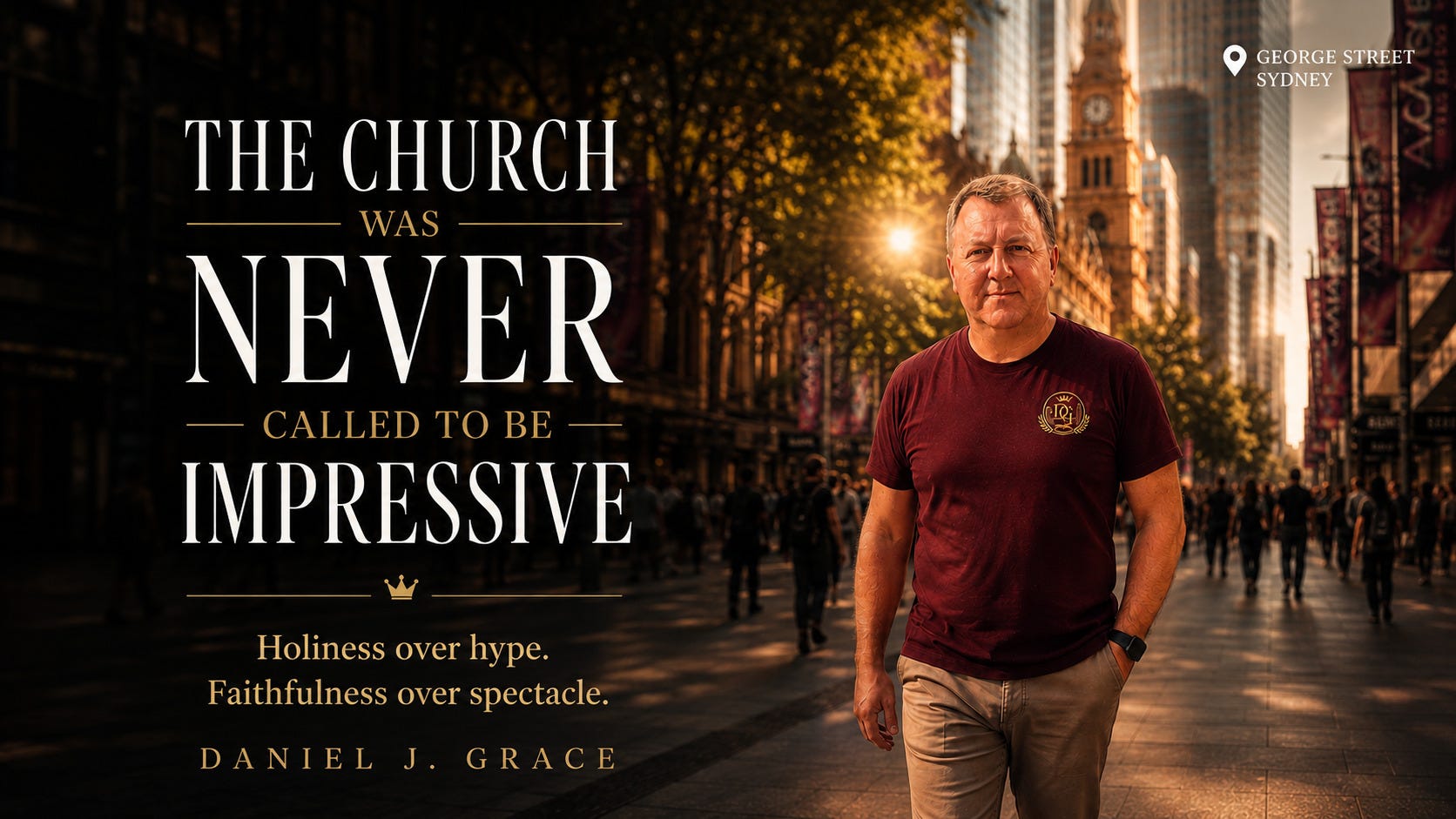
The Church Was Never Called to Be Impressive
There is something strange happening in modern Christianity.
We keep talking about impact, growth, platform, reach, influence, visibility, numbers, strategy, and momentum. We use these words so often that we almost forget to ask whether Jesus ever sounded like this.
He usually did not.
Jesus did not begin his ministry by building a brand. He did not gather a board of advisors to discuss market reach. He did not choose the most polished people. He did not measure faithfulness by the size of the crowd. In fact, when crowds became too excited for the wrong reasons, he often withdrew.
That should disturb us a little.
Because many churches today would not know what to do with a Messiah who kept leaving the stage.
We say we want Jesus, but often we want the successful version of Jesus. The version who fills the room, grows the budget, attracts donors, increases engagement, and keeps everyone feeling that the movement is going somewhere.
But the Jesus of the Gospels is far harder to manage.
He spends time with the wrong people.
He touches the unclean.
He eats slowly.
He asks uncomfortable questions.
He refuses political shortcuts.
He disappoints religious professionals.
He lets people walk away.
And then, at the centre of the Christian faith, he is not enthroned in visible success. He is crucified.
That is not impressive in the way we usually mean the word.
It is holy.
The hidden life of Jesus
Before Jesus preached publicly, he lived quietly.
This is one of the most ignored facts in Christian imagination. We love the miracles, the sermons, the conflicts, the cross, and the resurrection. Of course we do. They are central.
But before all of that, the Son of God spent years in obscurity.
Years.
He lived in Nazareth. He worked. He prayed. He obeyed. He honoured his mother and earthly family. He entered ordinary human time without rushing to prove who he was.
Think about that.
The eternal Word became flesh, and for most of his earthly life, almost nobody noticed.
If we were writing the story, we would probably rush him to Jerusalem by age twenty. We would give him a public launch, a speaking tour, a powerful network, a clear leadership structure, and a communications team.
God gave him Nazareth.
A hidden town.
A poor family.
A slow life.
A quiet obedience.
This is not a small detail. It tells us something about God.
God is not embarrassed by hidden faithfulness.
We are.
When churches become anxious
Much of the modern church is anxious.
Not always openly. We know how to cover it with spiritual words. But underneath many church conversations there is a nervous question:
Are we still relevant?
So we try harder. We adjust the language. We sharpen the graphics. We count the attendance. We chase trends. We build systems. We compare ourselves with the church down the road, the preacher online, the ministry that seems to be growing faster.
Some of this is not evil. Churches should communicate clearly. They should steward resources wisely. They should care whether people are being reached.
But when anxiety becomes the engine, the church starts to change shape.
Prayer becomes preparation for productivity.
Worship becomes atmosphere.
Pastoral care becomes retention.
Discipleship becomes content.
Mission becomes branding.
And Jesus becomes useful.
That may be the most dangerous shift of all.
Not denied.
Not rejected.
Used.
Used to support our plans. Used to decorate our ambitions. Used to keep the machine running with sacred language.
But Jesus did not come to serve the machine. He came to call sinners into the kingdom of God.
The boardroom and the basin
There is one scene in John’s Gospel that still exposes us.
Jesus knows that his hour has come. He knows betrayal is near. He knows the cross is waiting. And what does he do?
He gets up from the table, takes a towel, pours water into a basin, and washes his disciples’ feet.
This is not leadership theatre. This is not a symbolic gesture performed for cameras. There are no cameras. There is only dust, feet, water, and the humility of God.
Peter cannot handle it.
That makes sense. Most of us cannot handle it either.
We are far more comfortable with a Jesus who leads from the front than a Jesus who kneels at the feet of confused men who will soon fail him.
But this is the pattern.
Christ does not reveal divine glory by climbing over others. He reveals it by lowering himself in love.
The church forgets this every time it treats ordinary service as beneath its calling.
The nursery worker matters.
The tired pastor matters.
The old woman praying quietly matters.
The person setting up chairs matters.
The unseen act of forgiveness matters.
The small visit to the lonely matters.
These things may never trend. They may never become a conference story. They may never produce impressive numbers.
But heaven sees them.
And heaven is not bored.
The danger of measurable faithfulness
We like things we can measure because measurement gives us the feeling of control.
How many came?
How many clicked?
How many gave?
How many joined?
How many shared?
Again, numbers are not evil. The book of Acts counts people. The early church knew when many were being added. Growth can be a gift of God.
But numbers can never tell the whole truth.
A church can grow and become shallow.
A ministry can expand and become proud.
A preacher can gain followers and lose tenderness.
A community can look alive and be spiritually tired.
Jesus warned about this.
Sardis had a reputation for being alive, but Christ said it was dead. Laodicea thought it was rich, but Christ called it poor, blind, and naked. Ephesus had endurance and doctrine but had lost its first love.
That should make every successful church tremble.
Not with despair. With honesty.
The question is not only, “Are we growing?”
The question is, “Are we becoming more like Christ?”
Are we more patient?
More truthful?
More prayerful?
More merciful?
More holy?
More willing to suffer without becoming bitter?
More ready to love people who cannot help our image?
If the answer is no, then our success may be hiding our sickness.
Jesus and the slow work of the soul
Jesus was never in a hurry.
This is hard for us because we are almost always in a hurry. We hurry through prayer. We hurry through conversations. We hurry through worship. We hurry through grief. We hurry through repentance. We even hurry through silence.
But Jesus moves with strange freedom.
He stops for blind men calling from the roadside. He notices a woman who touches the edge of his garment. He speaks with a Samaritan woman at a well. He welcomes children when others see them as an interruption. He stays with people long enough for their wounds to become visible.
This is not inefficient ministry.
This is the kingdom.
The kingdom of God is not built by contempt for small things. It comes like a seed. Like yeast. Like light. Like salt. Like a hidden treasure. Like a father waiting for a son to come home.
Slow images.
Ordinary images.
Images that refuse our obsession with speed.
Maybe the church does not need to become more impressive. Maybe it needs to become less restless.
Less addicted to noise.
Less frightened by silence.
Less ashamed of hiddenness.
Less controlled by comparison.
More willing to be faithful in places where nobody claps.
The pastor as shepherd, not performer
One of the great tragedies of our age is that many pastors are being shaped into performers.
They must preach well, lead well, manage well, communicate well, grow the church, handle conflict, cast vision, maintain online presence, respond to crisis, be emotionally available, spiritually mature, administratively sharp, culturally aware, and always somehow fresh.
Then we wonder why so many are exhausted.
The New Testament image is not celebrity. It is a shepherd.
A shepherd knows the sheep. A shepherd protects. A shepherd feeds. A shepherd notices the weak one at the back. A shepherd smells like the field.
This kind of ministry is not always glamorous. Often it is repetitive. Often it is heavy. Sometimes it is thankless.
But it is close to the heart of Christ.
Jesus did not say, “I am the impressive speaker.”
He said, “I am the good shepherd.”
That matters.
If pastors are forced to become performers, congregations become audiences. And when congregations become audiences, church becomes a religious event people evaluate rather than a body in which they learn to love.
Then everyone becomes a critic.
The sermon was too long.
The music was too loud.
The room was too cold.
The program was not exciting.
The church down the road does it better.
Something dies in us when we forget that we are not consumers of spiritual goods. We are members of one body.
Bodies require patience.
Bodies are inconvenient.
Bodies need care.
The beauty of unimpressive saints
Some of the most faithful Christians I have known would never be invited onto a platform.
They are not polished enough. Not famous enough. Not strategic enough. Not young enough. Not marketable enough.
But they know how to pray.
They know how to forgive.
They know how to sit with suffering people.
They know how to stay faithful when life becomes hard.
They know how to serve without turning service into a performance.
Their lives do not shout. They carry weight.
There is a difference.
The church needs these people more than it knows. They are living proof that Christianity is not mainly an idea to be promoted but a life to be lived in communion with Christ.
They remind us that holiness is often quiet.
A meal prepared.
A visit made.
A sin confessed.
A grudge released.
A prayer whispered.
A promise kept.
The world may call this small.
Jesus does not.
The cross is not good branding
The cross ruins our illusions.
It tells us that God’s victory does not look like human triumph. It tells us that love may be rejected and still be love. It tells us that obedience may lead through suffering, not around it. It tells us that the deepest work of God may be hidden under apparent failure.
This is why a truly Christian church can never be built on impressiveness.
The cross will always interrupt that project.
At Calvary, there are no successful optics. No strong public image. No crowd approval. No visible momentum. The disciples scatter. The religious leaders mock. The empire executes. The sky darkens.
And there, in that place of shame, God is reconciling the world to himself.
If we forget this, we will start calling the wrong things powerful.
We will think power is attention.
Power is money.
Power is influence.
Power is applause.
Power is being known.
But in Christ, power is love poured out.
Power is mercy.
Power is truth.
Power is holiness.
Power is forgiveness.
Power is resurrection after crucifixion.
The church does not need to compete with the world on the world’s terms. It cannot win that way without losing its soul.
What if faithfulness is enough?
This question sounds weak only because we have been trained badly.
What if faithfulness is enough?
Not laziness.
Not small thinking.
Not fear.
Not hiding.
Faithfulness.
Doing the will of God where we are. Loving the people given to us. Telling the truth without cruelty. Serving without needing to be seen. Praying when prayer feels dry. Preaching Christ without turning him into a product. Remaining near the wounded. Refusing to measure the kingdom only by what can be counted.
What if this is not failure?
What if this is the narrow road?
Maybe the future of the church will not be saved by becoming louder. Maybe it will be saved by becoming truer.
A truer church may not always look impressive.
It may look like repentance.
It may look like simplicity.
It may look like pastors becoming shepherds again.
It may look like Christians are leaving the addiction to the platform behind.
It may look like prayer meetings with no photos.
It may look like forgiveness no one posts about.
It may look like small churches loving their towns quietly.
It may look like hidden saints becoming the backbone of renewal.
That would not make headlines.
But it might look a lot like Jesus.
Staying with the unimpressive Christ
The Christ we follow was born in humility, lived in hiddenness, served with tenderness, died in shame, and rose in glory.
We do not get to skip the first parts because we prefer the last.
If we want resurrection life, we must stay near the crucified Lord. If we want true witness, we must let go of the need to appear powerful. If we want the church to be renewed, we must stop asking only how to become impressive and start asking how to become faithful.
The church was never called to be impressive.
It was called to be holy.
It was called to love.
It was called to bear witness.
It was called to follow Jesus, even when Jesus walks away from the crowd, kneels with a towel, touches the wounded, welcomes the forgotten, and carries a cross outside the city.
That may not satisfy the modern church board.
But it is the way of Christ.
And in the end, that is the only way that life works.
© 2026 Daniel J. Grace. All rights reserved.
Written by Daniel J. Grace
Website: https://danieljamesgrace.com
ORCID: https://orcid.org/0000-0002-9259-8032
Zenodo: https://zenodo.org/
Media / Contact: contact@danieljamesgrace.com
Originally published on Dr. Daniel J. Grace’s Substack. For more articles on Christian faith, biblical theology, church history, discipleship, and contemporary Christian witness, visit: https://www.danieljamesgrace.com