

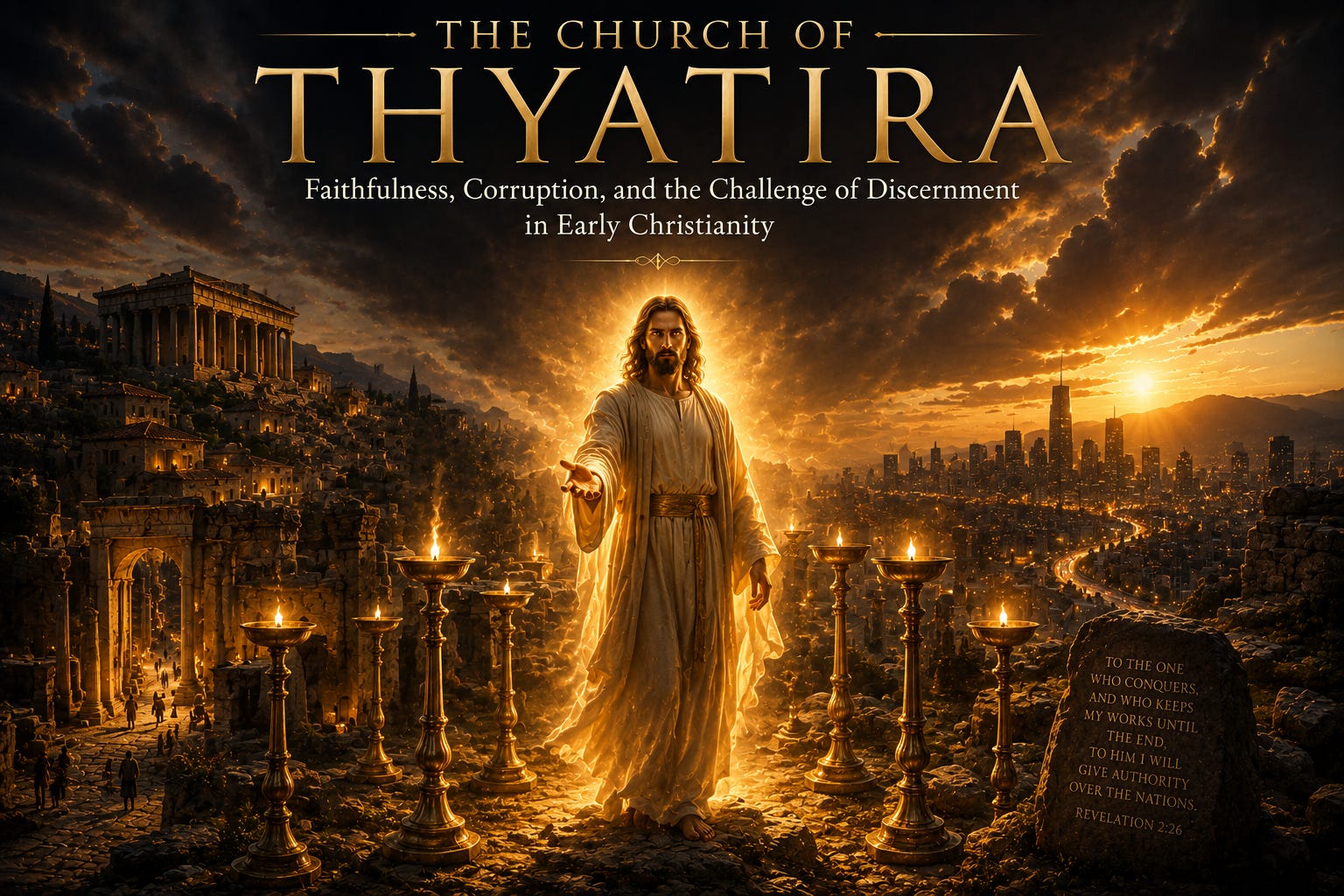
The Church of Thyatira: Faithfulness, Corruption, and the Challenge of Discernment in Early Christianity
Truth, Tolerance, and the Struggle Against Spiritual Compromise

Introduction
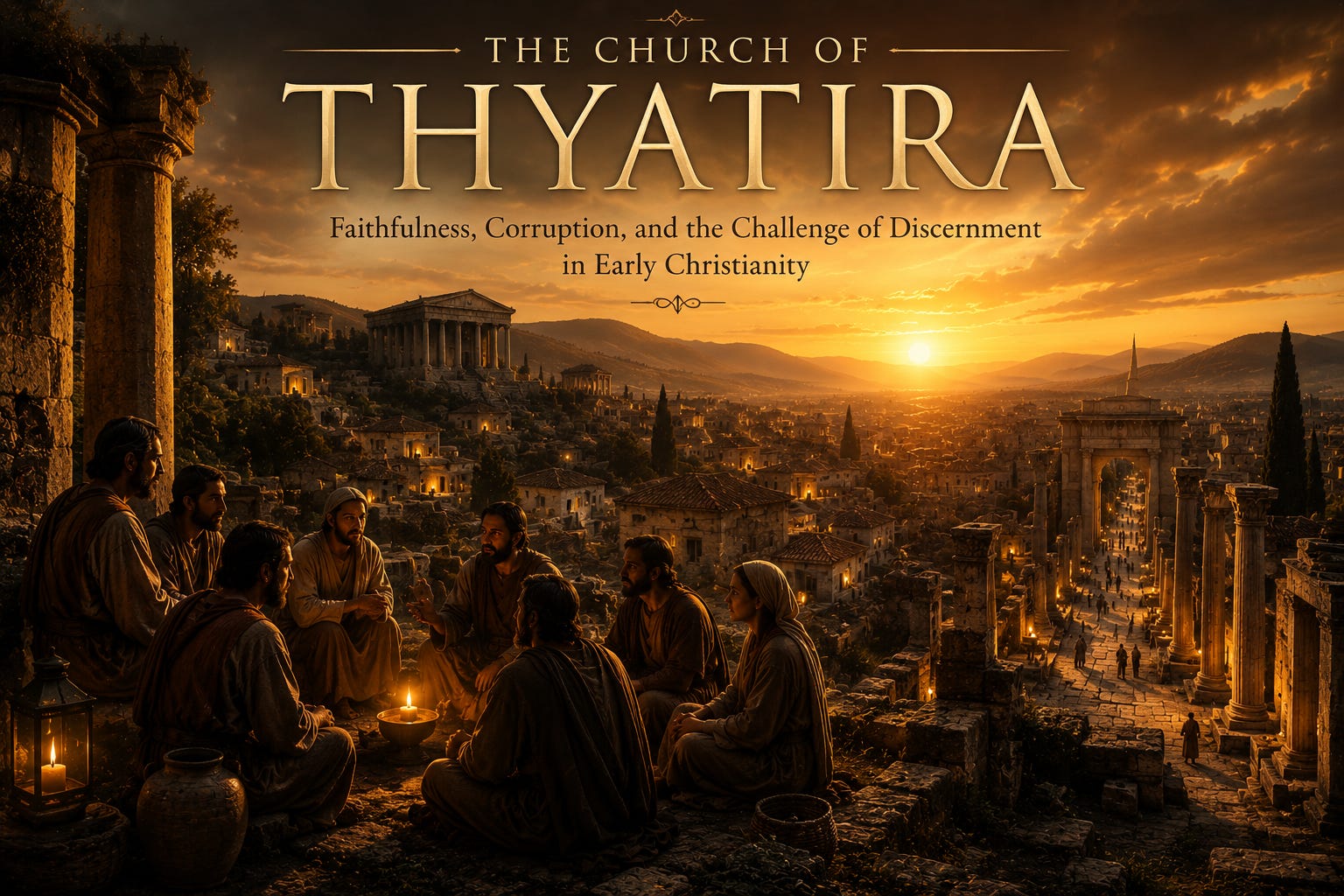
Among the Seven Churches addressed in the Book of Revelation, the church of Thyatira occupies a unique and complex position. Unlike Ephesus, renowned for doctrinal vigilance, or Smyrna, praised for steadfast endurance under persecution, Thyatira was a congregation marked by both commendable virtues and serious spiritual compromise. Christ’s message to Thyatira contains His longest letter among the seven churches, revealing both profound encouragement and stern warning.
The church of Thyatira presents a timeless challenge for Christians throughout history. It demonstrates how a congregation may grow in love, service, and faithfulness while simultaneously tolerating dangerous teachings capable of corrupting its spiritual foundation. The letter confronts believers with difficult questions concerning discernment, leadership, moral integrity, and the relationship between tolerance and truth.
For modern readers, Thyatira remains remarkably relevant. In an age characterized by competing ideologies, moral uncertainty, and increasing pressure to compromise biblical convictions, the church of Thyatira serves as both a warning and a guide. It teaches that genuine Christian love must never be separated from truth and that spiritual growth requires continual vigilance against corruption.
This article explores the historical background, biblical significance, theological themes, and contemporary relevance of the church of Thyatira, demonstrating why Christ’s message continues to speak powerfully to the modern church.
The Historical City of Thyatira
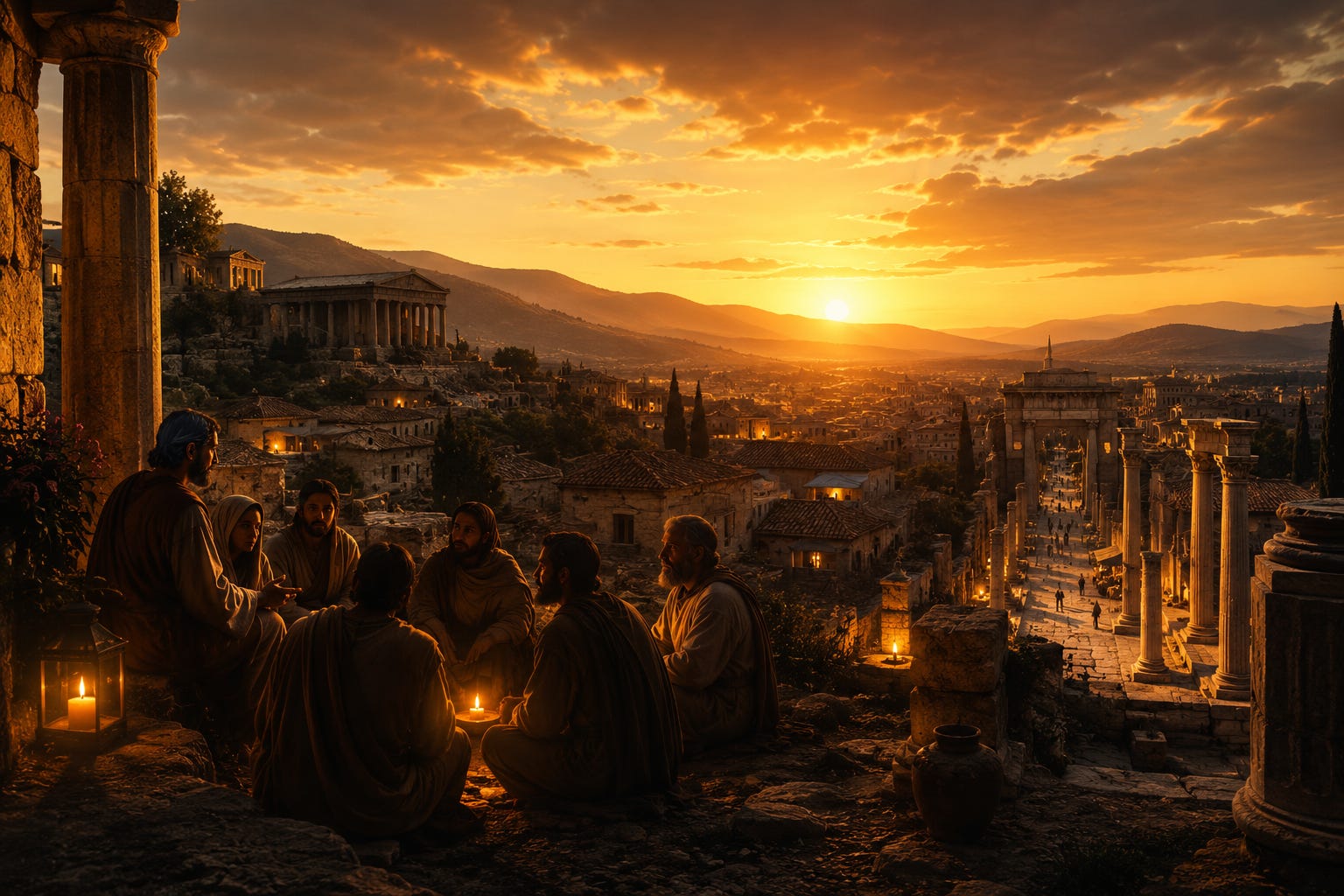
Thyatira was located approximately sixty kilometres southeast of Pergamum in the fertile Lycus River valley of Asia Minor, within present-day Türkiye. Unlike Ephesus or Pergamum, Thyatira possessed neither significant political influence nor major religious prestige. It was primarily a commercial and industrial centre.
Historically, the city served as a military outpost established by the Seleucid Empire. Its strategic location placed it along important trade routes connecting various regions of Asia Minor. Because of this position, Thyatira developed into a thriving commercial centre with numerous trade guilds.
Ancient inscriptions reveal that Thyatira hosted guilds representing:
wool workers,
linen manufacturers,
dyers,
leather workers,
bronze smiths,
potters,
bakers,
and merchants.
The city’s most famous biblical resident was Lydia, described in the Book of Acts as a seller of purple cloth from Thyatira. Her conversion under the ministry of the Apostle Paul represents the first recorded Christian convert in Europe and highlights Thyatira’s commercial importance.
The presence of numerous trade guilds created unique challenges for Christians. Participation in guild activities often involved pagan religious ceremonies, sacrificial meals, and social expectations that conflicted with Christian beliefs. Refusal to participate could result in economic hardship and social exclusion.
Consequently, believers in Thyatira faced constant pressure to compromise their convictions in order to maintain business relationships and economic stability.
Christ’s Introduction to Thyatira
The message begins in Revelation 2:18:
“These are the words of the Son of God, whose eyes are like blazing fire and whose feet are like burnished bronze.”
This description immediately establishes Christ’s authority and divine identity.
The title “Son of God” appears uniquely in this letter. In a city where pagan worship and imperial cults claimed divine authority, Christ declares Himself the true Son of God.
The imagery of blazing eyes signifies:
perfect knowledge,
penetrating judgment,
spiritual discernment,
and divine omniscience.
Nothing remains hidden from His sight.
The feet of burnished bronze symbolize:
strength,
purity,
stability,
and righteous judgment.
This imagery may have held special significance for Thyatira due to its association with bronze manufacturing.
Before addressing the church’s problems, Christ reminds believers that He alone possesses the authority to evaluate their condition.
Commendation: A Growing Church
Unlike some churches that had declined spiritually, Thyatira received significant praise.
Christ declares:
“I know your deeds, your love and faith, your service and perseverance, and that you are now doing more than you did at first.”
This commendation is remarkable.
Thyatira demonstrated:
Love
Christian love formed a visible characteristic of the congregation.
Their concern for one another reflected genuine Christian compassion.
Faith
The church maintained belief in Christ despite external pressures.
Their faith produced visible fruit through practical ministry.
Service
The believers actively served others.
Christianity in Thyatira was not merely theoretical but expressed through action.
Perseverance
Despite economic and social challenges, the church continued faithfully.
Spiritual Growth
Perhaps most impressive was Christ’s statement that they were doing more than at first.
Unlike Ephesus, which had abandoned its first love, Thyatira appeared to be growing in many positive areas.
This highlights an important truth:
A church may display numerous strengths while still harboring serious weaknesses.
External success does not eliminate the need for spiritual discernment.
The Problem of Tolerated Corruption
Despite these strengths, Christ identifies a severe problem.
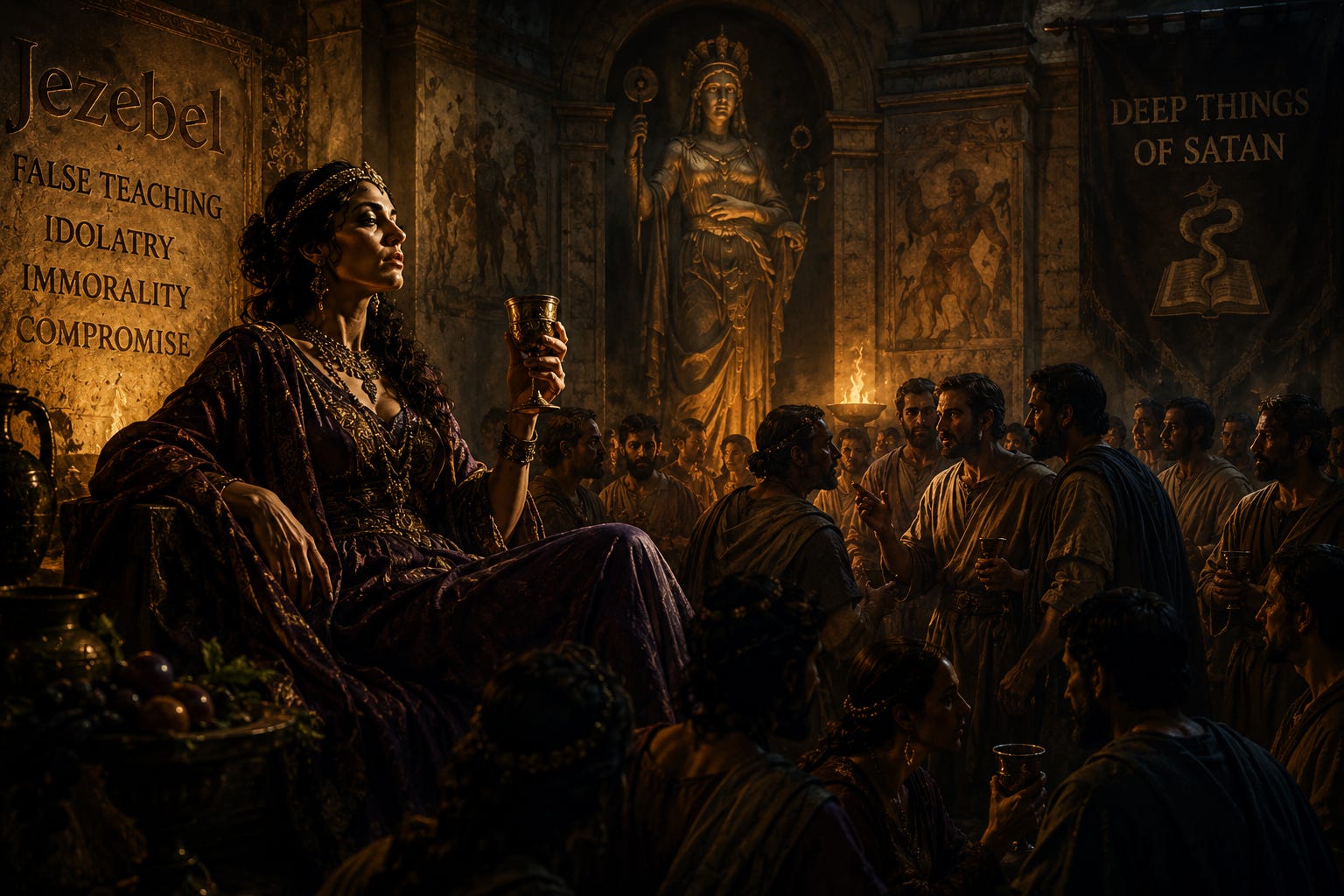
“Nevertheless, I have this against you: You tolerate that woman Jezebel.”
This statement introduces the central issue facing Thyatira.
The reference to Jezebel likely does not indicate the woman’s actual name but rather symbolically connects her to the infamous Queen Jezebel of the Old Testament.
The original Jezebel:
promoted idolatry,
persecuted God’s prophets,
encouraged immorality,
and corrupted Israel’s worship.
Similarly, the figure within Thyatira promoted teachings that led believers away from faithfulness to Christ.
The problem was not merely her existence.
The problem was the church’s tolerance of her influence.
This distinction remains crucial.
Christian love does not require acceptance of teachings that undermine the Gospel.
Tolerance becomes dangerous when it allows destructive influences to flourish unchecked.
False Teaching and Spiritual Compromise
The teachings associated with Jezebel encouraged believers to participate in practices connected with pagan worship.
The text specifically mentions:
sexual immorality,
food sacrificed to idols,
and spiritual compromise.
These issues were closely connected to Thyatira’s trade guild culture.
Participation in guild activities frequently involved:
pagan feasts,
temple ceremonies,
ritual meals,
and social practices incompatible with Christian faith.
Some apparently argued that believers could participate without spiritual consequences.
Such reasoning offered a convenient solution to economic pressures.
However, Christ rejects this compromise entirely.
The church faced a choice between:
faithfulness and hardship,
or compromise and acceptance.
This tension remains relevant today.
Modern Christians may not face guild feasts, but similar pressures continue to exist in various forms.
Believers often encounter demands to compromise convictions for:
professional advancement,
social acceptance,
financial gain,
political approval,
or cultural relevance.
The church of Thyatira demonstrates the dangers of accommodating influences that gradually erode biblical truth.
The Danger of Spiritual Deception
One of the most concerning aspects of the Thyatira situation is the apparent spiritual legitimacy claimed by false teaching.
The message references individuals who claimed deeper spiritual knowledge.
Christ refers sarcastically to these teachings as the “deep things of Satan.”
This phrase suggests that some individuals promoted hidden spiritual insights unavailable to ordinary believers.
Throughout church history, various movements have claimed:
secret knowledge,
special revelation,
hidden spiritual authority,
or unique access to divine truth.
Such claims often appeal to pride and curiosity.
However, authentic Christianity centres not upon secret knowledge but upon faithful obedience to revealed truth.
The church of Thyatira reminds believers that spiritual deception often appears attractive, sophisticated, and persuasive.
Discernment requires continual dependence upon Scripture and the guidance of the Holy Spirit.
Christ’s Call to Repentance
Despite the seriousness of the situation, Christ demonstrates remarkable patience.
He states:
“I have given her time to repent.”
This statement reveals God’s mercy.
Judgment is never arbitrary.
God consistently provides opportunities for repentance before discipline.
However, repentance cannot be postponed indefinitely.
The refusal to repent ultimately results in consequences.
The message illustrates both divine mercy and divine justice.
God desires restoration.
Yet persistent rebellion eventually leads to judgment.
This balance remains foundational to biblical theology.
God’s grace never eliminates the need for repentance.
His patience should never be mistaken for approval.
Judgment, the Faithful Remnant, and Theological Significance
Divine Judgment and Accountability
One of the most sobering aspects of Christ’s message to Thyatira is the certainty of divine accountability. While Christ had extended mercy and opportunity for repentance, the refusal to turn from corruption would eventually result in judgment.
The warning given in Revelation is severe because the influence of false teaching was not merely an individual matter. It affected an entire community of believers.
Scripture consistently teaches that leadership carries responsibility. Those who influence others spiritually will be held accountable for the consequences of their teaching. Throughout both the Old and New Testaments, God repeatedly warns against shepherds who lead His people astray.
The situation in Thyatira demonstrates that spiritual corruption rarely remains isolated. Error spreads. Compromise grows. Small concessions often lead to larger departures from truth.
Christ’s warning reminds believers that Christianity is not merely a private faith. Individual actions influence entire communities.
This principle remains highly relevant today.
Modern churches face numerous challenges:
theological confusion,
celebrity-driven leadership,
moral compromise,
prosperity teaching,
political extremism,
and cultural accommodation.
The church of Thyatira reminds believers that truth matters because ideas shape lives.
The Faithful Remnant Within Thyatira
Despite the problems facing the church, not everyone had embraced compromise.
Christ specifically addresses a faithful remnant:
“Now I say to the rest of you in Thyatira, to you who do not hold to her teaching.”
This statement offers hope.
Even within troubled churches, God preserves faithful believers.
Throughout biblical history, the concept of the remnant appears repeatedly.
Examples include:
Noah during the flood,
Elijah during Israel’s apostasy,
the faithful exiles in Babylon,
and the early Christians under Roman persecution.
The remnant is not defined by numbers but by faithfulness.
In Thyatira, these believers:
resisted corruption,
rejected false teaching,
maintained their loyalty to Christ,
and continued walking in truth.
Christ does not burden them with additional requirements.
Instead, He simply commands:
“Hold on to what you have until I come.”
This instruction is remarkably encouraging.
The faithful are not called to invent new revelations or pursue spiritual novelty.
They are called to remain faithful.
In an age obsessed with innovation and change, this message remains profoundly relevant.
Christian maturity is often found not in discovering something new but in remaining faithful to timeless truth.
Holding Fast in a Compromising Culture
The command to “hold fast” reflects one of the central themes of Revelation.
Believers live in a world filled with competing voices.
Every generation experiences pressure to compromise.
For Thyatira, compromise involved pagan guild culture.
For modern believers, pressures may emerge through:
secular ideologies,
consumer culture,
political movements,
entertainment industries,
social media influences,
and shifting moral standards.
The challenge remains the same.
Will believers remain faithful to Christ when faithfulness becomes costly?
Holding fast requires:
conviction,
courage,
discernment,
humility,
and perseverance.
The faithful remnant of Thyatira demonstrates that genuine Christianity is possible even within difficult environments.
The Promise of Authority
Christ gives an extraordinary promise to those who overcome:
“To the one who is victorious and does my will to the end, I will give authority over the nations.”
This promise reflects future participation in Christ’s kingdom.
Throughout Revelation, believers are repeatedly reminded that present suffering is temporary.
Faithfulness ultimately leads to victory.
The language of authority should not be understood primarily in political terms.
Rather, it reflects participation in Christ’s reign and the ultimate triumph of God’s kingdom.
The church of Thyatira needed this reminder.
Many believers likely felt powerless.
Economic pressures, social exclusion, and spiritual conflict may have caused discouragement.
Christ assures them that earthly circumstances do not determine eternal realities.
The kingdom of God will ultimately prevail.
This promise remains a source of encouragement for believers today.
The Morning Star
Christ also promises:
“I will also give that one the morning star.”
This image carries profound theological significance.
Later in Revelation, Christ identifies Himself as:
“The bright Morning Star.”
Thus, the promise ultimately points toward Christ Himself.
The greatest reward of Christianity is not merely heaven, blessings, or authority.
The greatest reward is fellowship with Christ.
This truth transforms the entire message.
The Christian life is not simply about avoiding judgment.
It is about knowing Christ.
The faithful remnant of Thyatira receives the promise of deeper communion with the One they serve.
This remains the ultimate goal of Christian faith.
Thyatira and Church History
Many interpreters throughout history have viewed the Seven Churches as representing successive periods of church history.
While interpretations differ, Thyatira has often been associated with periods characterized by:
institutional corruption,
spiritual compromise,
and the mixture of truth with error.
Regardless of whether one accepts this historical framework, the symbolism remains powerful.
The church of Thyatira illustrates a recurring pattern visible throughout history:
spiritual vitality followed by compromise,
faithfulness challenged by cultural pressures,
and truth threatened by corruption.
These patterns have appeared repeatedly within Christian history.
The letter therefore functions not only as a historical message but as an enduring warning applicable to every generation.
Modern Lessons from Thyatira
The relevance of Thyatira for contemporary Christianity cannot be overstated.
Several lessons emerge clearly.
1. Love Must Be Joined with Truth
Thyatira excelled in love, service, and faith.
Yet these strengths did not excuse tolerance of error.
Modern churches often struggle to balance compassion with conviction.
Biblical love never requires abandonment of truth.
Genuine love seeks the spiritual well-being of others and therefore remains committed to truth.
2. Tolerance Has Limits
Modern culture frequently elevates tolerance as a supreme virtue.
However, the message to Thyatira demonstrates that unlimited tolerance may become destructive.
A church that tolerates teachings that undermine the Gospel eventually weakens its witness.
Christianity calls believers to love all people while remaining faithful to biblical truth.
3. Discernment Is Essential
Spiritual deception rarely appears obvious.
False teaching often contains elements of truth mixed with error.
The believers of Thyatira were challenged to exercise discernment.
Modern Christians must do the same.
Discernment requires:
biblical literacy,
prayer,
wisdom,
and spiritual maturity.
4. Faithfulness Matters More Than Popularity
The faithful remnant likely represented a minority.
Yet Christ commended them.
Throughout history, faithfulness has often required standing against prevailing trends.
Success in God’s kingdom is measured by obedience rather than popularity.
5. Christ Sees Everything
The blazing eyes of Christ remind believers that nothing remains hidden.
Motives, actions, teachings, and decisions are all known to Him.
This reality should produce both comfort and reverence.
Christ sees the struggles of faithful believers.
He also sees hidden compromise.
Nothing escapes His attention.
The Ongoing Challenge of Discernment
Perhaps more than any other church, Thyatira teaches the necessity of discernment.
The church was not destroyed by external persecution.
It was threatened by internal compromise.
This pattern remains relevant today.
Many of the greatest dangers facing Christianity emerge not from outside attacks but from inside distortions.
Believers must continually evaluate:
teachings,
practices,
priorities,
and influences.
Discernment is not cynicism.
Nor is it suspicion.
Rather, it is the ability to distinguish truth from error while remaining rooted in Christ.
The church of Thyatira reminds believers that spiritual maturity requires both love and discernment.
Neither can be neglected.
The message to Thyatira presents a profound portrait of a church marked by both commendable virtues and dangerous compromise.
Its strengths remind believers of the importance of:
love,
faith,
service,
perseverance,
and spiritual growth.
Its failures warn against:
corruption,
false teaching,
compromise,
and lack of discernment.
Yet above all, Thyatira reveals the patience, justice, and mercy of Christ.
He calls His people to repentance not because He desires condemnation but because He desires restoration.
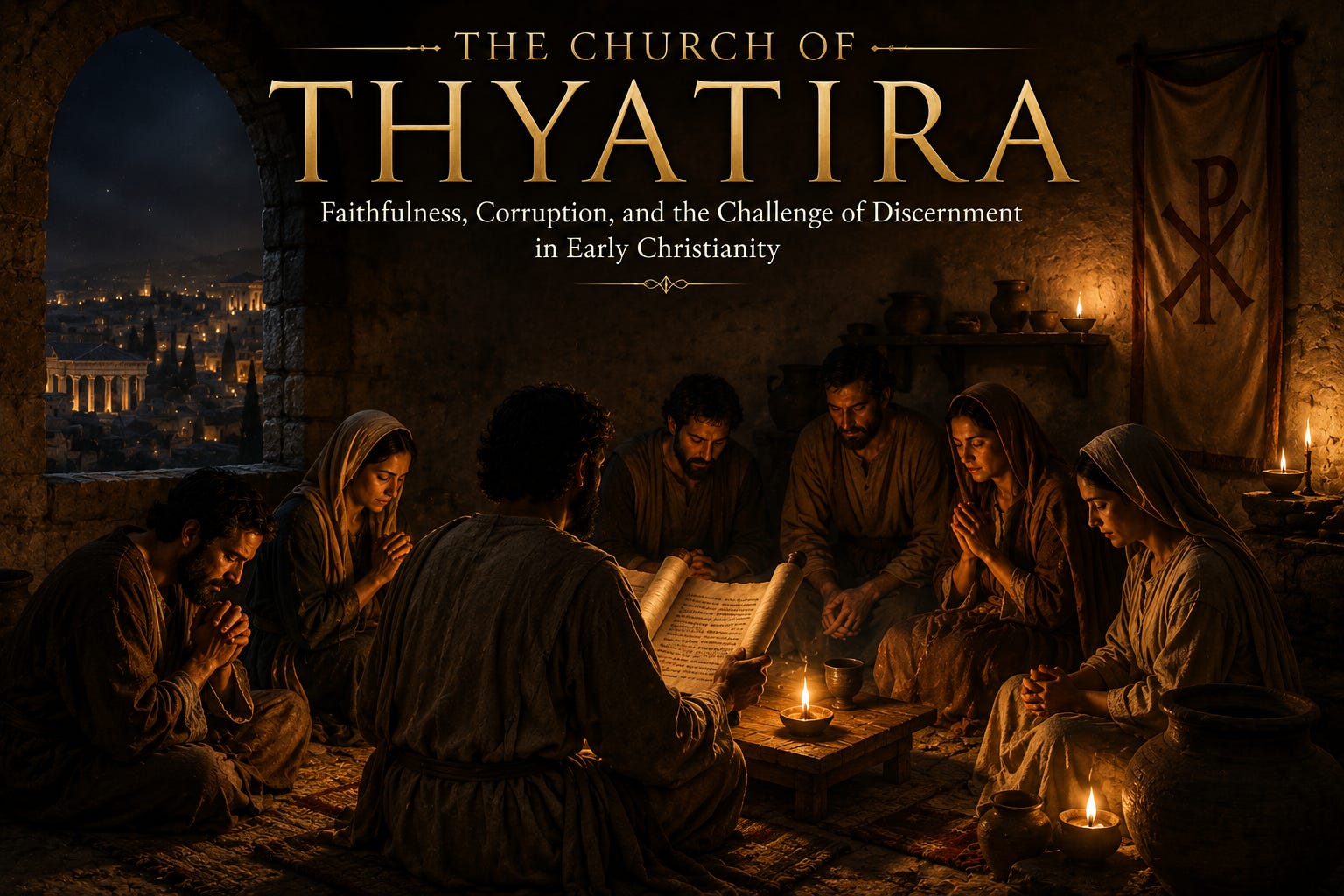
The faithful remnant within Thyatira demonstrates that genuine faithfulness remains possible even in difficult circumstances.
Their example continues to encourage believers today as they seek to remain steadfast in a rapidly changing world.
Thyatira and the Modern Church
Thyatira and Modern Consumer Christianity
The message to Thyatira possesses extraordinary relevance for contemporary Christianity. While separated by nearly two thousand years, the spiritual challenges confronting Thyatira remain remarkably familiar.
The modern church exists within a world shaped by consumerism, technology, social media, political polarisation, and cultural change. Churches often face pressure to adapt their message to meet the expectations of society rather than the commands of Christ.
Like Thyatira, many churches today possess admirable qualities:
active ministries,
charitable outreach,
vibrant worship,
strong community engagement,
and numerical growth.
Yet success alone does not guarantee spiritual health.
The church of Thyatira demonstrates that external vitality may coexist with internal compromise.
Modern Christianity frequently encounters the temptation to redefine biblical teachings in order to maintain cultural acceptance. Difficult doctrines may be softened. Moral standards may be adjusted. Spiritual conviction may be replaced by popular opinion.
The challenge facing Thyatira therefore remains the challenge facing the modern church:
How can believers engage culture without compromising truth?
The answer is found not in withdrawal from society nor complete accommodation to it, but in faithful witness grounded in Scripture and guided by the Holy Spirit.
The Danger of Spiritual Comfort
One of the subtle dangers facing modern Christianity is spiritual comfort.
Unlike persecuted believers throughout history, many Christians today enjoy unprecedented freedom and prosperity.
While these blessings should be appreciated, they may also create spiritual complacency.
The church of Thyatira reminds believers that danger does not always come through persecution.
Sometimes danger arrives through comfort.
When Christianity becomes culturally accepted, believers may gradually lose their sense of dependence upon God.
Prayer becomes less urgent.
Repentance becomes less frequent.
Conviction becomes weaker.
The church may continue functioning while spiritual vitality slowly diminishes.
This process often occurs gradually and almost unnoticed.
The lesson of Thyatira is clear:
Spiritual health requires continual vigilance regardless of external circumstances.
Leadership and Accountability
The message to Thyatira also offers important lessons concerning leadership.
The influence of false teaching within the church demonstrates how significant leadership can be in shaping the direction of a congregation.
Christian leaders are entrusted with tremendous responsibility.
Pastors, teachers, elders, ministry leaders, and writers all influence how believers understand Scripture and apply their faith.
Leadership therefore requires:
humility,
integrity,
accountability,
wisdom,
and submission to biblical authority.
History repeatedly demonstrates that spiritual influence without accountability can produce serious consequences.
The church of Thyatira warns leaders against:
pride,
manipulation,
spiritual abuse,
and doctrinal compromise.
At the same time, it encourages faithful leadership rooted in truth and service.
The greatest Christian leaders are not those who attract the largest audiences but those who remain faithful to Christ.
The Challenge of Discernment in the Digital Age
The modern world presents unique challenges that the believers of Thyatira could scarcely have imagined.
Today, millions of people access theological content through:
social media,
podcasts,
livestreams,
YouTube channels,
blogs,
and online ministries.
This unprecedented access creates tremendous opportunities for education and evangelism.
However, it also increases exposure to misinformation, false teaching, and spiritual confusion.
Believers are constantly confronted with competing voices.
Some teachings faithfully reflect biblical truth.
Others distort Scripture for personal gain, ideological purposes, or popularity.
The lesson of Thyatira remains essential:
Not every spiritual voice should be trusted.
Discernment requires careful evaluation of teachings according to Scripture.
Christians must learn to ask:
Does this teaching align with biblical truth?
Does it exalt Christ?
Does it produce godliness?
Does it encourage obedience?
Does it reflect the character of God?
These questions remain vital in an age of information overload.
Love Without Truth and Truth Without Love
Perhaps one of the most important lessons from Thyatira concerns the relationship between love and truth.
The church clearly possessed love.
Yet it failed to confront destructive influences.
This imbalance created serious problems.
At the same time, other churches throughout history have emphasized truth while neglecting love.
Both extremes are dangerous.
Christianity requires both.
Truth without love becomes harsh and legalistic.
Love without truth becomes sentimental and compromising.
The ministry of Jesus perfectly united both qualities.
He demonstrated:
compassion without compromise,
mercy without moral confusion,
and grace without abandoning truth.
The church of Thyatira reminds believers that authentic Christianity must preserve this balance.
Faithfulness in an Uncertain World
Modern believers face a rapidly changing world.
Technological advancements, cultural shifts, political instability, and social transformation create uncertainty.
In such circumstances, many people seek security through:
ideology,
institutions,
wealth,
or personal achievement.
The message to Thyatira points believers toward a different source of stability.
Faithfulness to Christ remains the foundation of Christian life.
Cultures change.
Empires rise and fall.
Ideas gain popularity and disappear.
Yet Christ remains unchanged.
This truth provides hope amid uncertainty.
The faithful remnant of Thyatira endured because their confidence rested not in circumstances but in Christ.
Modern believers are called to demonstrate the same faithfulness.
The Relevance of Thyatira for the Twenty-First Century
Among the Seven Churches, Thyatira may be one of the most applicable to contemporary Christianity.
The church demonstrates:
spiritual growth accompanied by compromise,
love without sufficient discernment,
tolerance without accountability,
and faithfulness challenged by cultural pressures.
These themes continue to characterize many modern churches.
Yet the message is ultimately hopeful.
Christ does not abandon His church.
He confronts error because He desires restoration.
He warns because He loves.
He calls believers to repentance because He desires fellowship.
The church of Thyatira reveals both the seriousness of compromise and the possibility of renewal.
No church is beyond redemption.
No believer is beyond restoration.
God’s grace remains available to those who respond in humility and faith.
Conclusion
The church of Thyatira stands as one of the most challenging and instructive congregations addressed in the Book of Revelation.
Its story reveals a community characterized by:
love,
service,
faith,
perseverance,
and growth.
Yet it also exposes the dangers of:
compromise,
false teaching,
spiritual deception,
and tolerated corruption.
The message of Christ to Thyatira continues to resonate across the centuries because human nature remains unchanged.
Every generation faces the temptation to compromise.
Every church must choose whether it will prioritize cultural acceptance or faithfulness to Christ.
The faithful remnant within Thyatira demonstrates that genuine discipleship remains possible even in difficult circumstances.
Their example continues to inspire believers who seek to follow Christ in a world filled with competing influences.
For modern Christians, the challenge remains clear:
To love deeply without abandoning truth.
To show grace without compromising conviction.
To serve faithfully while exercising discernment.
To remain steadfast regardless of cultural pressure.
And above all, to hold firmly to Christ until He comes.
The message to Thyatira reminds believers that spiritual faithfulness is not measured by popularity, influence, or success. It is measured by obedience to Christ.
As the final church in this series, Thyatira leaves readers with a profound question that continues to confront every generation:
Will the church remain faithful to Christ when compromise appears easier?
The answer to that question will shape not only the future of individual congregations but also the witness of Christianity in the modern world.
“He who has an ear, let him hear what the Spirit says to the churches.”
© 2026 Dr. Daniel J. Grace. All Rights Reserved.
Research • Journalism • Theology