The Church of the Flashing Screen
How digital distraction became a rival liturgy, training our hearts to scroll, compare, and perform while Christ calls us back to prayer, silence, and holy love.

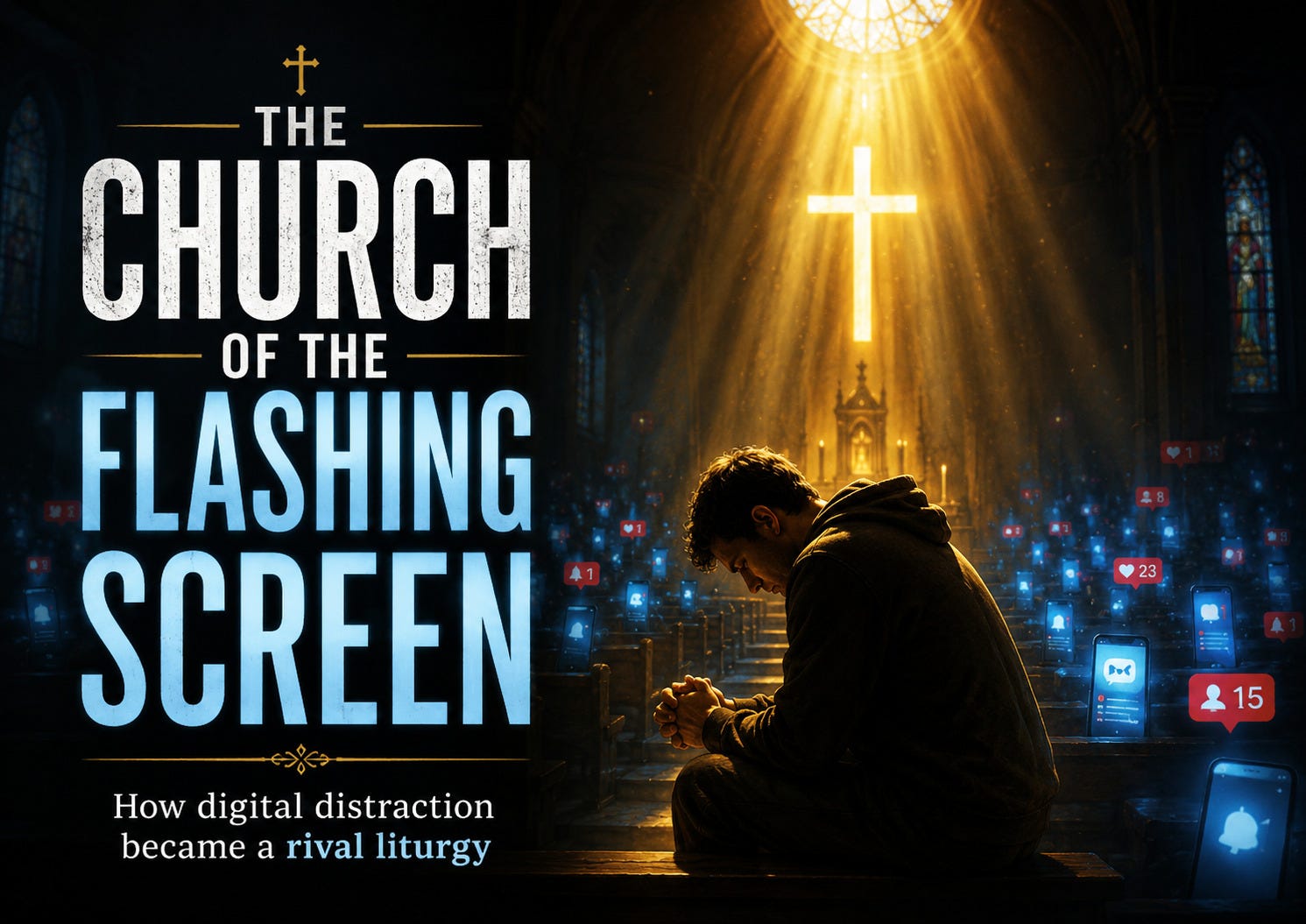
The Church of the Flashing Screen
How digital distraction became a rival liturgy, training our hearts to scroll, compare, and perform while Christ calls us back to prayer, silence, and holy love.
There was a time when people walked into church expecting the room itself to teach them something.
The silence before worship. The opening prayer. The reading of Scripture. The gathering of ordinary people before a holy God. These things reminded us that life was not finally about our speed, our usefulness, our opinions, or our visibility. We came to be re-centred again. We came to listen. We have come remember that we were creatures before we were workers, disciples before we were producers, and beloved before we were useful.
But many of us now carry another kind of church in our pockets.
It has no steeple, no pulpit, no altar, and no hymnbook. Yet it calls to us many times a day. It flashes, vibrates, notifies, seduces, interrupts, rewards, and demands. We enter it before breakfast. We return to it between conversations. We consult it before prayer. We refer to it after worship. We bring it to bed. We wake and reach for it before our feet touch the floor.
This place is the church of the flashing screen.
Of course, a screen is not evil in itself. Technology can serve positive purposes. It can connect families, spread truth, publish sermons, organise help, encourage the lonely, and carry the gospel to places we may never physically enter. The problem is not that Christians use technology. The problem is that technology often uses us without our noticing.
The flashing screen does not merely take our time. It trains our loves.
Every repeated action forms something in us. We scroll, and our hearts learn to expect endless novelty. We compare, and our souls learn dissatisfaction. We refresh, and our minds learn restlessness. We post, and our identity quietly begins to depend on response. We consume outrage, and our spirits become sharp, suspicious, and easily provoked.
This is why digital distraction is not just a productivity issue. It is a spiritual formation issue.
The question is not only, “How much time do I spend online?” The more profound question is, “What kind of person is this rhythm making me?”
Christian faith has always known that our habits shape our hearts. What we repeat, we become ready to love. What we attend to, we begin to desire. What we desire, we eventually organise our lives around. This is why worship matters. This is why worship is significant. This is why Scripture, silence, fellowship, confession, Sabbath, and mercy matter. They are not religious decorations added to an otherwise normal life. They are the gracious rhythms through which God reorders our attention and our love.
The screen also has rhythms. It has its own call and response.
It calls. We look.
It offers. We click.
It flatters. We return.
It wounds. We keep watching.
It empties us. We refresh again.
This experience is not neutral. A person who begins the day with the flashing screen is being taught before they have spoken to God. Before Scripture tells them who they are, the screen has already told them what they lack. Before prayer anchors them in grace, the screen has already pulled them into comparison. Before worship gathers their scattered hearts, the screen has already divided them into fragments.
No wonder so many Christians feel weary.
We are not only tired because we are busy. We are tired because a restless world disciplines our attention. We are weary because our hearts are constantly summoned by things that cannot provide life. We are tired because the soul was made for God, yet we continue to feed it with noise.
This struggle is not a new battle. The tools are new, but the spiritual danger is ancient. The human heart has always been drawn to rival altars. The names change. The shape changes. The speed changes. But the struggle remains the same: who or what will teach us how to love?
Jesus understood the danger of a divided heart. He warned that no one can serve two masters. He taught his disciples to seek first the kingdom of God. He withdrew to lonely places to pray. He welcomed the weary. He refused to let the pressure of crowds define his communion with the Father.
This is one of the most striking things about Jesus: his life was full, but not frantic.
He was always careful, diligent, and compassionate. Yet he was not driven by panic. He did not confuse urgency with anxiety. He did not turn ministry into performance. He did not measure faithfulness by visibility. He did not surrender his soul to the demands of the world.
The church must learn these lessons again.
Too often, we have copied the world’s speed and called it a mission. We have adopted the metrics of the marketplace and called it fruitfulness. We have confused constant activity with spiritual life. We have trained pastors, leaders, volunteers, and ordinary believers to live as if exhaustion were proof of devotion.
But the gospel does not begin with our productivity. It begins with the grace of God.
Christ does not say, “Come to me, all who are efficient and impressive.” He says, “Come to Me, all you who labour and are heavy laden, and I will give you rest.” That invitation is not sentimental. It is revolutionary. Jesus is calling weary people out from under false masters. He is exposing the burdens that pretend to provide life while slowly crushing the soul.
The flashing screen tells us to stay available.
Christ tells us to abide.
The flashing screen tells us to prove ourselves.
Christ tells us we are loved.
The flashing screen tells us to keep watching.
Christ tells us to come and rest.
The flashing screen tells us everything is time-sensitive.
Christ teaches us what is eternal.
This does not mean we should throw every device into the sea and ignore the modern world. The Christian life is not fear-driven withdrawal. But neither is it passive surrender. We must become more honest about the ways our digital habits are forming us.
Perhaps the first act of resistance is simply to notice.
Notice what happens to your heart after an hour of scrolling. Notice how comparison steals gratitude. Notice how outrage makes prayer difficult. Notice how constant information can make wisdom feel distant. Notice how often the screen promises connection but leaves you feeling unseen. Notice how hard silence has become.
Then begin again, not with shame, but with grace.
Put the phone down long enough to pray one honest sentence. Read a Psalm slowly. Let worship be worship, not just content. Sit with another person without checking anything. Leave some moments unrecorded. Practise the Sabbath not as a luxury, but as an act of obedience. Let your soul remember that it was not created to be endlessly stimulated. It was created to love God.
The church also needs to recover slower forms of discipleship. We need worship that teaches attention. We need preaching that forms patience, not just reaction. We need communities where people are known beyond their usefulness. We need leaders who model limits. We need to stop treating every space as something to fill and every quiet moment as something to escape.
A distracted age does not need a church that merely becomes louder online. It needs a church that knows how to be present.
Present to God.
Present to Scripture.
Present it to your neighbour.
Present to grief.
Present to mercy.
Present to the small, hidden places where holiness grows.
The church of the flashing screen will keep calling us. It will keep promising life through visibility, urgency, and endless connection. But Christ calls with a different voice. He does not flash. He does not manipulate. He does not exploit our attention. He restores it.
And perhaps this moment is where renewal begins: not with a dramatic rejection of the modern world, but with a quiet return to holy love.
A Christian puts down the phone and opens the Scriptures.
A family eats without devices.
A church protects silence in worship.
A pastor refuses to confuse exhaustion with faithfulness.
A believer prays badly but honestly.
A soul remembers that it belongs to Christ.
These small acts may not look powerful. But the kingdom of God often begins in hidden places.
The screen trains us to return because we are restless.
Christ teaches us to return because we are loved.

© 2026 Daniel J. Grace. All rights reserved.
Written by Daniel J. Grace
Faith • Civilization • Theology
Independent Researcher and Author/MEAA MemberOfficial Website: https://www.danieljamesgrace.com
Amazon Book: https://www.amazon.com/dp/B0H4DG8C98