

The Apostle Paul and Asia Minor: Mission, Ministry, and the Spread of Early Christianity
How the Apostle Paul Helped Shape the Christian Communities of Asia Minor

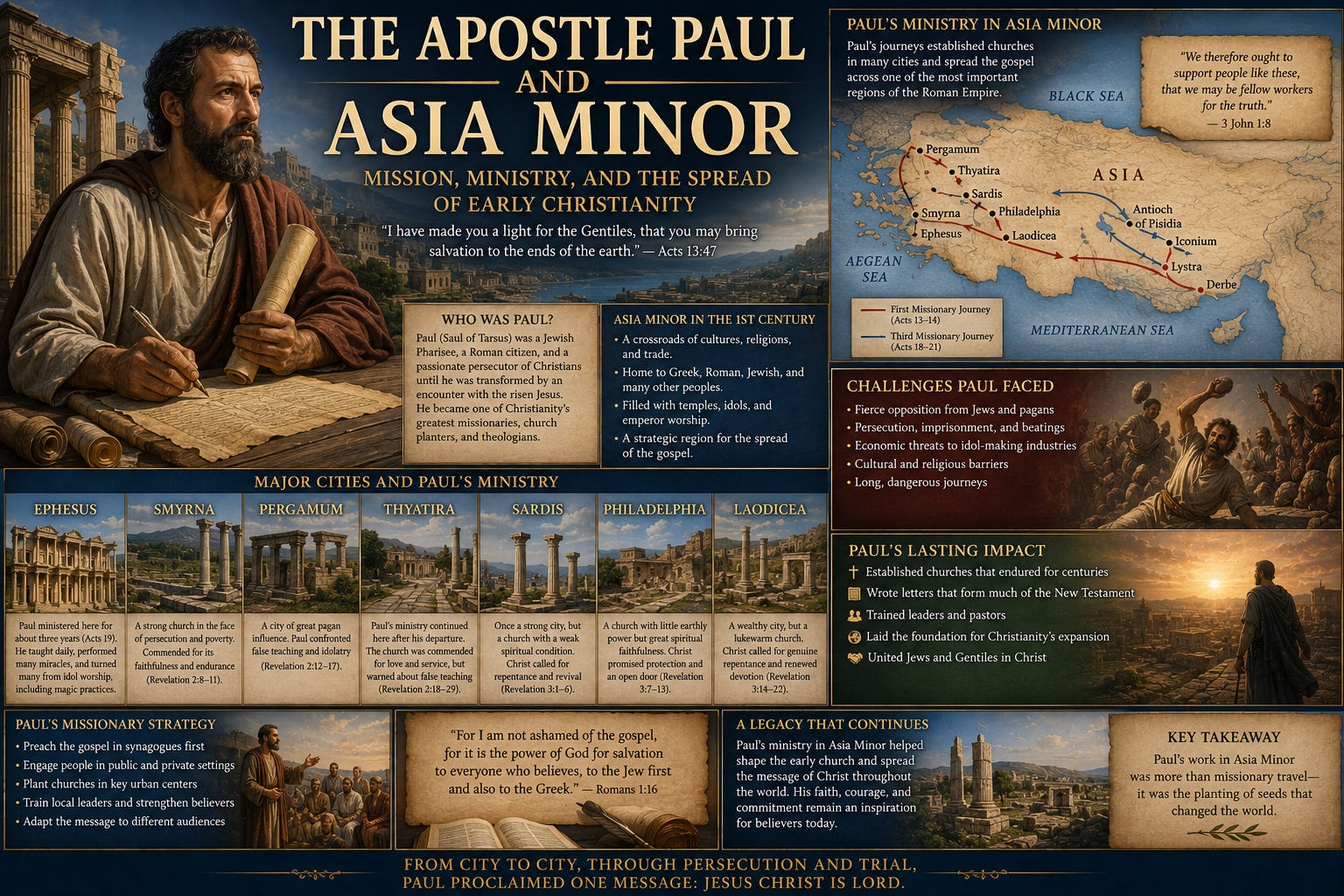
The Apostle Paul played a central role in the expansion of Christianity throughout Asia Minor during the first century AD. Through a series of missionary journeys, he established churches, strengthened believers, confronted paganism, and proclaimed the gospel across one of the most culturally diverse regions of the Roman Empire. Asia Minor, corresponding largely to modern-day Türkiye, became one of the most important centers of early Christianity. Cities such as Ephesus, Smyrna, Pergamum, Antioch of Pisidia, Iconium, Lystra, Derbe, and Laodicea became influential Christian communities whose impact extended far beyond their local regions. This article examines Paul’s ministry throughout Asia Minor, his missionary strategies, the challenges he faced, and the lasting legacy of his work in shaping the Christian faith.
Introduction
Few individuals have influenced the history of Christianity as profoundly as the Apostle Paul. Originally known as Saul of Tarsus, Paul emerged from a background deeply rooted in Jewish tradition and Roman citizenship. Following his dramatic conversion on the road to Damascus, he became one of Christianity’s most effective missionaries, theologians, and church founders.
While Paul’s ministry extended throughout the eastern Mediterranean, Asia Minor occupied a particularly significant place in his missionary efforts. The region served as a bridge between East and West, connecting the cultures of Greece, Rome, Anatolia, and the Near East. Its major cities were centers of commerce, learning, religion, and political influence, making them ideal locations for the spread of the gospel.
The churches established by Paul in Asia Minor would later become some of the most important Christian communities of the apostolic era and beyond.
Asia Minor in the First Century
During Paul’s lifetime, Asia Minor was one of the most prosperous regions of the Roman Empire. Roman roads connected major cities, facilitating trade, travel, and communication. The population was diverse, including Greeks, Romans, Jews, Phrygians, Galatians, Lycaonians, and numerous other ethnic groups.
Religion permeated daily life. Temples dedicated to Greek and Roman gods dominated city landscapes. Emperor worship flourished throughout the region, particularly in major urban centers. Mystery religions, local cults, magical practices, and traditional pagan beliefs coexisted within a complex spiritual environment.
Against this backdrop, Christianity emerged as a radically different message proclaiming salvation through Jesus Christ rather than through idols, emperors, or traditional religious systems.
Paul’s First Missionary Journey
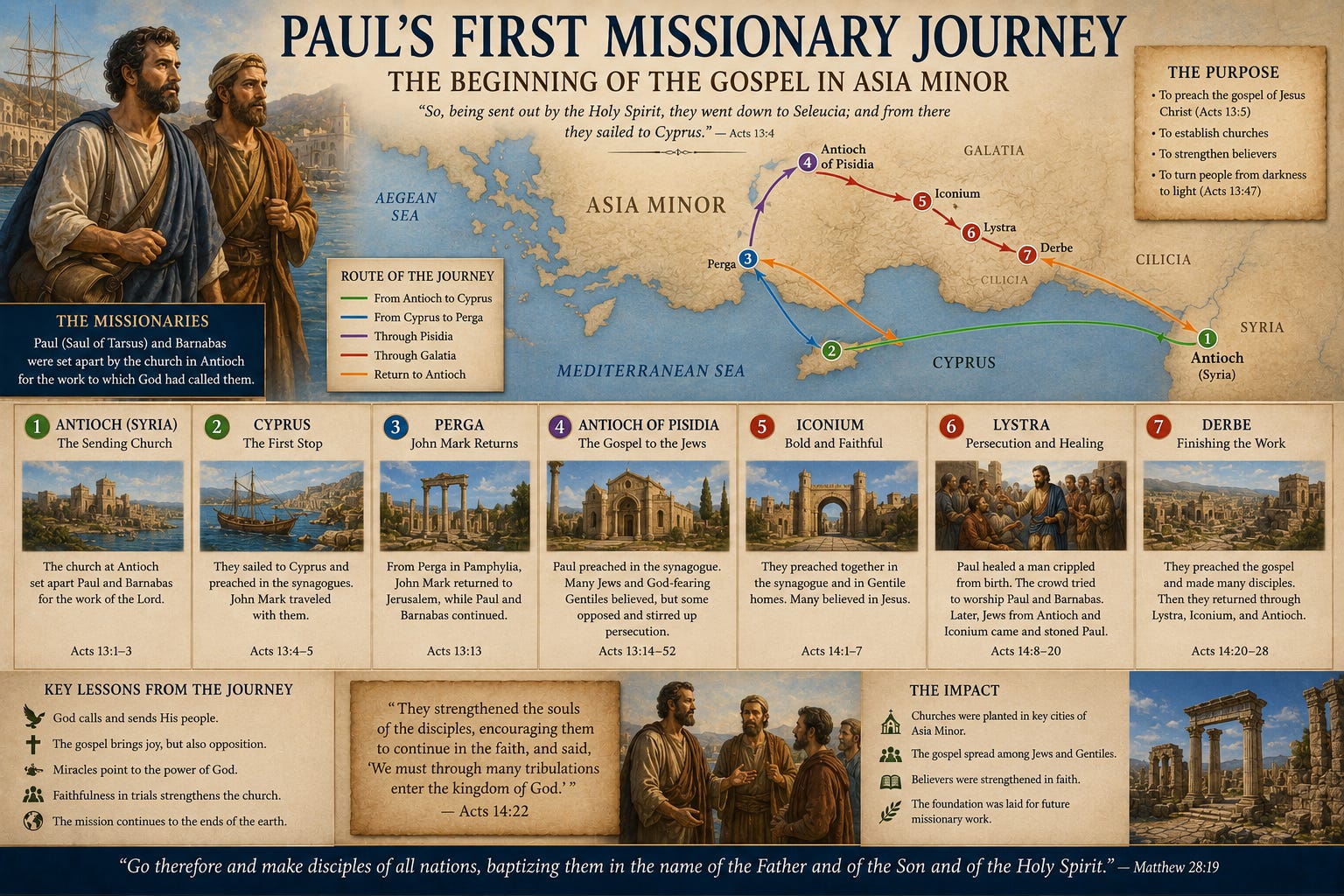
Paul’s first missionary journey, undertaken with Barnabas, introduced Christianity to several important cities of Asia Minor.
They travelled through Cyprus before arriving in southern Asia Minor, where they preached in cities such as Antioch of Pisidia, Iconium, Lystra, and Derbe. Their ministry often began in local synagogues, where they proclaimed Jesus as the promised Messiah.
Responses varied dramatically. Some embraced the gospel, while others opposed it fiercely. In Lystra, Paul was even stoned and left for dead by a hostile crowd. Yet despite persecution, new Christian communities were established throughout the region.
This journey demonstrated both the opportunities and challenges facing the early church.
Ephesus: Paul’s Most Influential Ministry
Among all the cities of Asia Minor, Ephesus became the center of Paul’s most significant ministry.
Located near the Aegean coast, Ephesus was one of the largest cities of the Roman Empire. Its strategic harbour, commercial importance, and religious prominence made it an ideal base for missionary activity.
Paul spent approximately three years in Ephesus, longer than in most other locations. During this period, he taught daily, discipled believers, and established a strong Christian community.
The Book of Acts records extraordinary events associated with his ministry, including healings, conversions, and the public destruction of magical scrolls. These events demonstrated the growing influence of Christianity within a city famous for its devotion to Artemis and occult practices.
From Ephesus, the gospel spread throughout the Roman province of Asia, reaching neighbouring cities and communities.
Challenges and Opposition
Paul’s ministry was not without difficulties. Throughout Asia Minor, he encountered opposition from various groups.
Jewish leaders sometimes resisted his message, viewing Christianity as a threat to established religious traditions. Pagan priests and craftsmen feared the decline of traditional worship. Roman authorities occasionally regarded Christian activities with suspicion.
One of the most dramatic examples occurred in Ephesus, where silversmiths who manufactured shrines of Artemis organised a public protest against Paul’s ministry. The resulting riot highlighted the economic and religious impact Christianity was beginning to have on society.
Despite these challenges, Paul remained committed to preaching the gospel and strengthening local churches.
Letters to the Churches
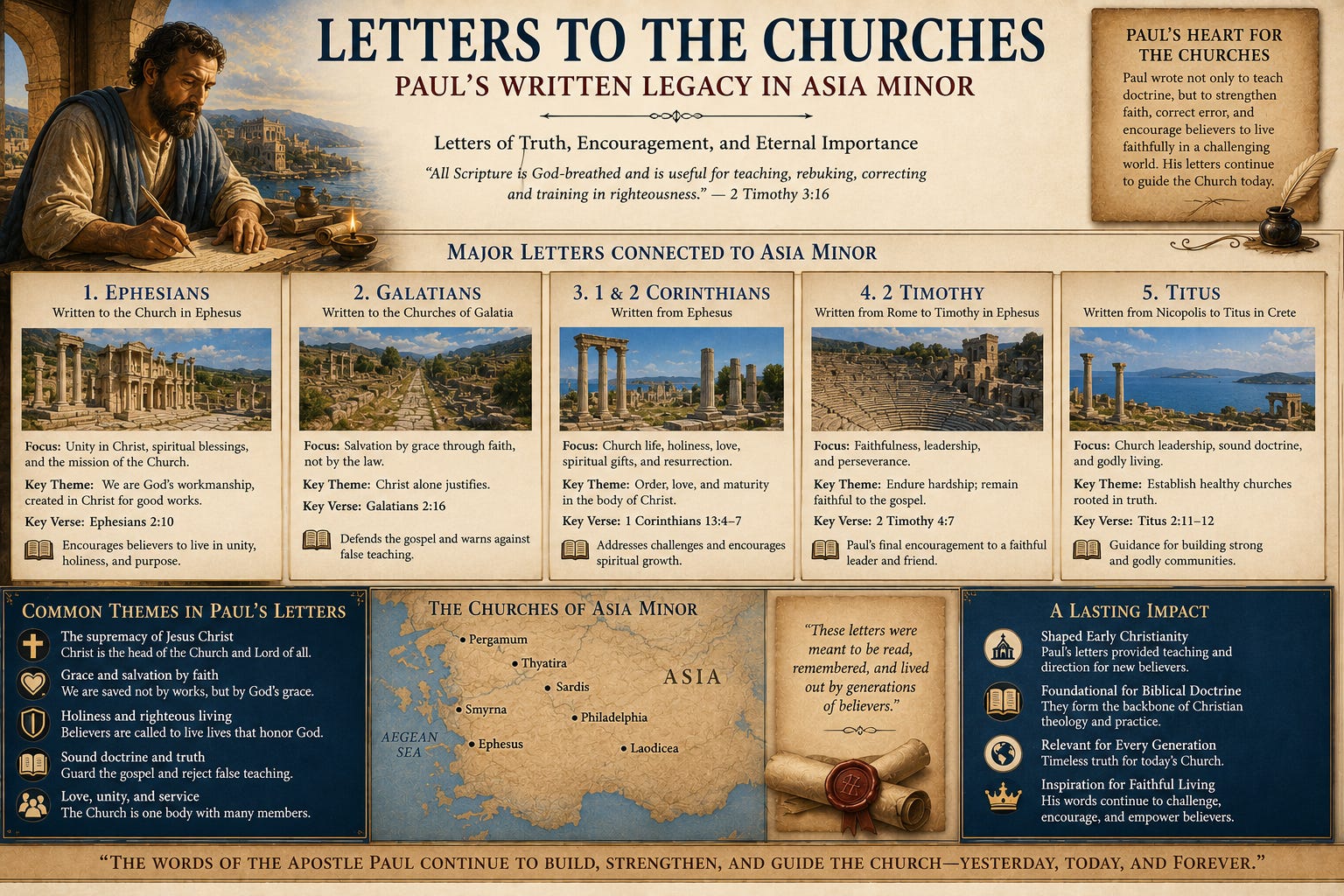
Paul’s influence extended beyond his physical travels through his letters. Several New Testament epistles were written either to churches located in Asia Minor or to individuals serving there.
The Epistle to the Ephesians emphasised the unity of believers in Christ. The Letter to the Galatians addressed churches established during Paul’s early journeys. Other letters influenced Christian communities throughout the region.
These writings provided theological instruction, practical guidance, pastoral encouragement, and correction when necessary. They continue to shape Christian thought nearly two thousand years later.
The Seven Churches and Paul’s Legacy
Although the Seven Churches of Revelation were addressed several decades after Paul’s ministry, his influence can still be seen throughout the region.
Ephesus, Smyrna, Pergamum, Thyatira, Sardis, Philadelphia, and Laodicea existed within a network of Christian communities that had been strengthened by apostolic teaching and missionary activity.
The foundations laid by Paul helped prepare Asia Minor to become one of the most important centers of Christianity during the first centuries of the church.
Many of these cities later produced bishops, theologians, martyrs, and church leaders who contributed significantly to Christian history.
Paul’s Missionary Strategy
One reason for Paul’s effectiveness was his strategic approach to ministry. Rather than focusing exclusively on rural areas, he concentrated on influential urban centers. By establishing churches in major cities, the gospel could naturally spread along existing trade routes and communication networks.
Paul also adapted his presentation of the gospel to different audiences. He could speak with Jewish scholars in synagogues, Greek philosophers in public forums, Roman officials in government settings, and ordinary citizens in marketplaces.
His ability to communicate across cultural boundaries helped Christianity expand rapidly throughout the Roman world.
The Apostle Paul’s ministry in Asia Minor represents one of the most significant chapters in the history of early Christianity. Through perseverance, courage, and strategic vision, he established churches that would influence generations of believers.
The cities he visited became centers of Christian teaching, worship, and mission. His letters continue to shape theology and discipleship across the world. The challenges he faced—from persecution and opposition to cultural and religious resistance—remain relevant to modern Christians seeking to live faithfully in complex societies.
The story of Paul in Asia Minor is ultimately a story of transformation. Through his ministry, the message of Christ spread across one of the most influential regions of the ancient world, leaving a legacy that continues to impact the global church today.
Dr. Daniel J. Grace
Research • Journalism • Theology
© 2026 Dr. Daniel J. Grace. All Rights Reserved.