
The Angelology of 1 Enoch
Cosmic Order, Rebellion, and Divine Judgement in Ethiopian Christianity

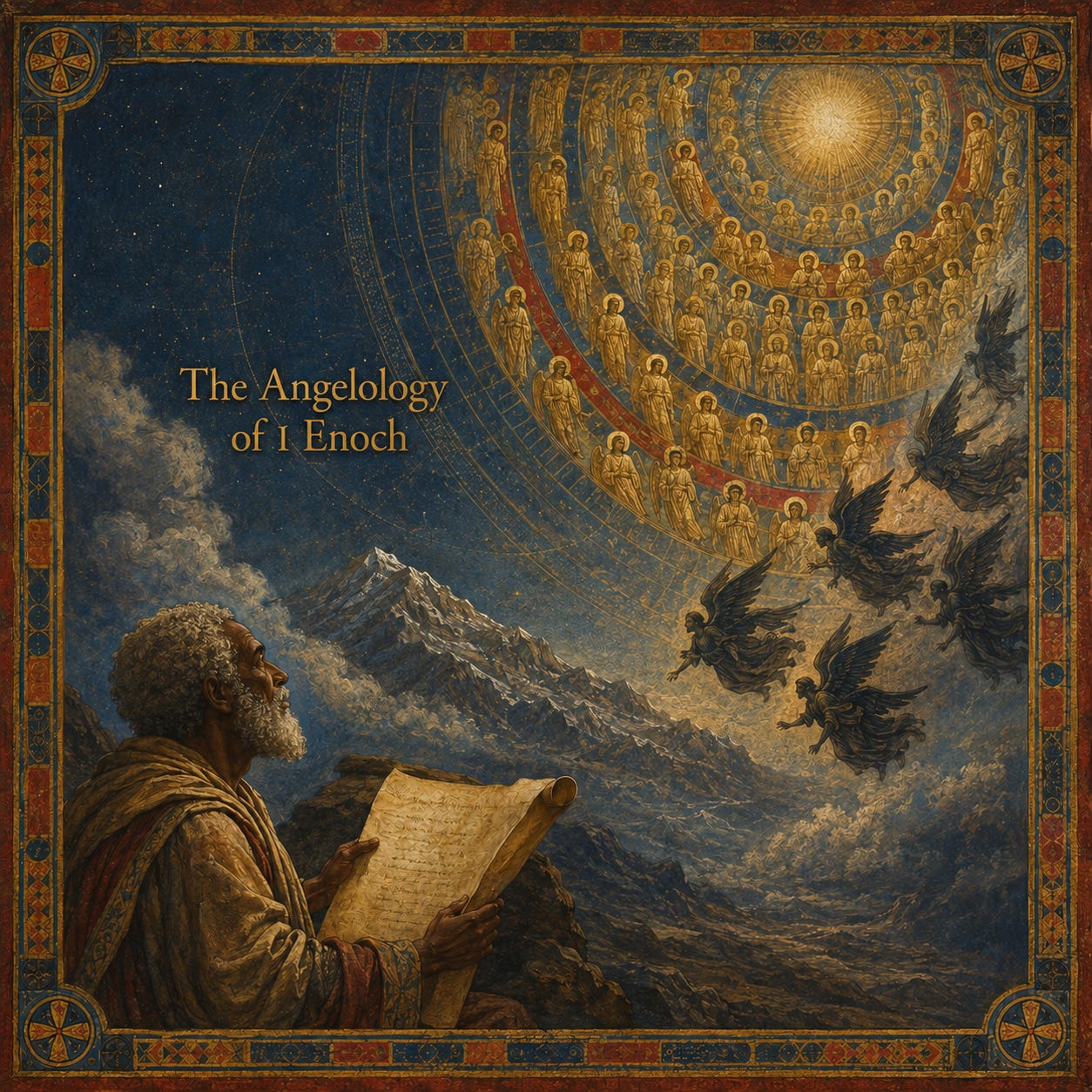
When people hear the word angel, they often imagine a gentle heavenly messenger, a guardian, or a comforting presence. 1 Enoch gives us a far more demanding picture. Its angels belong to a disciplined cosmic order. They possess authority and knowledge, but both remain under God’s rule. Some serve faithfully. Others abandon their calling, misuse what they know, and turn delegated power into a source of violence.
That conflict lies at the heart of the Book of the Watchers, the opening major section of 1 Enoch. It isn’t simply an ancient tale about fallen angels. It’s a theological account of what happens when power is separated from obedience, knowledge from wisdom, and freedom from responsibility.
It’s also a story of hope. The rebellion damages creation, but it never removes creation from God’s sovereignty. Evil is real, destructive, and persistent, yet it doesn’t receive the final word.
A Heaven Governed by Order
The heavenly world of 1 Enoch isn’t a vague spiritual realm populated by independent supernatural beings. It’s an ordered creation governed by God. Angels have different responsibilities, and their authority is always delegated.
This becomes especially clear in 1 Enoch 9–10. Michael, Sariel, Raphael, and Gabriel see the devastation caused by the Watchers and bring the earth’s suffering before God. They don’t act as rival gods or independent rescuers. They intercede, receive divine commands, and then carry them out.
Raphael is instructed to bind Asael. Gabriel is sent against the giants. Michael receives authority to deal with Shemihazah and his companions. Noah is warned so that human life may continue beyond the coming judgement.
The pattern matters. Faithful angels observe, intercede, receive instruction, and obey. Their greatness is not found in independence from God but in their proper participation in God’s governance of creation.
The same principle appears elsewhere in 1 Enoch. Angels guide Enoch through heavenly regions, explain what he sees, and disclose realities beyond normal human perception. Yet the guiding angel is never the ultimate source of revelation. God remains the source, while the angel serves as an authorised messenger and interpreter.
Even the movements of the sun, moon, stars, winds, seasons, and heavenly portals reflect this ordered vision. Creation moves through appointed courses and measured times. The cosmos is intelligible because it isn’t abandoned to chaos.
This background is essential. The Watchers’ sin is serious precisely because they rebel against an order that was good.
The Rebellion of the Watchers
The story begins with Genesis 6:1–4, where the “sons of God” take human women and produce the Nephilim. Genesis gives only a brief and difficult account. 1 Enoch expands it into a much larger explanation of cosmic and human corruption.
Two hundred Watchers look upon the daughters of humanity and decide to take wives from among them. Their leader, Shemihazah, fears that the others may abandon the plan and leave him to bear the punishment alone. They therefore bind themselves together by an oath on Mount Hermon.
This isn’t an accidental fall. It’s deliberate, organised rebellion.
Their transgression has several dimensions.
First, the Watchers abandon their appointed heavenly dwelling. Their descent is more than movement from one place to another. It’s a rejection of vocation. They refuse the kind of existence for which they were created and assume a form of life that wasn’t given to them.
Second, they take human wives and produce hybrid offspring. The text isn’t condemning human marriage or embodiment. The problem is that heavenly beings appropriate a human mode of life contrary to their own created identity. They cross a boundary established within creation and do so for their own desire.
Third, they reveal dangerous forms of knowledge. Asael teaches the manufacture of weapons, metalworking, and ornamentation. Other Watchers teach sorcery, incantations, divination, and interpretations associated with the heavenly bodies.
The text doesn’t condemn knowledge itself. Enoch receives profound knowledge, and faithful angels communicate heavenly mysteries. The decisive question is whether knowledge is rightly authorised, morally ordered, and directed toward the good of creation.
The Watchers reveal knowledge without wisdom. Weapons increase humanity’s capacity for bloodshed. Magical practices seek control over powers that remain under God’s authority. Knowledge of the heavens is redirected from reverence toward manipulation. Technical capacity grows faster than moral responsibility.
That concern feels remarkably contemporary. A society may possess extraordinary knowledge while lacking the wisdom to govern it. Technology can heal, connect, and protect, but it can also exploit, dominate, and destroy. 1 Enoch warns that knowledge becomes dangerous when those who possess it consider themselves answerable to no higher moral order.
The Giants and the Spread of Violence
The Watchers’ offspring translate heavenly rebellion into earthly catastrophe. The giants consume the produce of human labour. When ordinary resources no longer satisfy them, they attack human beings, animals, and eventually one another. The earth becomes filled with bloodshed.
The giants embody what corrupted power does when it enters history. A decision made among heavenly beings becomes visible as hunger, oppression, exploitation, and violence. Cosmic disorder acquires social consequences.
Yet the giants’ deaths don’t end the crisis. In 1 Enoch 15–16, the spirits proceeding from their dead bodies remain on the earth as evil spirits. They afflict and deceive humanity until the final judgement.
This creates an important distinction. The Watchers are rebellious heavenly beings who are bound for judgement. The evil spirits are the continuing spiritual aftermath of their dead offspring. Later Christian traditions sometimes bring fallen angels and demons together, but the Book of the Watchers preserves a more layered account.
Evil has a history. It begins through acts of rebellion, takes material and social form, and produces consequences that outlive the original offenders. The flood destroys the giants’ bodies, but it doesn’t immediately remove every effect of their violence.
Even so, 1 Enoch never presents evil as an eternal power equal to God. The Watchers can wound creation, and evil spirits can continue their destructive activity, but neither can overthrow divine sovereignty. Their power is limited, judged, and ultimately temporary.
Enoch Between Heaven and Earth
Genesis says that Enoch “walked with God” and that God took him. 1 Enoch develops this brief description into a remarkable portrait of a righteous scribe, visionary traveller, mediator, and witness to divine judgement.
The contrast between Enoch and the Watchers is deliberate.
The Watchers descend from heaven by their own initiative. Enoch enters heavenly regions by divine permission. They cross boundaries to satisfy desire and seize an unauthorised life. Enoch crosses boundaries because he is summoned and shown what God chooses to reveal.
The Watchers distribute knowledge that corrupts. Enoch receives revelation so that he may bear truthful witness.
After their condemnation, the Watchers ask Enoch to prepare a petition for them. The irony is striking. Heavenly beings who once claimed superior power now depend upon a righteous human scribe to present their appeal. Enoch delivers the petition, but he doesn’t control the verdict.
Their request is rejected. They were entrusted with heavenly responsibility and used their position to corrupt the earth. Their knowledge increased their accountability rather than reducing it.
Enoch therefore models faithful mediation. He doesn’t invent revelation, manipulate it, or use it for self-exaltation. He receives, records, and communicates what has been authorised. The difference between Enoch and the Watchers isn’t that one possesses knowledge while the others do not. It’s the difference between revelation received in obedience and knowledge seized or transmitted in rebellion.
Judgement as the Restoration of Creation
Divine judgement in 1 Enoch is severe. Asael is bound. The Watchers are confined. The giants are destroyed. Evil spirits are limited, and final judgement awaits every hostile power.
But judgement isn’t presented as punishment for its own sake. It answers the cry of a wounded creation.
The earth has been filled with blood. Human beings have suffered under violence. Boundaries protecting the integrity of creation have been violated. God’s judgement identifies the guilty, restrains destructive powers, preserves Noah, vindicates the oppressed, and prepares the world for renewal.
Judgement is therefore both judicial and restorative. It declares that violence is truly evil, but it also prevents evil from defining the future.
This is one reason the angelology of 1 Enoch matters theologically. The book doesn’t offer a simple conflict between two equal cosmic forces. God and the rebels aren’t balanced opponents. The rebellious powers remain creatures. They can misuse their gifts, but they cannot make themselves sovereign.
The final horizon is not endless conflict. It’s the restoration of divine order.
Why Ethiopia Matters
1 Enoch originated in ancient Jewish apocalyptic traditions, not in an originally Ethiopian Christian setting. Aramaic fragments discovered among the Dead Sea Scrolls confirm that substantial Enochic material circulated centuries before the Christianisation of the Aksumite kingdom.
Yet the complete survival of the book is inseparable from Ethiopian Christianity.
Parts of 1 Enoch survived in Aramaic and Greek, but the only complete textual tradition was preserved in Geʿez, the classical literary and liturgical language of Ethiopian Christianity. Without Ethiopian scribes and manuscripts, modern scholars wouldn’t possess the full work that they now study.
The Ethiopian Orthodox Tewahedo Church also receives 1 Enoch as Scripture. This differs from Roman Catholic, Eastern Orthodox, and Protestant traditions, which generally place it outside their Old Testament canons.
That difference should be described carefully. It’s misleading to say simply that 1 Enoch is “non-canonical,” as though every Christian tradition shares an identical canon. Its canonical status is tradition-specific. At the same time, Ethiopian reception shouldn’t be turned into sensational claims about a “hidden Bible” suppressed by the rest of Christianity. The actual history is more interesting than that.
The book developed within ancient Jewish textual traditions. Different Jewish and Christian communities formed different canonical boundaries over time. Ethiopian Christianity preserved 1 Enoch as a living scriptural witness, while most other Christian traditions did not.
This Ethiopian reception challenges Western scholarship to see the book as more than background material for Genesis, Jude, or the New Testament. It has also lived within an ecclesial world of prayer, commentary, manuscript transmission, spiritual vigilance, and theological reflection.
Ethiopia didn’t create the earliest Enochic traditions, but Ethiopian Christianity became the principal guardian of their complete textual form. That contribution deserves more than a passing footnote.
Power, Knowledge, and Responsibility
The enduring theological strength of 1 Enoch lies in its account of power under authority.
Angels aren’t righteous simply because they are angels. Their goodness is expressed through faithful participation in God’s will. The Watchers become corrupt when they detach power, desire, movement, and knowledge from the purposes for which they were given.
Human beings aren’t portrayed as entirely passive. The Watchers introduce corrupting knowledge, but humanity receives, practises, and normalises it. Supernatural rebellion and human responsibility interact. The spiritual dimension of evil never becomes an excuse for human wrongdoing.
This layered account avoids two extremes. It doesn’t reduce every evil to individual human choices, ignoring the larger powers and inherited structures that shape society. Nor does it blame supernatural forces in a way that removes human accountability.
Evil can be personal, spiritual, social, technological, and structural at the same time.
That is why restoration must involve more than punishing isolated offenders. Destructive powers must be restrained. Corrupted knowledge must be exposed. Victims must be heard. Creation itself must be healed.
The Final Word
The angelology of 1 Enoch isn’t a catalogue of supernatural beings. It’s a theology of delegated authority, corrupted knowledge, moral responsibility, divine justice, and cosmic hope.
The Watchers show what happens when created power rejects its proper limits. Their rebellion damages heaven’s relationship with earth, enlarges humanity’s capacity for violence, and produces consequences that continue beyond the first act of transgression.
Enoch shows another way. He receives revelation rather than seizing it. He crosses cosmic boundaries by invitation rather than rebellion. He bears witness without claiming sovereignty over the message.
Above all, the book insists that evil cannot finally define reality. The earth’s cry reaches heaven. The oppressed are not forgotten. Rebellious powers are judged, and creation is directed toward renewal.
Angelic transgression may wound the world, but it cannot determine the world’s final destiny. The final word belongs to the God who hears, judges, restrains, vindicates, and restores.
Further Reading
John J. Collins, The Apocalyptic Imagination: An Introduction to Jewish Apocalyptic Literature.
George W. E. Nickelsburg, 1 Enoch 1: A Commentary on the Book of 1 Enoch.
George W. E. Nickelsburg and James C. VanderKam, 1 Enoch: The Hermeneia Translation.
Annette Yoshiko Reed, Fallen Angels and the History of Judaism and Christianity.
Loren T. Stuckenbruck, The Myth of Rebellious Angels.
Archie T. Wright, The Origin of Evil Spirits.
Bruk A. Asale, “The Ethiopian Orthodox Tewahedo Church Canon of the Scriptures: Neither Open nor Closed.”
Daniel J. Grace is an independent researcher whose work explores biblical theology, early Christianity, religious history, and the relationship between faith and civilisation.
ORCID: https://orcid.org/0000-0002-9259-8032
DOI: https://doi.org/10.5281/zenodo.2187212