

Roman Religion and Emperor Worship: Faith, Power, and the Challenge Facing Early Christians
Understanding the Religious and Political Environment of the Roman Empire and Its Impact on the Early Church

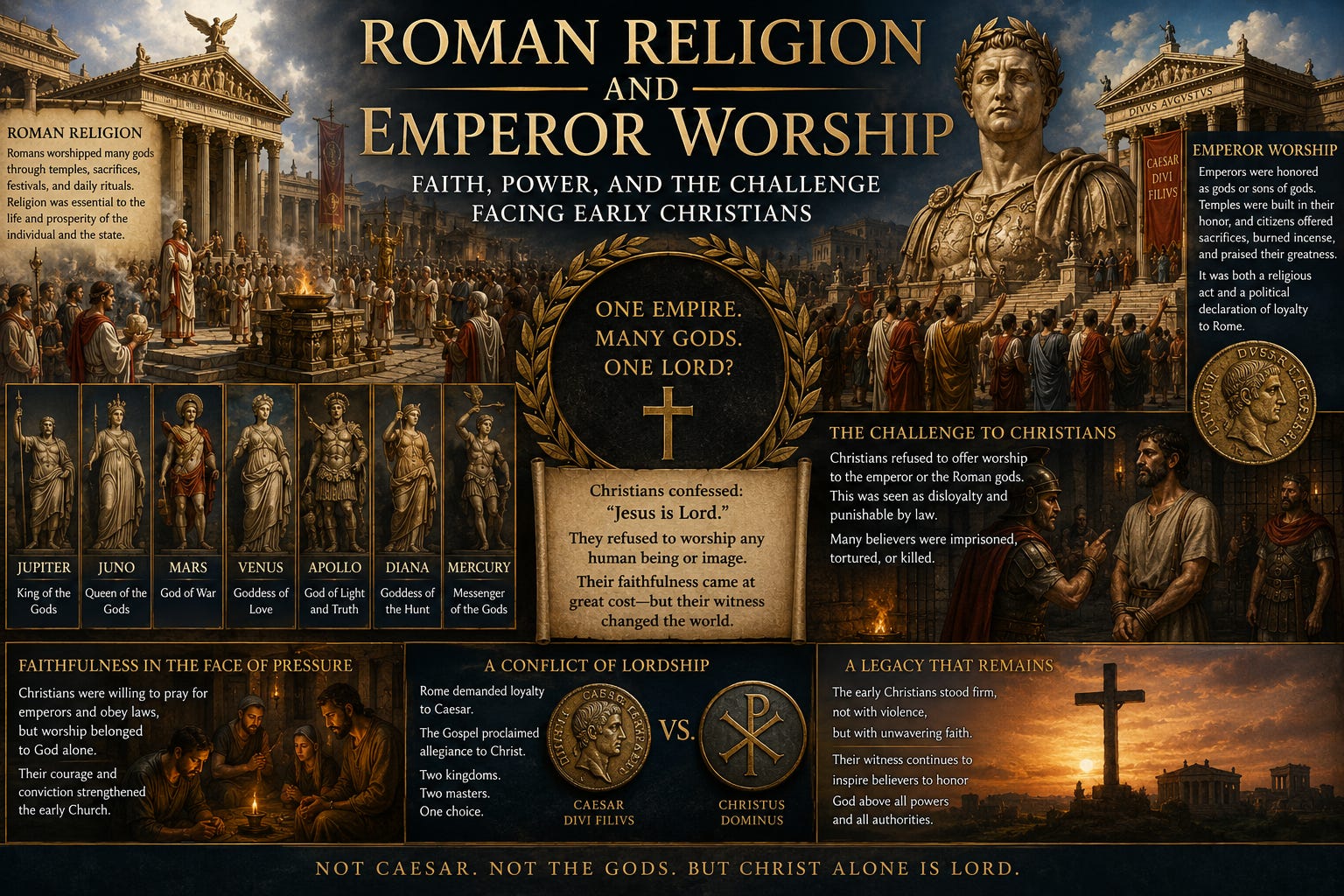
Religion in the Roman Empire was deeply intertwined with politics, social identity, and public life. Unlike modern distinctions between church and state, Roman religion functioned as an essential component of civic loyalty and imperial unity. Traditional worship of the Roman gods existed alongside the growing practice of emperor worship, which elevated emperors to divine or semi-divine status. Participation in religious ceremonies was often viewed as a demonstration of loyalty to Rome itself. For early Christians, however, emperor worship presented a profound challenge. While Christians respected governmental authority, they refused to offer worship to any figure other than Jesus Christ. This refusal frequently placed them in conflict with Roman authorities and broader society. This article examines the foundations of Roman religion, the rise of emperor worship, and the consequences faced by Christians who remained faithful to their convictions.
Introduction
The Roman Empire governed millions of people across Europe, North Africa, and the Middle East. Maintaining unity among such diverse populations required more than military power and political administration. Religion served as one of the primary instruments through which Rome promoted social stability and imperial cohesion.
Roman citizens lived in a world filled with temples, sacrifices, festivals, and religious ceremonies. The gods were believed to influence every aspect of life, including harvests, military victories, health, family prosperity, and political success. Public worship was not simply a private matter of personal faith; it was considered essential to the well-being of society.
As the Empire expanded, Roman authorities generally tolerated local religions provided they did not threaten public order or challenge imperial authority. This atmosphere of religious diversity allowed many traditions to coexist. However, the emergence of Christianity introduced a unique challenge. Christians refused to worship the Roman gods or acknowledge the emperor as divine. Their exclusive devotion to Christ distinguished them from virtually every other religious group within the Empire.
Traditional Roman Religion
Roman religion was polytheistic, meaning that Romans worshipped numerous gods and goddesses. Many of these deities were adapted from Greek mythology, although they were often given Roman names and characteristics.
Among the most important gods were Jupiter, Juno, Mars, Venus, Apollo, Diana, Mercury, and Neptune. Each deity governed specific aspects of life and nature. Citizens offered sacrifices, prayers, and gifts in exchange for divine favor and protection.
Religion was woven into daily life. Before major decisions, military campaigns, political elections, and public ceremonies, priests performed rituals to seek guidance from the gods. Temples dominated city landscapes, while religious festivals brought communities together throughout the year.
For Romans, maintaining the favour of the gods was considered essential for the prosperity of both the individual and the state.
The Rise of Emperor Worship
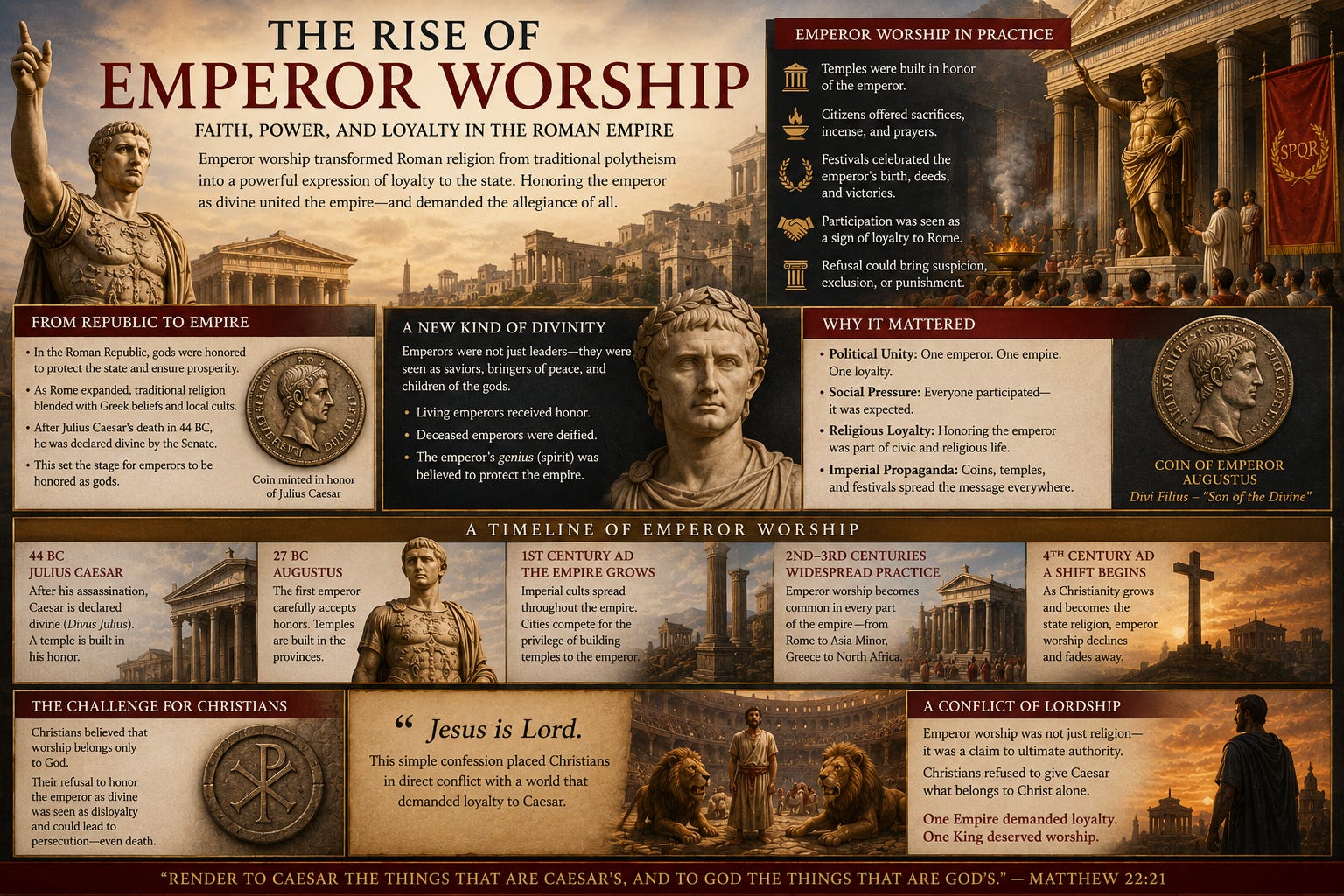
The development of emperor worship represented one of the most significant religious transformations of the Roman world. Following the death of Julius Caesar in 44 BC, he was officially declared divine by the Roman Senate. This act laid the foundation for future emperors to receive divine honours.
Under Augustus, the first Roman emperor, emperor worship became increasingly organised. While Augustus was cautious about accepting worship in Rome during his lifetime, provinces throughout the Empire enthusiastically promoted imperial cults.
Temples dedicated to emperors appeared across the Roman world. Citizens burned incense before imperial images, offered sacrifices, and participated in ceremonies celebrating the emperor’s greatness. These practices were viewed not only as religious acts but also as expressions of political loyalty.
By the first century AD, emperor worship had become particularly prominent in Asia Minor, where cities competed for the privilege of hosting imperial temples.
Emperor Worship in Asia Minor
The cities addressed in the Book of Revelation existed within one of the strongest centers of emperor worship in the Roman Empire. Ephesus, Pergamum, Smyrna, and other cities proudly hosted imperial temples and festivals.
Pergamum in particular became famous for its imperial cult. Revelation’s reference to “Satan’s throne” has often been connected by scholars to the city’s prominent role in emperor worship.
Participation in imperial ceremonies was frequently expected of citizens. Refusal could lead to social exclusion, economic difficulties, public suspicion, and even legal consequences.
For Christians living in these cities, the pressure to compromise was constant.
Why Christians Refused
The central confession of Christianity was simple yet revolutionary:
Jesus is Lord.
This declaration directly conflicted with claims that Caesar possessed divine status. Christians believed that worship belonged exclusively to God and to Jesus Christ.
The First Commandment prohibited worship of any other deity. Consequently, even seemingly minor acts, such as burning incense before an imperial image, represented a violation of the Christian faith.
Christians were willing to pray for emperors, obey laws, and respect governing authorities. However, they refused to offer worship.
This distinction was often misunderstood by Roman officials, who interpreted Christian refusal as political rebellion rather than religious conviction.
Persecution and Faithfulness
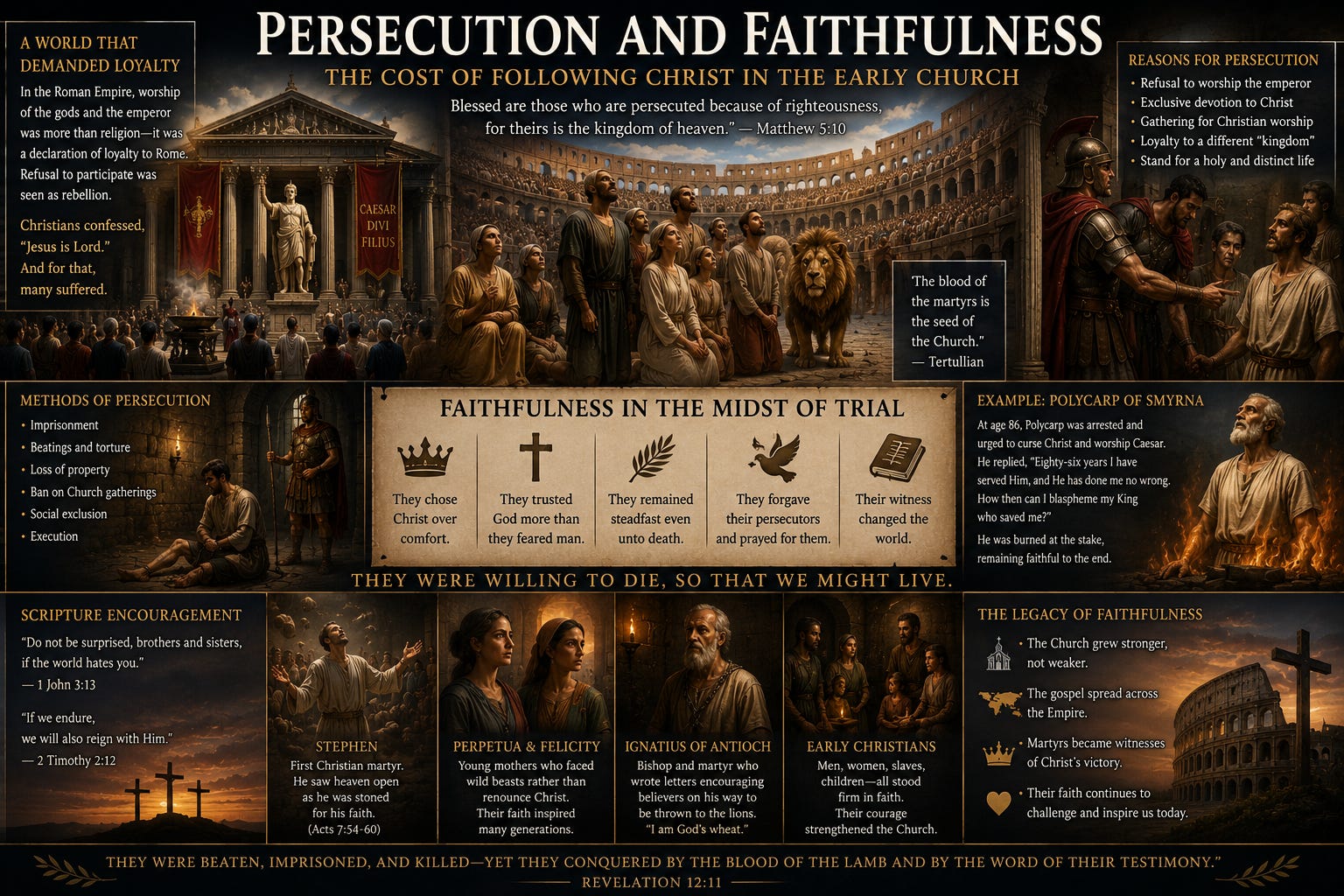
Throughout the first three centuries, Christians periodically faced persecution because of their refusal to participate in emperor worship.
Some believers lost property, employment, and social standing. Others were imprisoned, tortured, or executed.
Martyrs such as Polycarp of Smyrna became symbols of Christian faithfulness. When ordered to deny Christ and honour Caesar, they chose obedience to God despite the consequences.
Their courage strengthened Christian communities and demonstrated that loyalty to Christ surpassed loyalty to earthly rulers.
Theological Significance
The conflict between Christianity and emperor worship was ultimately a struggle over authority and identity.
Who deserved ultimate allegiance?
Who possessed supreme authority?
Who should be worshipped?
Roman religion answered these questions through devotion to the gods and the emperor. Christianity answered them through exclusive devotion to Jesus Christ.
The Book of Revelation repeatedly encourages believers to resist compromise and remain faithful even when confronted by political and social pressure.
Roman religion and emperor worship formed a powerful combination of faith, politics, and social identity. For many citizens, participation in these practices was simply part of everyday life. For Christians, however, emperor worship represented a direct challenge to the exclusive lordship of Christ.
The courage displayed by early believers reminds modern readers that faithfulness often requires standing apart from prevailing cultural expectations. Their refusal to compromise helped preserve the integrity of Christian belief and shaped the future of the Church.
Dr. Daniel J. Grace
Research • Journalism • Theology
© 2026 All rights reserved..