
Philadelphia: Faithfulness in an Age of Uncertainty
A Reflection on Endurance, Hope, and the Human Search for Stability


Among the Seven Churches described within the Book of Revelation, the Church of Philadelphia stands apart through its association with perseverance, endurance, and spiritual faithfulness despite limitation. Unlike Sardis, which struggled with spiritual emptiness beneath appearance, or Pergamum, which faced the pressure of compromise, Philadelphia represents another dimension of human existence entirely — the challenge of remaining faithful while living within uncertainty, weakness, instability, and limited power.
The message directed toward Philadelphia carries a remarkably different tone from several of the other churches. Rather than emphasising severe warning, the narrative recognises endurance itself. The church is not described through political dominance, wealth, military influence, or visible greatness. Instead, it is acknowledged through perseverance despite limitations. This distinction gives Philadelphia profound psychological and philosophical significance, particularly within the modern world, where success is frequently measured through visibility, influence, and external achievement.
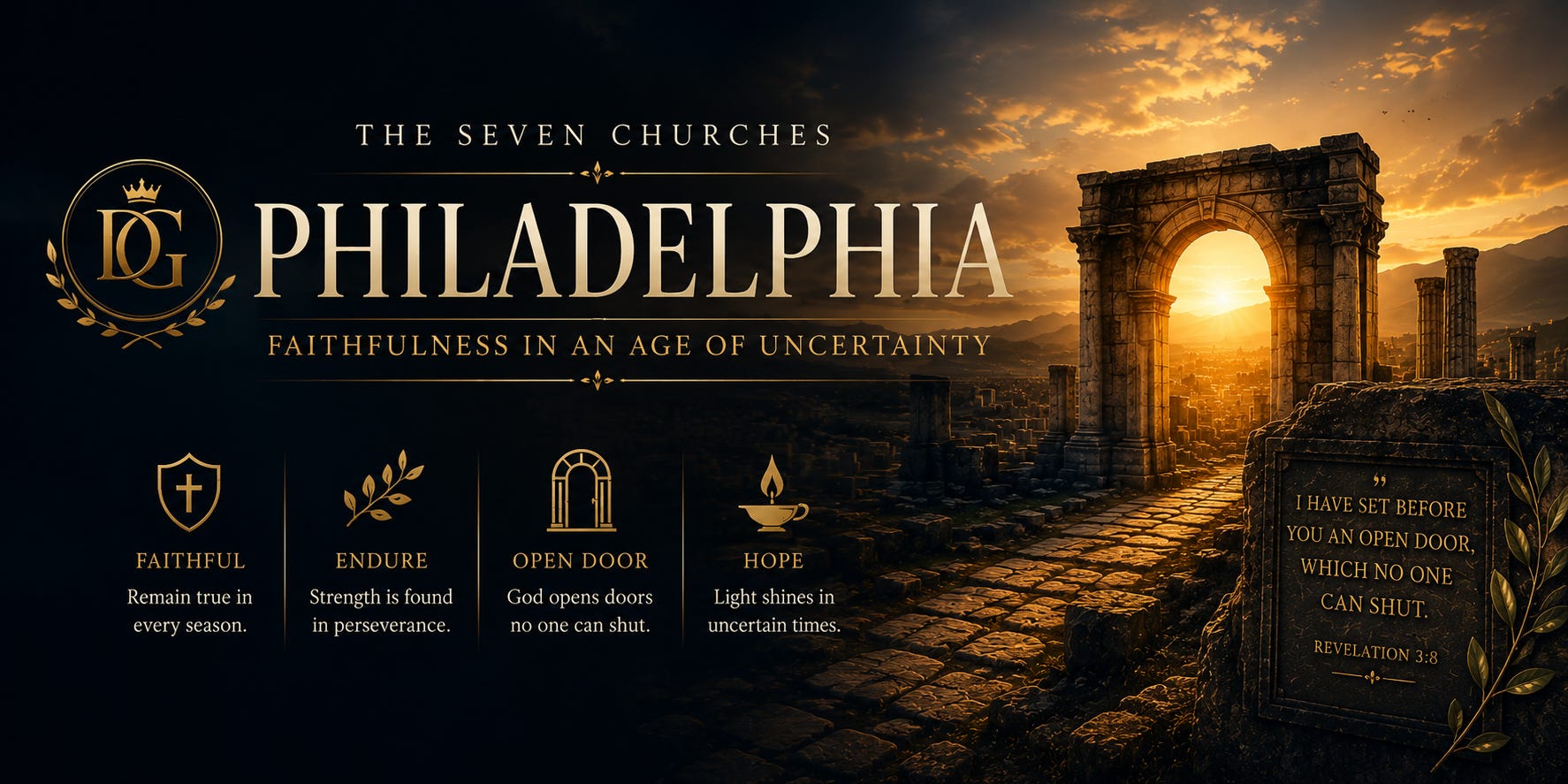
The ancient city of Philadelphia occupied a geographically unstable region vulnerable to earthquakes and repeated destruction. Historical instability shaped the daily reality of its inhabitants. Buildings collapsed. Structures required rebuilding. Fear of uncertainty remained part of ordinary life. This physical instability becomes symbolically important because the message to Philadelphia speaks directly into the human experience of living without complete security.
Modern civilisation often attempts to eliminate uncertainty. Societies pursue control through technology, systems, surveillance, economic structures, information, and endless productivity. Human beings search constantly for stability, predictability, and guarantees regarding the future. Yet despite extraordinary advancement, uncertainty continues to define human existence. Economic instability, emotional vulnerability, illness, loneliness, social fragmentation, psychological pressure, and global tension remain deeply present beneath modern systems.
Philadelphia therefore becomes more than an ancient church. It becomes a reflection upon how human beings navigate instability itself.
One of the deepest emotional struggles within modern society is the fear of insufficiency. Individuals frequently feel they are not powerful enough, successful enough, influential enough, wealthy enough, educated enough, attractive enough, spiritually strong enough, or socially important enough. Modern civilisation intensifies comparison continuously. Human value becomes measured through competition, performance, visibility, and achievement. Under such conditions, countless individuals silently develop feelings of inadequacy and exhaustion.
The message to Philadelphia quietly challenges these assumptions.
Faithfulness is not measured solely through power.
This principle carries enormous spiritual and psychological depth. Modern societies frequently admire dominance while overlooking perseverance. Yet human dignity often appears most clearly within individuals who continue despite limitation, uncertainty, weakness, rejection, or fear. The person who quietly remains faithful while carrying burdens invisible to others may possess extraordinary strength unrecognised by the surrounding culture.

Philadelphia represents this hidden endurance.
The church is described as possessing “little strength,” yet continuing faithfully. This phrase resonates deeply because it reflects one of the most universal human experiences. Most individuals move through life without feeling completely strong or fully secure. Human existence itself involves vulnerability. Fear, uncertainty, limitation, disappointment, exhaustion, and emotional struggle remain inseparable from ordinary life. Yet despite these realities, individuals continue searching for meaning, identity, hope, and spiritual stability.
The greatness of Philadelphia lies precisely within this perseverance.
Its message rejects the idea that only the powerful matter. It recognises the dignity of individuals who continue despite weakness.
This perspective remains profoundly relevant within modern civilisation, where external achievement often becomes mistaken for personal worth. Social systems reward visibility, influence, and measurable success. However, many forms of genuine human courage remain unseen. The parent quietly endures exhaustion to support the family. The individual surviving chronic illness while maintaining dignity. The person carrying grief while continuing daily responsibilities. The human being preserving compassion within a cynical world. These forms of perseverance rarely receive public celebration, yet they may represent some of the deepest expressions of inner strength.
Philadelphia speaks directly to these invisible forms of endurance.
Its message also contains important reflections regarding opportunity and openness. Symbolically, the church is associated with an “open door” — an image carrying profound existential significance. Human beings frequently fear closed futures. Rejection, failure, instability, and uncertainty can produce emotional paralysis. Many individuals eventually begin believing their possibilities have permanently disappeared. Hope weakens. Motivation collapses. Fear narrows perception.
Yet the symbolism of the open door suggests another possibility.
Human existence cannot be reduced entirely to present limitations.
Even within uncertainty, new paths remain possible.
This theme becomes psychologically powerful because modern life often produces emotional exhaustion severe enough to damage hope itself. Constant pressure, disappointment, economic struggle, social comparison, digital overstimulation, and emotional isolation can gradually convince individuals that life has become permanently trapped. Philadelphia interrupts this despair by insisting that limitation does not automatically eliminate meaning or future possibility.
This does not mean life suddenly becomes easy. The message to Philadelphia does not deny hardship or uncertainty. Rather, it acknowledges vulnerability honestly while affirming perseverance within it. Hope is not presented as naïve optimism disconnected from reality. Instead, hope becomes the refusal to surrender entirely to despair despite unstable conditions.
The symbolism of endurance within Philadelphia also reflects a broader civilizational warning. Modern societies increasingly prioritise speed over depth, consumption over reflection, stimulation over wisdom, and productivity over inner life. Human beings are pushed constantly toward performance without rest. Under such conditions, emotional fatigue becomes normalised. Individuals continue functioning externally while internally experiencing anxiety, fragmentation, emptiness, or psychological exhaustion.
Philadelphia offers another vision of human existence.
It values endurance more than spectacle.
It values faithfulness more than domination.
It values integrity more than performance.
This philosophical shift carries enormous significance because civilisations frequently collapse morally long before collapsing materially. A society may continue advancing technologically while simultaneously weakening emotionally, spiritually, and ethically. Human beings become increasingly connected digitally while growing increasingly isolated psychologically. Public communication expands while genuine understanding diminishes. Under such conditions, preserving inner stability becomes one of the greatest challenges of modern existence.
Philadelphia, therefore, represents more than personal spirituality alone. It reflects the struggle to preserve humanity itself within systems that continuously pressure individuals toward exhaustion, conformity, distraction, and emotional fragmentation.
One of the most beautiful dimensions of the Philadelphia narrative is its recognition that limitation does not prevent significance. Human beings frequently underestimate the value of ordinary faithfulness. Modern culture encourages individuals to pursue visibility, recognition, and extraordinary success, yet history repeatedly demonstrates that civilisations are sustained largely through quiet endurance rather than public spectacle.
Communities survive because some individuals continue acting with integrity despite pressure.
Families survive because some individuals continue loving despite exhaustion.
Human dignity survives because some individuals refuse to become entirely cynical despite disappointment.
Philadelphia honours these quieter forms of strength.
The emotional power of this message also emerges through its relationship with identity. Modern civilisation often encourages individuals to construct identity externally through achievement, image, status, ideology, or social approval. Yet these foundations remain unstable because they depend heavily upon changing circumstances. Economic collapse, illness, aging, rejection, or failure can rapidly destabilise identities built entirely upon external validation.
The message to Philadelphia instead emphasises inner faithfulness.
Identity rooted entirely in external success becomes fragile.
Identity rooted in endurance becomes resilient.
This distinction remains psychologically important because modern societies produce extraordinary anxiety surrounding failure and inadequacy. Many individuals silently fear becoming insignificant, forgotten, powerless, or irrelevant. The pressure to constantly prove value creates emotional exhaustion across entire populations. Philadelphia gently confronts this fear by recognising worth beyond public achievement alone.
Human value cannot be measured solely through visible power.
This principle stands in direct opposition to many assumptions dominating modern civilisation.
The ruins of ancient Philadelphia continue reminding humanity that uncertainty has always shaped human existence. Empires rise and collapse. Economies fluctuate. Political systems change. Technological revolutions transform daily life. Yet beneath historical transformation, human beings continue wrestling with remarkably similar existential realities — fear, instability, limitation, hope, endurance, and the search for meaning.
This is why the message of Philadelphia continues resonating across centuries.
Its themes remain universal.
Every generation experiences uncertainty.
Every civilisation struggles with instability.
Every individual eventually encounters limitation, vulnerability, disappointment, or fear.
Yet within these realities, human beings continue to possess the capacity for perseverance, integrity, hope, and spiritual endurance.
Philadelphia ultimately becomes one of the most hopeful voices among the Seven Churches precisely because it refuses to equate weakness with worthlessness. It acknowledges limitations honestly while affirming the dignity of those who continue faithfully despite unstable conditions. The message suggests that true strength does not always appear through dominance, certainty, or public greatness. Sometimes strength appears quietly through endurance itself.
In many ways, Philadelphia speaks directly into the emotional atmosphere of the modern world. Anxiety, uncertainty, instability, comparison, exhaustion, and fear increasingly shape contemporary life. Yet the message insists that human beings are not defined entirely by these pressures. Inner perseverance remains possible even within unstable civilisations.

The enduring beauty of Philadelphia lies in this truth: the human spirit may continue moving forward even amid uncertainty.
Across centuries, the Church of Philadelphia continues asking humanity a deeply important question:
Can faithfulness survive within a world obsessed with power, performance, and certainty?
Dr. Daniel J. Grace
Research • Journalism • Theology
drdanieljgrace.substack.com