

Persecution in the Roman Empire: Faith, Courage, and the Survival of Early Christianity
How the Early Christians Endured Opposition and Helped Transform the Ancient World

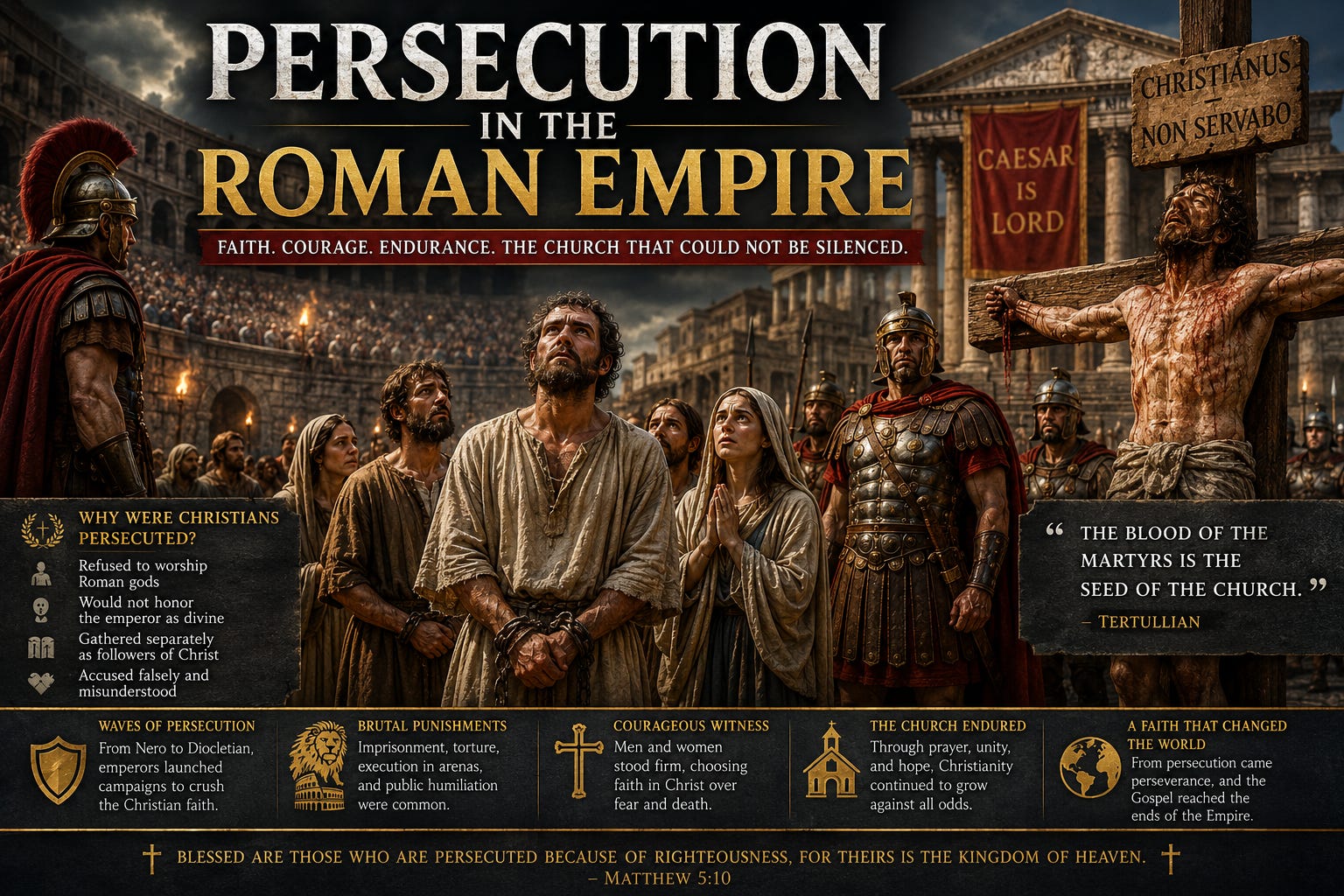
The history of early Christianity cannot be understood without examining the persecution faced by believers throughout the Roman Empire. While popular imagination sometimes portrays persecution as constant and universal, the reality was more complex. Christians experienced periods of relative peace interrupted by waves of hostility, local violence, and imperial campaigns against the Church. Despite these challenges, Christianity continued to grow, spreading from a small Jewish movement in Judea to a faith that eventually transformed the Roman world. This article explores the causes of persecution, the experiences of early Christians, the role of martyrdom, and the enduring lessons that emerge from one of history’s most remarkable stories of faith and perseverance.
Introduction
When Christianity first appeared in the first century AD, few observers could have imagined its future impact. The followers of Jesus were initially viewed as a small and obscure religious group operating within the vast Roman Empire.
Rome ruled millions of people from Britain to Mesopotamia. The Empire tolerated a wide variety of cultures and religions, provided they did not threaten public order or challenge imperial authority.
Christianity, however, gradually attracted suspicion.
Its followers refused to worship Roman gods, declined participation in emperor worship, and often gathered separately from wider society. These practices caused misunderstandings and generated hostility among both government officials and ordinary citizens.
Yet persecution failed to destroy the Christian movement. Instead, the faith continued to spread, demonstrating extraordinary resilience in the face of opposition.
Why Were Christians Persecuted?
Contrary to modern assumptions, Christians were not persecuted simply because they believed in Jesus.
The deeper issue involved loyalty and religious identity.
Roman society viewed religion as essential to social stability. Public sacrifices and ceremonies were believed to secure divine favor for the Empire. Participation demonstrated loyalty to Rome and its traditions.
Christians refused to participate in these rituals.
They worshipped only one God and acknowledged Jesus Christ as Lord. This exclusive devotion distinguished them from most other religious groups.
To Roman authorities, such behaviour sometimes appeared dangerous. Refusing sacrifices could be interpreted as disrespect toward the gods, disloyalty toward the emperor, or even a threat to public order.
Misunderstandings and False Accusations
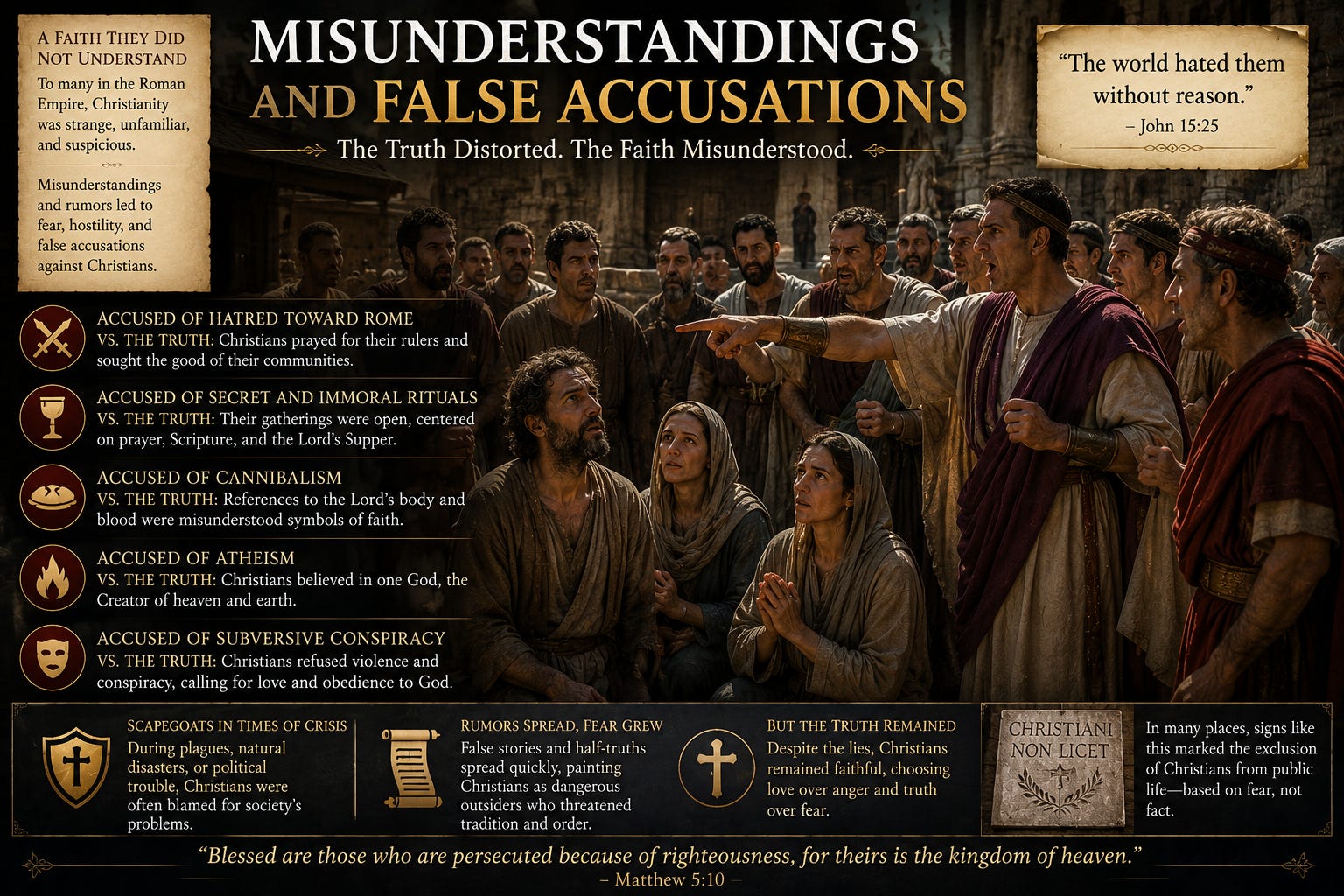
Many accusations against Christians were based on misunderstanding.
Because Christians referred to one another as brothers and sisters, outsiders sometimes suspected secret societies.
Their celebration of the Lord’s Supper, involving references to Christ’s body and blood, led to bizarre rumours and false accusations.
Their private gatherings occasionally fueled public suspicion.
In times of crisis, such as plagues, military defeats, or natural disasters, Christians often became convenient scapegoats.
The unfamiliar nature of the Christian faith made believers vulnerable to fear and misinformation.
Nero and the First Major Persecution
One of the earliest and most famous persecutions occurred during the reign of Emperor Nero.
In AD 64, a devastating fire destroyed large sections of Rome. Ancient sources report that Nero blamed Christians for the disaster, diverting suspicion away from himself.
Many believers were arrested and subjected to brutal punishments.
Although this persecution was largely confined to Rome rather than the entire Empire, it established a precedent that would influence future attitudes toward Christians.
Tradition associates the deaths of both Peter and Paul with this period of persecution.
Emperor Worship and Christian Resistance
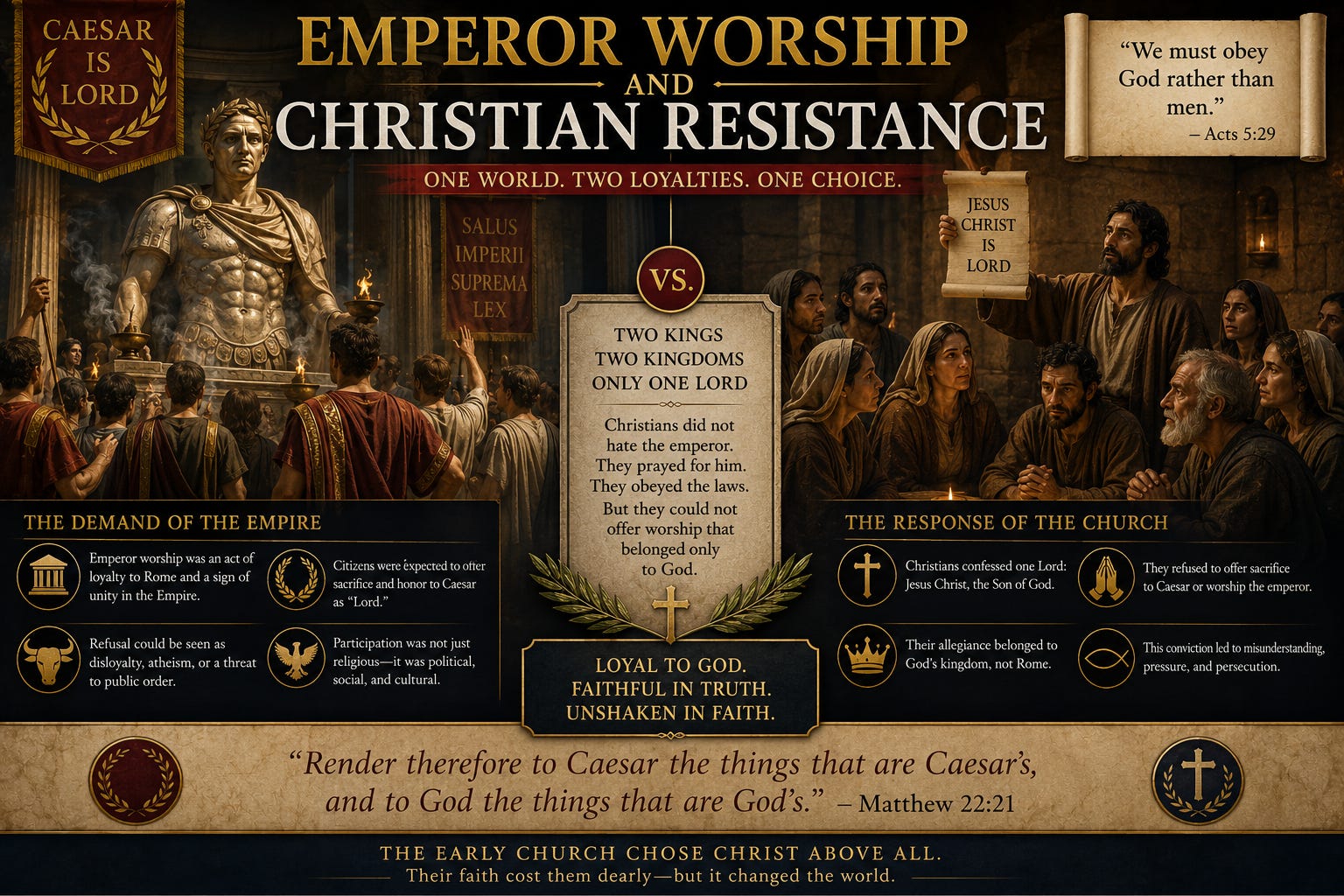
One of the greatest points of conflict involved emperor worship.
Throughout the Roman Empire, citizens participated in ceremonies honouring the emperor. In many regions, particularly Asia Minor, emperor worship became an important expression of political loyalty.
For Christians, however, worship belonged exclusively to God.
They could respect the emperor, obey laws, and pray for rulers, but they could not offer sacrifices or acknowledge the emperor as divine.
This refusal placed Christians in direct conflict with one of the most important symbols of Roman unity.
The churches addressed in the Book of Revelation experienced these pressures firsthand.
Persecution in Asia Minor
Asia Minor became one of the most significant centers of both Christianity and persecution.
Cities such as Ephesus, Smyrna, Pergamum, and Laodicea contained thriving Christian communities. At the same time, they were strongholds of emperor worship and traditional religion.
Believers frequently faced social exclusion, economic hardship, and legal pressure.
The church in Smyrna, for example, experienced severe persecution. The martyrdom of Polycarp, Bishop of Smyrna, became one of the most famous examples of Christian faithfulness.
When ordered to renounce Christ, Polycarp refused. His courage inspired generations of believers and became a symbol of unwavering commitment to faith.
Martyrs and the Power of Witness
The word “martyr” originally meant “witness.”
Early Christian martyrs became witnesses not only through their words but through their willingness to suffer for their beliefs.
Roman officials expected fear to discourage Christians. Instead, many believers displayed remarkable courage.
Their willingness to face imprisonment, torture, and death often astonished observers.
Far from weakening Christianity, martyrdom frequently strengthened the Church.
The courage of martyrs demonstrated that their faith was not merely an intellectual belief but a conviction worth sacrificing everything to defend.
The Great Persecutions
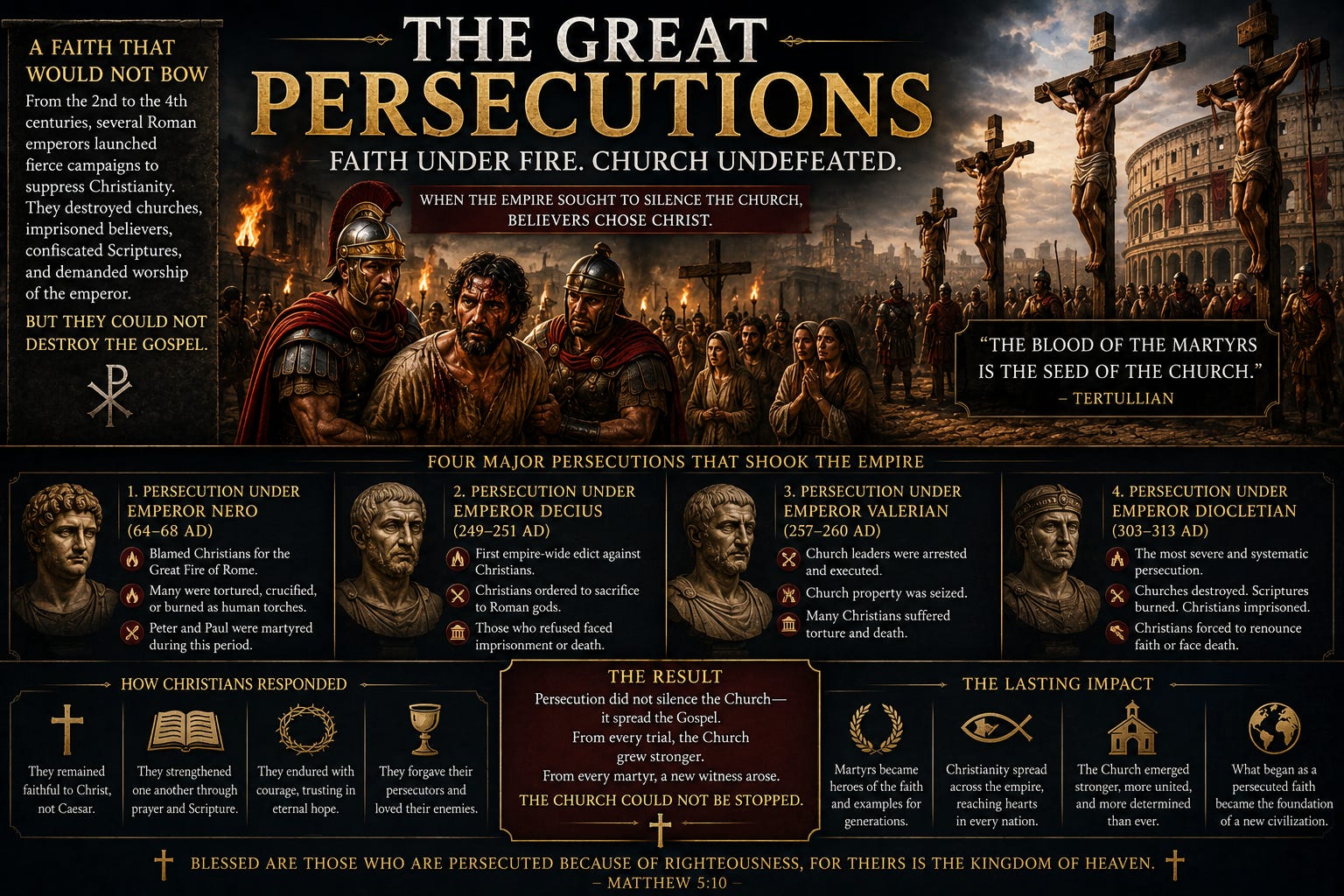
Not all persecutions were local or temporary.
Several emperors launched broader campaigns against Christians.
During the reigns of Decius and later Diocletian, Christians faced some of the most severe persecutions in Roman history.
Church buildings were destroyed. Scriptures were confiscated. Clergy were imprisoned. Citizens were ordered to offer sacrifices to Roman gods.
Many Christians suffered greatly, while others fled or went into hiding.
Yet despite these efforts, Christianity continued to survive and expand.
Why Christianity Survived
The survival of Christianity remains one of history’s most remarkable developments.
Several factors contributed to this outcome.
First, Christian communities provided strong networks of support. Believers cared for one another during times of crisis, illness, and persecution.
Second, Christianity offered hope that transcended earthly suffering. The promise of eternal life gave believers courage in the face of death.
Third, the example of faithful Christians often attracted new converts. Observers were impressed by their compassion, integrity, and courage.
Finally, the message of the Gospel addressed deep human questions concerning meaning, forgiveness, and salvation.
Persecution could suppress individuals, but it could not eliminate the ideas and convictions that inspired them.
Constantine and the End of Imperial Persecution
A dramatic turning point occurred in the early fourth century.
Emperor Constantine embraced Christianity and issued the Edict of Milan in AD 313, granting legal protection to Christians.
For the first time, Christianity moved from a persecuted faith to a legally recognised religion within the Empire.
The Church emerged from centuries of struggle and entered a new phase of growth and influence.
Although challenges remained, systematic imperial persecution largely came to an end.
Modern Lessons
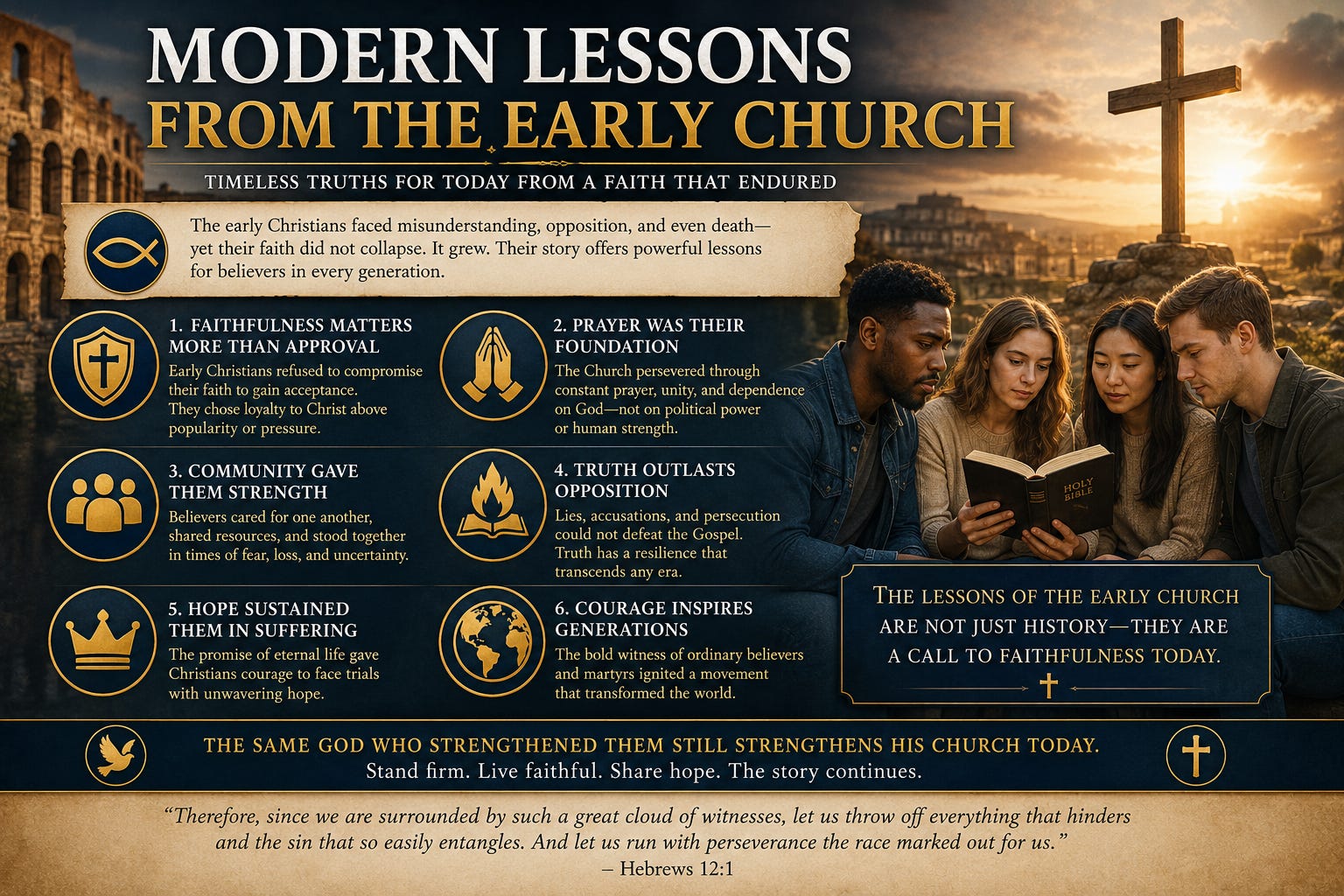
The experience of the early Christians offers valuable lessons for modern believers.
First, faithfulness is often tested during difficult circumstances rather than comfortable ones.
Second, courage can have a powerful influence on others.
Third, truth does not depend upon popularity or political power.
Finally, the story of early Christianity reminds us that conviction, hope, and perseverance can overcome extraordinary obstacles.
The endurance of the early Church demonstrates that spiritual strength often emerges most clearly during periods of adversity.
Persecution played a significant role in shaping the identity of early Christianity. Christians faced misunderstanding, discrimination, social exclusion, imprisonment, and even death because of their commitment to Jesus Christ.
Yet persecution failed to destroy the Church. Instead, it revealed the depth of Christian conviction and contributed to the spread of the Gospel throughout the Roman world.
The courage of martyrs, the faithfulness of ordinary believers, and the perseverance of Christian communities left a lasting legacy that continues to inspire people around the world today.
The story of persecution in the Roman Empire is ultimately not a story of defeat. It is a story of endurance, hope, and faith that transformed history.
Dr. Daniel J. Grace
Research • Journalism • Theology
© 2026 Dr. Daniel J. Grace. All Rights Reserved.