
People Remember Early Christian Disagreements. They Forget the Cost.
The Suffering, Loyalty, and Human Cost Behind the Formation of the Early Church

Modern discussions of early Christianity often focus on disagreements.
Different groups. Different texts. Different interpretations of Jesus. Different claims about authority.
Those questions matter.
But something important is often left out.
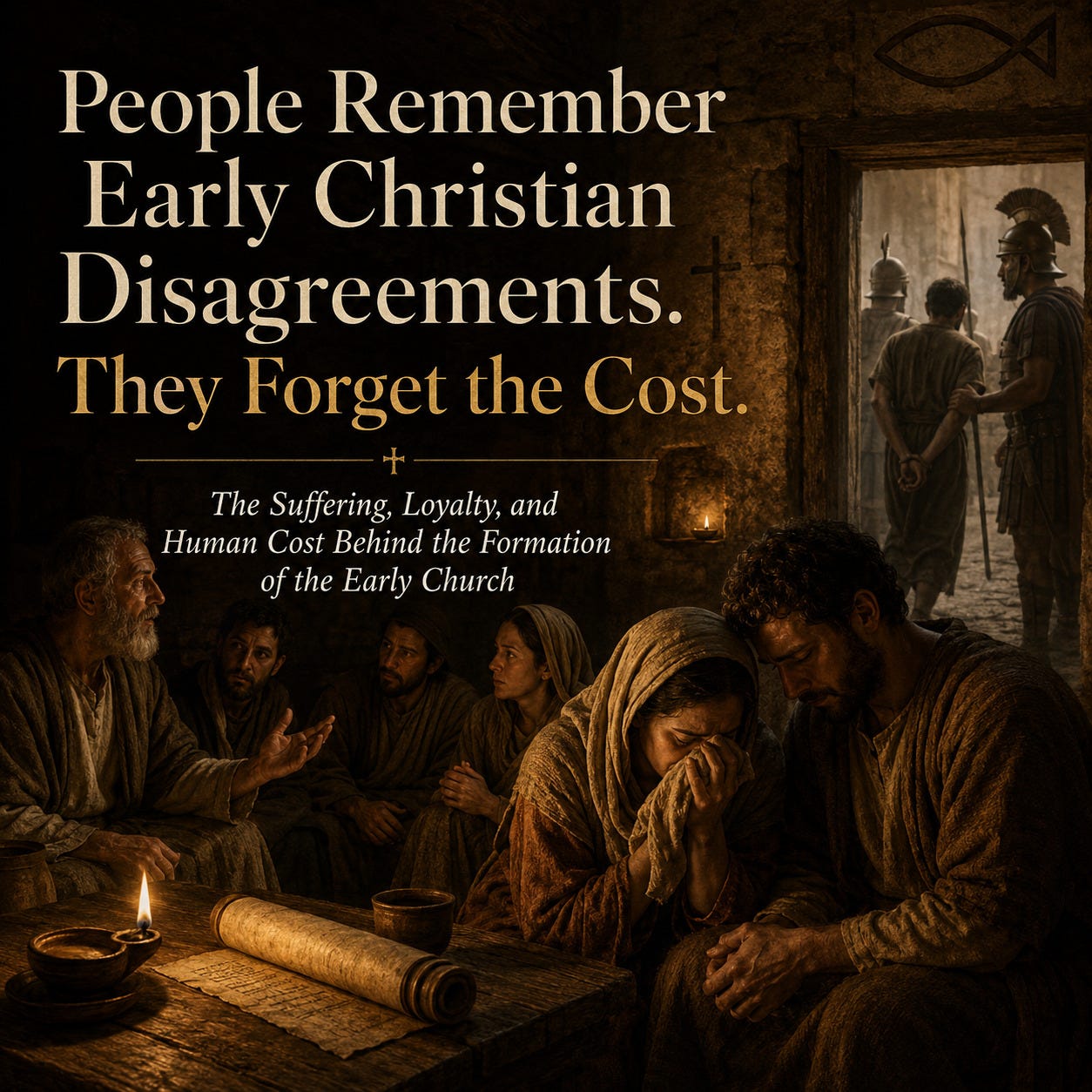
The first Christians were not debating their faith from the comfort of universities, conferences, or online forums. Many lived under suspicion. Some lost family relationships, employment, social standing, freedom, and, in certain periods, their lives.
Early Christianity was not only a battle of ideas.
It was lived through vulnerable human beings.
Persecution was not constant across the Roman Empire. Not every Christian spent every day hiding from the authorities. Some communities lived for long periods without direct interference. Others faced local hostility or suffered during particular campaigns.
We should not exaggerate the history.
But we should not erase it either.
Being Christian could carry a real cost.
Roman religion was woven into family life, civic loyalty, public festivals, trade, politics, and social identity. Refusing to sacrifice was not always treated as a private religious choice. It could look like rejection of the community itself.
Christians could be accused of being antisocial, impious, disloyal, or hostile to inherited customs.
Conversion could divide households.
It could damage professional relationships.
It could remove a person from the ordinary structures that gave life security and belonging.
That is easy to forget when early Christianity is reduced to competing versions.
Believers were not simply choosing between different religious products. They were deciding what they believed about Christ, worship, salvation, and the church under conditions that could be dangerous.
Their suffering does not prove every Christian claim.
People from many religions and ideologies have suffered sincerely for beliefs that others reject. Martyrdom proves conviction. It does not automatically prove truth.
Still, conviction matters historically.
The first Christians did not usually preserve their faith because it offered immediate social advantage. Christianity did not begin as the religion of imperial power. Many believers maintained their allegiance when doing so could bring loss rather than privilege.
That tells us something important.
They did not experience the gospel as a convenient invention.
They believed it demanded loyalty.
The Greek word martys means “witness.” Over time, it became closely associated with those who suffered and died rather than deny Christ.
Their bodies became their testimony.
That does not mean suffering should be romanticised.
Prison was still prison.
Social rejection was still rejection.
Execution was still the destruction of a human life.
Christian communities gave suffering theological meaning, but meaning did not remove pain.
The martyr stories also require historical care. Some were shaped for worship, teaching, and encouragement. They could emphasise courage, compress events, or present the martyr as an ideal model of faith.
Yet literary shaping does not mean nothing happened.
It shows how communities remembered what had happened.
They preserved these stories because suffering had become part of Christian identity.
The same is true of Christian texts.
Teachings were remembered, copied, carried, translated, defended, and passed from one community to another. This work depended on ordinary people.
Teachers.
Scribes.
Clergy.
Travellers.
Households.
Believers whose names were never recorded.
Some protected texts during periods of hostility. Some continued worship when gathering was dangerous. Some remained faithful when abandoning Christianity might have preserved their security.
When scholars discuss early Christian diversity, these people can disappear.
Christianity becomes a collection of documents.
A competition between communities.
A struggle over authority.
All of that existed.
But behind every text was a human being.
Behind every church was a community.
Behind every theological dispute were people who believed the question mattered for worship, salvation, and faithfulness.
They were not arguing about abstract ideas.
They were trying to preserve what they believed had been entrusted to them.
This human cost also helps explain the later rise of asceticism.
When persecution became less common and Christianity gained public recognition, some believers sought another form of radical commitment.
The desert became a new place of witness.
The monk did not usually stand before an executioner. But he confronted hunger, loneliness, temptation, fear, and bodily weakness.
Asceticism could be understood as a prolonged surrender of comfort.
Martyrdom gave up life in one decisive moment.
Monasticism gave up ordinary life slowly.
The connection should not be pushed too far, but it matters.
Both traditions placed the body inside faith.
Belief was not only spoken.
It was endured.
People today often remember that early Christians disagreed.
They should remember that many of them also suffered.
The existence of different Christian groups does not erase the seriousness of the first believers. Diversity does not prove that no historical core existed. It shows that human communities interpret, divide, develop, and compete.
That still happens today.
New religious movements appear. Older traditions divide. Leaders claim new revelation. Communities form around new texts, practices, and authorities.
Human religious behaviour has not changed as much as we sometimes imagine.
The first Christians were diverse.
They were also vulnerable.
They argued.
They also endured.
They developed traditions.
They also buried their dead.
A fair history must remember both.
The human cost of early Christianity does not answer every question about doctrine or truth.
But it should stop us from treating the first Christians as abstract figures in a scholarly argument.
They were people.
And some paid a terrible price simply for remaining Christian.
History should remember not only what early Christians argued about, but what some of them were willing to lose.
Originally published by Faith • Civilization • Theology.
Author: Dr. Daniel J. Grace
ORCID: https://orcid.org/0000-0002-9259-8032
Website: https://faithcivilizationtheology.com
DOI: https://doi.org/10.5281/zenodo.21615244
© 2026 Daniel J. Grace. All rights reserved.
This work is licensed under the Creative Commons Attribution 4.0 International Licence. It may be shared and adapted with proper attribution to the author.