

Pentecostal Theology – Part 5
Challenges, Opportunities, and the Future of Spirit-Filled Christianity

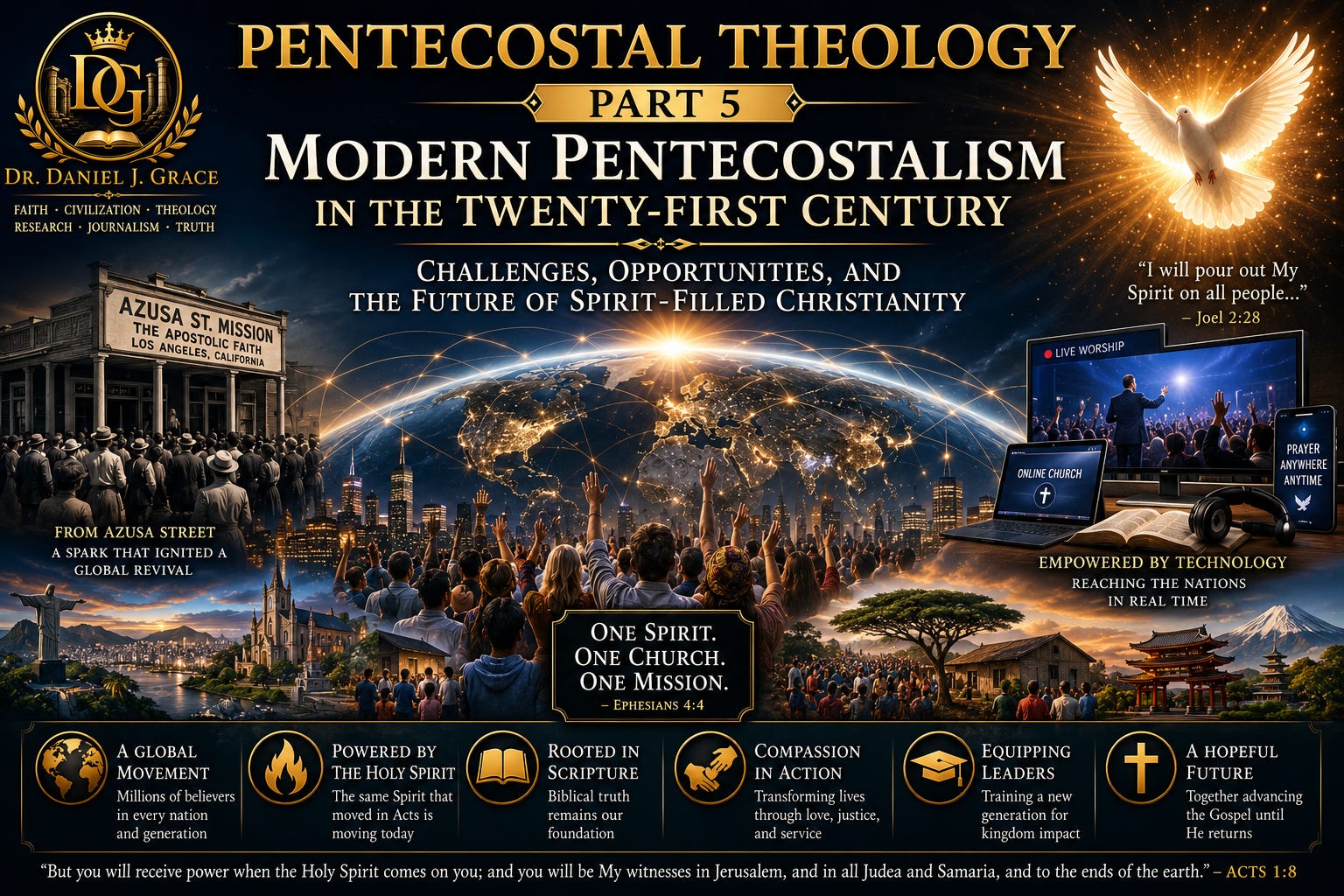
Modern Pentecostalism in the Twenty-First Century
Pentecostalism has become one of the most influential movements in modern Christianity. What began as a revival among a relatively small group of believers in the early twentieth century has developed into a global movement that reaches across cultures, languages, and denominational boundaries. Today, nearly every nation on earth has Pentecostal and Charismatic Christians, who represent one of the fastest-growing segments of global Christianity.
As Pentecostalism moves further into the twenty-first century, it faces new opportunities and challenges. The movement continues to experience remarkable growth in many regions of the world, yet it must also navigate cultural change, technological advancement, theological debates, and shifting social realities. Understanding these developments is essential for anyone seeking to understand the future of Pentecostal theology and practice.
One of the most significant features of modern Pentecostalism is its diversity. Unlike some Christian traditions that operate under a single organisational structure, Pentecostalism consists of thousands of denominations, networks, independent churches, and ministry organisations. While these groups share common beliefs concerning the Holy Spirit and spiritual gifts, they often differ in worship styles, church governance, theological emphasis, and cultural expression.
This diversity has both strengths and challenges. On one hand, it allows Pentecostal churches to adapt effectively to local cultures and contexts. On the other hand, it can sometimes lead to confusion regarding doctrine, accountability, and leadership standards. As Pentecostalism continues to grow, many leaders recognise the importance of maintaining biblical faithfulness while preserving the movement’s flexibility and spiritual vitality.
Technology has dramatically transformed modern Pentecostal ministry. Churches now use websites, social media platforms, podcasts, livestreams, and digital resources to reach audiences around the world. A sermon preached in one country can be viewed instantly by believers on another continent. Worship services, Bible studies, and prayer meetings increasingly occur in both physical gatherings and online environments.
The COVID-19 pandemic accelerated this digital transformation. Churches that once relied exclusively on face-to-face ministry had to embrace technology in new ways. Many Pentecostal congregations discovered that online platforms could extend their reach far beyond local communities. While digital ministry cannot fully replace personal fellowship, it has become an important tool for evangelism, discipleship, and communication.
The rise of social media has also created opportunities and risks. Pentecostal leaders can now share messages with millions of people instantly. Testimonies, sermons, worship music, and educational content can spread rapidly across the internet. However, the speed of communication can also contribute to misinformation, theological confusion, and the spread of unverified claims. Modern Pentecostals increasingly face the challenge of exercising wisdom and discernment in a digital age.
Another important development within contemporary Pentecostalism is the growth of theological education. In earlier generations, some critics accused Pentecostals of placing experience above scholarship. While this criticism was often exaggerated, many Pentecostal leaders recognised the need for stronger theological foundations. As a result, Pentecostal colleges, seminaries, and universities have expanded significantly throughout the world.
Pentecostal scholars today make contributions to the fields of biblical studies, church history, theology, ethics, missions, and the social sciences. Academic research has helped strengthen Pentecostal theology while enabling constructive dialogue with other Christian traditions. This development shows that people do not need to view spiritual experience and intellectual inquiry as opposites. Instead, many Pentecostals believe both are essential for healthy Christian growth.
The relationship between Pentecostalism and social issues has also evolved. Earlier Pentecostal movements often focused primarily on evangelism and spiritual renewal. While these priorities remain central, many modern Pentecostal churches have become increasingly involved in humanitarian work, poverty relief, education, healthcare, and community development. Across Africa, Asia, Latin America, and other regions, Pentecostal organisations operate schools, hospitals, orphanages, and social assistance programmes.
This broader engagement reflects a growing recognition that the Gospel addresses both spiritual and practical needs. Pentecostals continue to emphasise salvation through Christ while also seeking to demonstrate God’s love through acts of compassion and service. Many leaders view social ministry not as a replacement for evangelism but as an expression of Christian faith in action.
One of the most debated topics within modern Pentecostalism is prosperity theology. Certain ministries have taught that faithfulness to God will inevitably result in financial success, material blessing, and physical health. While some Pentecostals support aspects of this teaching, many scholars and church leaders have expressed serious concerns regarding its excesses.
Critics argue that prosperity theology can distort biblical teaching by reducing faith to a formula for personal gain. They point out that Scripture includes many examples of faithful believers who experienced suffering, persecution, and hardship. As a result, many Pentecostal theologians advocate a more balanced approach that recognises God’s provision while acknowledging the realities of suffering in a fallen world.
The issue of leadership accountability has also received increased attention. As Pentecostal ministries have grown larger and more influential, questions regarding governance, transparency, and ethical conduct have become increasingly important. Instances of financial misconduct, moral failure, or abuse of authority have emphasised the necessity of strong accountability structures within churches and ministry organisations.
Many Pentecostal denominations have responded by implementing clearer leadership standards, ethical guidelines, and oversight mechanisms. These efforts reflect a desire to preserve public trust and ensure that ministry remains consistent with biblical values.
The global nature of Pentecostalism presents another fascinating challenge. Pentecostal believers in Brazil, Nigeria, South Korea, Australia, India, and the United States may share common beliefs while expressing their faith in very different ways. Cultural diversity enriches the movement but also requires ongoing dialogue and mutual understanding. Modern Pentecostalism increasingly recognises the importance of listening to voices from different nations and cultural backgrounds.
Relations with other Christian traditions have also improved considerably. During its early years, more established denominations sometimes viewed Pentecostalism with suspicion. Today, cooperation between Pentecostals, Evangelicals, Catholics, Anglicans, Baptists, and other Christian groups is more common. While theological differences remain, many believers work together in areas such as evangelism, humanitarian aid, religious freedom, and community outreach.
The future of Pentecostalism will likely depend on its ability to maintain balance. The movement’s greatest strength has always been its emphasis on the living presence and power of the Holy Spirit. Yet future generations will also require sound biblical teaching, theological depth, ethical leadership, and cultural wisdom. Spiritual passion must be accompanied by spiritual maturity.
Young people represent another important area of focus. Across many countries, younger generations face unique challenges related to identity, technology, mental health, secularism, and social change. Pentecostal churches must discover ways to communicate timeless biblical truths within rapidly changing cultural environments. This task requires creativity, humility, and faithfulness to Scripture.
Despite the challenges, the future of Pentecostalism remains remarkably promising. The movement continues to grow, particularly in regions where Christianity is expanding rapidly. Its emphasis on prayer, worship, evangelism, spiritual gifts, and personal transformation continues to resonate with millions of people seeking a living relationship with God.
Ultimately, Pentecostalism’s enduring influence rests not on organisational structures, media platforms, or cultural trends. Its identity is rooted in the conviction that the Holy Spirit continues to work in the lives of believers today. This belief has inspired generations of Christians and remains central to the movement’s mission.
As Pentecostals look toward the future, they are called to remain faithful to their biblical foundations while engaging thoughtfully with the realities of the modern world. By combining spiritual vitality with wisdom, compassion, and theological integrity, Pentecostal believers can continue to make a significant contribution to global Christianity in the decades ahead.
Conclusion
Modern Pentecostalism stands at a unique moment in history. It has grown from a small revival movement into a global Christian force that influences worship, missions, theology, and church life across the world. While challenges remain, opportunities for ministry and witness continue to expand. The future of Pentecostalism will depend upon its ability to remain centred on Christ, guided by Scripture, empowered by the Holy Spirit, and committed to serving both God and humanity in a rapidly changing world.

Dr Daniel J. Grace
Faith • Civilization • Theology
Research • Journalism • Truth
🌐 danieljamesgrace.com
© 2026 Dr Daniel J. Grace. All Rights Reserved.
No part of this article may be reproduced, distributed, transmitted, or published in any form or by any means without prior written permission from the author, except for brief quotations used in academic citation, review, or research purposes.