

Pentecostal Theology – Part 4
From Azusa Street to a Worldwide Christian Revival

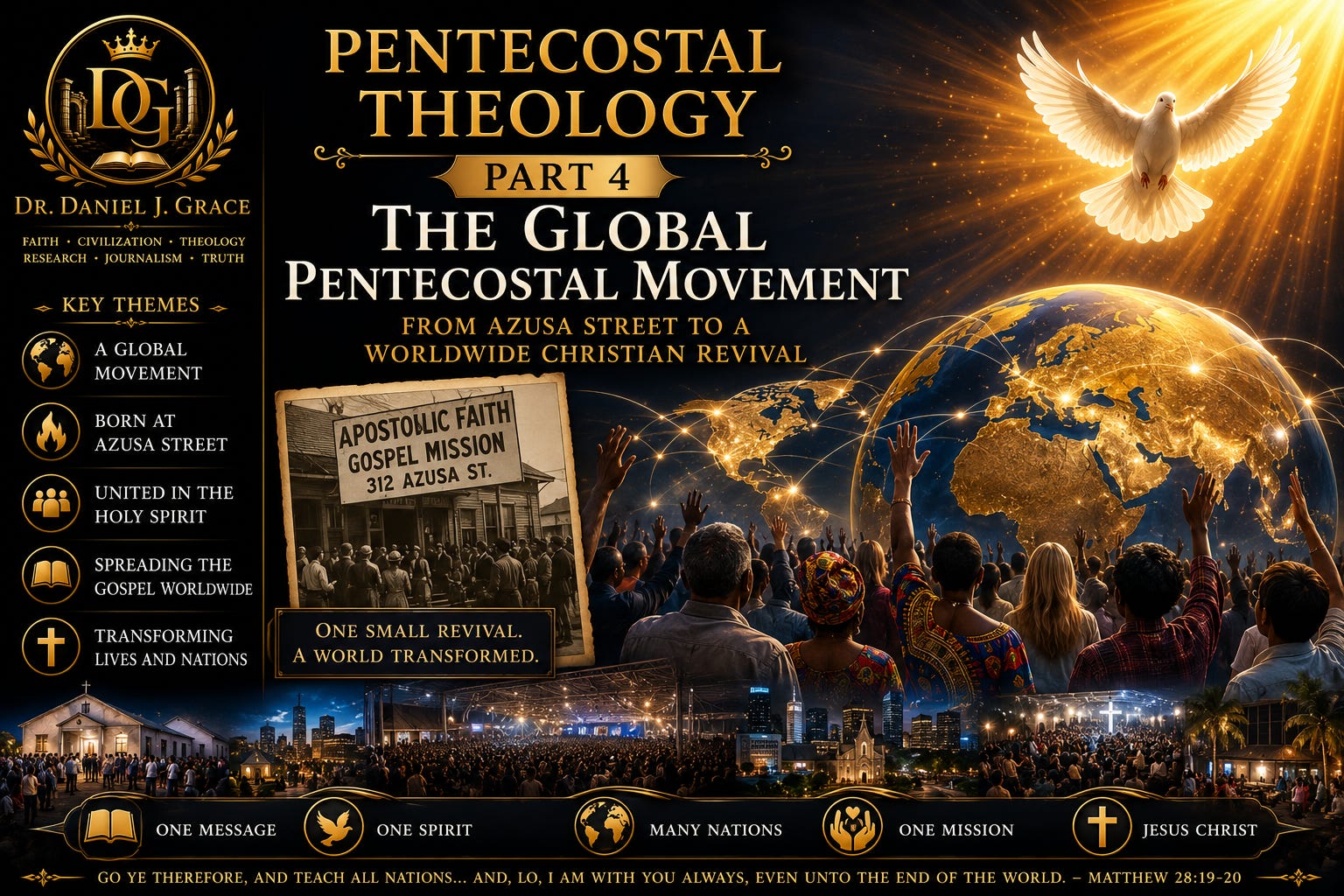
The Global Pentecostal Movement
Few movements in Christian history have experienced growth as rapid and far-reaching as Pentecostalism. What began as a small revival movement in the early twentieth century has developed into one of the largest and most influential expressions of Christianity in the modern world. Today, Pentecostal and Charismatic Christians number hundreds of millions across every continent, making the movement a significant force within global Christianity.
Scholars commonly trace the origins of modern Pentecostalism to the early 1900s in the United States. While the movement’s theological roots can be found in earlier Christian traditions, including Methodism and the Holiness Movement, Pentecostalism emerged as a distinct movement through a renewed emphasis on the Holy Spirit and spiritual gifts.
One of the key figures in the movement’s early development was Charles Parham, a Bible teacher who encouraged students to study the New Testament teachings concerning the baptism of the Holy Spirit. Parham concluded that speaking in tongues was closely connected to the experience of Spirit baptism described in the Book of Acts. His teachings would later influence many who became leaders in the Pentecostal movement.
However, the event most frequently associated with the birth of global Pentecostalism is the Azusa Street Revival in Los Angeles, California. Beginning in 1906 under the leadership of William J. Seymour, an African American preacher, the revival attracted people from diverse racial, cultural, and denominational backgrounds. Participants reported experiences of spiritual renewal, passionate worship, prayer, healing, and speaking in tongues.
The Azusa Street Mission became a gathering place for Christians seeking a more profound experience with God. Visitors travelled from across the United States and around the world to witness what was taking place. Many returned to their home countries carrying Pentecostal teachings and practices, contributing to the movement’s rapid international expansion.
One remarkable aspect of the Azusa Street Revival was its emphasis on unity. At a time when racial segregation was common in American society, worshippers from different ethnic backgrounds gathered together for prayer and worship. Although the movement would later face divisions and organisational challenges, its early commitment to spiritual equality had a lasting impact on Pentecostal identity.
As Pentecostalism spread, new denominations and ministries emerged. Churches were established throughout North America, Europe, Latin America, Africa, Asia, and Oceania. Missionaries travelled extensively, sharing the message of Spirit-filled Christianity and planting congregations in diverse cultural settings. This missionary focus became one of the driving forces behind Pentecostal growth.
The movement found particularly fertile ground in Latin America. Countries such as Brazil, Guatemala, Chile, and Mexico witnessed remarkable Pentecostal expansion throughout the twentieth century. Pentecostal churches often appealed to ordinary people by emphasising personal conversion, vibrant worship, prayer, healing, and direct access to God. Today, Latin America remains one of the most influential regions within global Pentecostalism.
Africa also experienced extraordinary Pentecostal growth. Across the continent, Pentecostal churches developed both through missionary efforts and indigenous leadership. African Pentecostalism often combines biblical teaching with strong community involvement, prayer ministries, and an emphasis on spiritual transformation. In many nations, Pentecostal churches have become major contributors to education, social welfare, and community development.
Asia represents another significant area of Pentecostal influence. Countries such as South Korea, the Philippines, Indonesia, China, and India have seen substantial growth in Pentecostal and Charismatic Christianity. Large congregations, prayer movements, and missionary initiatives have contributed to the movement’s expansion throughout the region.
Organisational strategies alone cannot explain the rise of Pentecostalism. Many scholars point to the movement’s emphasis on personal spiritual experience as a major factor in its success. Pentecostal believers often testify to experiences of conversion, healing, answered prayer, and spiritual renewal. These testimonies create a sense of living faith that resonates across cultural and social boundaries.
Worship has also played a crucial role in Pentecostal growth. Services are often characterised by enthusiastic singing, prayer, testimonies, and active participation. Rather than viewing worship as a spectator activity, Pentecostals encourage believers to engage personally in expressions of praise and devotion. This participatory approach has appealed to many people seeking a vibrant and experiential faith.
Another factor contributing to Pentecostal expansion is its adaptability. While remaining rooted in biblical teaching, Pentecostal churches often incorporate local languages, music styles, and cultural expressions into worship. This flexibility has enabled Pentecostalism to take root in a wide variety of cultural settings without losing its central theological convictions.
Despite its growth, Pentecostalism has faced criticism and challenges. Questions have been raised regarding prosperity teaching, excessive emotionalism, unverified miracle claims, and accountability within some ministries. Pentecostal scholars and leaders have responded by encouraging sound biblical teaching, theological education, and responsible ministry practices. Many Pentecostal institutions now offer advanced theological training and academic research programmes aimed at strengthening the movement’s intellectual foundations.
The emergence of the Charismatic Movement during the twentieth century further expanded Pentecostal influence. Charismatic Christians within Roman Catholic, Anglican, Lutheran, Baptist, and other traditions embraced many Pentecostal beliefs concerning the Holy Spirit while remaining within their existing denominations. This development helped spread Pentecostal ideas far beyond traditional Pentecostal churches.
Today, Pentecostalism is widely recognised as one of the most significant developments in modern Christian history. Its influence extends beyond denominational boundaries and has shaped contemporary worship, evangelism, missions, and spiritual formation across much of global Christianity.
As the movement continues to grow, Pentecostal believers face the challenge of remaining faithful to their spiritual heritage while addressing the realities of a rapidly changing world. Issues such as secularism, technology, social justice, cultural diversity, and theological education require thoughtful engagement. Yet Pentecostals remain confident that the same Holy Spirit who empowered the early church continues to guide believers today.
Conclusion
The Global Pentecostal Movement represents one of the most remarkable stories in modern Christian history. From the humble beginnings of the Azusa Street Revival to a worldwide community numbering hundreds of millions, Pentecostalism has transformed the religious landscape of many nations. Its emphasis on the Holy Spirit, spiritual renewal, evangelism, and personal faith keeps motivating believers across cultures and continents. Understanding the global growth of Pentecostalism helps us appreciate both its historical significance and its ongoing influence within Christianity today.
Next Article
Part 5 – Modern Pentecostalism in the Twenty-First Century
Challenges, Opportunities, and the Future of Spirit-Filled Christianity

Dr Daniel J. Grace
Faith • Civilization • Theology
Research • Journalism • Truth
🌐 danieljamesgrace.com
© 2026 Dr Daniel J. Grace. All Rights Reserved.
No part of this article may be reproduced, distributed, transmitted, or published in any form or by any means without prior written permission from the author, except for brief quotations used in academic citation, review, or research purposes.