
Part Two: Hidden Faith in the Black Sea
How Family Memory, Hidden Worship, and Quiet Courage Preserved a Forgotten Christian Heritage ✝️🌊🏔️📖

Secret Worship, Family Memory, and the Christians Who Refused to Forget
Welcome back, friend.
In Part One, we explored how Christianity first arrived among the Laz people of the eastern Black Sea and became part of their identity for centuries. We walked through the Kingdom of Lazica, the influence of Byzantium, and the gradual transformation that followed the arrival of new empires and changing political realities.
But history is not only about kings and battles.
It is also about ordinary people.
It is about what happened behind closed doors when public life became difficult.
It is about mothers teaching prayers to their children.
It is about grandfathers preserving stories that could not be spoken openly.
And it is about faith that survived not in great cathedrals, but in hidden places.
This chapter explores one of the most fascinating and emotional aspects of Black Sea Christian history: the traditions of hidden faith.
When Public Faith Became Difficult
Historical records show that Christian communities remained throughout the Black Sea region for centuries after the Ottoman conquest.
Many churches continued functioning.
Many families openly practiced Christianity.
Yet over time, some communities faced increasing social, economic, and political pressures.
The experience varied enormously.
Some villages remained openly Christian.
Others gradually converted to Islam.
Some communities lived somewhere in between.
For many families, survival required difficult decisions.
A father might worry about feeding his children.
A farmer might struggle under taxation.
A young man might see greater opportunities if he joined the majority faith.
History is rarely black and white.
People often made decisions within circumstances we can hardly imagine today.
The Stories That Families Remember
Official documents tell us one story.
Family memory often tells another.
Across the Black Sea region—among Greeks, Georgians, Armenians, Pontic peoples, and some Laz families—stories survived about hidden religious practices.
Some spoke of secret prayers.
Others remembered concealed icons.
Some recalled grandparents who continued old traditions quietly inside the home.
Not every story can be verified by historians.
Yet these memories matter because they reveal how communities understood their own past.
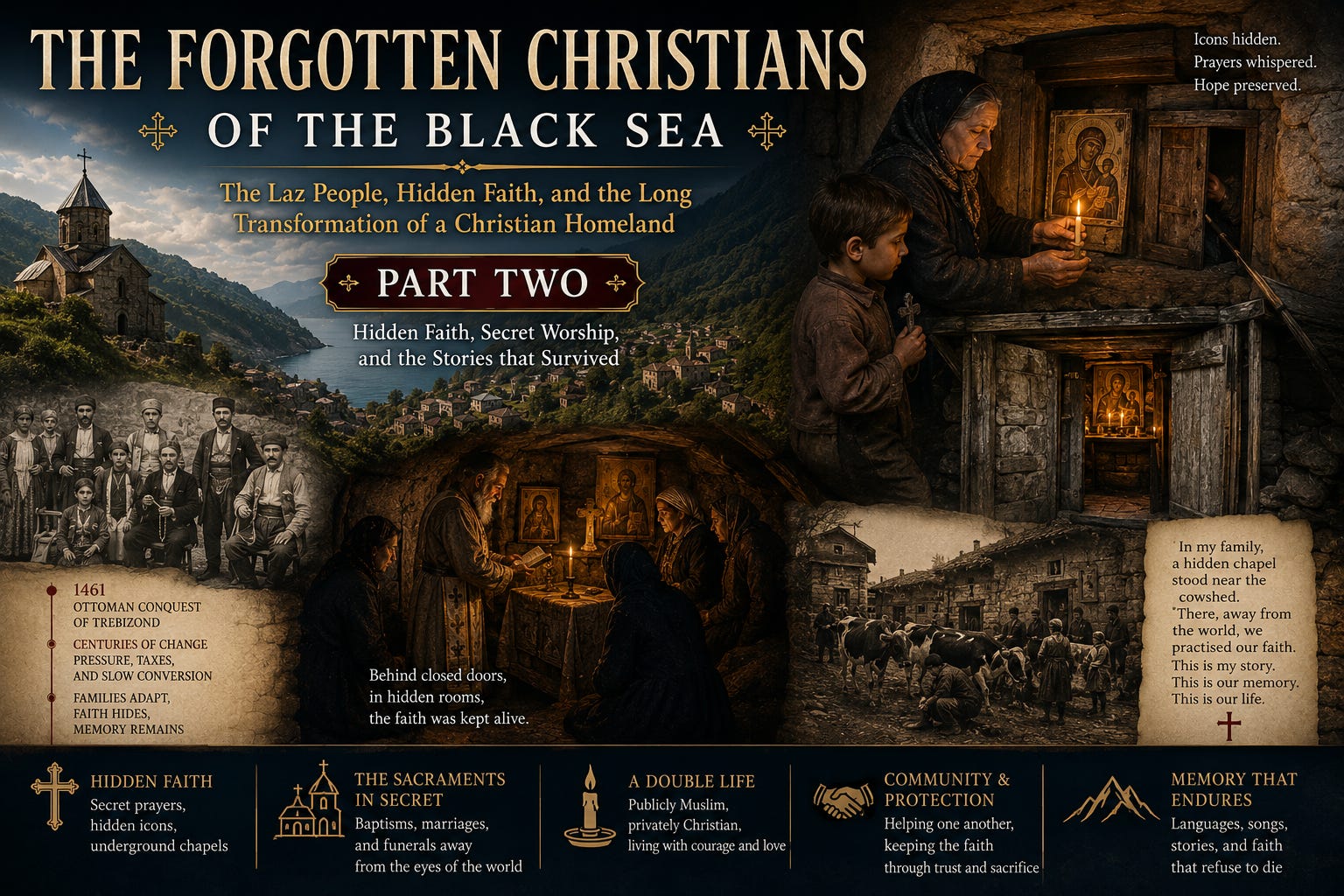
In my own family, stories were passed down about a hidden prayer room located near rural buildings and livestock shelters.
According to family memory, relatives gathered there to pray away from public attention.
The room was simple.
No grand architecture.
No church bells.
Just a small place where faith could be practiced quietly.
Whether every detail can be documented today is impossible to know.
But the memory itself survived.
And sometimes memories survive because they carried something precious.
Faith Behind Closed Doors
Imagine a small Black Sea village two hundred years ago.
Outside, daily life continues.
Fishing boats return from the sea.
Children run along mountain paths.
Neighbors exchange greetings.
Nothing appears unusual.
Yet inside one home, after darkness falls, a family gathers around a small oil lamp.
An old icon is brought from its hiding place.
A grandmother whispers prayers she learned from her own grandmother.
The children listen carefully.
No one speaks loudly.
The walls have ears.
The room is filled not with fear alone, but with love.
Love for family.
Love for tradition.
Love for God.
Whether such scenes happened exactly this way in every village is impossible to know.
Yet family stories across the region often describe similar moments.
The details vary.
The emotions remain remarkably consistent.
Identity Between Two Worlds
One of the most difficult aspects of hidden faith is the experience of living between worlds.
Many people in history have faced similar situations.
Outwardly they belonged to one community.
Inwardly they remembered another.
For some Black Sea families, identity became complicated.
Language, culture, religion, and loyalty did not always fit neatly together.
A person could be loyal to the state while remembering older family traditions.
A family could embrace a new public identity while privately honoring ancestors.
Human lives are rarely simple.
History often forces people into situations where every choice carries a cost.
This complexity deserves understanding rather than judgment.
The Cost of Memory
Over generations, many traditions faded.
Children moved away.
Languages changed.
Old churches disappeared.
Villages transformed.
Sometimes only fragments remained.
A prayer remembered by an elderly relative.
A cross carved into a stone.
An unusual family custom.
A story about a hidden room.
A forgotten cemetery.
Small pieces of a much larger story.
For many descendants, these fragments became clues leading back to their ancestors.
Why These Stories Matter
Some people ask whether family memories are important if historians cannot verify every detail.
I believe they are.
History is not only about official records.
It is also about lived experience.
It is about what families carried in their hearts.
The stories of hidden faith remind us that religion is not merely a set of doctrines.
For many people, it is part of identity, memory, and belonging.
These stories also remind us that ordinary people often show extraordinary courage.
Not the courage of armies or emperors.
The courage of parents protecting their children.
The courage of grandparents preserving hope.
The courage of families refusing to forget who they were.
The Hidden Flame
Today, the Black Sea region continues to change.
The Laz people remain proud of their culture, language, music, and heritage.
Many descendants are exploring their history with renewed interest.
Some discover forgotten Christian roots.
Others simply seek a deeper understanding of their ancestors.
Whatever path they follow, the past still speaks.
The hidden prayer rooms may be gone.
The old icons may have disappeared.
The voices that whispered those prayers may have fallen silent.
Yet something remains.
Memory remains.
Faith remains.
Hope remains.
And perhaps that is the greatest lesson of all.
The flame may grow small.
It may flicker in the wind.
It may hide behind walls for a season.
But as long as someone remembers, it never completely goes out.
In Part Three, we will explore how the final centuries of the Ottoman Empire, nationalism, migration, and modern history reshaped the Christian communities of the Black Sea—and what remains today.
To be continued…

Dr. Daniel J. Grace
Faith • Civilization • Theology
Research • Journalism • Truth
🌐 danieljamesgrace.com
© 2026 Dr. Daniel J. Grace. All Rights Reserved.
No part of this article may be reproduced, distributed, transmitted, or published in any form or by any means without prior written permission from the author, except for brief quotations used in academic citation, review, or research purposes.