

Part 4: The Hidden Flame Still Burns
Rediscovering Memory, Heritage, and Faith Along the Shores of the Black Sea

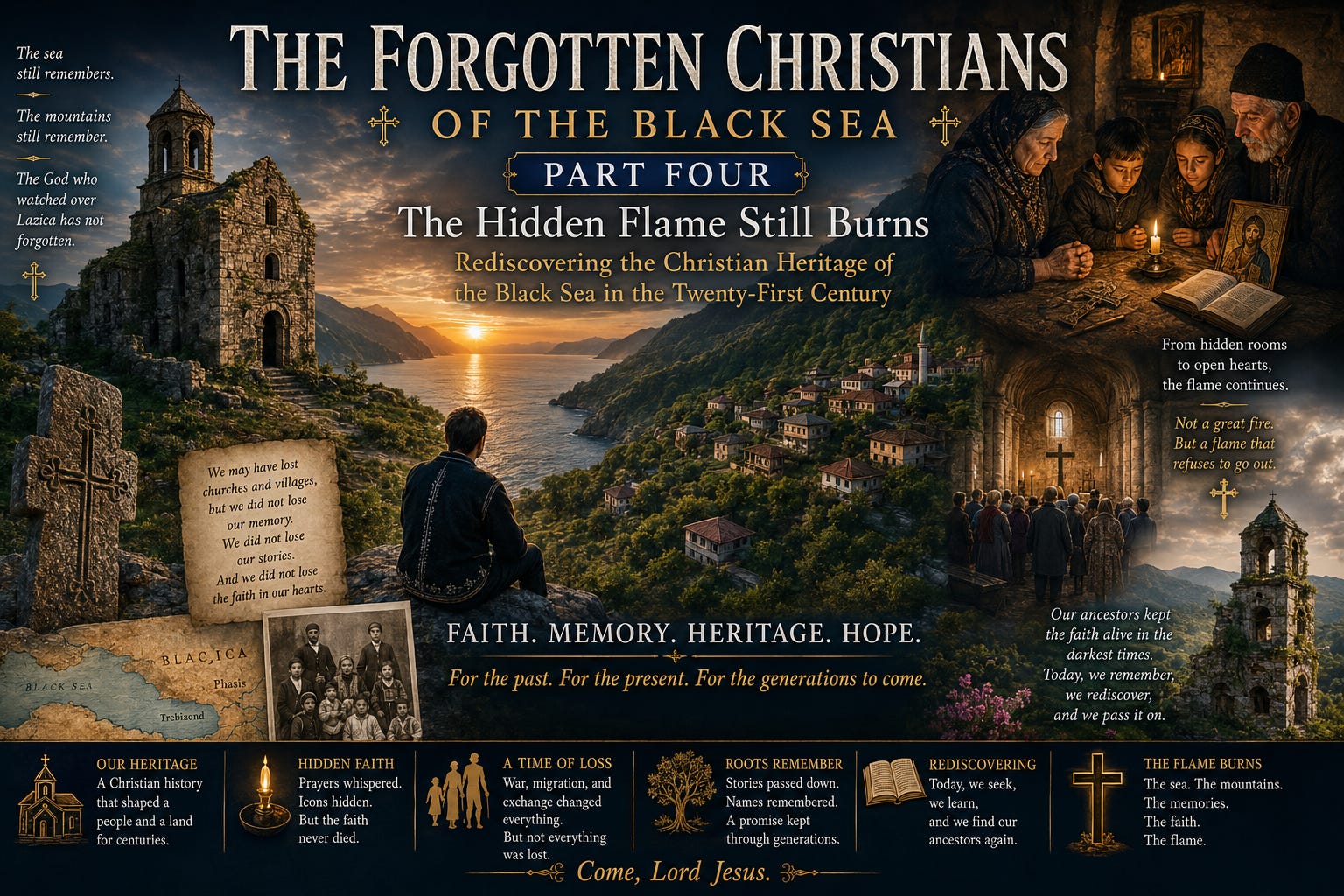
Rediscovering the Christian Heritage of the Black Sea in the Twenty-First Century
Welcome back, friend.
We’ve traveled a long road together.
In Part One, we explored the Christian roots of the Laz people and the ancient kingdom of Lazica.
In Part Two, we stepped into the hidden world of secret prayers, family memory, and faith preserved behind closed doors.
In Part Three, we witnessed the collapse of an old world through war, migration, and the great upheavals of the twentieth century.
Now we come to the final chapter.
And surprisingly, it is not a story about endings.
It is a story about remembering.
It is a story about rediscovery.
And perhaps, in some small way, it is a story about hope.
The Sea Still Remembers
Stand on the Black Sea coast at sunrise.
Watch the waves roll against the rocks.
Look up toward the mountains disappearing into the clouds.
The landscape looks much the same as it did centuries ago.
The fishermen still head out before dawn.
Tea fields still cover the hillsides.
The rivers still rush down from the mountains.
The sea remembers.
The mountains remember.
Yet many of the people walking those shores today know little about the Christian history that once shaped the region.
Ancient churches stand in ruins.
Monasteries sleep beneath forests.
Old cemeteries fade beneath grass and stone.
History has not disappeared.
It has simply become quieter.
The Laz People Today
Today, most Laz people live in northeastern Türkiye, especially around Rize, Ardeşen, Fındıklı, Pazar, Hopa, and surrounding districts.
Others live in Georgia.
Many more have spread across Europe, Australia, and the wider world.
The Laz remain proud of their heritage.
Their language survives.
Their music survives.
Their dances survive.
Their love of family survives.
Yet many younger Laz are asking new questions.
Who were our ancestors?
Where did we come from?
What happened before the modern era?
What was life like before the Ottoman centuries?
These questions are leading some people to rediscover forgotten chapters of their history.
The Search for Lost Roots
The internet has changed everything.
A generation ago, family stories often remained inside the home.
Today, people can search archives, genealogy records, historical documents, and old photographs from anywhere in the world.
Some discover that their grandparents spoke about churches that no longer exist.
Others uncover old baptismal records.
Some find family names appearing in Georgian, Greek, or Byzantine sources.
Many are surprised to learn that Christianity existed throughout the Black Sea region for more than a thousand years before modern times.
For some, these discoveries are simply historical.
For others, they become deeply personal.
History suddenly has a face.
A family.
A name.
A memory.
The Power of Family Stories
Not every truth is found in official records.
Some survive around kitchen tables.
A grandmother remembers a prayer.
A grandfather tells a story about a hidden room.
A parent recalls an old family custom no one can quite explain.
These memories matter.
They connect generations.
They remind us that history is not only about kings and empires.
It is also about ordinary people.
My own family carried stories that never appeared in history books.
Stories about hidden faith.
Stories about prayer.
Stories about survival.
Whether every detail can be verified by historians is not always the point.
The stories survived because they meant something.
They carried identity.
They carried hope.
Christianity in the Black Sea Today
Christianity has not disappeared from the Black Sea entirely.
Ancient Orthodox communities continue in Georgia.
Small Christian communities remain throughout Türkiye.
A handful of Protestant fellowships gather quietly.
Some believers come from Muslim backgrounds.
Others come from long Christian family lines.
Their numbers are small.
Yet they remain.
A candle may burn softly.
But it still burns.
In some places, believers gather in simple homes.
In others, ancient churches continue serving small congregations.
The Christian presence is no longer what it once was.
Yet it has never been completely extinguished.
Why This History Matters
Some may wonder why any of this matters.
Why study forgotten villages?
Why remember ruined churches?
Why revisit painful history?
Because memory matters.
Because people matter.
Because faith matters.
And because understanding the past helps us understand ourselves.
The story of the Black Sea Christians is not only about loss.
It is also about resilience.
About families who preserved what they could.
About communities that adapted to changing circumstances.
About ordinary people who refused to forget who they were.
Their story reminds us that identity is more than politics.
More than borders.
More than governments.
Identity lives in memory.
A Personal Reflection
As I reflect on the stories passed down through my own family, I find myself thinking less about conflict and more about endurance.
The people who came before us were not famous.
They were farmers.
Fishermen.
Mothers.
Fathers.
Grandparents.
They faced challenges we can barely imagine.
Yet they continued.
They raised families.
They preserved memories.
They carried faith through difficult times.
And because they did, we can still hear their voices today.
Not directly.
But through the stories they left behind.
The Hidden Flame
Perhaps that is the image I carry most strongly.
A small flame.
Not a great fire.
Not a roaring blaze.
Just a small candle burning in the darkness.
A grandmother lighting it.
A family gathering around it.
A prayer whispered into the night.
History often celebrates emperors and conquerors.
But sometimes the most important victories belong to those who quietly keep the flame alive.
The Christians of the Black Sea did exactly that.
And in many ways, their descendants continue doing it today.
A Final Word
The story of the Laz people and the forgotten Christians of the Black Sea is not a story of complete loss.
It is a story of survival.
The language survived.
The culture survived.
The memories survived.
And somewhere, hidden within those memories, faith survived too.
The churches may stand in ruins.
The hidden chapels may be gone.
The generations who carried these stories may have passed into history.
Yet the sea still remembers.
The mountains still remember.
And perhaps, somewhere deep within the hearts of their descendants, the old flame still burns.
The God who watched over Lazica has not forgotten.
The God who comforted hidden believers has not forgotten.
The God who heard whispered prayers in mountain villages has not forgotten.
And He has not forgotten us.
The story is not over.
The sea still sings.
The mountains still stand.
And the hidden flame still burns.
Come, Lord Jesus.
End of Series
The Forgotten Christians of the Black Sea: The Laz People, Hidden Faith, and the Long Transformation of a Christian Homeland

Dr. Daniel J. Grace
Faith • Civilization • Theology
Research • Journalism • Truth
🌐 danieljamesgrace.com
© 2026 Dr. Daniel J. Grace. All Rights Reserved.
No part of this article may be reproduced, distributed, transmitted, or published in any form or by any means without prior written permission from the author, except for brief quotations used in academic citation, review, or research purposes.